.
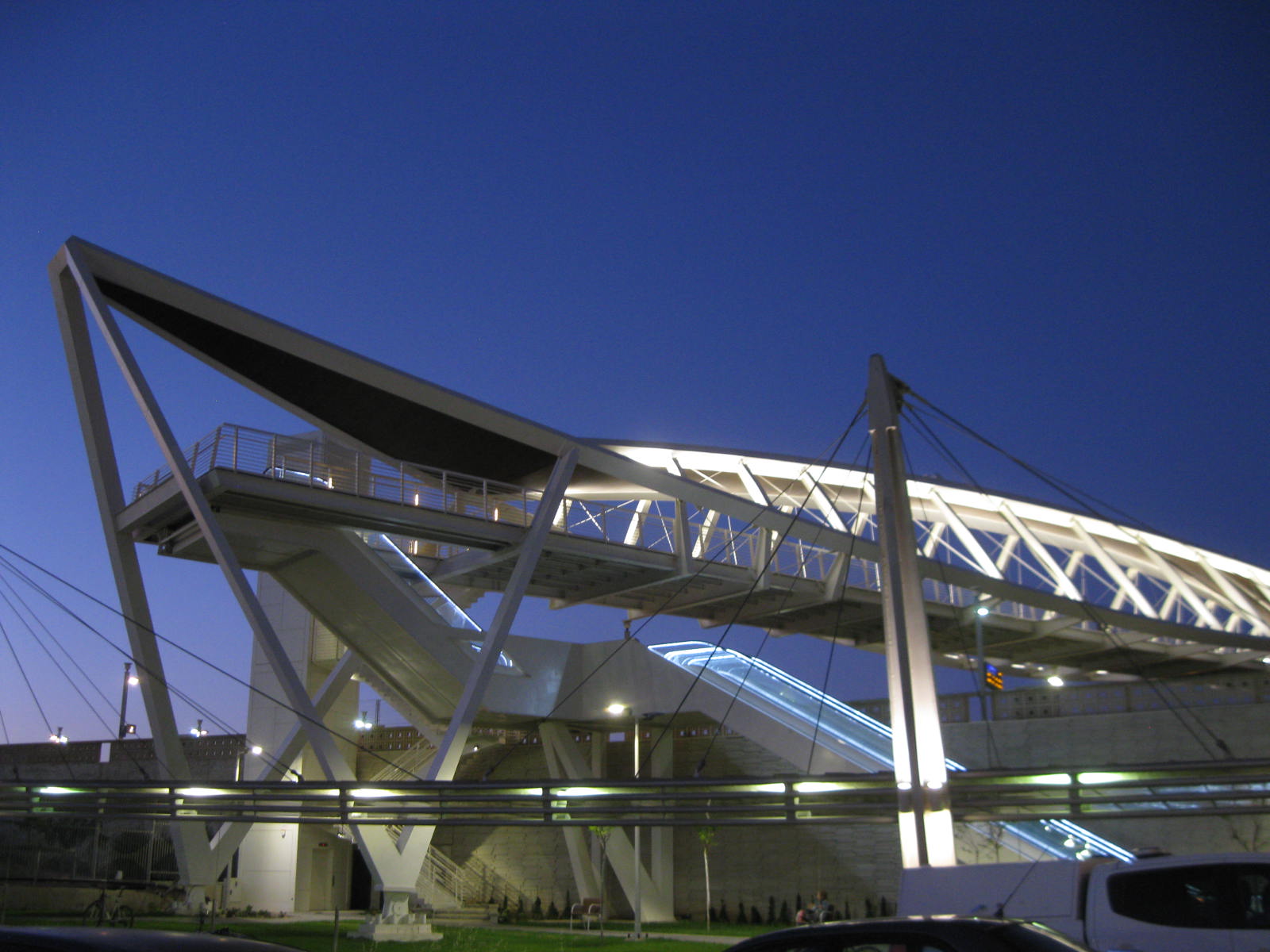
No, it's not a spaceship that landed in Beer Sheva.
It's just part of SCE Sami Shamoon College.
It is an engineering school; can you tell?
On Monday the sign welcomed us to a conference called Movilot Shinui, meaning women who are bringing in and leading change.
It was for International Women's Day.
The speaker of honor was a member of the Israeli cabinet, Minister of Justice Ayelet Shaked.
She told her life story and how she made it to such a high position.
She seems so young to have done all that.
Coffee break was inside the glass "spaceship," with a nice view of the campus lawns and the growing southern city of Beer Sheva.
Over a dozen highly educated, highly successful professional women gave 7-minute TED talks, telling their inspiring life stories.
The lady in the photo is an Israeli Arab who bravely overcame all obstacles to advance in her engineering education, research, and career.
She had the large audience laughing and cheering with her animated and impassioned message.
She told the Bedouin students present never to let their future husbands' families pay the traditional "bride price" for them, not is camels and not in gold, because then they feel and act like they own you.
The Bedouin women here in the Negev are actually in the forefront to advance the rights of women in their society and I applaud them.
Happy International Women's Day!
.
(Linking to ABC Wednesday and Our World Tuesday and Wednesday Around the World.)
.
Showing posts with label Beer Sheva. Show all posts
Wednesday, March 8, 2017
Tuesday, August 23, 2016
An apartment block 1/4 km long
.
Old apartment buildings like this in Beer Sheva are known as "batei rakevet," literally, "railway houses," because they seem to go on forever and ever.
I think this is the one known in the guidebooks as "the 1/4 kilometer long apartment building," an exceptionally long one and thus an architectural curiosity.
After the creation of the State of Israel in 1948 mass waves of new immigrants swamped the country.
Beer Sheva in the south was still small then, so housing had to be put up quickly and cheaply.
At least the apartment owners have some green trees out back to soften the view.
.
Old apartment buildings like this in Beer Sheva are known as "batei rakevet," literally, "railway houses," because they seem to go on forever and ever.
I think this is the one known in the guidebooks as "the 1/4 kilometer long apartment building," an exceptionally long one and thus an architectural curiosity.
After the creation of the State of Israel in 1948 mass waves of new immigrants swamped the country.
Beer Sheva in the south was still small then, so housing had to be put up quickly and cheaply.
At least the apartment owners have some green trees out back to soften the view.
.
Friday, July 15, 2016
The Gay Pride parade that didn't happen
.
I snapped this picture from my bus window late Thursday as we passed Beer Sheva City Hall.
The young people with the flags were starting to gather for what would be a demonstration of hundreds (some sources say thousands) outside the Municipality to protest the cancellation of the city’s first-ever Gay Pride parade.
Some points from a news report:
.
I snapped this picture from my bus window late Thursday as we passed Beer Sheva City Hall.
The young people with the flags were starting to gather for what would be a demonstration of hundreds (some sources say thousands) outside the Municipality to protest the cancellation of the city’s first-ever Gay Pride parade.
Some points from a news report:
Organizers had canceled the event Wednesday night to protest a High Court of Justice ruling that allowed police to bar participants from marching through the city’s main thoroughfare due to what police called “real concern” for participants’ safety in the face of threats. . . .For the full article please see The Times of Israel.
The petition asking the High Court to force police to allow the original parade route was filed earlier this week by the Beersheba Pride House and the Association for Civil Rights in Israel, who objected to the local LGBT community being relegated to side streets.After the petition was filed, Beersheba police acknowledged its decision was also made to avoid “offending religious sentiments” in the area, and to prevent traffic disruptions that could delay vehicular access to the nearby Soroka Medical Center, the largest hospital in the country’s south.
.
Saturday, May 7, 2016
The ancient, wild, huge quarry in Beer Sheva
.
A nice, comfortably small group turned out for one of the Jane's Walks on Friday morning.
Shir was our good guide, extolling the value of slow meandering, taking us through fun exercises in positive psychology, and opening our eyes to better engage with nature.
Nice boys, eh? I think they are students at Ben Gurion University of the Negev.
One studying geology said that we were sitting in part of a canyon formed millions of years ago, the Afiq (Gaza-Beersheba) canyon.
Today the quarry is in between Beer Sheva's residential blocks.
Its area is about 8 acres and it is very deep. And very exciting!
(With a click or two you can enlarge the photos.)
The Ottomans (who controlled our area for 400 years) quarried stone here from 1900 to 1917 to build their city of Beer Sheva (the area now known as the Old City).
Let us pray the quarry never becomes a construction site!
I hope it stays wild, but the next-best thing is an envisioned Geo-botanical Park and Center for Environmental Education in conjunction with the Nature Protection Society.
Here is the relevant part in a 2010 Jerusalem Post article called "Blueprint for Beersheva" --
.
A nice, comfortably small group turned out for one of the Jane's Walks on Friday morning.
Shir was our good guide, extolling the value of slow meandering, taking us through fun exercises in positive psychology, and opening our eyes to better engage with nature.
Nice boys, eh? I think they are students at Ben Gurion University of the Negev.
One studying geology said that we were sitting in part of a canyon formed millions of years ago, the Afiq (Gaza-Beersheba) canyon.
Today the quarry is in between Beer Sheva's residential blocks.
Its area is about 8 acres and it is very deep. And very exciting!
(With a click or two you can enlarge the photos.)
The Ottomans (who controlled our area for 400 years) quarried stone here from 1900 to 1917 to build their city of Beer Sheva (the area now known as the Old City).
Let us pray the quarry never becomes a construction site!
I hope it stays wild, but the next-best thing is an envisioned Geo-botanical Park and Center for Environmental Education in conjunction with the Nature Protection Society.
Here is the relevant part in a 2010 Jerusalem Post article called "Blueprint for Beersheva" --
(Linking to ABC Wednesday and Camera Critters.)One of the more underrated projects in the 2020 brochure is “The Quarry,” which lacks, at this point, a targeted completion date. To Beersheba activist Ethelea Katzanell, that’s unfortunate.
“The quarry – a hole in the heart of the city – is really an important ancient geological site located between the Bet and Daled neighborhoods,” she says. “Lots of people don’t even know it’s there – it’s fenced off, so you’d have to make a special effort to see it.
“I’m surprised this project isn’t being pushed forward – it has a big potential for quick implementation, and doesn’t involve a tremendous amount of money.”
The influential Katzanell serves on a host of city advisory boards. “I’m on the Environmental Committee, the Historical Site Committee and both the Tourist and Beautification Committees,” Katzanell laughs, as she ticks the assignments off. “Anything having to do with what the city offers people, both residents and tourists alike. To me, the Quarry is such an important asset to Beersheba, and one so close to completion, we should be moving ahead on this now.
“The history is fascinating. It started back in the 1980s. when the BGU Geology Department studied the area and proposed turning the quarry into a geological site – you can see the strata going back millions of years. They presented the idea to the city as an educational and tourist site very much like other geological sites all over the world. Nothing happened. They couldn’t find a sponsor.
“In 1994, the project was resurrected. An English version of the proposal was written up and presented again. All the city offices signed off on it, permits were approved, everything was ready – even a sponsor had been found, a French donor.
“Just as it was ready to go, the sponsor, for whatever reason, withdrew. And the project dropped out of sight, again.
“In 2007, I heard a rumor that the project was going to be killed – that a tower was going to be built on the Quarry site,” Katzanell continued. “I was horrified. I rewrote the project for a third time, included everything that had been proposed before, and turned it over to “Earth’s Promise,” a local environmental organization. Together with their experts, geologists and environmentalists, they proposed the creation of a Geo-botanical Park and Center for Environmental Education, in conjunction with the Nature Protection Society. The Park would include all the geographical distinctions, the strata marks, plus all the unique local vegetation for teaching and study.
“I’m surprised another sponsor hasn’t been found. This is a relatively modest project in terms of cost, and the city has already signed off on it. The Quarry Project could be completed pretty easily. I’m hoping that now, in 2010, we can finally move ahead with this.”
.
Labels:
Beer Sheva,
Camera-Critters,
Jane's Walk,
people,
quarry
Friday, May 6, 2016
Jane's Walk tours in Beer Sheva
.
Four tall buildings are going up on a small, formerly quiet residential street in Beer Sheva's Gimel Neighborhood.
And the neighbors, the old-timers, are not happy about it.
This afternoon the worldwide Jane's Walk citizen-guided walking tours began in Beer Sheva.
More over the weekend.
Check the link to find a Jane's Walk in your area.
.
(Linking to Sky Watch Friday.)
.
Four tall buildings are going up on a small, formerly quiet residential street in Beer Sheva's Gimel Neighborhood.
And the neighbors, the old-timers, are not happy about it.
This afternoon the worldwide Jane's Walk citizen-guided walking tours began in Beer Sheva.
More over the weekend.
Check the link to find a Jane's Walk in your area.
.
(Linking to Sky Watch Friday.)
.
Monday, May 2, 2016
Double Helix bridge by night
.
Beer Sheva's new Double Helix bridge is especially beautiful at night!
Once you get yourself or your bicycle up the tall escalator . . .
you can go over to the growing Advanced Technologies Park.
The bridge spans the railroad tracks.
The big building is Beer Sheva North/Ben Gurion University train station.
(Central Station is the other train terminal in Beer Sheva.)
More about the Double Helix in my earlier posts.
.
(Linking to Our World Tuesday.)
.
Beer Sheva's new Double Helix bridge is especially beautiful at night!
Once you get yourself or your bicycle up the tall escalator . . .
you can go over to the growing Advanced Technologies Park.
The bridge spans the railroad tracks.
The big building is Beer Sheva North/Ben Gurion University train station.
(Central Station is the other train terminal in Beer Sheva.)
More about the Double Helix in my earlier posts.
.
(Linking to Our World Tuesday.)
.
Labels:
Beer Sheva,
bridge,
Double Helix bridge,
Our World Tuesday,
train
Wednesday, January 27, 2016
Beer Sheva's Holocaust Memorial
.
The United Nations decided that January 27, the day on which Auschwitz was liberated, should be the International Day in memory of the victims of the Holocaust.
Israel has its own day, in the spring, to remember the Shoah.
This is Beer Sheva's memorial square "to remember the victims of the Holocaust."
The four words written in Hebrew are from the Book of Esther 9:28 and mean
"Their memory will not fade from their descendants"
or in a different translation,
"The memorial of them should not perish from their seed."
.
The United Nations decided that January 27, the day on which Auschwitz was liberated, should be the International Day in memory of the victims of the Holocaust.
Israel has its own day, in the spring, to remember the Shoah.
This is Beer Sheva's memorial square "to remember the victims of the Holocaust."
The four words written in Hebrew are from the Book of Esther 9:28 and mean
"Their memory will not fade from their descendants"
or in a different translation,
"The memorial of them should not perish from their seed."
.
Saturday, January 16, 2016
Double Helix bridges the gap
.
Beer Sheva's new Double Helix bridge was officially opened last week!
Half a year ago train traffic was shut down for one weekend so giant cranes could lift the bridge parts into place.
The small pedestrian bridge on the left lets students walk from the train and bus stations over to Ben-Gurion University of the Negev.
The new big bridge lets people walk over to the growing Advanced Technologies Park.
Trains go under (it's less than an hour to Tel Aviv).
And people go over.
The view from the bridge: Ramot, a new neighborhood of Beer Sheva.
The train station and bus stops.
And a parking lot for the Park and Ride folks.
Some escalator repair was still needed last Thursday.
There are two flights of escalators up to the top and also an elevator.
All the photos can be much enlarged with a click or two.
Here is a bit more information:
Double Helix Bridge Connecting ATP to Train Station Dedicated
.
(Linking to OurWorld Tuesday.)
.
UPDATE: A nice article about how Beer Sheva is growing, with a photo of the bridge when it was still lying on the earth in two big sections.
UPDATE Oct. 2, 2017: The bridge won an international award! Here is the announcement with a beautiful little video: http://in.bgu.ac.il/en/pages/news/bridge_award.aspx
.
Beer Sheva's new Double Helix bridge was officially opened last week!
Half a year ago train traffic was shut down for one weekend so giant cranes could lift the bridge parts into place.
The small pedestrian bridge on the left lets students walk from the train and bus stations over to Ben-Gurion University of the Negev.
The new big bridge lets people walk over to the growing Advanced Technologies Park.
Trains go under (it's less than an hour to Tel Aviv).
And people go over.
The view from the bridge: Ramot, a new neighborhood of Beer Sheva.
The train station and bus stops.
And a parking lot for the Park and Ride folks.
Some escalator repair was still needed last Thursday.
There are two flights of escalators up to the top and also an elevator.
All the photos can be much enlarged with a click or two.
Here is a bit more information:
Double Helix Bridge Connecting ATP to Train Station Dedicated
.
(Linking to OurWorld Tuesday.)
.
UPDATE: A nice article about how Beer Sheva is growing, with a photo of the bridge when it was still lying on the earth in two big sections.
UPDATE Oct. 2, 2017: The bridge won an international award! Here is the announcement with a beautiful little video: http://in.bgu.ac.il/en/pages/news/bridge_award.aspx
.
Friday, January 15, 2016
Double Helix bridge officially opened!
.
Last June I showed you the new pedestrian bridge that had just been lifted and placed over the railroad tracks in Beer Sheva.
This week it was officially opened so I stopped by to go up and check it out.
The escalator repair man was also up on the bridge, checking out why one of the escalators was not moving.
His yellow sign said "ELEVATOR [sic] UNDER SERVICE. PLEASE KEEP DISTANCE" but I could not resist going near to take this sweet picture!
It's quite a climb if the stairs are not rolling.
I will post more bridge pictures in the next few days.
It is in the form of a double helix and is quite beautiful!
Here is an article about the ribbon-cutting ceremony: http://in.bgu.ac.il/en/Pages/news/helix_bridge.aspx
P.S. Yesterday's blog photo was taken from the bridge.
.
Last June I showed you the new pedestrian bridge that had just been lifted and placed over the railroad tracks in Beer Sheva.
This week it was officially opened so I stopped by to go up and check it out.
The escalator repair man was also up on the bridge, checking out why one of the escalators was not moving.
His yellow sign said "ELEVATOR [sic] UNDER SERVICE. PLEASE KEEP DISTANCE" but I could not resist going near to take this sweet picture!
It's quite a climb if the stairs are not rolling.
I will post more bridge pictures in the next few days.
It is in the form of a double helix and is quite beautiful!
Here is an article about the ribbon-cutting ceremony: http://in.bgu.ac.il/en/Pages/news/helix_bridge.aspx
P.S. Yesterday's blog photo was taken from the bridge.
.
Labels:
Beer Sheva,
bridge,
Double Helix bridge,
working people
Monday, December 22, 2014
Swiss Youth Center in Beer Sheva
.
Here is another building with Swiss funding.
The Keren Hayesod Switzerland Youth Center.
This public building is in Beer Sheva's Old City.
.
(Linking to Whimsical Windows, Delirious Doors.)
.
Here is another building with Swiss funding.
The Keren Hayesod Switzerland Youth Center.
This public building is in Beer Sheva's Old City.
.
(Linking to Whimsical Windows, Delirious Doors.)
.
Friday, November 21, 2014
Beer Sheva, Bedouins, and a boy
.
A few pictures for SkyWatch Friday from today's trip to Ramat Negev.
The clouds are rolling in and tomorrow should bring thunderstorms and maybe flash floods.
Little patches of sun bring light to the desert.
Please enlarge this photo to get a better look at the sprawling skyline of Beer Sheva contrasted with a Bedouin settlement in the foreground.
And a Bedouin boy walking along the busy highway.
A lucky catch (not intended, not even seen) from a speeding bus!
.
A few pictures for SkyWatch Friday from today's trip to Ramat Negev.
The clouds are rolling in and tomorrow should bring thunderstorms and maybe flash floods.
Little patches of sun bring light to the desert.
Please enlarge this photo to get a better look at the sprawling skyline of Beer Sheva contrasted with a Bedouin settlement in the foreground.
And a Bedouin boy walking along the busy highway.
A lucky catch (not intended, not even seen) from a speeding bus!
.
Sunday, September 21, 2014
The train north
.
Last Tuesday morning was my first time to take a train from Beer Sheva.
The city has two stations.
This smaller, plainer one is Beer Sheva North - University station.
External shade elements help lessen the heat of the desert sun.
The English version of this sign made me chuckle.
Senior citizens pay half price on public transportation in Israel.
My Beer Sheva to Tel Aviv train ticket cost only 15.50 shekels ($4.25).
Here comes the train, a double decker!
.
.
(In an older post you can see the interior of an intercity train.)
.
Linking to Whimsical Windows, Delirious Doors.
.
Last Tuesday morning was my first time to take a train from Beer Sheva.
The city has two stations.
This smaller, plainer one is Beer Sheva North - University station.
External shade elements help lessen the heat of the desert sun.
The English version of this sign made me chuckle.
Senior citizens pay half price on public transportation in Israel.
My Beer Sheva to Tel Aviv train ticket cost only 15.50 shekels ($4.25).
Here comes the train, a double decker!
.
.
(In an older post you can see the interior of an intercity train.)
.
Linking to Whimsical Windows, Delirious Doors.
.
Friday, May 23, 2014
The future of the past: Historic Site Preservation Week
.
So many learning opportunities now in Israel during the Annual Historic Site Preservation Week!
You will be hearing in posts to come about the houses of worship we visited on a Beer Sheva synagogue tour.
But first, look how a full day of lectures began!
It's so Israeli!
The audience joined the accordionist in singing the good old songs of the Palmach days.
It got us in the mood to hear about local history, as well as the present and future of Beer Sheva.
The low-ceilinged auditorium where we alternately froze and baked from 8:30 to 14:30 was in the old Yad Labanim building.
See more about it in the post where we talked about Brutalist architecture.
The Society for Preservation of Israel Heritage Sites tries to protect the irreplaceable historical buildings and heritage sites associated with Israel’s re-birth.
That means places from before about 1949, but not after.
If funds can be raised, over 250 sites are in need of restoration work.
As one architect speaker said in her presentation, holding on to a place, remembering and cherishing it, and hopefully restoring it--all this first begins in our collective memory.
And another spoke of "the future of the past."
In order for our youth to understand and appreciate our past, that past has to have a future.
.
(Linking to Whimsical Windows, Delirious Doors.)
So many learning opportunities now in Israel during the Annual Historic Site Preservation Week!
You will be hearing in posts to come about the houses of worship we visited on a Beer Sheva synagogue tour.
But first, look how a full day of lectures began!
It's so Israeli!
The audience joined the accordionist in singing the good old songs of the Palmach days.
It got us in the mood to hear about local history, as well as the present and future of Beer Sheva.
The low-ceilinged auditorium where we alternately froze and baked from 8:30 to 14:30 was in the old Yad Labanim building.
See more about it in the post where we talked about Brutalist architecture.
The Society for Preservation of Israel Heritage Sites tries to protect the irreplaceable historical buildings and heritage sites associated with Israel’s re-birth.
That means places from before about 1949, but not after.
If funds can be raised, over 250 sites are in need of restoration work.
As one architect speaker said in her presentation, holding on to a place, remembering and cherishing it, and hopefully restoring it--all this first begins in our collective memory.
And another spoke of "the future of the past."
In order for our youth to understand and appreciate our past, that past has to have a future.
.
(Linking to Whimsical Windows, Delirious Doors.)
Labels:
Beer Sheva,
events,
heritage,
music,
preservation,
Yad LaBanim
Thursday, May 8, 2014
Stuff for sale
.
Apparently a bustling street market springs up every Friday morning in Beer Sheva's Old City.
I think it might also be on one or two additional days during the week.
Seems to be for clothes, books, food, trinkets, and "art."
Someday I will have to take time and walk around this market.
I am still learning about Beer Sheva, which is about 45 minutes from my place on the infrequent buses from Meitar.
.
Apparently a bustling street market springs up every Friday morning in Beer Sheva's Old City.
I think it might also be on one or two additional days during the week.
Seems to be for clothes, books, food, trinkets, and "art."
Someday I will have to take time and walk around this market.
I am still learning about Beer Sheva, which is about 45 minutes from my place on the infrequent buses from Meitar.
.
Sunday, March 9, 2014
What is it?
.
Beer Sheva's Old City is a strange mixture of crumbling "old" early 20th century Ottoman Turkish buildings, renovated houses, and new structures.
But this castle-like place is the strangest place I've seen so far.
In September it was still being worked on.
I'll have to go see what it turned out to be, if I can find that little street again.
The Municipality has started investing in renewal of the Old City.
Let's see if it will attract more visitors and shoppers.
.
UPDATE:
(Linking to Our World Tuesday and Whimsical Windows, Delirious Doors.)
.
Beer Sheva's Old City is a strange mixture of crumbling "old" early 20th century Ottoman Turkish buildings, renovated houses, and new structures.
But this castle-like place is the strangest place I've seen so far.
In September it was still being worked on.
I'll have to go see what it turned out to be, if I can find that little street again.
The Municipality has started investing in renewal of the Old City.
Let's see if it will attract more visitors and shoppers.
.
UPDATE:
Beersheba ca. 1900
Photo by American Colony-Jerusalem Photo Dept.
(Collection is now in the Library of Congress)
Some history from Wikipedia:
.The Ottomans, who had controlled Palestine since the 16th century, took an interest in Beersheba in the late 19th century.[7] At the beginning of the 19th century, European pilgrims to Palestine described Beersheba as a barren stretch of land with a well and a handful of Bedouins living nearby. Towards the end of the 19th century, the Ottomans built a police station in Beersheba in order to keep the Bedouin in check.[8]They built roads and a number of small buildings from local materials which are still standing today. A town plan, created by Swiss and German architects, called for a grid street pattern,[9] a pattern which can be seen today in Beersheba's Old City. All houses built during that period were of one story, and the two-story police station towered above them.
(Linking to Our World Tuesday and Whimsical Windows, Delirious Doors.)
.
Labels:
Beer Sheva,
doors,
historical photos,
Our World Tuesday
Saturday, February 22, 2014
More Beer Sheva Brutalism: Yad LaBanim
.
Here is Beit Yad Labanim, another of Beer Sheva's many examples of Brutalist architecture.
(We saw in the post about BGU's library that the term Brutalism was coined in 1953 from the French béton brut, "raw concrete," a phrase used by Le Corbusier to describe the poured board-marked concrete with which he constructed many of his post-World War II buildings.)
Originally designed to be Beer Sheva's main synagogue, the money ran out before its completion, and the strange building stood deserted for years.
In the late 1970s a group of bereaved parents came together to try to have the building's designation changed.
By 1983 they succeeded in completing it as a memorial hall to their soldier sons and daughters who had fallen in Israel's wars.
See more about the concept of Yad Labanim houses throughout Israel here.
Or see my photos of Jerusalem's Yad Labanim, which also has unusual architecture.
I have not ventured in yet, but I read that inside are art exhibitions, cultural activities from time to time, and a 300-seat theater.
Enlarge this photo 2x and see some interesting details!
Pigeons on the roof are kept out by metal grating stretched over the openings.
And that bare patch--is it just the plaster falling off the wall or could it be a deliberate "window" into the brutalist reinforced concrete?
.
Haaretz has an entertaining article about Beer Sheva's love-hate affair with Brutalism.
(It is behind a paywall but the newspaper offers ten free articles per month after a simple registration.)
.
(Linking to Whimsical Windows, Delirious Doors.)
.
Here is Beit Yad Labanim, another of Beer Sheva's many examples of Brutalist architecture.
(We saw in the post about BGU's library that the term Brutalism was coined in 1953 from the French béton brut, "raw concrete," a phrase used by Le Corbusier to describe the poured board-marked concrete with which he constructed many of his post-World War II buildings.)
Originally designed to be Beer Sheva's main synagogue, the money ran out before its completion, and the strange building stood deserted for years.
In the late 1970s a group of bereaved parents came together to try to have the building's designation changed.
By 1983 they succeeded in completing it as a memorial hall to their soldier sons and daughters who had fallen in Israel's wars.
See more about the concept of Yad Labanim houses throughout Israel here.
Or see my photos of Jerusalem's Yad Labanim, which also has unusual architecture.
I have not ventured in yet, but I read that inside are art exhibitions, cultural activities from time to time, and a 300-seat theater.
Enlarge this photo 2x and see some interesting details!
Pigeons on the roof are kept out by metal grating stretched over the openings.
And that bare patch--is it just the plaster falling off the wall or could it be a deliberate "window" into the brutalist reinforced concrete?
.
Haaretz has an entertaining article about Beer Sheva's love-hate affair with Brutalism.
(It is behind a paywall but the newspaper offers ten free articles per month after a simple registration.)
It says this, for instance:
Brutalism and its varied concrete features were seen as an allegory for the young, Israeli-born Jew − rough, direct, aggressive, just like cement itself.The architects of Brutalism were themselves native-born, young contemporaries of the state. Their character and vision overlapped with the allegory to a remarkable extent.The great irony is that their buildings were constructed mostly for newly arrived immigrants whom the state was sending to the country’s far geographical periphery to live in its Israeli-conceived concrete works. The architects themselves, of course, didn’t follow.
(Linking to Whimsical Windows, Delirious Doors.)
.
Labels:
architecture,
Beer Sheva,
Brutalism,
windows,
Yad LaBanim
Subscribe to:
Posts (Atom)