Showing posts with label Monastery--St.Gerasimus. Show all posts

Saturday, January 6, 2018

Both Nativity and Epiphany today

.

This manger scene, with its gift-bringing three Wise Men (or Magi or kings) dressed in white, can be good to illustrate the two holy days being celebrated in Israel today. 
For Catholics and Protestants, today is the Feast of Epiphany. 
For the Greek and Russian Orthodox, Copt, Syrian, Romanian, and Ethiopian Christians, January 6-7 is the Feast of the Nativity. 


The creche welcomes visitors at the gate of the Monastery of St. Gerasimus, or in Arabic, Deir Hajla. 
Our busload from Meitar was there two weeks ago. 


If you enlarge the photo you can see the braided palm work, which is a specialty there.
The Greek Orthodox monastery is near Jericho,  not far from the baptism site Kasr al Yahud on the River Jordan.  
At an altitude of several hundred meters below sea level, the centuries-old St. Gerasimus is the lowest still-lived in monastery in the world, our guide said. 

You can see more in my previous posts from a few years ago here
If you are celebrating one of these two feast days today, I wish you a blessed and happy day! 
.
(Linking to inSPIREd Sunday.)
.

Tuesday, March 4, 2014

Monastery of St. Gerasimus

.
 H is for heresy, hesychasm, and hermit.
Today is the feast day of St. Gerasimus.

Since my visit to the old old monastery of Gerasimus near Jericho two years ago I have posted much about the beautiful Greek Orthodox  place in the desert.
In honor of his feast day, here are some more photos.


Saint Gerasimus and the animals.


The church.


I think it is the Father Abbot supervising a tree pruning.

 The mosaic workshop.


Another of the many desert hermit monks who practiced the hesychastic asceticism.


A repaired crack in the church wall, result of an earthquake.
The Jordan Valley is part of the Great Rift Valley, prone to quakes. 


Skulls and bones of monks down through the ages.


A modern cafe-oasis for thirsty pilgrims and tourists who like to visit this monastery.

The surrounding desert.
.
(Linking to inSPIRED Sunday and  ABC Wednesday.)
.

Tuesday, April 9, 2013

Mosaicist, Greek Orthodox

.
(All photos can be enlarged with two clicks.)


M is for  mosaic-making monk in a monastery.


He kindly let me watch how a modern mosaic is painstakingly made, in his workshop at the very old St. Gerasimus Monastery near Jericho.


See more about St. Gerasimus Monastery, also known in Arabic as Deir Hajleh and in Hebrew as Beth-Hogla, here:

http://jerusalemhillsdailyphoto.blogspot.co.il/2012/05/monastery-full-of-animals.html
and
http://jerusalemhillsdailyphoto.blogspot.co.il/2012/05/mother-mary-nursing-her-baby.html
Lots of photos and info at http://www.biblewalks.com/Sites/StGerassimos.html


Mosaic carpets in various stages of progress.
Maybe you'd like to order one?
.
(Linking to ABC Wednesday.)
.
UPDATE: Thanks to Pasadena Adjacent's use of the word smalti in her comment,  I learned a nice new word and found this great illustrated glossary of mosaic terms:
http://www.mosaicartsource.com/mosaicart/mosaic_art_resource/mosaic_glossary.html    and they even have a blog about mosaics!
.

Saturday, September 22, 2012

Gaining an hour but losing the day


A big clock in the bell tower--I guess it tells the monks at St. Gerasimus monastery exactly when to ring the bells for prayer.

Tonight this and all our clocks will have to be turned back an hour.
Crazy, no?
It is only September;  it is still sunny, hot and dry, like summer.
So why does Israel have to go off sha'on kayits, the "summer clock" (Daylight Savings) and jump so soon into sha'on choref, "winter clock"?

Every year the politicians and the Knesset argue about when to go off D.S.T. but they can't get their act together.

All I know is that the dark of night will be coming way too soon.
.
REMINDER: The Wikipedia photo competition is happening now! Contribute your cultural heritage pictures and you might even win a prize.
Details at my post about Wiki Loves Monuments. 
And today's Wiki blog post proves that heritage buildings should be photographed before they are lost.  (Something Israel, especially, should be thinking about, maybe.)
.

Tuesday, June 12, 2012

Votive offerings, ex-votos, and tamata

.
For OurWorld Tuesday and V-day at ABC Wednesday I show you some votive offerings that can be found all around Israel.

Here is a string of votive offerings, also called votive deposits, on the iconostasis of a Greek Orthodox church in Jerusalem.
(You know, click on the photo and then again on the opened photo, to see the details.)

It can be made of thin embossed metal or sometimes stone and the image on it reminds God of what the person is praying for.
It can also be in thanksgiving for a wish already granted, and then it is called an ex-voto.

A votive offering can also be something of value, like jewelry or these dollars that were left at the Greek Orthodox monastery church in Tiberias.
Stuck in the frame of the icon you can see little photos of people on whom the visiting pilgrim is asking a specific blessing or healing.

This one at the Gerasimus Monastery near Jericho emphasizes a breast, so hopefully someone was cured of breast cancer.

Strange, but sort of hidden or stuck behind the icon in the previous photo were these baby dolls.
They too are votive offerings, from couples asking for, or thanking for, the birth of a child.
.
Wikipedia has more information about ex-votos and votive offerings down through the ages.
I just learn now that the Greek Orthodox ones such as this post shows are called tamata (singular: tama).
.
This whole thing about votive offerings is fairly new to me (I'm Jewish, remember), so I'd appreciate anything you readers can add from your own experience and sightings.
.

Sunday, May 13, 2012

"Mother Mary" nursing her baby

.
You know this old Jewish joke?

"How do we know Jesus was Jewish?
1. He lived at home until he was 30
2. He went into his father's business
3. His mother thought he was God."

Every Jewish Mother thinks her son is like unto God, but Mary took it seriously.

I was so surprised to go down to the old crypt of St. Gerasimus Monastery a few days ago and to see this image on the wall!

Since then I have learned that the Milk-giver icon first appeared in the 6th century and the Greek Orthodox call it Mlekopitatelnitsa, the Milk-giving Virgin Mary.
Although rare, it also entered Western religious art, but maybe 800 years later, where it is known as Maria Lactans.

Mary wears the crown of the Queen of Heaven.

Although this monastery near Jericho is not on the route, a certain Christian tradition has it that Joseph, Mary, and Jesus overnighted here on their flight into Egypt and that in the crypt Jesus learned to take his first steps.
.
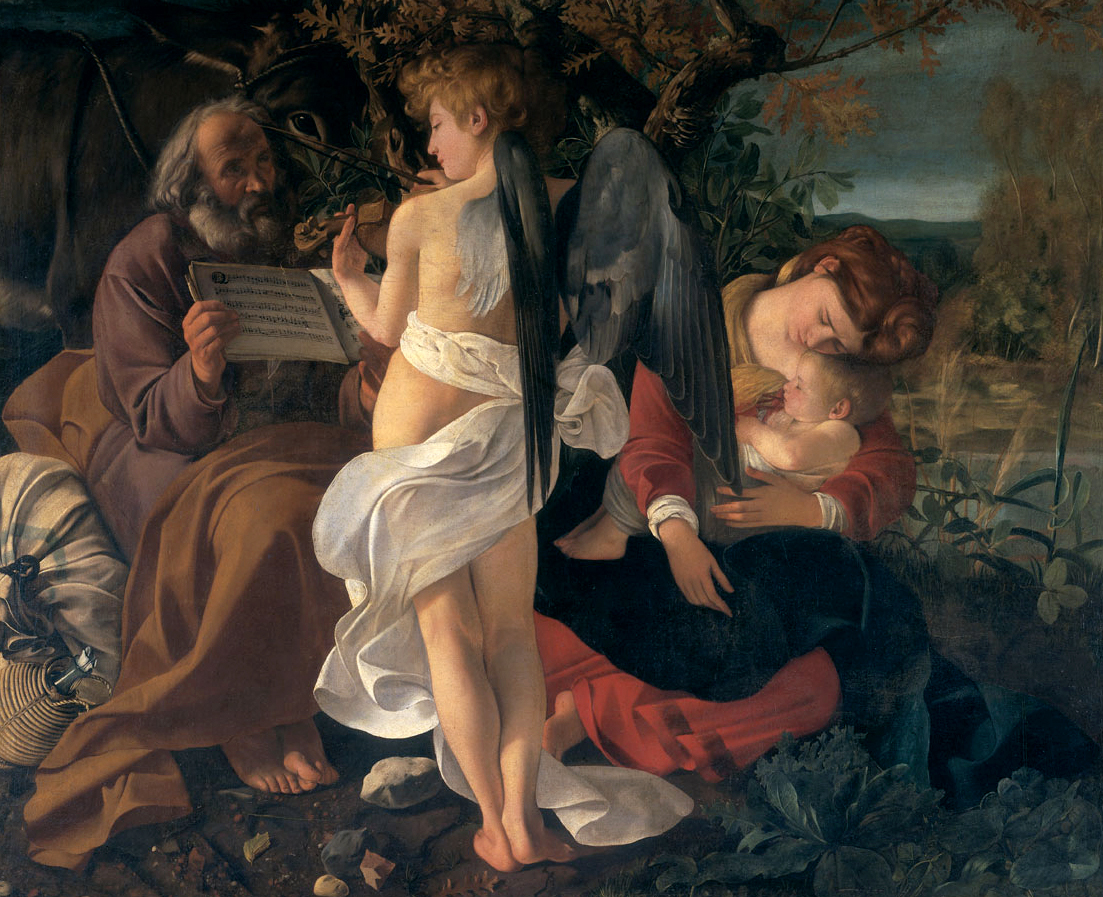
One of my favorite old paintings is this amazing scene by Caravaggio called "Rest on the Flight Into Egypt."
.
BTW, the carved wooden chest with the slot on top invites visitors to donate money or valuables to the monastery.
I am sure many of the Eastern Orthodox pilgrims are so moved that they contribute generously.
.
To those of you mothers in countries where today is Mother's Day (not in Israel), I wish you all the blessings of this Sunday.
.

How some see God

.
You are welcome to join our small group of bloggers who answer the PsalmChallenge and read and illustrate one Psalm every week, led by Robert Geiss at Daily Athens Photo.

PSALM 62
1. For the leader. On Jeduthun. A psalm of David.

2. Truly for God my soul waits quietly; from Him is my salvation.
3. Truly He is my rock and my salvation; my fortress—I shall never stumble.

4. How long will you attack a man—all of you to slay him—like a leaning wall, a tottering fence?
5. Truly, they lay plans to topple him from his eminence; they delight in falsehood; with their mouths they bless, but inwardly they curse. Selah.

6. Truly, wait quietly for God, O my soul, for from Him is my hope.
7. Truly He is my rock and my salvation, my fortress—I shall not stumble.
8. Upon God: my salvation and my glory; my rock of power, in God is my refuge.
9. Trust in Him at all times, O people; pour out your heart before Him; God is a refuge for us. Selah.

10. Truly, poor men are but a breath; rich men, false. Placed on a scale, they are together less than a breath.
11. Put no confidence in extortion, and have no illusions about plunder; riches accumulated—let your heart pay no attention.
12. (Not only) one thing God has spoken (but) twice have I heard: power belongs to God,
13. and faithfulness is Yours, my Lord. Thus You requite a man according to what he has done.
.
.
Photo:
Church dome in St. Gerasimus Monastery near Jericho.
To see the Creator God, just click on the photo and then once on the photo that opens.
.
Today I used Rabbi Benjamin J. Segal's translation. See also his notes on Psalm 62 and the Hebrew original at his "A New Psalm, A New Look at Age-Old Wisdom."
.

Saturday, May 12, 2012

A monastery full of animals

.
This particular monastery does not have a problem with pigeons; in fact they raise pigeons.
And goats too.
They have some camels and donkeys, as well; oh, and aviaries and a talking parrot.

In short, a good place to find photos for Camera Critters meme.

Hogla is the Hebrew word for partridge, and St. Gerasimus Monastery has many cute ones like this in the photo.
The Arabic name for the monastery is Deir Hajleh [literally, the monastery of the partridge].
The Arabic comes from the Hebrew name of the town that was here back in biblical days, Beth-Hogla [literally, house of the partridge].

The Book of Joshua 18:19-21 says " Now the cities of the tribe of the children of Benjamin according to their families were Jericho, and Beth-hoglah, and . . . "

The very old monastery is in the desert near Jericho.

Greek Orthodox Archimandrite Chrysostomos has been abbot of the monastery for some 30 years.
His hard work and vision have turned the place into a beautiful oasis.
The kind monk is known as a holy man and pilgrims come from near and far to seek his blessing.

But why a full sized lion in the courtyard (and a lion on many of the icons)?

He is Yarden, or Jordanes, who became the faithful pet of St. Gerasimus after the monk saved him from injury.
But that story will come soon in a post of its own.
.
I think it is unusual for a monastery to have more animals than people.
At last count there were six monks and five novices, plus some volunteers mostly from Greece and Cyprus.

I wish I could live there as a volunteer for a time. It is a very special place.
.