Showing posts with label terraces. Show all posts

Saturday, May 17, 2014

Moonlight Stone-ata

.

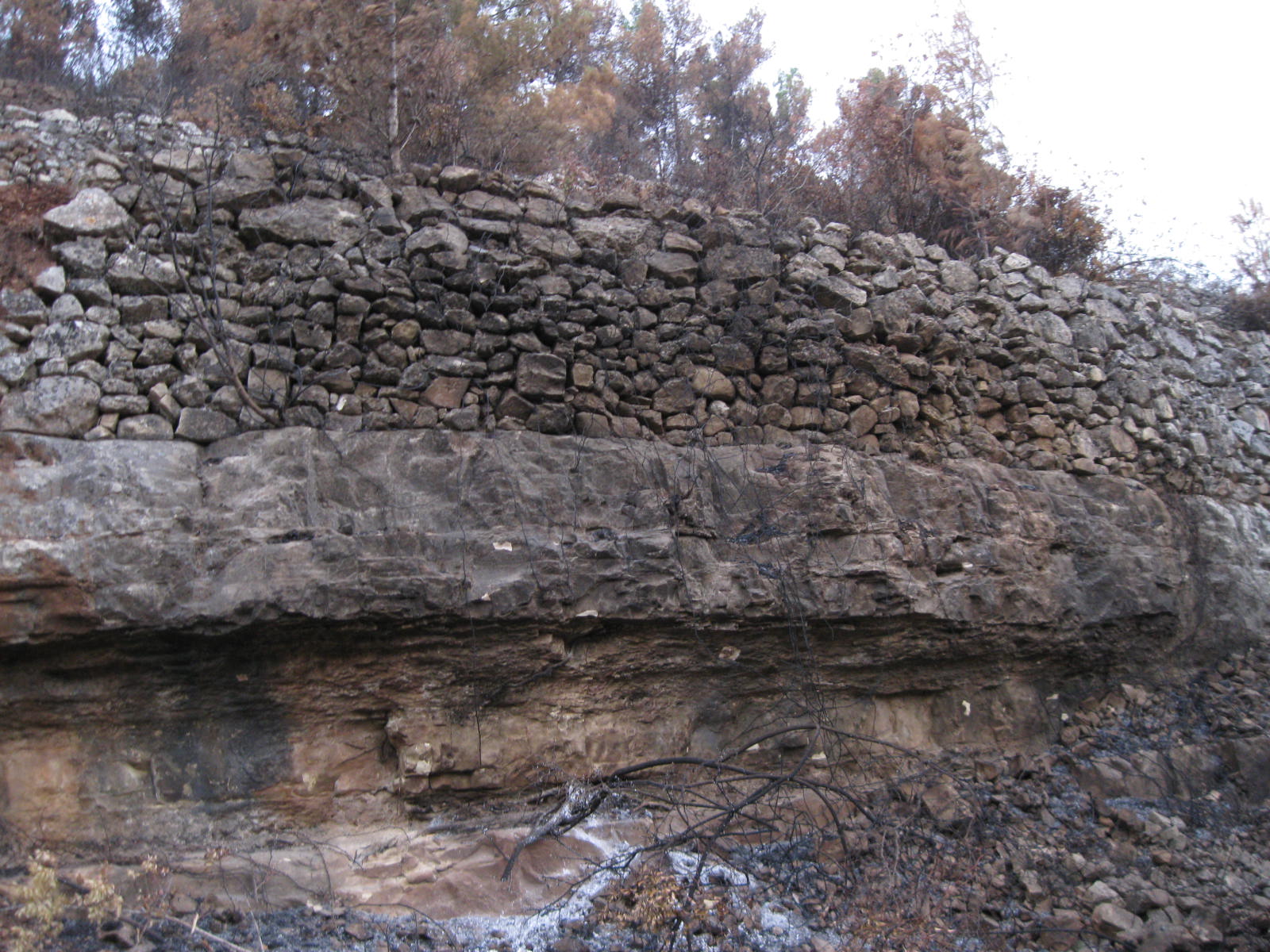
In olden days men really knew how to build a terrace wall, didn't they?
This one in the hills west of Jerusalem was probably made by 12th century Crusaders.
To the right of the corner, a tall staircase ascends.

The stones  looked especially beautiful in the soft half-light of dawn.
Enlarge the photo 2x and see them better. 
I took this picture at 5:37, in between the full moon's setting and the bright sun's rising (as you may know from the previous two posts).
.
The mystical in-between time brought to mind the Hebrew song Karev Yom:
(you can listen here)

The day is approaching that is neither day nor night
Most High, let it be known that Yours is the day and Yours is the night
Place guards over Your City all day and all night
Lighten the darkness of the night with the light of day
The day is approaching that is neither day nor night . . . 
.

Saturday, June 1, 2013

Decaying slowly through the millennia

.
I am lucky!
 I just have to walk a block or two from my moshav/village, out into the terraced valleys of the Jerusalem Hills, to find pictures for today's City Daily Photo Theme Day, which is "The beauty of decay."


This rounded place on a hill slope is one of my favorites.
See its arched opening, now half buried by the ages?!
I try to imagine who used it, when,  and for how long . . . 

Please enlarge these photos with one click, then another.
I left them big so you can enjoy the luscious details.

The hills are peppered with mysterious stone structures  that are thousands of years old.
They are hard to date, but some go back even to 4,500 years ago.
Archaeologists have proof that different peoples have inhabited this area for 6,000 years.


 The door and a window of this now low structure on the valley floor are still visible.
The big pine tree toppled over in last winter's rain and now it, too, will start to decay. 


A forest fire swept through this valley a few years ago, but this tall cypress survived.
It thrives between two dams.

Jerusalem is surrounded by hills and the only way to raise crops was to build agricultural terraces.
Farmers picked rocks from the ground and used them to build terrace walls; they may have had to bring in soil for each little plot.
They devised irrigation channels from the many springs in the Jerusalem Hills.

In the bottom of the valleys they built dams, as pictured above.
When rain water rushed down the valley from the hills, these dams stopped the soil from being washed away.

In Biblical days, farmers were able to feed their families from these terraces as well as most of the great throngs of pilgrims who ascended to the Temple in nearby Jerusalem on the three yearly pilgrimage festivals.

In recent centuries, up to 1948, Arab farmers grew many fruit and olive trees and I'm not sure what else in the hills.
I admire all who did this hard work in a not easy land.
.
To see how farmers used stone shomerot, watchmen's huts, please see previous posts.
There are hundreds here in the Jerusalem Hills in various stages of decay.
.
Now let's go visit the other CDP bloggers and see what's decaying in their cities.
Shalom to all. 
.
(Linking also to Toby's meme (in Israel!)  Whimsical Windows, Delirious Doors.)
.

Sunday, February 3, 2013

Just go over!

.

Today the blessed sun returned after our six straight days of rain.

The unusual heavy wetness  was too much for this ancient agricultural terrace wall, and the stones collapsed onto  a section of  green-and-white-marked hiking trail in our valley.

I prayed the heavy rocks would not start falling again as I was climbing over.

It reminded me that the Rebbe Maharash (of Chabad) had this saying:
"The whole world says, if you can't go under, go over.   
I say, forget going under, just go over!"
 
Meaning that often there is no time or energy or need for painstakingly working through a problem, so we should  jump to the most direct, simple, and powerful solution and just DO it.
Usually this is the most outrageous solution to the challenge, but that's OK. 

Just start by stepping right over it, as though there were no obstacle to begin with.
Maybe that’s why obstacles are there in the first place--so we will go higher. 
.

Sunday, January 20, 2013

Breached walls, desecrated crown

.
For this Sunday's PsalmChallenge, here is Psalm 89.


1. A maskil of Ethan the Ezrahite.

2. Of the LORD’s loving kindness I will sing forever; to all generations I will make Your faithfulness known with my mouth.
3. I declare, “Your loving kindness is set forever; there in the heavens You have made Your faithfulness firm.”

4. “I have made a covenant with My chosen one; I have sworn to David My servant:
5. I will confirm your offspring forever; I will set your throne for all generations.”   Selah.

6. Let the heavens praise Your wonders, O LORD, even Your faithfulness in the assembly of holy ones.
7. For who in the skies can compare to the LORD, be likened to the LORD among divine beings,
8. a God held in awe in the council of the many holy ones, fearsome above all surrounding Him?
9. O LORD God of hosts: who is as mighty as You, O LORD? Your faithfulness surrounds You; 


10. it is You Who rules the swelling of the sea; when its waves surge, You still them.
11. It is You Who crushed Rahab as if he were a corpse; with Your powerful arm, You scattered Your enemies.
12. Yours is the heaven, the earth too; the world and its fullness―You founded them.
13. North and south—You created them; Tabor and Hermon sing joyously to Your name.
14. Yours is an arm with might; Your hand is powerful; Your right hand, exalted.
15. Righteousness and law are the firm base of Your throne; loving kindness and faithfulness go before Your presence.
16. Happy is the people who know the festive shout; O LORD they walk in the light of Your presence.
17. In Your name they rejoice all day long; they are exalted through Your righteousness.
18. For You are the grandeur of their power; our horn is exalted by Your will.
19. Truly our shield belongs to the LORD; our king, to the Holy One of Israel.

20. Then You spoke to Your faithful ones in a vision and said, “I have conferred supremacy upon a warrior; I have exalted one chosen from the people.
21. I have found David, My servant; with My sacred oil I have anointed him.
22. My hand shall be firmly with him, and My arm shall strengthen him.
23. No enemy shall overpower1 him, no wicked man afflict him.
24. I will pound his adversaries before him; those who hate him, I will strike down.
25. My faithfulness and loving kindness shall be with him; and through My name, his horn shall be exalted.
26. I will cause his hand to be on the sea, his right hand on the rivers.
27. He shall address Me, “You are my father, my God and the rock of my deliverance.”
28. And so I will appoint him firstborn, the highest of earthly kings.
29. Forever I will keep My loving kindness for him, and My covenant is faithfully his.
30. I will cause his offspring to be for all time, his throne, as long as the heavens endure.
31. If his sons forsake My teaching and do not follow My laws;
32. if they desecrate My edicts, and do not keep My commandments,
33. then I will punish their transgression with a rod, and their iniquity with plagues.
34. But My loving kindness I will not take away from him; I will not betray My faithfulness.
35. I will not desecrate My covenant; what My lips have uttered I will not change.


36. Unequivocally I have sworn by My holiness: I will not be false to David.
37. His offspring shall continue forever, his throne, as the sun before Me,
38. as the moon, confirmed forever, a faithful witness in the sky.”    Selah.


39. Yet You, You have rejected, spurned, and raged at Your anointed one.
40. You have repudiated the covenant with Your servant; You have desecrated his crown in the dirt.


41. You have breached all his walls, caused his strongholds to be rubble.
42. All who pass by plunder him; he has become an object of abuse to his neighbors.
43. You have exalted the right hand of his adversaries: You have made all his enemies rejoice.
44. You have turned back his sword’s blade, and You did not raise him up in battle.
45. You have ended his splendor, and his throne You have hurled to the dirt.
46. You have cut short the days of his youth; You have cloaked him with shame.   Selah.
 
47. How long, O LORD, will You hide Your face; will Your fury blaze like fire forever?
48. Remember how short my lifespan. How could You have created all men in vain?
49. What man can live and not see death, can save himself from the hand of Sheol?   Selah.
50. Where is Your first loving kindness, My Lord, which You swore to David in Your faithfulness?
51. Remember, O LORD, the abuse toward Your servant, that I have borne in my bosom—many the peoples—
52. how Your enemies have flung abuse, O LORD, how they flung abuse at the steps of Your anointed one.

53. Blessed is the LORD forever. Amen and amen.
.
Translation: Rabbi Benjamin J. Segal.  See also the Hebrew original and his essay about the psalm.

Photos:
1. Mediterranean shore at Tel Aviv.
2. Stained glass window with inscription וְכִסְאוֹ כַשֶּׁמֶשׁ נֶגְדִּי  "his throne, as the sun before Me."  At the Great Synagogue, Jerusalem.
3. David by Kobi Knaan.  Mamilla Mall. 
4. A breached ancient terrace wall near my village in the Jerusalem Hills. 
.

Thursday, November 8, 2012

Birds enjoying the view

.

These crows for Camera-Critters and clouds for SkyWatch Friday are from two weeks ago.
But this Friday, Saturday, Sunday  we are expecting some real rain for a change and temperatures falling down to 18, then 17, then 16 degrees C.
It has not been that cold in a long long time.

The photo is taken from the trail leading down into Ein Kerem village.
I walked there and back, several hours, because on the Sabbath there is no public transportation.
The big wall you see surrounds the convent of the Sisters of Sion.  Notre Dame de Sion was built back in 1861 and it is a beautiful quiet place.

And the farming terraces  are often from biblical times and are common in the Jerusalem Hills.
I love how they were built to last. 
They, too, are part of our built heritage.
.

Wednesday, January 4, 2012

You shall be called repairer of the breach

.
I walked down to the valley this afternoon to see how winter is changing the charred landscape.

In July 2010 a fire burned the forest on the hills west of my village (shown here and here).
In June 2011 the Keren Kayemet foresters started sawing down the dead trees and putting in firebreaks.
Recently they must have gotten down to the more cosmetic touches, like sawing the two small trees that you see in the photo above.
The problem is, those trees had been growing out of the ancient terrace wall.

Their removal left a big hole.
I left the photo nice and big so you can click on it and enjoy the beautiful stones in detail.
With nothing to support them, that row of stones is not long for this world, I fear.
And once there is one breach in the wall, more will follow.

I love Isaiah's prophecy in Isaiah 58:12:
You will rebuild the ancient ruins, raise foundations from ages past, and be called "Repairer of the breach [or: of broken walls], Restorer of streets to live in."

Jerusalem is surrounded by hills and the only way to raise crops was to build agricultural terraces.
Farmers picked rocks from the ground and built the terrace walls; they may have had to bring in soil for each little plot.
They devised irrigation channels from the many springs in the Jerusalem Hills.

In the bottom of the valleys they built dams, as pictured above.
When rain water rushed down the valley from the hills, these dams stopped the soil from being washed away.
.
In Biblical days, farmers were able to feed their families from these terraces and also most of the great throngs of pilgrims who ascended to the Temple in Jerusalem on the pilgrimage festivals.

In recent centuries, up to 1948, Arab farmers grew many fruit trees and I'm not sure what else in the hills.
I admire all who did this hard work in a not easy land.
.

Friday, October 15, 2010

Blog Action Day for Water

.
Blog Action Day this year chose WATER as the focus of attention for bloggers worldwide.

Here is my moshav (agricultural village) in the middle of the Jerusalem Hills.
The hills and even the valley around us are blessed with many ancient springs.
About two-thirds up the mountain there is even a Shvil HaMa'ayanot, the Trail of Springs.

When I moved to this region (from the Tel Aviv area) and started exploring in 2006, the spring-fed pools were full and on hot days hikers would jump in and cool off.
. But no more.
By 2007 these ancient irrigation pools were dry.
.
Israel is now in her 5th or 6th successive year of drought.
.
I have posted about the dangerously low level of the Sea of Galilee, which is a major source of drinking water, and about the rapidly shrinking Dead Sea.
On World Water Day I showed how my neighbors built a channel to capture rainwater.
.
But when you actually see how the aquifers, the springs, the pools right near home are drying up, it is shocking.
.
People, peoples, built these agricultural terraces on the hillsides and devised the irrigation systems thousands and hundreds of years ago.
The Jewish farmers in Temple times even managed to feed the thousands of pilgrims who came up to Jerusalem for the three annual pilgrimage festivals.

These Jewish farmers of two thousand years ago, and in recent centuries the Arab farmers, and the ancient peoples who preceded all of these, they would be so sad to witness the current dire situation.

If only it would rain . . .

UPDATE:  How to hike this area, plus an explanation of aquifer formation:
 http://inandaroundjerusalem.com/the_judean_mountains_west_of_jerusalem_-_overview_and_summary_of_hikes/hiking_on_the_shvil_hamaayanot_and_visit_to_yad_kennedy

P.S. The water photo is for James' meme, Weekend Reflections.
.

Thursday, August 19, 2010

Blue gets monotonous

.
This is the countryside of our Jerusalem Hills, also known as the Hills of Judea.
Ancient agricultural terrace walls all around.
Summer means blue cloudless skies and lots of heat.
Summer knows no green on the ground, only dry brown.
The rains end around March and begin again only in late September or October.
.
SkyWatch Friday posts are pretty boring here at Jerusalem Hills daily photo during the long hot summer.
Be patient.
.

Saturday, July 31, 2010

Toasted turtle, fried figs

.
A sad shot for today's Camera-Critters.
This evening I took a walk around the spring, just ten minutes walk from home.
It looks so different after last Sunday's forest fire.

I found a toasted turtle (dead),

fried figs,

and stripped stones in ancient terrace walls all up and down the hills.
.
Sigh . . .
.

Saturday, December 19, 2009

Chanuka menorah with mouse

I never expected the flames of the Chanuka candles to be reflected in the wood of my old table. But it happened, and just in time for James' "Weedend Reflections" meme.

Even the mouse got into the light show, going from blue to green and red.

Today is the 8th (last) day of Chanuka.
Yesterday afternoon, just before sunset (the beginning of the Sabbath), the chanukiya full of candles was lit for the last time until next December.
.
To "publicize the miracle" the Chanuka lamp is placed in a window.
.
The ancient terrace wall seen from my back window is necessary because our village is built on the slopes (and the top) of a little mountain. I like to look at the stone wall and reflect on its history.
.

Monday, November 3, 2008

Home in the Jerusalem Hills

Every week more and more bloggers are contributing a look at their world on That's My World Tuesday. Come join us!
.
Welcome to my village in the Jerusalem Hills (also known as the Hills of Judea).
We are just west of Jerusalem.
Perched on a hill, our altitude is plus and minus 600 meters, depending on which terrace you live.
The moshav (meaning collective agricultural village) was founded in 1950 by Jews from Kurdistan (Iraq). Soon new immigrants from Morocco also came.
It was a hard life for them, starting from nothing.

Today there are 234 households with about 620 souls.

I myself am a newcomer to this region of Israel, having formerly lived by the coast. Unlike the members of the moshav, I do not own a house. Instead I rent a simple one-room-plus-kitchen house with a big yard from the days of the founders.

From the next mountain across the valley you can see the sun set on our lovely hilltop.

Because the region is so hilly, no big-scale crop growing is possible.
 In recent years the moshav has moved away from collectivism and gone toward privatism, but once every member family was required to have a chicken house for egg production.

Today only less than a dozen hen houses still have chickens.
 Many others have been converted into warehouses, workshops, and even housing for low-budget renters.

Not much traffic on our narrow winding road.
One bus line takes me to Jerusalem, running once every few hours.
It is a nice quiet life, with nice neighbors.
 At night you hear only the chorus of the jackals, even right under my window.
I am blessed to have the best of both worlds--living in the country with woods all around us and yet being half an hour's bus ride from Jerusalem, the center of the world!
.

Wednesday, June 25, 2008

Walls of Jerusalem and of the hills

Welcome to the fun we bloggers have at ABC Wednesday. Today's letter is W.

Western Wall, formerly known as the Wailing Wall.
With the beginnings of the excavation where I worked last year.
Watchtower known as David's Tower and Jerusalem's Old City city wall.
One of the old terrace walls which dot the Jerusalem Hills. Some date from First Temple period.
Wedges in a wall: how to build a straight wall.

Wednesday, June 4, 2008

Trails to terraces

To the Israel Trail turn left.
Trail marker.
The trail less traveled. . .
Terraces, ancient ones, are all up and down the Jerusalem Hills.
Terrace walls.

Sunday, March 9, 2008

How Green Was My Valley

The now-white almond trees and the white boulders and terrace walls give some "relief" from the ubiquitous green of the valley.