.
Olives weren't the only green things we found in the olive grove.
Look at this big praying mantis!
Give it a click or two and enjoy the details of this strange insect.
A contribution to Camera Critters Weekend Meme.
.
Sunday, November 9, 2014
Saturday, November 8, 2014
"Waste not, want not."
.
Now we reach the final stage in our series of posts about the olive press.
See the stuff falling from the pipe into the big bale?
It is olive waste, what's left after the machines grind up the olives together with their pits.
We call it gefet in Hebrew; I've seen it called pomice or pulp in English.
Whatever its name, there is a lot of it!
One newspaper article said that around 70,000 tons of gefet are produced by olive presses in Israel every year.
Susan and Mikki testified that the stuff feels oily.
I had a great, albeit too short, time at Kibbutz Gezer with Dani Livney and his team of volunteers.
If you ever have free time between October and December, you can join in the happy harvest too!
You can also follow the progress and catch the enthusiasm through Dani's blog.
.
Related posts:
1. A quite different olive press, in Latrun Trappist Monastery, 2009.
2. A fire at the Franciscan monastery proved that the olive tree trunks could keep burning inside for days, no matter how much they were hosed down with water.
3. See the whole series of 5 posts on the Kibbutz Gezer olive harvest and olive pressing.
.
Now we reach the final stage in our series of posts about the olive press.
See the stuff falling from the pipe into the big bale?
It is olive waste, what's left after the machines grind up the olives together with their pits.
We call it gefet in Hebrew; I've seen it called pomice or pulp in English.
Whatever its name, there is a lot of it!
One newspaper article said that around 70,000 tons of gefet are produced by olive presses in Israel every year.
Susan and Mikki testified that the stuff feels oily.
The Bedouin and Arabs have long known how to turn this gefet into fuel.
Now Israeli Jews are learning too: the OliveBar Ltd. Biomass Quality Heating makes "logs" or bricks out of it, for burning in wood-burning stoves. (See pictures at the link.)
In wood-burning stoves gefet becomes an ecologically perfect
fuel, burning with 2.5 times more energy than a comparable piece of
wood.
And what is left after burning can be put on the garden as
fertilizer.
Now they are even starting to make "green" charcoal briquettes.
This Haaretz article has interesting information about the "new" idea of not wasting olive waste.
.
So here ends the story of my two days of olive harvesting, 2014.I had a great, albeit too short, time at Kibbutz Gezer with Dani Livney and his team of volunteers.
If you ever have free time between October and December, you can join in the happy harvest too!
You can also follow the progress and catch the enthusiasm through Dani's blog.
.
Related posts:
1. A quite different olive press, in Latrun Trappist Monastery, 2009.
2. A fire at the Franciscan monastery proved that the olive tree trunks could keep burning inside for days, no matter how much they were hosed down with water.
3. See the whole series of 5 posts on the Kibbutz Gezer olive harvest and olive pressing.
.
Wednesday, November 5, 2014
Here comes the olive oil!
.
Here is how Dani, who cares for the olive grove at Kibbutz Gezer, describes the process at the press:
The Thai worker gave Mikki, friend Susan, and me a little taste of the fresh olive oil.
It was TOO fresh, very bitter.
It needs to rest a few weeks in order to get the good taste.
Still, Susan and Mikki happily said "Lechaim!" -- to life!
.
Here is how Dani, who cares for the olive grove at Kibbutz Gezer, describes the process at the press:
The mash is mixed for about half an hour in a mixer called a malaxer. This allows the olive molecules to buddy up and to begin separating from the solids and water. Next the solids are separated from the liquids, and then the water is separated from the oil, using a centrifuge. And voila!
The Thai worker gave Mikki, friend Susan, and me a little taste of the fresh olive oil.
It was TOO fresh, very bitter.
It needs to rest a few weeks in order to get the good taste.
Still, Susan and Mikki happily said "Lechaim!" -- to life!
.
Tuesday, November 4, 2014
The olive pressing process
.
Continuing our olive saga (see here and here) which began last week in Kibbutz Gezer:
November and December are the time for making olive oil.
High season, so each grower's bin(s) of olives have to wait their turn at the olive press.
Here the Thai worker spreads out the fruit and collects the twigs.
(The olives I helped pick were much cleaner because we took the time to go over them already in the field.)
Much of Israel's agricultural work gets done thanks to hard-working guest-workers from Thailand.
These men working at the olive press live on-site.
Next, Mikki watched the olives climb up the "ladder" conveyor belt.
The olives got their first shower from the jets of water as the rolling rods shook leaves to the side and let any little stones fall through.
It's fun to enlarge the photos and see all these details up close.
Then they got a serious bath.
Here come the olives, dropping off the moving belt.
Once the olives are all clean they say goodbye to their firm bodies and get mashed up, pits and all.
The big rotating screw grinds them and pushes the pulp forward to the final stage--oil!
But lest this post become way too long, let's see the beautiful oil come out in tomorrow's post.
.
Continuing our olive saga (see here and here) which began last week in Kibbutz Gezer:
November and December are the time for making olive oil.
High season, so each grower's bin(s) of olives have to wait their turn at the olive press.
Here the Thai worker spreads out the fruit and collects the twigs.
(The olives I helped pick were much cleaner because we took the time to go over them already in the field.)
Much of Israel's agricultural work gets done thanks to hard-working guest-workers from Thailand.
These men working at the olive press live on-site.
Next, Mikki watched the olives climb up the "ladder" conveyor belt.
The olives got their first shower from the jets of water as the rolling rods shook leaves to the side and let any little stones fall through.
It's fun to enlarge the photos and see all these details up close.
Then they got a serious bath.
Here come the olives, dropping off the moving belt.
Once the olives are all clean they say goodbye to their firm bodies and get mashed up, pits and all.
The big rotating screw grinds them and pushes the pulp forward to the final stage--oil!
But lest this post become way too long, let's see the beautiful oil come out in tomorrow's post.
.
Monday, November 3, 2014
Olives go to press
.
As you heard in Friday's post, we were off harvesting olives last week at Kibbutz Gezer.
Here is me, Susan, Dani, Maybelline, and Mikki.
Susan from Michigan, who came up with the idea to spend a week of her vacation in Israel working through WWOOF, invited me to join the olive harvest. We had been roommates at the Hebrew-learning ulpan in Kibbutz Hazorea in 1968. We had a lot to talk over after all these years.
Dani, a former American, divides his workday between being in charge of the olive plantation and working as a lawyer in Jerusalem.
Maybelline and her friend, Steven, were traveling the world. In their native Singapore they had never seen a wheelbarrow before! They said the country was too small and urban to have room for agriculture but that maybe their parents or grandparents had still seen some farms.
Mikki the Israeli college student lifted the crates of our day's harvest into the trailer.
Here he is, multitasking.
And off we drove to the olive press.
We drove through the flat expanses of the Shefelah, the lowlands of central Israel, under a big sky.
(Rain came that evening, exactly as I boarded my bus back to the Negev.)
Enlarge the photo 2x and you will find recently-baled bales ofhay cotton with bright orange-colored covers.
A smiling forklift driver off-loaded our olives and drove them toward the press.
In the next post you will see how solid olive fruit is turned into golden oil.
.
To learn more you can take a look at Gezer Olives website.
.
(Linking to OurWorld Tuesday.)
As you heard in Friday's post, we were off harvesting olives last week at Kibbutz Gezer.
Here is me, Susan, Dani, Maybelline, and Mikki.
Susan from Michigan, who came up with the idea to spend a week of her vacation in Israel working through WWOOF, invited me to join the olive harvest. We had been roommates at the Hebrew-learning ulpan in Kibbutz Hazorea in 1968. We had a lot to talk over after all these years.
Dani, a former American, divides his workday between being in charge of the olive plantation and working as a lawyer in Jerusalem.
Maybelline and her friend, Steven, were traveling the world. In their native Singapore they had never seen a wheelbarrow before! They said the country was too small and urban to have room for agriculture but that maybe their parents or grandparents had still seen some farms.
Mikki the Israeli college student lifted the crates of our day's harvest into the trailer.
Here he is, multitasking.
And off we drove to the olive press.
We drove through the flat expanses of the Shefelah, the lowlands of central Israel, under a big sky.
(Rain came that evening, exactly as I boarded my bus back to the Negev.)
Enlarge the photo 2x and you will find recently-baled bales of
A smiling forklift driver off-loaded our olives and drove them toward the press.
In the next post you will see how solid olive fruit is turned into golden oil.
.
To learn more you can take a look at Gezer Olives website.
.
(Linking to OurWorld Tuesday.)
Labels:
friends,
olives-Gezer,
Our World Tuesday,
volunteer,
working people
Saturday, November 1, 2014
The Monster landmark of Jerusalem
.
Theme Day at worldwide City Daily Photo bloggers group today is LANDMARK.
My favorite landmark in new Jerusalem is The Monster!
It's a giant slide loved by kids and by their parents and even grandparents as well.
The neighborhood folks make a birthday party for the sculpture every year.
Jerusalem's "Golem" was created in 1973 in the Kiryat Hayovel neighborhood by sculptress Niki de Saint Phalle as a gift to the children of Jerusalem.
A UC San Diego website says that de Saint Phalle (1930-2002) "is best known for her oversized figures which embrace contradictory qualities such as good and evil, modern and primitive, sacred and profane, play and terror."
But no one calls it Golem.
We call it HaMifletset, Hebrew for "the monster."
It is a landmark.
The bottom doubles as a sand box.
The sheer size of the cavernous slide can be frightening the first time a little boy sees it.
But my grandsons gradually learned to accept and love the Monster.
.
(More pictures at my earlier posts.)
.
UPDATE Nov. 3: Google gave Niki a doodle in honor of her 84th birthday!
Unfortunately, as a result of inhaling toxic polyester fumes while creating her artwork, she suffered from emphysema, from which she died in 2002 at the age of 71.
(Hat tip to my fellow Israeli blogger Yael for the doodle tip. Visit her delightful blog, "More or less, simple life of a grandmother.")
Theme Day at worldwide City Daily Photo bloggers group today is LANDMARK.
My favorite landmark in new Jerusalem is The Monster!
It's a giant slide loved by kids and by their parents and even grandparents as well.
The neighborhood folks make a birthday party for the sculpture every year.
Jerusalem's "Golem" was created in 1973 in the Kiryat Hayovel neighborhood by sculptress Niki de Saint Phalle as a gift to the children of Jerusalem.
A UC San Diego website says that de Saint Phalle (1930-2002) "is best known for her oversized figures which embrace contradictory qualities such as good and evil, modern and primitive, sacred and profane, play and terror."
But no one calls it Golem.
We call it HaMifletset, Hebrew for "the monster."
It is a landmark.
The bottom doubles as a sand box.
The sheer size of the cavernous slide can be frightening the first time a little boy sees it.
But my grandsons gradually learned to accept and love the Monster.
.
(More pictures at my earlier posts.)
.
UPDATE Nov. 3: Google gave Niki a doodle in honor of her 84th birthday!
Unfortunately, as a result of inhaling toxic polyester fumes while creating her artwork, she suffered from emphysema, from which she died in 2002 at the age of 71.
(Hat tip to my fellow Israeli blogger Yael for the doodle tip. Visit her delightful blog, "More or less, simple life of a grandmother.")
Friday, October 31, 2014
Olive time!
.
Shalom friends! I'm back!
For the past half week I've been helping harvest olives at Kibbutz Gezer in the Shefela, in central Israel!
Here you see me "combing" the olives off the branch with a big comb.
Or maybe it's more like a plastic rake. Or a mega back-scratcher.
First you spread a long long tarp under the trees.
After raking, shaking, or beating the olives off the branches you get them all into one pile, pick out any little twigs, and then push and pour them into plastic crates.
That's Danny, the nice kibbutznik in charge of the harvest.
Young Israeli Mickey made a good healthy field breakfast.
We worked from 6:50 until 1:00.
Nice volunteers from USA and Singapore.
Did you know we have WWOOF in Israel?!
A good time was had by all!
Yesterday we drove our olives to the olive press to see how the oil is made.
Pictures to follow!
.
Shalom friends! I'm back!
For the past half week I've been helping harvest olives at Kibbutz Gezer in the Shefela, in central Israel!
Here you see me "combing" the olives off the branch with a big comb.
Or maybe it's more like a plastic rake. Or a mega back-scratcher.
First you spread a long long tarp under the trees.
After raking, shaking, or beating the olives off the branches you get them all into one pile, pick out any little twigs, and then push and pour them into plastic crates.
That's Danny, the nice kibbutznik in charge of the harvest.
Young Israeli Mickey made a good healthy field breakfast.
We worked from 6:50 until 1:00.
Nice volunteers from USA and Singapore.
Did you know we have WWOOF in Israel?!
A good time was had by all!
Yesterday we drove our olives to the olive press to see how the oil is made.
Pictures to follow!
.
Saturday, October 25, 2014
A steam locomotive comes home
.
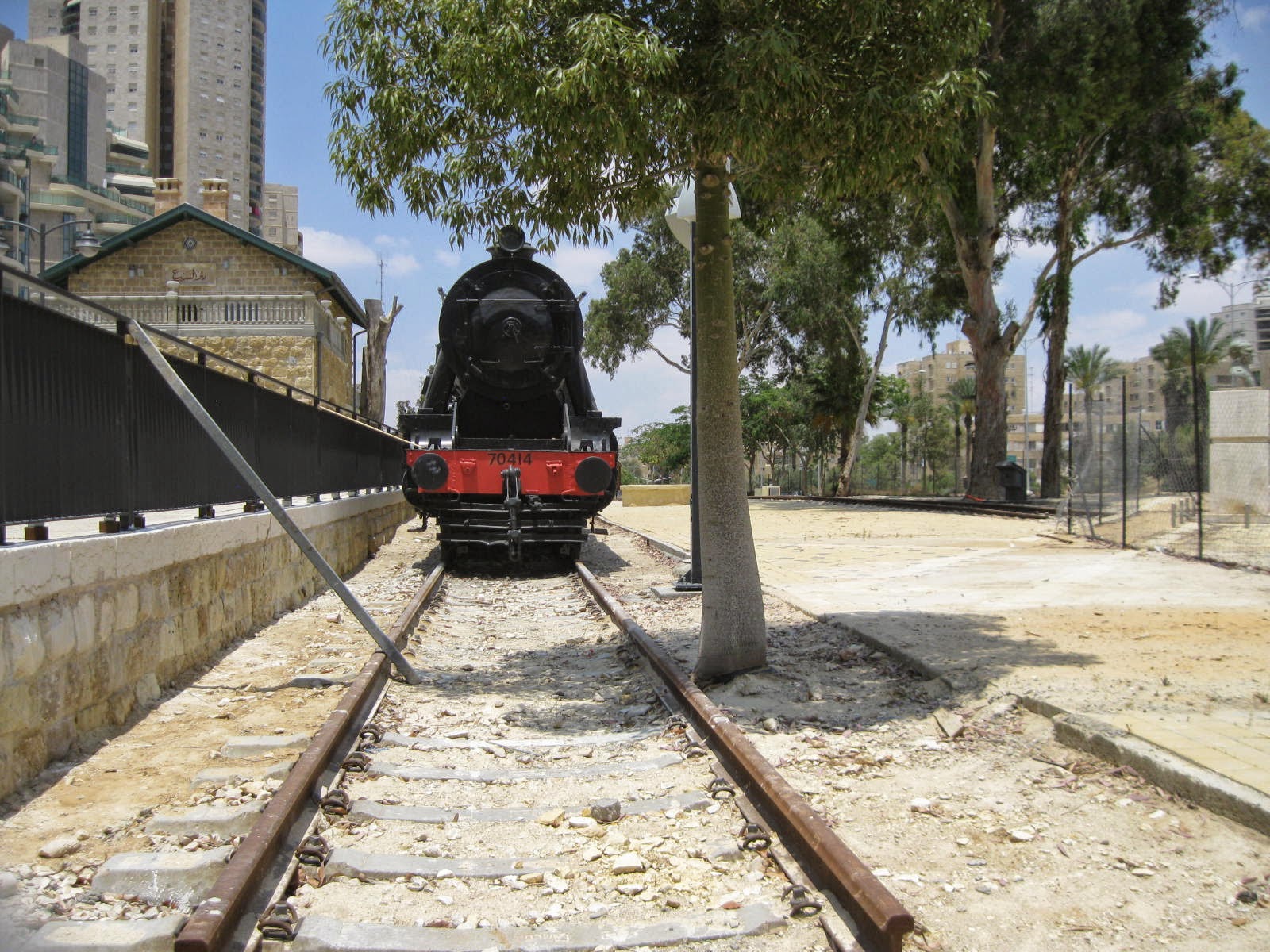
Here is the locomotive you've all been waiting for!
It has finally come to rest beside the 1915 Ottoman Turkish Beer Sheva train station.
Isn't it a beauty?!
Just outside the newly-restored but not yet officially opened train yard is Atatürk Plaza.
You can see the bust of Atatürk and the obelisk commemorating the 298 Turkish soldiers who were killed on the Beer Sheva front in World War I.
See more about this in my post about the annual Australian Light Horse Commemoration Day.
During Sukkot holiday the compound was open for just a few days.
Engine 70414 Compound guides were proud and excited to explain the history and also about the restoration work.
Site director Chen, in the photo, said their crew was stoked whenever a train-washing day came around, like after a muddy rain. (Well, she didn't use the work stoked but I think it is appropriate for a coal-burning steam engine.)
In the coming posts I will try to explain how and why this steam engine had a circuitous route, from England to Palestine, through the Suez Canal to Turkey, to Great Britain, and finally back to Beer Sheva.
It is a long story and involves a secret operation.
But meanwhile I'd like you simply to feast your eyes on 70414 and enjoy!
.
(Linking to Our World Tuesday.)
.
Here is the locomotive you've all been waiting for!
It has finally come to rest beside the 1915 Ottoman Turkish Beer Sheva train station.
Isn't it a beauty?!
Just outside the newly-restored but not yet officially opened train yard is Atatürk Plaza.
You can see the bust of Atatürk and the obelisk commemorating the 298 Turkish soldiers who were killed on the Beer Sheva front in World War I.
See more about this in my post about the annual Australian Light Horse Commemoration Day.
During Sukkot holiday the compound was open for just a few days.
Engine 70414 Compound guides were proud and excited to explain the history and also about the restoration work.
Site director Chen, in the photo, said their crew was stoked whenever a train-washing day came around, like after a muddy rain. (Well, she didn't use the work stoked but I think it is appropriate for a coal-burning steam engine.)
In the coming posts I will try to explain how and why this steam engine had a circuitous route, from England to Palestine, through the Suez Canal to Turkey, to Great Britain, and finally back to Beer Sheva.
It is a long story and involves a secret operation.
But meanwhile I'd like you simply to feast your eyes on 70414 and enjoy!
.
(Linking to Our World Tuesday.)
.
Labels:
BeerSheva Turkish train,
guides,
Our World Tuesday,
Turks
Friday, October 24, 2014
Reflections on the development of Beer Sheva
.
Reflected in the century-old Turkish train station's window are modern buildings of Beer Sheva.
And on the other side of the street, more high-rise residential buildings.
I'm sure the Ottoman Turks who started to build Beer Sheva towards the end of the 19th century never dreamed it would grow into Israel's second largest city (in terms of area).
Today it spreads across more than 117 square kilometers.
At least some of the apartments still have balconies.
I wonder what a unit costs here.
In Israel most people own their own residence; renting is less common.
Wedged in between the two rows of modern buildings is the Train Yard.
Here from the station balcony (where the first three photos were taken) you can see some of the authentic train cars and two more of the original structures that have been beautifully restored.
.
(Linking to Whimsical Windows, Delirious Doors and to James' Weekend Reflections .)
.
Reflected in the century-old Turkish train station's window are modern buildings of Beer Sheva.
And on the other side of the street, more high-rise residential buildings.
I'm sure the Ottoman Turks who started to build Beer Sheva towards the end of the 19th century never dreamed it would grow into Israel's second largest city (in terms of area).
Today it spreads across more than 117 square kilometers.
At least some of the apartments still have balconies.
I wonder what a unit costs here.
In Israel most people own their own residence; renting is less common.
Wedged in between the two rows of modern buildings is the Train Yard.
Here from the station balcony (where the first three photos were taken) you can see some of the authentic train cars and two more of the original structures that have been beautifully restored.
.
(Linking to Whimsical Windows, Delirious Doors and to James' Weekend Reflections .)
.
Thursday, October 23, 2014
National heritage site: the Turkish railway station
.
From across this empty lot in Beer Sheva you can get an unobstructed photo of the new/old Train Yard and the 99-year-old train station, albeit from the back.
The grand opening of this new cultural venue will be in November, but last week we got in on one of the several days of practice run.
You already saw pictures of the young lady in fancy period costume who was welcoming the visitors.
An ensemble of musicians on oud, drum, and violin bowed in the Oriental style added to the old Ottoman Turkish ambiance in the train compound.
In coming posts I'll show you the beautiful old steam locomotive and all.
If you want a sneak preview, please enlarge the sign and have a read.
.
From across this empty lot in Beer Sheva you can get an unobstructed photo of the new/old Train Yard and the 99-year-old train station, albeit from the back.
The grand opening of this new cultural venue will be in November, but last week we got in on one of the several days of practice run.
You already saw pictures of the young lady in fancy period costume who was welcoming the visitors.
An ensemble of musicians on oud, drum, and violin bowed in the Oriental style added to the old Ottoman Turkish ambiance in the train compound.
In coming posts I'll show you the beautiful old steam locomotive and all.
If you want a sneak preview, please enlarge the sign and have a read.
.
Wednesday, October 22, 2014
St. John Paul II's first feast day
.
On St. John Paul II's first feast day (today, Oct. 22), we remember his visit to Israel in the year 2000.
The historic message in the note the Pope placed in the Western Wall (now enshrined at Yad Vashem).
Abraham H. Foxman, ADL (Anti-Defamation League) National Director and a Holocaust survivor from Poland, wrote this about the recently-canonized Polish pope:
Click on the photo to read what John Paul was feeling about the Holy Land as he stood on Mt. Nebo (in Jordan) and gazed at the promised land, as did Moses from the same mountain.
.
Good reading:
Israel welcomes visit by Pope John Paul II (Israel Ministry of Foreign Affairs)
.
Visit to Israel, Jordan, and the Palestinian Authority: A Pilgrimage of Prayer, Hope, and Reconciliation (ADL)
.
Moses, John Paul, and Benedict on Mt. Nebo (this blog)
.
On St. John Paul II's first feast day (today, Oct. 22), we remember his visit to Israel in the year 2000.
The historic message in the note the Pope placed in the Western Wall (now enshrined at Yad Vashem).
Photo by Grzegorz Galazka
Abraham H. Foxman, ADL (Anti-Defamation League) National Director and a Holocaust survivor from Poland, wrote this about the recently-canonized Polish pope:
The canonization of Pope John XXIII, the father of Vatican II, and Pope John Paul II, who denounced anti-Semitism as “sin against God and humanity” and who was the first pope to visit the Great Synagogue of Rome since the time of Peter, formalizes and celebrates the courageous leadership of these two holy men who were determined to set the church on the right path toward better relations with other faiths.For us in the Jewish community, Popes John Paul II and John XXIII have already been saints for a long time.They are towering men whose visionary leadership and groundbreaking reforms transformed Jewish-Catholic relations and reversed two thousand painful years of church-based anti-Semitism.
Click on the photo to read what John Paul was feeling about the Holy Land as he stood on Mt. Nebo (in Jordan) and gazed at the promised land, as did Moses from the same mountain.
.
Good reading:
Israel welcomes visit by Pope John Paul II (Israel Ministry of Foreign Affairs)
.
Visit to Israel, Jordan, and the Palestinian Authority: A Pilgrimage of Prayer, Hope, and Reconciliation (ADL)
.
Moses, John Paul, and Benedict on Mt. Nebo (this blog)
.
Monday, October 20, 2014
Date machines
.
My date palm post yesterday reminded me of the AgriTech exhibition in Tel Aviv back in 2012.
These "clam shell" platforms are part of big pruning/picking towers.
Enlarge the photo: the posters demonstrate the machines' work.
The biggest model, AF-20, boasts a working height of about 70 ft (21.5 meters) and a load capacity of 1,500 lb (700 kg)!
Here is how the Israeli manufacturer, Afron, describes it:
Next time you eat sweet dates, give a thought to the workers who were way up there picking them for you.
There is also a nice story about Lisa Solomon, the date plantation manager at Kibbutz Ketura in the Arava, in Israel's south.
.
(Linking to Our World Tuesday.)
.
My date palm post yesterday reminded me of the AgriTech exhibition in Tel Aviv back in 2012.
These "clam shell" platforms are part of big pruning/picking towers.
Enlarge the photo: the posters demonstrate the machines' work.
The biggest model, AF-20, boasts a working height of about 70 ft (21.5 meters) and a load capacity of 1,500 lb (700 kg)!
Here is how the Israeli manufacturer, Afron, describes it:
The Afron family of pruning / picking towers include models specifically designed for date trees. Afron date tree models are designed for date trees from 25 feet (7.5 meters) up to 65 feet (20 meters) in height.Further technical details are here.
All Afron date tree models include a “clam shell” type operator platform that is designed to encircle the date tree trunk. This provides full access to the date tree canopy for several workers.
Not only can Afron date tree models be used for picking and pruning, but also include optional attachments for spraying and mechanical harvesting through the use of a shaker head.
All functions of the tower can be controlled by a single operator on the operators platform.
Next time you eat sweet dates, give a thought to the workers who were way up there picking them for you.
There is also a nice story about Lisa Solomon, the date plantation manager at Kibbutz Ketura in the Arava, in Israel's south.
.
(Linking to Our World Tuesday.)
.
Sunday, October 19, 2014
Let's make a date
Subscribe to:
Posts (Atom)