.
Brown goats, brownish sheep, a brown shepherdess, and the brown Negev desert.
Yep, BROWN is today's November 1 theme for City Daily Photo group.
See what fellow bloggers found for the subject here.
.
Showing posts with label Bedouin. Show all posts
Friday, November 1, 2019
Saturday, June 9, 2018
Iftar (my first!) at Wadi Attir in the wide desert
.
I got to participate in a lovely iftar this week, my first!
No, it wasn't in this big Bedouin hospitality tent, but it WAS in the courtyard of the new buildings next to it.
It was at Project Wadi Attir, a new and growing Bedouin + Jewish sustainability initiative in the Negev desert.
If you enlarge this photo all the way, you can see the modern and clean sheep and goat shed.
One of their ways to have income is to make and sell cheese.
Traditional Bedouin medicinal herbs and cosmetics are another.
Here is the courtyard where we assembled and later, at sundown, ate.
The iftar was in collaboration with Women Wage Peace, a multi-faith non-political movement formed by women in the aftermath of the big 2014 conflict with Gaza.
They arranged a panel discussion by a Muslim of Wadi Attir, a Polish Catholic priest from Beer Sheva, and a woman rabbi, who presented the different attitudes and approaches to religious fasting.
On the left: Lina Alatawna, the new young (!) female (!!) Bedouin Director General of Project Wadi Attir--a big success story! See here:
http://www.sustainabilitylabs.org/wadiattirnews/lina-alatawna-named-general-manager-of-pwa/
On the right: "Ghadir Hani, formerly our Executive Secretary, has begun working with Ali in the Field Crops department, managing outreach and sales, and helping with special programs. In addition to farmer's markets, Ghadir has also been introducing the products to new markets through word-of-mouth marketing events in people's homes in nearby neighborhoods like Omer, and has been a fixture at special local events..." quoted from the April newsletter.
The man wearing a kipa is my town Meitar's mayor; he also spoke, as did the mayor of our neighboring Bedouin town, Hura.
While the adults heard the talks, the Bedouin kids and their young Jewish guests made squares for a peace quilt out in the tent.
The following day, Unity Day in Israel, this happened (quoted from Women Wage Peace English Facebook page):
After all was said and done, the sun set and we hastened outside to the waiting tables full of good food (some prepared by the hosts and some brought by us guests).
The Muslims dug in without hesitation.
They had been fasting from food AND water from before 4:00 a.m. until 7:47 p.m.!
I can't imagine having that kind of self-discipline and devotion for the entire month of Ramadan, which often falls during our very hot summer.
.
Here is a nice explanation from "What You Should Know Before Attending Your First Iftar."
(This blessing/greeting means "May you have a generous Ramadan," i.e. be generous in your giving to others.)
.
(Linking to inSPIRED Sunday.)
.
I got to participate in a lovely iftar this week, my first!
No, it wasn't in this big Bedouin hospitality tent, but it WAS in the courtyard of the new buildings next to it.
It was at Project Wadi Attir, a new and growing Bedouin + Jewish sustainability initiative in the Negev desert.
If you enlarge this photo all the way, you can see the modern and clean sheep and goat shed.
One of their ways to have income is to make and sell cheese.
Traditional Bedouin medicinal herbs and cosmetics are another.
Here is the courtyard where we assembled and later, at sundown, ate.
The iftar was in collaboration with Women Wage Peace, a multi-faith non-political movement formed by women in the aftermath of the big 2014 conflict with Gaza.
They arranged a panel discussion by a Muslim of Wadi Attir, a Polish Catholic priest from Beer Sheva, and a woman rabbi, who presented the different attitudes and approaches to religious fasting.
On the left: Lina Alatawna, the new young (!) female (!!) Bedouin Director General of Project Wadi Attir--a big success story! See here:
http://www.sustainabilitylabs.org/wadiattirnews/lina-alatawna-named-general-manager-of-pwa/
On the right: "Ghadir Hani, formerly our Executive Secretary, has begun working with Ali in the Field Crops department, managing outreach and sales, and helping with special programs. In addition to farmer's markets, Ghadir has also been introducing the products to new markets through word-of-mouth marketing events in people's homes in nearby neighborhoods like Omer, and has been a fixture at special local events..." quoted from the April newsletter.
The man wearing a kipa is my town Meitar's mayor; he also spoke, as did the mayor of our neighboring Bedouin town, Hura.
While the adults heard the talks, the Bedouin kids and their young Jewish guests made squares for a peace quilt out in the tent.
The following day, Unity Day in Israel, this happened (quoted from Women Wage Peace English Facebook page):
Unity Day at the Women Wage Peace Mothers’ Tent outside the Knesset
=================
On June 6th, Unity Day, we will spread out 150 quilts which were sewn from thousands of Pieces for Peace which we received from all over the world; we will then create a human chain of unity, and will express our common longing for peace; later Yael Decklebaum will join us at the tent and will sing her songs and talk about her journeys to peace; we will sing the Prayer of the Mothers with her.
1-4 PM Presentation of the Peace Quilts in the Rose Garden
4 PM A human chain along the street leading to the Knesset
After all was said and done, the sun set and we hastened outside to the waiting tables full of good food (some prepared by the hosts and some brought by us guests).
The Muslims dug in without hesitation.
They had been fasting from food AND water from before 4:00 a.m. until 7:47 p.m.!
I can't imagine having that kind of self-discipline and devotion for the entire month of Ramadan, which often falls during our very hot summer.
.
Here is a nice explanation from "What You Should Know Before Attending Your First Iftar."
The fast itself is considered a purification of sins and a time to cleanse mind, body, and soul. Feeding a fasting person is believed to come with great reward from God and therefore many individuals, organizations, mosques, and community centers will offer an Iftar gathering in which the breaking of the fast is celebrated. It's usually not a ceremonial affair, although at many community gatherings this is often seen as an opportunity to educate and create an inter-faith gathering with delicious food, friends, and conversation.Ramadan kareem!
(This blessing/greeting means "May you have a generous Ramadan," i.e. be generous in your giving to others.)
.
(Linking to inSPIRED Sunday.)
.
Sunday, December 3, 2017
Choosing a prayer spot
.
How many of us would conquer any shyness and just do the prayers wherever we find ourselves when the set prayer hours arrive?
Just put off your shoes, kneel down, and do the prostrations?
In Israel you see Muslims (well, mainly men) praying in many public open spaces.
Like this Bedouin father on the lawn at Beer Sheva's Soroka hospital last week.
While exploring the medical center's sprawling campus I discovered this dedicated [Muslim] "Prayer Room."
The door on the right, as you can see from the water running out, is the place to do ritual ablution before prayer.
Soroka's Prayer Room is open at these times during morning, noon, and evening for the five obligatory prayers.
.
UPDATE: I read now that Soroka was the first Israeli hospital to open a Muslim prayer room, sometime before 2003.
After a petition was filed in 2013, the High Court of Justice instructed the six largest hospitals to also build such a prayer room. See article in Haaretz .
.
While this is not exactly the "inspirational" religious architecture that bloggers share every weekend at inSPIRED Sunday, still, I'm linking it to the meme. And also to Our World Tuesday.
.
Saturday, May 6, 2017
Shepherds and flock on the move
.
I was out walking when suddenly a cloud of dust started moving toward me from the west.
(Hint: you can enlarge the photos and solve the mystery.)
Turned out to be a large flock of sheep and goats!
Two young Bedouin shepherds and their dog kept them moving at a fast clip.
The fine dust coming into my camera (and my nose) was not a good thing but there was no way that I was going to miss this exciting photo opp!
I followed the flock.
Here we were walking part of the Israel National Trail.
Some of the goats took a minute to stand on hind legs and eat a bit of the Meitar Forest.
You can see the houses of Meitar up on the hill.
The flock moved on toward their home in the hills and I turned back to start the climb up to my home in town.
Because the sun was setting and night would soon cover the desert.
.
(Linking to Camera Critters.)
.
Wednesday, March 22, 2017
Forest to Plate in Kfar Sallama, Galilee
.
The most delicious vegetarian lunch I've ever tasted!
This young Bedouin brought huge trays to our tour group directly from the kitchen window of the family preparing all these fresh dishes.
Here the basket of hot pita came.
All the ingredients were local, in season, organic, and -- did I say? -- delicious!
Some were grown right there in the yard where we ate, while some were gathered in the wild.
In fact, the business card of the family enterprise reads FOREST to PLATE.
Right there in the yard, between the modern houses of this village in the Galilee, is a diwan, a Bedouin tent of hospitality.
If our tour group from Meitar had been a few decades younger, we could have eaten inside, sitting on the ground.
You can see video of guests dancing there to live Arab flute music at The Bedouin Experience in the Galilee page on Facebook.
Their website is in Hebrew but has photos and music.
The old traditional Bedouin embroidered dresses are always nice to see.
The Galilee is covered with olive trees and still the oil production does not meet the local demand.
So many foods are made with olive oil.
In the garden an old olive crushing stone was on display.
Right under an olive tree!
One of the village's mosques.
Kfar Sallama has more than 3,100 inhabitants.
A photo of the village from 2008, from Wikipedia. I'm sure Kfar Sallama has expanded since then.
.
Very interesting is this list and map of Arab localities in Israel.
Check out the Northern District (ya'ani, the Galilee) especially.
.
(Linking to ABC Wednesday K-day.)
.
Saturday, May 21, 2016
Beer Sheva market folks in video
.
Tonight everyone in Israel who cares about soccer will be watching the crucial game of HaPoel Beer Sheva vs. Bnei Sakhnin (the team from Arab town Sakhnin).
If Beer Sheva wins, it will be the first time in forty years that the team becomes national champion.
A One VOD camera crew was in Beer Sheva's huge open-air market, interviewing shuk regulars about their favorite team.
This shot is more interesting because it catches a Bedouin woman's nice dress.
Enlarge the photo to see the intricate embroidery.
Sorry, but spectator sports are not my forte; I can't get into watching games.
Here in my little snippet a dyed-in-the-wool HaPoel Beer Sheva fan sings for the team.
But I recommend you go to the professional 5-minute ONE VOD video and enjoy seeing the diverse and colorful characters of our shuk (market) as they praise HaPoel.
It's fun even if you don't know Hebrew. : )
UPDATE Saturday 11 pm: Wow, we won, Beer Sheva won the game!! National soccer champions for the first time since 1976.
Big joy in the stadium and in the city and in homes!
.
Wednesday, May 18, 2016
S is for scales and sheep-shearing shears
.
For ABC Wednesday, let's say S is for scale.
When is the last time you saw an old balance scale like this?
When I made aliyah to Israel in 1968 the sellers in markets were still using them to weigh and price your fruits and vegetables.
Soon digital scales took over.
This old seller wouldn't have it any other way, though.
He sits in the Beer Sheva shuk, in the almost-all Bedouin part of the market, and wastes for customers.
He offers a mishmash of sewing thread, hand shears for shearing sheep, matches, and used containers.
Bedouin who live in unrecognized villages, those not on the national electric grid, need jerrycans to transport kerosene for their generators.
Oh, and next to some spices or some kind of seeds are packets of Pertixine, a powder for the control of mites and lice on poultry and animals.
Our guide (you see his hand) on this fascinating Jane's Walk tour through both parts of the market told us not to be fooled by the old man's humble appearance.
Turns out that in the 1960s he was a top gashash in the army.
In the IDF only Bedouin are gashashim--trackers, reconnaissance scouts--because they know the land and the desert like the proverbial back of their hand.
.
Labels:
ABC Wednesday,
Bedouin,
shuk Beersheba,
working people
Monday, May 16, 2016
Desert Embroidery, for World Fair Trade Day
.
Today is World Fair Trade Day!
And what better example of fair trade than Desert Embroidery, the Association for the Improvement of Women's Status, begun by the women in the Bedouin town Lakia.
The women in the association do fine traditional embroidery by hand.
Each works in her home and then brings her creations to the center to be finished into products that are sold in their shop.
To quote their website:
The colors and patterns handed down over the generations tell a unique story, depending on how they are blended; that is why each young Bedouin woman embroiders a dress of her own to tell her own life story.
Please take a look at the website which explains what the brave women of Lakia have accomplished.
Your heart will swell.
.
UPDATE: This paragraph tells fascinating things about the symbolism of Bedouin embroidery!
.
(Linking to Our World Tuesday.)
.
Today is World Fair Trade Day!
And what better example of fair trade than Desert Embroidery, the Association for the Improvement of Women's Status, begun by the women in the Bedouin town Lakia.
The women in the association do fine traditional embroidery by hand.
Each works in her home and then brings her creations to the center to be finished into products that are sold in their shop.
To quote their website:
In the 1980's, a group of Bedouin girls got together to improve life in their village. In 1996 the Association for the Improvement of Women's Status achieved official recognition as the first Bedouin women's non-profit organization in Southern Israel.
Today we run a successful embroidery program to generate income for Bedouin women and preserve traditional handicrafts. We operate a mobile library serving over 1,500 children, as well as educational programs for women and youth. We invite you to visit the Desert Embroidery Visitor Center or browse the fine handmade embroidery products we offer.
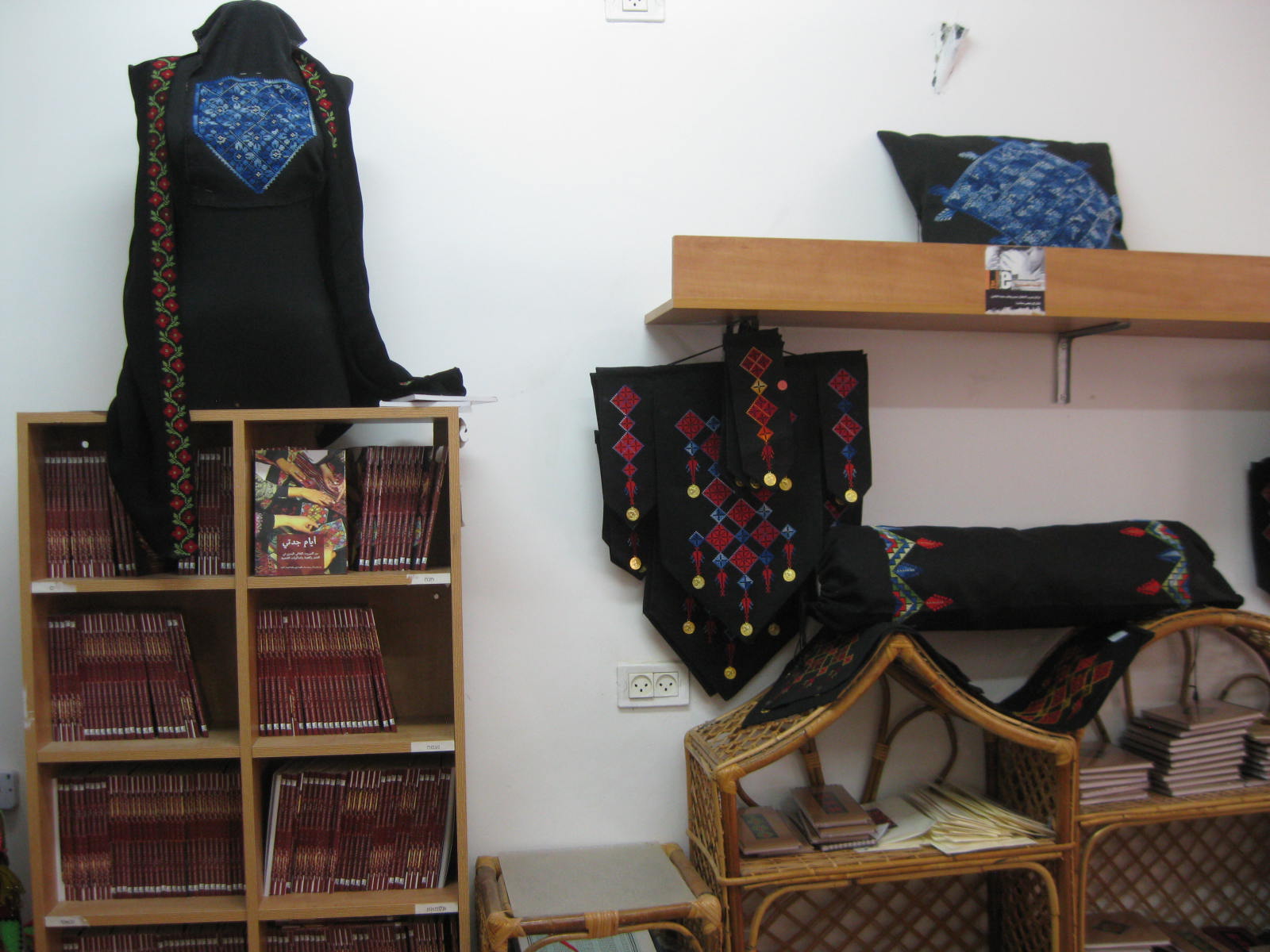
The colors and patterns handed down over the generations tell a unique story, depending on how they are blended; that is why each young Bedouin woman embroiders a dress of her own to tell her own life story.
Please take a look at the website which explains what the brave women of Lakia have accomplished.
Your heart will swell.
.
UPDATE: This paragraph tells fascinating things about the symbolism of Bedouin embroidery!
.
(Linking to Our World Tuesday.)
.
Labels:
Bedouin,
clothing,
Our World Tuesday,
women,
working people
Thursday, April 14, 2016
Desert Embroidery's Mobile Library in Lakia
Looks like a shelf stacked with kids' books in Arabic and Hebrew, right?
Actually it is the side of a truck, a library on wheels!
The project was started 15 years ago by some very energetic and courageous Bedouin women with vision living in the town of Lakia, here in the Negev.
The Mobile Library travels around Lakia.
It also goes out to several settlements in the Bedouin "diaspora" which are not recognized by the State of Israel.
The library's webpage, where you can see more photos, explains like this:
Although 58% of Lakia’s 10,000 residents are children, Lakia has no public library. The Mobile Library Project was set up in 2000 to provide children in Lakia and the unrecognized villages in the area with an opportunity to read and exchange books to improve their reading skills, instill a love of reading and facilitate their educational achievement.The library is only one of the projects of Desert Embroidery, Association for the Improvement of Women's Status, Lakia.
Three days a week, the Mobile Library travels in Lakia and the unrecognized villages of Abu Kef, Owajan and Alatresh, all of which are denied municipal services. At each stop enthusiastic children check out books in Arabic, Hebrew and English. Volunteer university students organize story hours and operate the library in exchange for a small stipend. We estimate that the library reaches some 1,750 children of all ages.
Future plans for the Mobile Library include extending operations to a full week, the expansion of library visits to more unrecognized villages for the benefit of even more children, development of an area for games, and the procurement of new books.
We can learn a lot by reading the three sections of Overview at the website and then looking through the other text and photos.
.
(Linking to Our World Tuesday and signs, signs.)
.
Tuesday, April 12, 2016
Shade for all
.
The view from the Beer Sheva-Meitar bus window. (Nicer than in the previous post.)
A flock of sheep and goats takes shelter from the noon-day sun.
The Keren Kayemet (Jewish National Fund), Israel's tree management organization, was nice enough to plant these trees at scattered places in the desert.
(I know it's the KKL's work because I enlarged the photo and found a white pillar with the emblem.)
And also taking advantage of the shade -- two Bedouin girls under a tree.
Even though they sit with their back to the flock, one or both of them must be the flock's shepherd.
.
(Linking to Our World Tuesday.)
.
Tuesday, April 5, 2016
Mosques and minarets (two!)
.
M is for mosques! This one has TWO minarets.
On Saturday our Arabic teacher took us to the nearby Negev Bedouin town of Lakiya.
We drove by two of the town's many mosques.
Sorry about my out-of-the-car-window shots, but there was no time to stop.
We had many welcomes and lectures and visits waiting for our class.
I learned so much in half a day!
It is so inspiring what some of the women have done, together, to advance their status within the traditional, male-dominated society.
More about that in coming posts.
.
(Meanwhile, happy ABC Wednesday.)
(Linking also to inSPIREd Sunday meme for houses of worship.)
.
Wednesday, January 6, 2016
Protesting blood feuds and illegal guns
.
I snapped this yesterday from my bus going home from Beer Sheva.
Bedouin men were lined up along the highway in a small demonstration near their town.
The Hebrew part of their banners says
Ken, ken lasovlanut
Lo, lo la-alimut.
Yes, yes to tolerance
No, no to violence.
And also this:
The police are asleep,
Crime is rampant.
I assume it is in response to two of their townspeople being murdered just in the past week.
A blood feud is going on between two big clans in the town.
The Bedouin want the Israeli police to go into Arab towns and search for and confiscate all the many illegal firearms.
But today this appeared in The Times of Israel:
UPDATE: This article was published about the subject today.
The best take-aways from it:
I snapped this yesterday from my bus going home from Beer Sheva.
Bedouin men were lined up along the highway in a small demonstration near their town.
The Hebrew part of their banners says
Ken, ken lasovlanut
Lo, lo la-alimut.
Yes, yes to tolerance
No, no to violence.
And also this:
The police are asleep,
Crime is rampant.
I assume it is in response to two of their townspeople being murdered just in the past week.
A blood feud is going on between two big clans in the town.
The Bedouin want the Israeli police to go into Arab towns and search for and confiscate all the many illegal firearms.
But today this appeared in The Times of Israel:
Arab Israeli MKs [Members of Knesset] from the opposition seek to establish a parliamentary investigative committee to examine the presence of illegal weapons in towns and villages across the country..
The coalition strikes down the proposal.
UPDATE: This article was published about the subject today.
The best take-aways from it:
1. “From my point of view,” says [Arab MK] Tibi, “take the legal weapons too. We
don’t want them in our communities. I held a hearing in the Knesset in
2012 in the presence of the prime minister, the interior security
minister, bereaved families and 40 Knesset members. It was a historic
event. We demanded that they collect the weapons.”
2. Internal Security Minister Gilad Erdan: “What happens is that the police, when they go into an Arab village or
town, need a much bigger force than when they go into a Jewish town.
It’s very easy to blame the police and say that the illegal weapons in
the Arab sector are because of them. But the problem has existed since
the establishment of the state. A lot of Israeli Arabs want to have
weapons for self-defense. Others want them for celebrations and
weddings. Others want them for status, or for criminal activity. Each
person has their own reason. But because the level of crime and violence
is so high, as a result, even more people arm themselves.”
3. Muhammad Haj Daod, a theater actor from Umm al-Fahm: “In the past, people would get into disputes and it would end with a sulha.
People met and made peace. It never got to the point of weapons except
for one incident of shooting that everyone remembers from the 1980s.
Since we got the police station in Umm al-Fahm, we see the weapons and
drugs spreading throughout the city.
“How do I explain it?” he asks. “In the past, families were organized in hamulas. Each hamula
[clan] has its leader and he is the one who decides. It was easier to
resolve disputes because there weren’t a lot of different people
involved in the decision. The decision was up to the head of the entire
family. Today, these leaders don’t exist anymore. Today, everyone does
whatever they feel like.”
.
Saturday, July 18, 2015
First time to meet the sheep + shepherd!
.
I finally met the good shepherd!!
Two years I've been roaming the desert outside my town and yesterday evening was the first time I saw the flock!
Enlarge the photo, don't miss his nice smile.
I always see their droppings and sometimes even an ovine leg gnawed to the bone by jackals but never saw the flock on the hoof.
After we chatted a bit, with the special sounds and calls that only shepherds have, he told the sheep "Heads up, enough grazing, let's go home."
I got nostalgic for my livestock work at Heifer Ranch in Arkansas; my way of calling sheep was "Sheep-sheep-sheep!" and for the goats the Hebrew "Bo-i bo-i bo-i!"
The sun had just set, ushering in our holy Sabbath Eve.
For the young Bedouin man, end-of-Ramadan Eid al-Fitr was just beginning.
It was a blessed evening all around.
.
(Linking to Camera Critters.)
.
Subscribe to:
Posts (Atom)


