Showing posts with label Darajat. Show all posts

Tuesday, January 24, 2012

Breaking bread together

.
Bread--before and after.

A bunch of B words for ABC Wednesday.


Bread being baked by a Bedouin.

Back in 2008 a dozen Jewish Israelis took part in a 5-day immersion course in spoken Arabic.
Part of each day we studied in class.
Each of us was hosted by a different family.
It was a blessed being together.

Click here to see more pictures of my time in the village of Darajat, down south in the Negev desert.

.

Tuesday, January 4, 2011

Yogurt cheese -- labaneh

.
For Y Day at ABC Wednesday I'll serve you up some yummy yogurt cheese.
In Israel we call it by its Arabic name, labaneh.

It all begins by milking the ewes early in the morning.
(I got to help milk during my 5-day Arabic course / home hospitality at the Bedouin village of Dirijat in the Negev desert!)
.
Labaneh is made in quantity only a few months during the year.
I suppose it depends on when the lambing season is.
.
I just happened to wander into a backyard and sighted all the production things.
Unfortunately it was just a few minutes before my ride was leaving back to Jerusalem, so I didn't have time to find out the exact process.
The older women do not speak much Hebrew or English, and my Arabic is still very small.
.
Notice even the bags are made from sheep.

.
But you can read about strained yogurt / labaneh in Wikipedia.
The women in Dirijat roll some of their labaneh into balls and pack it in glass jars with olive oil and sell it in their visitors center.

The Bedouin also like to press the strained labaneh in its cheese cloth between two heavy stones and later sun dry it.
It becomes hard and dry, like the ball in the photo, and can be stored for long periods.
.
I hope you all have the chance to dip hot pita or flat bread into cool labaneh, drizzled with olive oil and zaatar!
.

Tuesday, November 9, 2010

Quarries in Israel

.
A quest for quarries today, for ABC Wednesday.
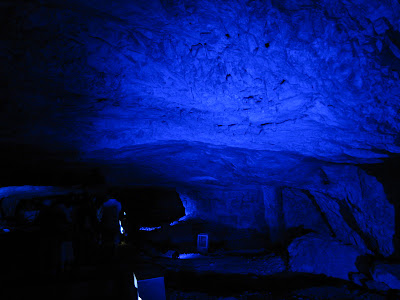
First, let's see two ancient masonry stone quarries in Jerusalem.
.
The photo above was taken underground during the Jerusalem Light Festival, hence the eerie blue color.
.
This is the huge quarry beneath the Old City from which Herod the Great took the "Herodian stones" needed to renovate the Temple and its retaining walls, including the Western Wall.
.
We call it Zedekiah's Cave, but, as a fascinating article in The New York Times says,

"For the Freemasons, the cave is definitely Solomon's quarry, making it one of the most revered, perhaps the most revered, site of their international secret society. The organization considers King Solomon the first Freemason, and its tradition of doctrines, passwords and symbols derives from the building of Solomon's Temple in Jerusalem. In the absence of the Temple, Freemasons revere the quarry, and they hold an elaborate ceremony inside the cave once a year. "

This thousands of years old quarry was found when I worked at a salvage dig of a Canaanite cemetery.
Today the area is covered by the awful Holyland Park residences.

Moving on to modern quarries, here's one in the Givat Shaul neighborhood.
It looks like the cement mixers fill up on site and drive out to their construction site.

Today the apartments and yeshivas have come right up against the old quarries.
The area used to be Dir Yassin . . . .
.
Further north, toward Haifa, this quarry is biting into Mount Carmel.
.
The Jerusalem Post reported in 2008 that our Minister of National Infrastructures "warned that there would be shortages in raw materials by 2020. There are currently 80 working quarries in Israel, and about a thousand which have been tapped out and are in need of rehabilitation. However no new quarry has been approved by the national planning council in the last 14 years."
.
But my favorite quarry photo is this memory of the great five days I lived in the village of Darajat, studying Arabic.
(For more about it, see under my label Darajat.)
Our Bedouin hosts took our small group up the mountain for a hike and to see the quarry in the Negev desert where they work.
.
Hope you don't have dust in your eyes after looking at all these quarries. Shalom!
.
Monday, March 8, 2010

It takes a village to teach Dina Arabic

.
Earlier today I posted something for International Women's Day.
.
But in addition, for That's My World Tuesday, I invite you to see my post of exactly one year ago which is a tribute to the welcoming and hard-working Arab women of Dirijat.
Please click here to go down to their village in the Negev desert.
.

Sunday, June 28, 2009

The greening

.
A blessing on your house, O people of Iran.
May justice reign and peace prevail.
Today, Sunday, June 28, bloggers worldwide post in support of freedom-seeking people in Iran. Some of those posts can be seen via City Daily Photo.
Blessings especially to blogger-friends S in Iran and Meead now in Portland.
.

Tuesday, March 17, 2009

St. Patrick's Day green?

I, I, what begins with I? That's our letter of the day at ABC Wednesday. If you thought I'd say Israel, incorrect. It's Irish instead! In honor of St. Patrick's Day. But in Israel just about no one knows of this special day. And Jerusalem has no holy (or otherwise) places connected with Ireland. We have no green beer today, no shamrocks. 
 Down in the Negev desert, however, is a Bedouin village that boasts something really really green.

 
"The wearing of the green" by a house!

 
This is the village where we studied Arabic and enjoyed home hospitality for five days.
We were told that the owner wanted a house the color of the buses he drives. He is a share-holding member of the Egged bus cooperative and he wants everybody to know it. Being a chaver Egged is a status symbol in Israel.
.

Sunday, March 8, 2009

This day was made for you

.
This post for International Women's Day is dedicated to the hard-working and welcoming women of the village of Dirijat (aka Darajat) and especially to the members of the hamula (clan) who housed and fed me for five days--Dahab, Amina, Zohara, Aisha, Nahed, and Wadina.

The village is in the Negev desert. Several times a year they offer a 5-day immersion course in spoken Arabic.
Our group last April had ten Jewish Israelis and one American lady pastor.
Each of us had a different host family. After class with our excellent teacher we went "home" to interact in our fledgling Arabic language.

One late afternoon some of the young people took us up the mountain on a hike to see the village from above. We saw the big quarry, a herd of camels, the area of the ancient Spice Route, and a desert sunset.

After breakfast of fresh pita, strong coffee, salads, and labaneh.

The matriarchs with the photo of the sheikh who started the village many years ago.

My dear hostess, in whose upstairs apartment I slept (on the floor).

Neighbor women watching the youngsters' Debka Troupe dancing for us.

Sheep milk is used to make labaneh. I asked to milk the sheep and clean the pen one morning and they let me! Kef!

All the women wanted to try out the mysterious camera of the American Pastor Suzanne (who is currently blogging about her time in Israel).
For several months a year the women are busy making big quantities of labaneh.

Scattered around the village are many ovens (taboon) that are kept warm all the time (burning dung). Two or three times a day the women come with their dough, flatten it like pizza, and put it directly on the hot rocks for a few minutes. Yum, hubez taboon flat bread!
Thank you from the heart to the good women of Dirijat who taught me so much.
Shukran ya niswan!
.

Tuesday, September 16, 2008

"I" is for idioms

In blogland it is ABC Wednesday--take a look.
Here in Israel I invite you to idioms beginning with "I".
It takes a village to raise a child. = It takes many people to teach a child all that he or she should know.

In the swing. = If things are in the swing, they are progressing well.
I've got a bone to pick with you. = I have some complaint to make against you.
In someone else's shoes = It is difficult to know what another person's life is really like, so we don't know what it is like to be in someone's shoes.

In the saddle = If you're in the saddle, you are in control of a situation.
If wishes were horses, beggars would ride. = Wishing for something or wanting it is not the same as getting or having it.

In a jam = If you are in a jam, you are in some trouble.
In the driver's seat = In charge of something or in control of a situation.
I'll cross that road [or bridge] when I come to it. = I'll think about something just when it happens, not in advance.

Thanks to UsingEnglish.com for definitions of the idioms.

Wednesday, June 25, 2008

W words of Israel

Water truck delivering water to a house in an Arab village in the Negev. Not yet connected to the national water system.
Explaining the meaning of www in Hebrew to the young Arab pupils in Darajat village school's computer room.
Wind damage during a winter storm in my Jerusalem Hills moshav (village).
Whirling weathervane in the wind in Jerusalem.
Yes Dutch bloggers, Jerusalem has one too!

Sunday, May 4, 2008

Scorpion


Suddenly we heard the little kids calling their father and he came running, sandal in hand, and put an end to this dangerous scorpion.
Minutes before, some of our group of visiting students and the village kids had been sitting on the cement floor of the courtyard, talking and waiting to be called to the outdoor dinner table.
 The scorpion was a dramatic reminder that Darajat is a village in the middle of the desert.

(Other bloggers posting animals for Camera-Critters Sunday can be visited here.)

Friday, May 2, 2008

Sky Watch Sabbath

A late afternoon, dust-filled sky over a sheikh's tomb and the cemetery of Darajat in the Negev desert. This is through a zoom lens. The hill actually was quite far away. One of the things I had not enough time to visit during my 5-day stay in the village. Even after our daily six hours learning Arabic in the classroom, the evenings were filled with activities.
Friday is the Moslem day of rest, while Friday night and Saturday are the Jewish Sabbath.
Shabbat shalom!

See skies around the world shared by bloggers at Sky Watch Friday.

Wednesday, April 30, 2008

O is for oud


(For newcomers to the blog, I should explain that for the week of Passover vacation I joined a dozen other Jewish Israelis at a special summer school program in the Arab village of Darajat in the Negev desert. We studied Arabic and enjoyed home hospitality of the gracious host families.)

Our group of Arabic learners was invited to Darajat's community center (what in former years would have been a big welcome tent made from goat hair [hence a tent's name, "hair house"]).
This oud player explained about his instrument and the songs and told about his family and their history. Together with his son on the drum, they made the real Middle Eastern oud music.


Notice the beautiful dress embroidered in the village and the traditional strong black coffee serving set. For sale were more dresses and homemade olive oil and jars of labineh.
Off to the side these girls broke into dance to the inviting music of the oud. When they noticed we were watching, they giggled and did the shy thing, running off.

For more ABC Wednesday contributors visit Mrs. Nesbitt's Place.

Tuesday, April 29, 2008

Debka

The debka is a lively Arab folk dance with lots of bouncing and stomping. Darajat has its own debka troupe. Here their teacher leads them through the steps in the school yard.

The next day the youngsters performed for us.

Males and females may dance the debka but traditionally, they do so in separate groups.
Here they are not only dancing together but also holding hands! Well, Darajat is a very progressive village in many ways.
The small boy in front is the raas, the head of the group, a good leader.

You'd never know it was a chamsin, with 100 degree heat. The young people went on jumping with boundless energy, enjoying themselves.

The pride of the dance troupe and of the villagers watching them was very moving in itself.
I tried hard to restrain my happy-tears. BRAVO!
.