.
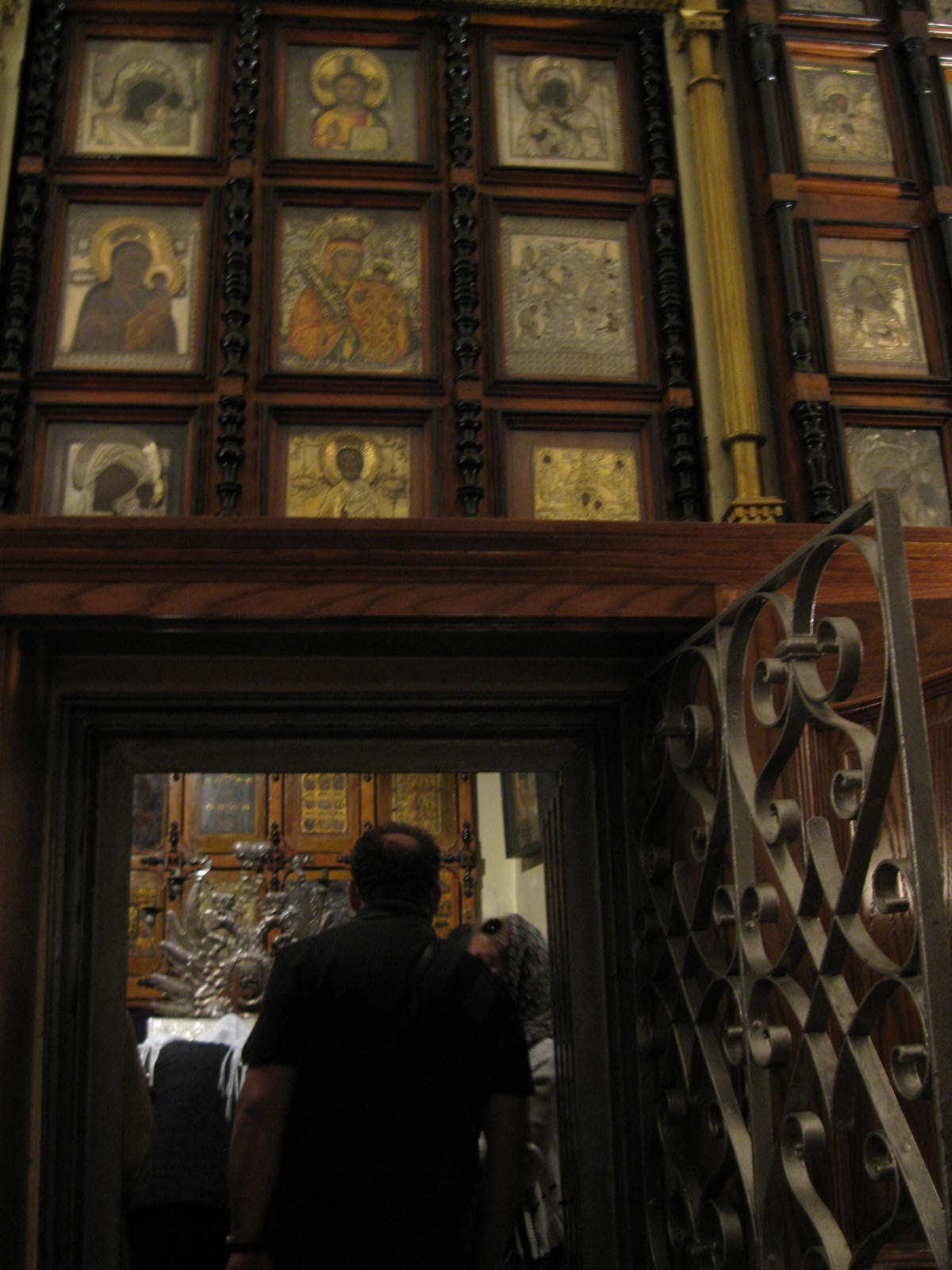
Today being Christmas for many Orthodox Christians, I am fondly remembering my visit a year ago to the beautiful St. Nikolas Russian Orthodox Cathedral in Vienna.
If you enlarge my photo with a few clicks, a strange (to the Western eye) Nativity scene will open to you.
The fresco on the wall of St. Nikolas church shows a baby Jesus in swaddling clothes and another young Jesus being bathed by Mary's, shall we say, personal assistant.
Joseph is off to the side, looking worried.
And who is that guy in the black hairy coat?
There are some surprising answers in this rather "un-orthodox" post in a museum researcher's blog.
His post is titled "Have yourself a gloomy little Christmas: The traditional Nativity icon."
If you prefer a more religious interpretation, see the blog "A Reader's Guide to Orthodox Icons."
By the way, some say the ox and ass stand close to the manger to warm the baby with their breath.
That I quite like!
.
(Linking to inSPIREd Sunday.)
.
Showing posts with label icons. Show all posts
Saturday, January 7, 2017
Sunday, March 22, 2015
The Ladder of Divine Ascent
.
An Orthodox priest filling the oil lamps above the tomb at the Holy Sepulchre.
A brave Benedictine nun positioned a ladder on the stairs leading down to the crypt and climbed up to extinguish the candle at one of the stations of the cross.
At the Abbey of St. Mary of the Resurrection, Abu Ghosh.
A brave nun friend on chapel-cleaning day.
Chapel at the tomb of St. Elisabeth.
.
Why am I posting pictures of monastics on tall ladders?
Because today is the Sunday of John of the Ladder!
St. John Climacus wrote the guide for his fellow monks, The Ladder of Divine Ascent.
He lived not far from here, at Santa Katarina monastery in Sinai and in desert caves in the 7th century.
I have been learning about him at Sr. Dr. Vassa's short video.
In it Sr. Vassa also talks about how you don't have to be a monastic to get into the habit of doing a little bit of spiritual reading, lectio divina, every day, just for a few minutes.
The 12th C icon for The Ladder of Divine Ascent, this one from St. Catherine's Monastery.
You can sample some sections of the book here.
Or an outline of the steps of the ladder.
More about St. John Climacus.
An easy walk-through of the icon is at this nice icons blog.
Also at Wikipedia.
But the most fun way is to see the Coffee with Sr. Vassa episode. Only ten minutes.
.
An Orthodox priest filling the oil lamps above the tomb at the Holy Sepulchre.
A brave Benedictine nun positioned a ladder on the stairs leading down to the crypt and climbed up to extinguish the candle at one of the stations of the cross.
At the Abbey of St. Mary of the Resurrection, Abu Ghosh.
A brave nun friend on chapel-cleaning day.
Chapel at the tomb of St. Elisabeth.
.
Why am I posting pictures of monastics on tall ladders?
Because today is the Sunday of John of the Ladder!
St. John Climacus wrote the guide for his fellow monks, The Ladder of Divine Ascent.
He lived not far from here, at Santa Katarina monastery in Sinai and in desert caves in the 7th century.
I have been learning about him at Sr. Dr. Vassa's short video.
In it Sr. Vassa also talks about how you don't have to be a monastic to get into the habit of doing a little bit of spiritual reading, lectio divina, every day, just for a few minutes.
The 12th C icon for The Ladder of Divine Ascent, this one from St. Catherine's Monastery.
You can sample some sections of the book here.
Or an outline of the steps of the ladder.
More about St. John Climacus.
An easy walk-through of the icon is at this nice icons blog.
Also at Wikipedia.
But the most fun way is to see the Coffee with Sr. Vassa episode. Only ten minutes.
.
Labels:
feast days,
Holy Sepulchre,
icons,
ladder,
monk,
nuns
Sunday, July 13, 2014
Angels
.
This tile art (which joins the Monday Mural meme) is on the outer wall of a government agency in Beer Sheva.
If you click to enlarge the photo, you might recognize the story from Genesis 18.
"Three men" come to visit Abraham and Sarah in their tent at the Oaks of Mamre, but they turn out to be angels in disguise.
On the wall, below the company name, it says Machoz Hadarom, meaning the Southern District, i.e. the Negev.
With the hundreds of rockets falling here in the south now, I'm wondering if the Iron Dome might just be sort of a modern version of protecting angels in the sky . . . .
.
(See an earlier post telling how the medieval Russian icon "The Hospitality of Abraham" gradually became the icon "Holy Trinity.")
.
This tile art (which joins the Monday Mural meme) is on the outer wall of a government agency in Beer Sheva.
If you click to enlarge the photo, you might recognize the story from Genesis 18.
"Three men" come to visit Abraham and Sarah in their tent at the Oaks of Mamre, but they turn out to be angels in disguise.
On the wall, below the company name, it says Machoz Hadarom, meaning the Southern District, i.e. the Negev.
With the hundreds of rockets falling here in the south now, I'm wondering if the Iron Dome might just be sort of a modern version of protecting angels in the sky . . . .
.
(See an earlier post telling how the medieval Russian icon "The Hospitality of Abraham" gradually became the icon "Holy Trinity.")
.
Friday, December 6, 2013
Goodbye John, hello Francis
.
Meanwhile, back in the Jerusalem Hills for a weekend visit, I discovered a new painting had been added to the church at St. John of the Desert Franciscan convent.*
The protective shield made it hard to get a good shot; on the other hand, it was good for Weekend Reflections.
Apparently it was necessary because pilgrims would kiss the icon and leave lipstick marks (or so I was told).
I guess the resident hermit monk who painted it thought that the only red St. Francis needed on him was his stigmata on hands and side.
The older painting it replaced was quite unusual in that it showed John the Baptist holding a scroll written in Hebrew ("Behold the Lamb of God . . . ").
You don't see much Hebrew on church walls.
.
*Franciscans in Israel use the word convent not necessarily to refer to a women's religious community, but rather to differentiate it from a monastery.
Monks or nuns in a monastery live a more secluded life, while those in a convent [think "convention"] are more apostolic and can work outside the walls.
.
(Linking to Whimsical Windows, Delirious Doors.)
.
Meanwhile, back in the Jerusalem Hills for a weekend visit, I discovered a new painting had been added to the church at St. John of the Desert Franciscan convent.*
The protective shield made it hard to get a good shot; on the other hand, it was good for Weekend Reflections.
Apparently it was necessary because pilgrims would kiss the icon and leave lipstick marks (or so I was told).
I guess the resident hermit monk who painted it thought that the only red St. Francis needed on him was his stigmata on hands and side.
The older painting it replaced was quite unusual in that it showed John the Baptist holding a scroll written in Hebrew ("Behold the Lamb of God . . . ").
You don't see much Hebrew on church walls.
.
*Franciscans in Israel use the word convent not necessarily to refer to a women's religious community, but rather to differentiate it from a monastery.
Monks or nuns in a monastery live a more secluded life, while those in a convent [think "convention"] are more apostolic and can work outside the walls.
.
(Linking to Whimsical Windows, Delirious Doors.)
.
Sunday, May 19, 2013
Is that a flame on her head??
.
I sometimes hear about weeping icons and myrrh-gushing icons and miracle-working icons, but . . . well . . .
But what happens when on the feast of Pentecost you are all alone in an old chapel built by the Crusaders, looking at an icon, and you actually see a "flame" above the woman's head??
Enlarge the photo, you will see it too!
The Book of Acts says that the Apostles [on the very first Pentecost] were gathered together in one place [the Upper Room] when suddenly a sound came from heaven like a rushing wind, filling the entire house where they were sitting.
"Divided tongues, as of fire, appeared among them, and a tongue rested on each of them."
They were all filled with the Holy Spirit and began to speak in other languages as directed by the Spirit.
.
You can see the flames as depicted in classical artwork at
http://jerusalemhillsdailyphoto.blogspot.co.il/2011/06/whats-that-on-your-head.html
My other posts about Pentecost in Jerusalem are here.
.
And as grateful as I am for the "miracle" I was treated to, I must add that this photo is for Weekend Reflections. Yes, reflections.
Happy Pentecost to all the Catholics and Protestants who celebrate it today!
Shalom from Jerusalem, where it all started.
.
(Linking to inSPIREd Sunday.)
.
I sometimes hear about weeping icons and myrrh-gushing icons and miracle-working icons, but . . . well . . .
But what happens when on the feast of Pentecost you are all alone in an old chapel built by the Crusaders, looking at an icon, and you actually see a "flame" above the woman's head??
Enlarge the photo, you will see it too!
The Book of Acts says that the Apostles [on the very first Pentecost] were gathered together in one place [the Upper Room] when suddenly a sound came from heaven like a rushing wind, filling the entire house where they were sitting.
"Divided tongues, as of fire, appeared among them, and a tongue rested on each of them."
They were all filled with the Holy Spirit and began to speak in other languages as directed by the Spirit.
.
You can see the flames as depicted in classical artwork at
http://jerusalemhillsdailyphoto.blogspot.co.il/2011/06/whats-that-on-your-head.html
My other posts about Pentecost in Jerusalem are here.
.
Here's how the icon appears normally.
And as grateful as I am for the "miracle" I was treated to, I must add that this photo is for Weekend Reflections. Yes, reflections.
Happy Pentecost to all the Catholics and Protestants who celebrate it today!
Shalom from Jerusalem, where it all started.
.
(Linking to inSPIREd Sunday.)
.
Tuesday, April 9, 2013
Mosaicist, Greek Orthodox
.
M is for mosaic-making monk in a monastery.
He kindly let me watch how a modern mosaic is painstakingly made, in his workshop at the very old St. Gerasimus Monastery near Jericho.
See more about St. Gerasimus Monastery, also known in Arabic as Deir Hajleh and in Hebrew as Beth-Hogla, here:
http://jerusalemhillsdailyphoto.blogspot.co.il/2012/05/monastery-full-of-animals.html
and
http://jerusalemhillsdailyphoto.blogspot.co.il/2012/05/mother-mary-nursing-her-baby.html
Lots of photos and info at http://www.biblewalks.com/Sites/StGerassimos.html
Mosaic carpets in various stages of progress.
Maybe you'd like to order one?
.
(Linking to ABC Wednesday.)
.
UPDATE: Thanks to Pasadena Adjacent's use of the word smalti in her comment, I learned a nice new word and found this great illustrated glossary of mosaic terms:
http://www.mosaicartsource.com/mosaicart/mosaic_art_resource/mosaic_glossary.html and they even have a blog about mosaics!
.
(All photos can be enlarged with two clicks.)
M is for mosaic-making monk in a monastery.
He kindly let me watch how a modern mosaic is painstakingly made, in his workshop at the very old St. Gerasimus Monastery near Jericho.
See more about St. Gerasimus Monastery, also known in Arabic as Deir Hajleh and in Hebrew as Beth-Hogla, here:
http://jerusalemhillsdailyphoto.blogspot.co.il/2012/05/monastery-full-of-animals.html
and
http://jerusalemhillsdailyphoto.blogspot.co.il/2012/05/mother-mary-nursing-her-baby.html
Lots of photos and info at http://www.biblewalks.com/Sites/StGerassimos.html
Mosaic carpets in various stages of progress.
Maybe you'd like to order one?
.
(Linking to ABC Wednesday.)
.
UPDATE: Thanks to Pasadena Adjacent's use of the word smalti in her comment, I learned a nice new word and found this great illustrated glossary of mosaic terms:
http://www.mosaicartsource.com/mosaicart/mosaic_art_resource/mosaic_glossary.html and they even have a blog about mosaics!
.
Saturday, March 30, 2013
A day of waiting. The Epitaphios
.
I always think that for my Christian friends Holy Saturday must be the saddest day of the religious year.
As a Jew I can't even bear to imagine what it must be like, thinking of one's lord and master lying alone in a cold and dark tomb.
All the more so for the original disciples, for they did not know that Easter would come so soon, if at all.
My two photos are from the seldom-visited Greek Orthodox church Viri Galilei, on the Mount of Olives.
Orthodox Wiki explains the epitaphios:
I always think that for my Christian friends Holy Saturday must be the saddest day of the religious year.
As a Jew I can't even bear to imagine what it must be like, thinking of one's lord and master lying alone in a cold and dark tomb.
All the more so for the original disciples, for they did not know that Easter would come so soon, if at all.
My two photos are from the seldom-visited Greek Orthodox church Viri Galilei, on the Mount of Olives.
Orthodox Wiki explains the epitaphios:
The Epitaphios (Greek: Επιτάφιος, epitaphios, or Επιτάφιον, epitaphion; Slavonic: Плащаница, plashchanitsa; Arabic: نعش, naash)
is an icon, today most often found as a large cloth, embroidered and often richly adorned, which is used during the services of Great Friday and Holy Saturday .
It also exists in painted or mosaic form, on walls or panels.
. . .
The icon depicts Christ after he has been removed from the cross, lying supine, as his body is being prepared for burial.
The scene is taken from the Gospel of St. John 19:38-42.
Shown around him, and mourning his death, may be his mother (the Theotokos; John the beloved disciple; Joseph of Arimathea; and Mary Magdalene, as well as angels. Nicodemus and others may also be depicted.
Usually, the troparion of the day is embroidered around the edges of the icon:
The Noble Joseph, taking Thy most pure body down from the Tree and having wrapped it in pure linen and spices, laid it in a new tomb.
- .
- UPDATE 2018: See more about the epitaphios here:
https://russianicons.wordpress.com/2018/02/25/two-plashchanitsa-inscriptions/ - .
Labels:
epitaphios,
Greek Orthodox,
Holy Saturday,
icons,
Jesus,
Viri Galilei
Tuesday, June 12, 2012
Votive offerings, ex-votos, and tamata
.
For OurWorld Tuesday and V-day at ABC Wednesday I show you some votive offerings that can be found all around Israel.
Here is a string of votive offerings, also called votive deposits, on the iconostasis of a Greek Orthodox church in Jerusalem.
(You know, click on the photo and then again on the opened photo, to see the details.)
It can be made of thin embossed metal or sometimes stone and the image on it reminds God of what the person is praying for.
It can also be in thanksgiving for a wish already granted, and then it is called an ex-voto.
A votive offering can also be something of value, like jewelry or these dollars that were left at the Greek Orthodox monastery church in Tiberias.
Stuck in the frame of the icon you can see little photos of people on whom the visiting pilgrim is asking a specific blessing or healing.
This one at the Gerasimus Monastery near Jericho emphasizes a breast, so hopefully someone was cured of breast cancer.
Strange, but sort of hidden or stuck behind the icon in the previous photo were these baby dolls.
They too are votive offerings, from couples asking for, or thanking for, the birth of a child.
.
Wikipedia has more information about ex-votos and votive offerings down through the ages.
I just learn now that the Greek Orthodox ones such as this post shows are called tamata (singular: tama).
.
This whole thing about votive offerings is fairly new to me (I'm Jewish, remember), so I'd appreciate anything you readers can add from your own experience and sightings.
.
For OurWorld Tuesday and V-day at ABC Wednesday I show you some votive offerings that can be found all around Israel.
Here is a string of votive offerings, also called votive deposits, on the iconostasis of a Greek Orthodox church in Jerusalem.(You know, click on the photo and then again on the opened photo, to see the details.)
It can be made of thin embossed metal or sometimes stone and the image on it reminds God of what the person is praying for.
It can also be in thanksgiving for a wish already granted, and then it is called an ex-voto.
Stuck in the frame of the icon you can see little photos of people on whom the visiting pilgrim is asking a specific blessing or healing.
This one at the Gerasimus Monastery near Jericho emphasizes a breast, so hopefully someone was cured of breast cancer.
Strange, but sort of hidden or stuck behind the icon in the previous photo were these baby dolls.They too are votive offerings, from couples asking for, or thanking for, the birth of a child.
.
Wikipedia has more information about ex-votos and votive offerings down through the ages.
I just learn now that the Greek Orthodox ones such as this post shows are called tamata (singular: tama).
.
This whole thing about votive offerings is fairly new to me (I'm Jewish, remember), so I'd appreciate anything you readers can add from your own experience and sightings.
.
Monday, May 7, 2012
The Treasure Room!
.
These birds stand guard over something very rare and special to many Christians:
-- a fragment of the True Cross! [although some say, "as legend has it . . . .]
The icon shows Emperor Constantine and his mother, St. Helena.
Queen Helena went to the Holy Land in about 326, searched for, and [some say] found, the three crosses that had stood on Calvary.
Mother and son then had the Church of the Holy Sepulchre built on the site.
To commemorate this, Jerusalem Catholics today (May 6-7) celebrated the day of The Finding of the Holy Cross.
My trusty calendar says that "On the day of the feast, Mass is celebrated, followed by a solemn procession through the Church of the Holy Sepulchre, led by the Custos holding a relic of the Holy Cross.
I assume the Franciscans have their own relic of the cross; however, what I show you in this post is the one belonging to the Greek Orthodox.
Getting back to our walk through the Treasure Room, which is only rarely open to pilgrims . . . in the photo above you see the glass-covered wooden cases along the walls of the tiny room.
They contains relics of early Christian saints, such as this hand.
And this forearm.
The lid of the reliquary is open to reveal a fragment of someone's skull.
During my brief visit to the Treasure Room I saw women crossing themselves and bending to kiss the glass over each of the relics.

Next time you are in the Holy Sepulchre look for this door into the little Treasure Room.
It is a very strange and special experience [I say, speaking as a Jew].
.
In fact, let's see if Julie will take this post for Taphophile Tragics.
It is also a one-room tour for Our World Tuesday.
See also my post.St. Thérèse's relics on pilgrimage in Israel.
.
.
With two clicks the images will enlarge and reveal the details.
The icon shows Emperor Constantine and his mother, St. Helena.
Queen Helena went to the Holy Land in about 326, searched for, and [some say] found, the three crosses that had stood on Calvary.
Mother and son then had the Church of the Holy Sepulchre built on the site.
To commemorate this, Jerusalem Catholics today (May 6-7) celebrated the day of The Finding of the Holy Cross.
My trusty calendar says that "On the day of the feast, Mass is celebrated, followed by a solemn procession through the Church of the Holy Sepulchre, led by the Custos holding a relic of the Holy Cross.
I assume the Franciscans have their own relic of the cross; however, what I show you in this post is the one belonging to the Greek Orthodox.
During my brief visit to the Treasure Room I saw women crossing themselves and bending to kiss the glass over each of the relics.
Next time you are in the Holy Sepulchre look for this door into the little Treasure Room.It is a very strange and special experience [I say, speaking as a Jew].
.
In fact, let's see if Julie will take this post for Taphophile Tragics.
It is also a one-room tour for Our World Tuesday.
See also my post.St. Thérèse's relics on pilgrimage in Israel.
.
.
Labels:
cross,
feast days,
Holy Sepulchre,
icons,
Our World Tuesday,
relics,
Taphophile Tragics
Tuesday, September 13, 2011
Saturday, June 11, 2011
What's that on your head?
.
Tonight the vigil of Pentecost begins.
The happy festival has to be one of the strangest on the Christian calendar.
Or so it appears to this Jew (and probably to quite a few Christians too).
Let's admit it--the mystery and the drama of the Church is fascinating.
.
As we said in yesterday's post, Pentecost is all about the Holy Spirit.
The symbol of the Holy Spirit is the dove, especially the dove descending.
This dove above a picture of Mary is in the stairway to the Ethiopian chapel in the Church of the Holy Sepulchre.
And if you can get past the reflection, you can see two angels adjusting Mary's crown. (One of her names is Queen of Heaven.)
.
Now we get to the best part!
The Book of Acts says
.
And here, in Notre Dame de Jerusalem, is a picture of the famous icon of the Feast.
It is known as "The Descent of the Holy Spirit."
Again the tongues of fire, and even their source!
But who is that king below the Apostles and Mary?
The website of the Greek Orthodox Archdiocese of America offers the interpretation of the icon and a good explanation of Pentecost (recommended!):
Thanks to the readers who responded to yesterday's photo with such very touching comments.
.
Tonight the vigil of Pentecost begins.
The happy festival has to be one of the strangest on the Christian calendar.
Or so it appears to this Jew (and probably to quite a few Christians too).
Let's admit it--the mystery and the drama of the Church is fascinating.
.
The symbol of the Holy Spirit is the dove, especially the dove descending.
This dove above a picture of Mary is in the stairway to the Ethiopian chapel in the Church of the Holy Sepulchre.
And if you can get past the reflection, you can see two angels adjusting Mary's crown. (One of her names is Queen of Heaven.)
.
The Book of Acts says
And suddenly from heaven there came a sound like the rush of a violent wind, and it filled the entire house where they were sitting. 3Divided tongues, as of fire, appeared among them, and a tongue rested on each of them.This tall painting in the Latin Patriarchate church actually shows these tongues of fire!
.
It is known as "The Descent of the Holy Spirit."
Again the tongues of fire, and even their source!
But who is that king below the Apostles and Mary?
The website of the Greek Orthodox Archdiocese of America offers the interpretation of the icon and a good explanation of Pentecost (recommended!):
Below the Apostles, a royal figure is seen against a dark background. This is a symbolic figure, Cosmos, representing the people of the world living in darkness and sin, and involved in pagan worship. However, the figure carries in his hands a cloth containing scrolls which represent the teaching of the Apostles. The tradition of the Church holds that the Apostles carried the message of the Gospel to all parts of the world.If you are one of the millions who celebrate this day, Happy Pentecost!
Thanks to the readers who responded to yesterday's photo with such very touching comments.
.
Thursday, February 17, 2011
The people of the Ethiopian Orthodox Church
.
As promised in yesterday's post about Jerusalem's Ethiopian Church, here are photos of some of the Ethiopian Christians and icons there.
I think the little one was taking a break from the 4:00 p.m. prayer service going on inside.
Monks and nuns live inside the church complex.
It is called Dabra Gannat, which in the Ge'ez language means Mount of Paradise.
The high wall surrounding the compound was added in 1897.
.
An Israeli website says that the Ethiopian monks (in this church and those who live on the roof of the Church of the Holy Sepulchre) " live, as it were, on an island where their lives change very slowly--an island to which they have been drawn through faith and where they have found a degree of contentment. Asked why he had come to Jerusalem, one elderly monk at first seemed to fail to grasp the question. Then he burst out 'because it is Jerusalem' -- an answer he felt quite sufficient, as indeed it is."
The FolkArt Gallery site says
"The purpose of Ethiopian art is to describe in color, the drama of the gospels. The icons have been used for devotional purposes, both as objects of power and as votive offerings. They are believed to be permeated with the spiritual presence of the saints and in particular of the Virgin Mary. Prayers made to an icon are offered directly to a specific saint or to the Virgin herself. The icon can elicit either a blessing on the righteous or punishment to wrongdoers."
Some of the church's icons are hundreds of years old.
Many of them show Ethiopian saints like this one, an old desert monk called Abba Samuel.
He lived among large wild animals and learned their language. He is usually pictured being transported on the back of lions.
I read that Ethiopians believed that it is possible to receive a promise of protection for anyone who invokes Abba Samuel's name.
Saint Aregawi (Argawy) founded a monastery on a high butte surrounded by steep cliffs, which to this day is accessible only by rope.
A friendly python helped the saint ascend and descend.
Or so I read online today. I think this is the painting of them.
St. George, Ethiopia's national patron saint, is frequently depicted rescuing a princess from the dragon, which represents evil.
Do you think that's a princess on the back of his saddle?
George is considered the special friend and messenger of Mary, so their icons are often positioned to face one another.
.
A good article to read about the story of the Ethiopian Christians in Jerusalem is at the Ministry of Foreign Affairs website.
.
If any of you in the USA would like to visit an Ethiopian Orthodox church, Betsy Porter gives this partial list:
- New York City: Church of the Savior (meets at Riverside Church,
Harlem); www.angelfire.com/ny2/medhanealem/
- Washington, DC: St. Mary of Zion Ethiopian, www.dskmariam.org
- Los Angeles: St. Mary of Zion, www.ethiopianorthodoxchurch.org
- Oakland, CA: Mekane Selam Medhane Alem Cathedral,
www.msmedhanealem.org
- Dallas, TX: St. Michael Ethiopian Church, www.stmichaeleoc.org
.
If you do, let me know!
.

As promised in yesterday's post about Jerusalem's Ethiopian Church, here are photos of some of the Ethiopian Christians and icons there.
I think the little one was taking a break from the 4:00 p.m. prayer service going on inside.
Monks and nuns live inside the church complex.
It is called Dabra Gannat, which in the Ge'ez language means Mount of Paradise.
The high wall surrounding the compound was added in 1897.
.
An Israeli website says that the Ethiopian monks (in this church and those who live on the roof of the Church of the Holy Sepulchre) " live, as it were, on an island where their lives change very slowly--an island to which they have been drawn through faith and where they have found a degree of contentment. Asked why he had come to Jerusalem, one elderly monk at first seemed to fail to grasp the question. Then he burst out 'because it is Jerusalem' -- an answer he felt quite sufficient, as indeed it is."
The FolkArt Gallery site says
"The purpose of Ethiopian art is to describe in color, the drama of the gospels. The icons have been used for devotional purposes, both as objects of power and as votive offerings. They are believed to be permeated with the spiritual presence of the saints and in particular of the Virgin Mary. Prayers made to an icon are offered directly to a specific saint or to the Virgin herself. The icon can elicit either a blessing on the righteous or punishment to wrongdoers."
Some of the church's icons are hundreds of years old.
Many of them show Ethiopian saints like this one, an old desert monk called Abba Samuel.
He lived among large wild animals and learned their language. He is usually pictured being transported on the back of lions.
I read that Ethiopians believed that it is possible to receive a promise of protection for anyone who invokes Abba Samuel's name.
Saint Aregawi (Argawy) founded a monastery on a high butte surrounded by steep cliffs, which to this day is accessible only by rope.
A friendly python helped the saint ascend and descend.
Or so I read online today. I think this is the painting of them.
St. George, Ethiopia's national patron saint, is frequently depicted rescuing a princess from the dragon, which represents evil.
Do you think that's a princess on the back of his saddle?
George is considered the special friend and messenger of Mary, so their icons are often positioned to face one another.
.
A good article to read about the story of the Ethiopian Christians in Jerusalem is at the Ministry of Foreign Affairs website.
.
If any of you in the USA would like to visit an Ethiopian Orthodox church, Betsy Porter gives this partial list:
- New York City: Church of the Savior (meets at Riverside Church,
Harlem); www.angelfire.com/ny2/medhanealem/
- Washington, DC: St. Mary of Zion Ethiopian, www.dskmariam.org
- Los Angeles: St. Mary of Zion, www.ethiopianorthodoxchurch.org
- Oakland, CA: Mekane Selam Medhane Alem Cathedral,
www.msmedhanealem.org
- Dallas, TX: St. Michael Ethiopian Church, www.stmichaeleoc.org
.
If you do, let me know!
.
Sunday, August 15, 2010
Do souls grow bigger in heaven?
.
Behold Mary, fallen asleep, in the crypt of the Dormition Abbey.
.
Today, at the Dormition and at many other churches in Jerusalem and around the world, Christians celebrated the Feast of the Assumption of Mary.
.
You are welcome to see the ceremony in progress as I photographed it in 2007.
.
In another earlier post, I was amazed by a strange old icon of Jesus holding a tiny little Mary. You might enjoy the unraveling of the mystery.
.
UPDATE: Blogger Malyss just taught me how they celebrate the day in Nice, with boats full of flowers carrying the statue of Mary!
.
.
Today, at the Dormition and at many other churches in Jerusalem and around the world, Christians celebrated the Feast of the Assumption of Mary.
.
You are welcome to see the ceremony in progress as I photographed it in 2007.
.
In another earlier post, I was amazed by a strange old icon of Jesus holding a tiny little Mary. You might enjoy the unraveling of the mystery.
.
UPDATE: Blogger Malyss just taught me how they celebrate the day in Nice, with boats full of flowers carrying the statue of Mary!
.
Sunday, March 28, 2010
Entering Jerusalem on Palm Sunday
.
For me it is the day before Pesach, a day for cleaning the cupboards of the last vestiges of bread, cookies, pasta, etc.--anything that may have touched leavening. Tomorrow we start a week of eating matsa, the hard "bread of affliction," instead of soft bread.
.
But for Christians, today is Palm Sunday and I wish you all a joyous holy day.
.
If I were a braver blogger, I would have gone to the Holy Sepulchre to get you fresh photos of the festivities.
I should explain that this ancient church is not your modern orderly type of church. It has no pews or chairs. You do not have your own space.
Instead you have surging masses of pilgrims, the press of bodies, a lack of air.
Last time I was in the huge church for Palm Sunday, I was literally trapped in the crowd and could not force my way to the only door.
.
But my pictures from 2007 are basically no different from what is happening this very day and year.
So I invite you to see my previous slideshows, from the comfort of our own homes:
For me it is the day before Pesach, a day for cleaning the cupboards of the last vestiges of bread, cookies, pasta, etc.--anything that may have touched leavening. Tomorrow we start a week of eating matsa, the hard "bread of affliction," instead of soft bread.
.
But for Christians, today is Palm Sunday and I wish you all a joyous holy day..
If I were a braver blogger, I would have gone to the Holy Sepulchre to get you fresh photos of the festivities.
I should explain that this ancient church is not your modern orderly type of church. It has no pews or chairs. You do not have your own space.
Instead you have surging masses of pilgrims, the press of bodies, a lack of air.
Last time I was in the huge church for Palm Sunday, I was literally trapped in the crowd and could not force my way to the only door.
.
But my pictures from 2007 are basically no different from what is happening this very day and year.
So I invite you to see my previous slideshows, from the comfort of our own homes:
- Morning services for Palm Sunday in the Holy Sepulchre
- Afternoon pilgrimage of the faithful from Mt. of Olives to the Old City
.
Labels:
Christians,
holy days,
Holy Sepulchre,
icons,
Jerusalem,
Palm Sunday,
Palm Sunday procession,
pilgrims
Tuesday, March 23, 2010
Laying their life on the line
.
Please click to enlarge and immerse yourself in the photo.
.
The iconic scene: John baptizes Jesus in the Jordan.
.
.
Wednesday, January 6, 2010
Epiphany at Abu Ghosh
.
But today, January 6, is the day Christians in Israel celebrate the feast day.
.
The beautiful book from which the Bible readings are chanted was hand-written and painted by the French-speaking monastics of the Monastère de la Résurrection.
T.S. Eliot and I wrote about Epiphany last Sunday .
But today, January 6, is the day Christians in Israel celebrate the feast day.
.
It stands next to the mosque in the Israeli Arab village of Abu Ghosh.
The acoustics are heavenly. You can hear the Benedictine nuns and monks singing in this short video on YouTube.

Traditional bread for this day is among the gifts.
"Gifts from the Magi" perhaps, near the icon of the nativity.
.
See more of them in a short experimental video by an art student.
A Sister in the rain near the monastic enclosure. This is a more modern building, separate from the old Crusader church.
.
The Olivetan Benedictines have a double monastery; the men's and the women's monasteries are within the same walled compound, and each has its own superior.
.
The Olivetan Benedictines have a double monastery; the men's and the women's monasteries are within the same walled compound, and each has its own superior.
.
(These photos are from Epiphany 2007 but I imagine--and hope--that not much has changed since then.)
.
Subscribe to:
Posts (Atom)


.jpg)
.jpg)
.jpg)
.jpg)
.jpg)