
Showing posts with label Flagellation. Show all posts

Thursday, April 18, 2013

Hundreds of centuries-old apothecary jars!

.
(All photos can be enlarged with a click, then one more click.)


In yesterday's post we talked about the Studium Biblicum Franciscanum Museum, located on the Via Dolorosa, in the Flagellation Monastery,  near the Lions Gate.

One of its unique treasures is the Pharmacy of St. Saviour's Monastery.


Here is how the Custody of the Holy Land website describes it:
 "The Pharmacy of St. Saviour's Monastery in Jerusalem dates back to as early as 1620. However its real development  must be attributed to Fr Anthony Menzani of Cuna (1650 - 1729) - a friar physician and pharmacist. 
It was described as one of the finest pharmacies in the Christian world at that time. 
Fr Anthony worked tirelessly practicing his medical art day and night. But he also loved his pharmacy. After many years work Fr Anthony invented and formulated the well renowned "Balsam of Jerusalem' which was an important remedy for various ailments for about two centuries in Europe and the near East."

"Commissioned by the Custody of the Holy Land to the firm of Boselli in Savona, near Genoa in Italy, the collection was embellished by supplementary pieces coming from Venice. The Savona pots are dated from the middle of the 17th century up to the 19th century. 
Many of them have the firm's mark on the bottom (a hawk with crown) and also the signature: "Giacomo Boselli Savona 1791". On the face of the jugs, along with the name of the drug and decorations, are painted the coat of arms of the Custody of the Holy Land and that of the Republic of Genoa."


Here is the Lion of St. Mark, the symbol of Venice.
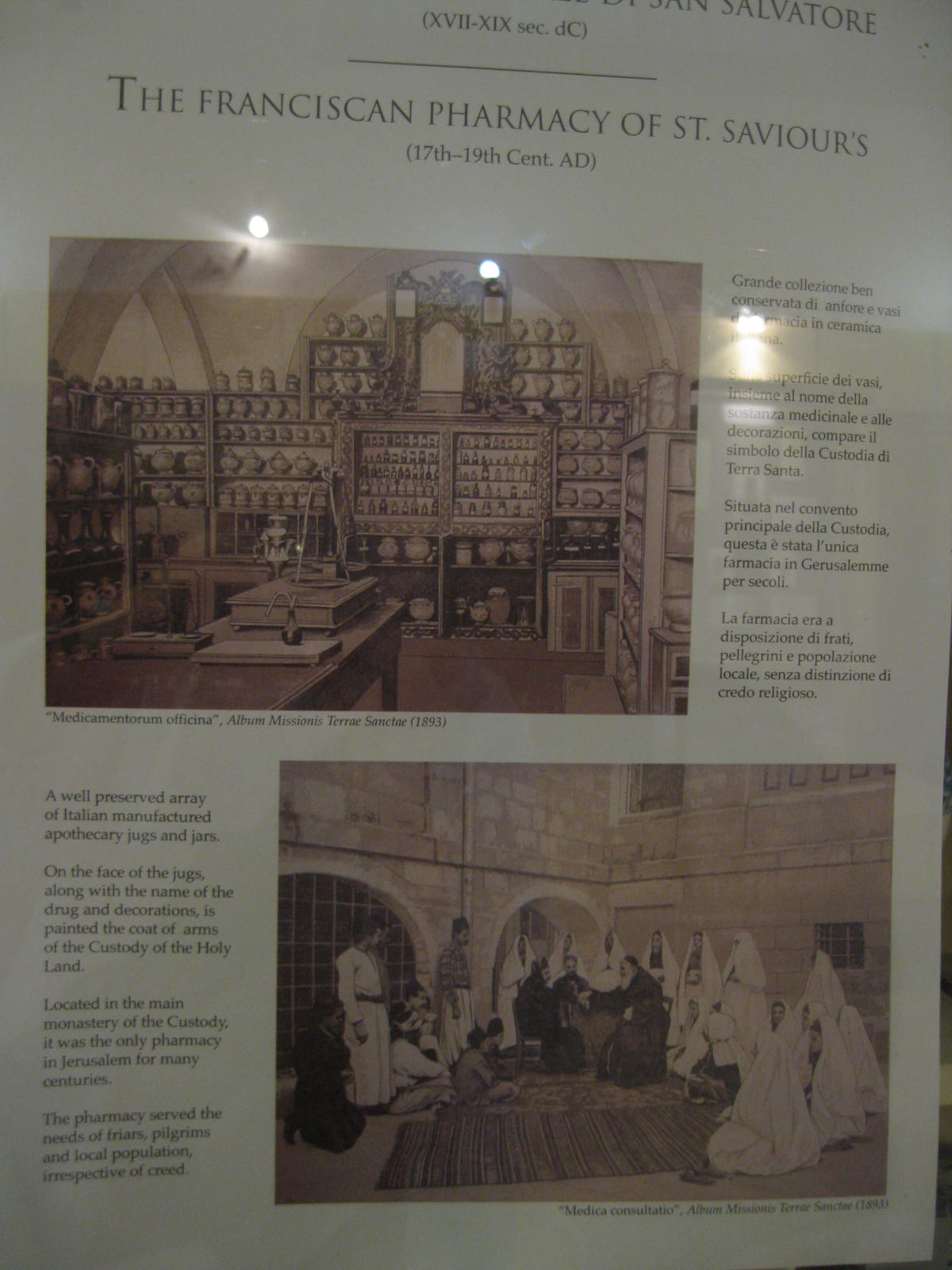

The photos from 1893 are so nice.

Today's Franciscans describe their former pharmacy in the sign:
. . .
Located in the main monastery of the Custody, it was the only pharmacy in Jerusalem for many centuries.
The pharmacy served the needs of friars, pilgrims and local population, irrespective of creed.
 -------------------
If you'd like to delve into the fascinating details, there is an article for you at Jerusalem Balsam website called
Franciscans Medical, An Early Glimpse at Western Medicine in Jerusalem 1700-1840:
The Case of the Jews and the Franciscans Medical Activity, by Zohar Amar and Efraim Lev.
-------------------
See also my posts about the  Materia Medica in the History of Jerusalem  exhibit that is or was at Shaare Zedek Hospital:
 http://jerusalemhillsdailyphoto.blogspot.co.il/2011/07/for-good-for-blessing-for-healing-and.html
and
http://jerusalemhillsdailyphoto.blogspot.co.il/2011/07/concocting-cure.html
.

Wednesday, April 17, 2013

Jerusalem's Christian treasures take a trip back home to Europe (until July 14)

.
UPDATE 2, April 19:   A short video by the Franciscan Media Center  about the Treasure of the Holy Sepulchre exhibit became available just now:
http://www.terrasanctablog.org/2013/04/19/holy-sepulcher-exhibit-opens-at-versailles/
You can choose your language. 


Recently I ventured into this nice Franciscan museum  in the Old City for the first time.


This old (17th century?)  scale model*  of the Church of the Holy Sepulchre, crafted from olive wood, ebony, and ivory, is one of the many unusual things on display.

It's a good thing I saw this while it was still in Jerusalem, because recently it and 250 other "unknown" Christian masterpieces were carefully crated up and shipped to Europe and as of yesterday are  being shown at the Chateau de Versailles!
Yes, in Paris!

You can click to read more about it,  see a slideshow, and  view a video at the website of the Palace:  http://en.chateauversailles.fr/news-/events/expositions/tresor-du-saint-sepulcre-en

And the Custody of the Holy Land explains it thus: 

The Treasure of the Holy Sepulchre in Paris


Paris, 16th April 2013

An important exhibition of Christian treasures from Jerusalem opens today in Versailles, in the presence of the Custos of the Holy Land, Fra Pierbattista Pizzaballa, the Guardian of Bethlehem, Fra Stéphane Milovitch and the Franciscan friars of the Commissary of Paris.

The Halls of the Crusades in the Palace of Versailles, just outside Paris, house an exhibition called Treasure of the Holy Sepulchre. Gifts from European Royal Courts to Jerusalem from 16th April to 14th July.
This is a particular event: for the first time 250 “unknown” masterpieces that were sent to Jerusalem over the centuries are on display in one place. They are offered to the public for three months by the Friars Minor of the Custody of the Holy Land, who still use many of these precious implements at the most solemn celebrations in the basilica which encloses the Calvary and the empty tomb of our Risen Lord.

The pieces are sumptuous chalices, crucifixes, lamps, candelabra, ciboria and liturgical vestments given by European sovereigns as a mark of devotion to the Saviour, but also to assert the power of their lineage and nation.

The works will be displayed according to their origin – in particular from the Holy Roman Empire, the kingdoms of Spain, France and Portugal, the Republic of Genoa – showing how the European court rivalled in generosity.

Open every day, except Monday, from 9 a.m. to 6.30 p.m., the exhibition is organized in collaboration with the General Council of the Hauts-de-Seine Department and also has a second venue: the House of Chateaubriand, in Châtenay-Malabry. Here the public will be able to admire nine pictures, also belonging to the Custody. The lengthy work of preparation for the Paris exhibition began three years ago and in the end will also be of benefit for the nascent Terra Sancta Museum, which the Custody intends opening in Jerusalem in 2015.
* UPDATE: Meanwhile I find this good information at http://www.christusrex.org/www1/ofm/sbf/SBFmsm.html:

 A striking example of more recent Palestinian art occupies the central spot of the northern hall. It is a small model of the Church of the Holy Sepulchre with inlaid work, in olive wood and mother of pearl, from the 17th-18th century.
The model represents the Basilica of the Resurrection after the Crusader restoration of the 12th Century, separated from the surrounding buildings. During the 17th century a number of similar devotional objects were produced by craftsmen in Bethlehem and sold to western pilgrims as souvernirs of their pilgrimage. 
The craftsmen based their work on the detailed plans of the sacred edifice drawn and published by the Franciscan Architect Fr. Bernardin Amico, who served the monasteries of Bethlehem and Jerusalem from 1593 to 1597.
Various sections of the roofing can be lifted, so that the inside can be seen.
 The model which is one of best preserved, is an excellent example of the type of work initiated by the Franciscans in Bethlehem, in the handicraft of applying mother of pearl inlay to olive wood.

Friday, November 23, 2012

A capital idea. (And a bloody Ashura)

.

 An ancient capital reflected in the glass ramp that leads to


the Church of the Flagellation,  which was originally built by the Crusaders in the 12th century.
The Convent (monastery) of the Flagellation now belongs to the Franciscans.

The external wall of the sanctuary is the 2nd Station of the Way of the Cross, marking the imposition of the cross.
.
(A post for Weekend Reflections.)
.
UPDATE
I see that many readers are freaked out by the name Church of the Flagellation (or Scourging).
It refers, of course, to the whipping Jesus got from the Romans in that place. 

But by some strange coincidence, I now notice that today is Ashura, a major Shi'ite holiday marked by bloody self-flagellation. 

I just saw a YouTube video from Lebanon but will spare you by not giving the link.
The Shi'ite men walk through the street in procession, rhythmically whipping their bare back with chains, or hitting their head and chest, or cutting their scalp with razor blades or swords.
The street is literally running with blood.
The most shocking is to see a few fathers cutting on the head of their young sons! 

I would hope our neighbors in the surrounding countries  could find better ways to publicly express grief and mourning for Hussein, grandson of the Prophet Muhammad, killed in the battle of Karbala in 680. 
.