Showing posts with label cemetery. Show all posts

Wednesday, April 25, 2018

ANZAC DAY today

.

Today is ANZAC Day, which Wikipedia explains as
 a national day of remembrance in Australia and New Zealand that broadly commemorates all Australians and New Zealanders "who served and died in all wars, conflicts, and peacekeeping operations" and "the contribution and suffering of all those who have served".
But the ANZAC troops are also remembered in other countries, and especially at the Commonwealth War Cemeteries in Israel and nearby Gaza.


Here in the Negev we have the beautiful Beersheba War Cemetery.
Some of the graves are of Australia and New Zealand Army Corps (ANZAC) soldiers.  
The administering Commonwealth War Graves Commission says that 
The cemetery was made immediately on the fall of the town [Oct. 1917], remaining in use until July 1918, by which time 139 burials had been made. It was greatly increased after the Armistice when burials were brought in from a number of scattered sites and small burial grounds. The cemetery now contains 1,241 Commonwealth burials of the First World War, 67 of them unidentified.

 A Jewish officer's tombstone says
FAR FROM HOME, CLOSE IN THE HEARTS OF THOSE WHO LOVED HIM. 
The pebbles on top are left as a traditional sign of respect by visitors to his grave.


Written in Welsh.
And a little LEST WE FORGET cross.


The traditional red poppy on the cross and one stuck in the ground.
HIS DUTY DONE.


A trooper from New Zealand.
Someone added the Kiwi's photo.


An Australian from the famous Light Horse brigade.


A New Zealander from the Mounted Rifles.


The unidentified ones are the saddest.
AN AUSTRALIAN SOLDIER OF THE GREAT WAR
KNOWN UNTO GOD


"In memory of a Ballarat boy.  Trooper Thomas Bell was aged just 16 when he died of wounds received in the charge*.
All gave some, some gave all."

[* i.e. the mounted charge on the Turkish trenches, to liberate Beer Sheva.]


The tall white structure is the Cross of Sacrifice, standard for all Commonwealth War Cemeteries around the world.

The Visitors Book, with lots of information, in the wall near the always-open entrance gate.


In the background is Beer Sheva's new and wonderful ANZAC Memorial Centre.
More on that in a future blog post.


One of the dedicated and caring Arab gardening team planting more flowers. 
.
Thank you, brave ANZAC soldiers, for turning the tide of World War I down here in the Negev desert that I now call home.   Your memory will live on! 
.
They shall grow not old, as we that are left grow old:
Age shall not weary them, nor the years condemn.
At the going down of the sun and in the morning,
We will remember them.
-- fourth stanza from Laurence Binyon's poem For the Fallen, 1914
(See more about this cemetery and about commemorations in Beer Sheva in 3 previous posts.  See also my posts about ANZAC Day in Jerusalem.)
More about this and other Australia places in Beer Sheva:  http://www.kkl-jnf.org/tourism-and-recreation/israeli-heritage-sites/anzac-trail/sites/anzac-sites-beersheba/
How the Australian army talks about ANZAC Day:  https://www.army.gov.au/our-history/traditions/anzac-day
.
(Linking to inSPIREd SundayOur World Tuesday and to  ABC Wednesday -- p is for poppy.)
.

Monday, February 27, 2017

Kalaniot, Shoshana Damari, in Trumpeldor Cemetery

.
During about half of every year Israel can get some rain.
In that winter season the wildflowers go wild!
Right now the red anemones are blooming, especially here in the Negev.

Every Israeli knows the old 1945 song about anemones, "Kalaniot" in Hebrew.
It has even been called Israel's unofficial national anthem.
You can enjoy poet Nathan Alterman's lyrics translated here.
The concluding verse says this:

Yes, generations come and pass without end
but each generation has an anemone in a tune.
Happy is the man if between storms and thunder
an anemone bloomed for him, if only just once.


Shoshana Damari, the singer with the Yemenite accent who made the song famous, even has an anemone-themed gravestone.
The standing stone has her name and the message "Anemones will always blossom."


Many admirers left the traditional stones of respect on her grave, wet because it had rained that day a month ago when I visited.
Wiki says that "Kalaniot" was sung to Shoshana Damari by family and friends when she was on her deathbed in February 2006.
Listen to her, our "queen of Israeli song," (often likened to Edith Piaf), singing Kalaniot here.


From her grave this is the view of Trumpeldor Cemetery.


The first burials began in 1903.
Tel Aviv has since grown up and now surrounds the famous old cemetery.


There is no more room here; you would have to be a VERY important VIP to be honored with a plot.
For more about this fascinating old Jewish cemetery please see my earlier posts.
.
(Linking to inSPIREd Sunday and Our World Tuesday.)
.

Monday, November 2, 2015

All Souls Day in a rural Austrian cemetery

.

 The graves had special candles and many fresh flowers today.


It is All Souls Day today and yesterday was All Saints Day.


These are special days here in Austria. 

This was just a small cemetery in rural Burgenland, but the graves were quite ornate.


I wish I could see it at night when the candles are lit.

(Linking to Our World Tuesday.)
.

Sunday, June 28, 2015

Trumpeldor Cemetery by night

.

My kind relative who hosted me for the weekend, her apartment overlooks Tel Aviv's historic Trumpeldor Cemetery.
It makes for a pretty quiet neighborhood, except for the frequent jets that come in over the Mediterranean (a block away) and fly over exactly overhead, some with landing gear already down, en route to Ben Gurion Airport.


Only a few plots remain and will go to top VIPs.
Since its founding in 1902, some 5,000 people have been buried there.
Tel Aviv was founded only later, in 1909.

You can see daytime shots of the cemetery and read more about it in my earlier posts:
"So many life stories in a small place" 
and
"Find a grave via SMS"
.
(Linking to inSPIREd Sunday, where bloggers share their photos of houses of worship and sometimes cemeteries.)
.

Monday, March 16, 2015

The descent from Jerusalem

.

The view from my bus window as we left Jerusalem--highways above and highways below. 

 The cemetery for Jerusalemites covers the whole mountain.


The lane with red paint in the middle is reserved for buses.
But on that late afternoon no one seemed to be ascending to Jerusalem.
The long line of cars on our side was heading west in the direction of Tel Aviv.
.
Linking to OurWorld Tuesday.
.

Tuesday, February 17, 2015

A Jewish funeral, Israel style

.
Have you ever been to a Jewish funeral?
I can walk you through the normal Israeli way of burial if you'd like.
Last Tuesday we were at this big cemetery in central Israel. 


Relatives and friends of the deceased arrive on their own and then gather in  this building.
There is a little time to greet the mourners and converse.
The body should be buried as soon as possible after death, preferably with 24 hours.


 Then the shocking part comes, when they bring the body, wrapped in a white shroud, on a stretcher and put it on this bier.  That's where I start crying.
Folks gather round while someone gives a eulogy.  
The collar of the close family is cut by the Chevra Kaddisha (burial society) official.
The immediate relatives (male)  recite the Kaddish prayer. 

On the wall is written verse 7 of Ecclesiastes (Kohelet) 12:
"And the dust returns to the earth as it was, and the spirit returns to God who gave it."


Four mourners carry the stretcher out onto this wagon . . .

 
and the long walk to the far side of the sprawling cemetery begins.
The Orthodox Chevra Kaddisha man chants prayers and Psalms along the way.


The body is lowered into a deep grave, covered with a few concrete slabs, and then covered with the good earth of Israel.
Male people are welcome to shovel a bit of dirt.
But the main work is then quickly done by a young religious man with a turia (a big hoe).
The closest relatives say Kaddish again.   El Malei Rachamim (God, full of mercy) is sung by the cantor.
A few people bring flowers but the more Jewish custom is for each to put a little stone on the grave. 
And that's it, the end of a life. 


My kids and I lingered around the fresh grave until a Bobcat drove up behind us and already started digging new holes.


Then the tractor drove in loaded with the concrete slabs.
Wow, they couldn't wait.
People are dying to get in to this cemetery.
Other cemeteries have run out of ground and are now burying people in multi-story fashion.


Thirty days after the burial the family returns for the ceremony to set the tombstone.
I must admit, the Jewish way of burial and mourning is very respectful and the ritual is supportive.

People say in Hebrew,  "May you be comforted among the mourners of Zion and Jerusalem and may you know only good news."
.
You are welcome to see the two previous posts on this subject.
.
Linking to ABC Wednesday.)

Monday, February 16, 2015

All together for Abba

.

Yes, I have been away for the last week.
It was a sad week but also a glad one.
My kids flew in from Australia and California and all the family reunited in Tel Aviv, that was the glad part.
They came for a funeral: on February 10 at noon their father was buried.
Moshe has been my ex-husband for a long time, but he was my husband for 22 years.
He died a good death after only one day and one night in the hospital, with his two oldest daughters at his side. 
Now the week of mourning has ended and the kids are already on their flights to the far corners of the world.
I am back home in the desert with lots of new memories and photographs.
.

Saturday, February 14, 2015

Keeper of the gate

.

Feline gatekeeper at Segula Cemetery,  February 10, 2015.

The gate rolls open promptly at 6:00 a.m.

The Bible verse quoted on white is Ecclesiastes/Koheleth 12:5,
"Then man goes to his eternal home." 

1 Remember then thy Creator in the days of thy youth, before the evil days come, and the years draw nigh, when thou shalt say: 'I have no pleasure in them';
 2 Before the sun, and the light, and the moon, and the stars, are darkened, and the clouds return after the rain;
 3 In the day when the keepers of the house shall tremble, and the strong men shall bow themselves, and the grinders cease because they are few, and those that look out shall be darkened in the windows,
 4 And the doors shall be shut in the street, when the sound of the grinding is low; and one shall start up at the voice of a bird, and all the daughters of music shall be brought low;
 5 Also when they shall be afraid of that which is high, and terrors shall be in the way; and the almond-tree shall blossom, and the grasshopper shall drag itself along, and the caperberry shall fail; because man goeth to his long home, and the mourners go about the streets;
 6 Before the silver cord is snapped asunder, and the golden bowl is shattered, and the pitcher is broken at the fountain, and the wheel falleth shattered, into the pit;
 7 And the dust returneth to the earth as it was, and the spirit returneth unto God who gave it.
. . . 

(Linking to Camera Critters.)
.

Sunday, January 4, 2015

A cared-for cat living in a cemetery

.

Half-hidden discreetly between the tombs:  a dish of milk, a dish of kibbles, and a cat-carrier with bedding inside.


I only recently discovered this fascinating cemetery in Beer Sheva.
It had no name, no signs. 
I'm not sure if it is only for non-Jews or if it is an "alternative" cemetery for anyone seeking burial outside the rules of the rabbis.
It is right next to the British War Cemetery.
.
(Because of the strange kitty corner found there, I will link to Camera Critters meme.)
-------------------------
P.S.  For the readers who enjoyed the fancy mailbox in my previous post, I should add that it hangs at the entrance to the old and beautiful building which houses what I think is called the Russian Ecclesiastical Mission in Jerusalem, near Safra Square.
.

Sunday, August 3, 2014

First World War -- 100 years ago, in Gaza

.
Today marks 100 years since the outbreak of World War I.

Many do not realize that thousands, many thousands, of young Commonwealth soldiers who were killed in that war are buried in Israel.
The Commonwealth War Graves Commission maintains four cemeteries in our region.

One is in Ramleh, not far from Ben Gurion Airport.
Recently I posted about the British Cemetery in Beer Sheva  here and also about the yearly  Australian Light Horse commemoration.
Please see ANZAC Day for my posts about the World War I cemetery in Jerusalem.


But the fourth cemetery is one I will never be able to visit.
It is in Deir al-Balah in central Gaza.
So here are two photos from the Commonwealth War Graves Commission website, on the Find A Cemetery page.


Gaza War Cemetery contains 3,217 Commonwealth burials of the First World War, 781 of them unidentified. 
Second World War burials number 210. There are also 30 post war burials and 234 war graves of other nationalities.

The CWGC gives this:

Historical Information

Gaza was bombarded by French warships in April 1915. 
At the end of March 1917, it was attacked and surrounded by the Egyptian Expeditionary Force in the First Battle of Gaza, but the attack was broken off when Turkish reinforcements appeared. 
The Second Battle of Gaza, 17-19 April, left the Turks in possession and the Third Battle of Gaza, begun on 27 October, ended with the capture of the ruined and deserted city on 7 November 1917. 
Casualty Clearing Stations arrived later that month and General and Stationary hospitals in 1918.

Some of the earliest burials were made by the troops that captured the city. About two-thirds of the total were brought into the cemetery from the battlefields after the Armistice. The remainder were made by medical units after the Third Battle of Gaza, or, in some cases, represent reburials from the battlefields by the troops who captured the city. Of the British Soldiers, the great majority belong to the 52nd (Lowland), the 53rd (Welsh), the 54th (East Anglian) and the 74th (Yeomanry) Divisions.

During the Second World War, Gaza was an Australian hospital base, and the AIF Headquarters were posted there. Among the military hospitals in Gaza were 2/1st Australian General Hospital, 2/6th Australian General Hospital, 8th Australian Special Hospital, and from July 1943 until May 1945, 91 British General Hospital. There was a Royal Air Force aerodrome at Gaza, which was considerably developed from 1941 onwards.
.
(Linking to Our World Tuesday.)
.

Monday, November 11, 2013

.
A SOLDIER
OF THE GREAT WAR
KNOWN TO GOD
.

The Beersheba War Cemetery contains 1,241 Commonwealth burials of the First World War, 67 of them unidentified.

 More about the cemetery from the Commonwealth War Graves Commission:
Country: Israel and Palestine (including Gaza)
Identified Casualties: 1173

By October 1917, General Allenby's force had been entrenched in front of a strong Turkish position along the Gaza-Beersheba road for some months, but they were now ready to launch an attack with Beersheba as its first objective. On 31 October, the attack was carried out by the XXth Corps . . . on the west, and the Desert Mounted Corps on the east. That evening the 4th Australian Light Horse Brigade charged over the Turkish trenches into the town.

The cemetery was made immediately on the fall of the town, remaining in use until July 1918, by which time 139 burials had been made.
It was greatly increased after the Armistice when burials were brought in from a number of scattered sites and small burial grounds.

The cemetery in 1917 or 1918.
.
(Glass stereotype dry plate  photo by the American Colony Photo Department.
Library of Congress )
.
.
(Linking to Our World Tuesday.)

Friday, November 1, 2013

Australian Light Horse annual commemoration in Beer Sheva

.
Yesterday I found my way through the streets of Beer Sheva  to the Park of the Australian Soldier.
My first time to see the annual commemoration and to see the new park, and both were very impressive.


The e-mail read "The Pratt Foundation and the Municipality of Be’er Sheva invite you to the commemoration of the 96th anniversary of the Battle of Be’er Sheva, marking the fall of the Ottoman controlled city of Be’er Sheva to ANZAC (Australian and New Zealand Army Corps) and British troops on 31 October 1917."


After morning tea the many guests took their seats and the ceremony opened with a long blast of a long and curling shofar.
The nice new Ambassador to Israel, H.E. Dave Sharma, gave a good speech about the great importance of the Battle of Beersheva.
BTW, he is Australia's youngest ambassador anywhere in the world.


Military representatives  of Australia, New Zealand, Israel, and the United Nations were there.
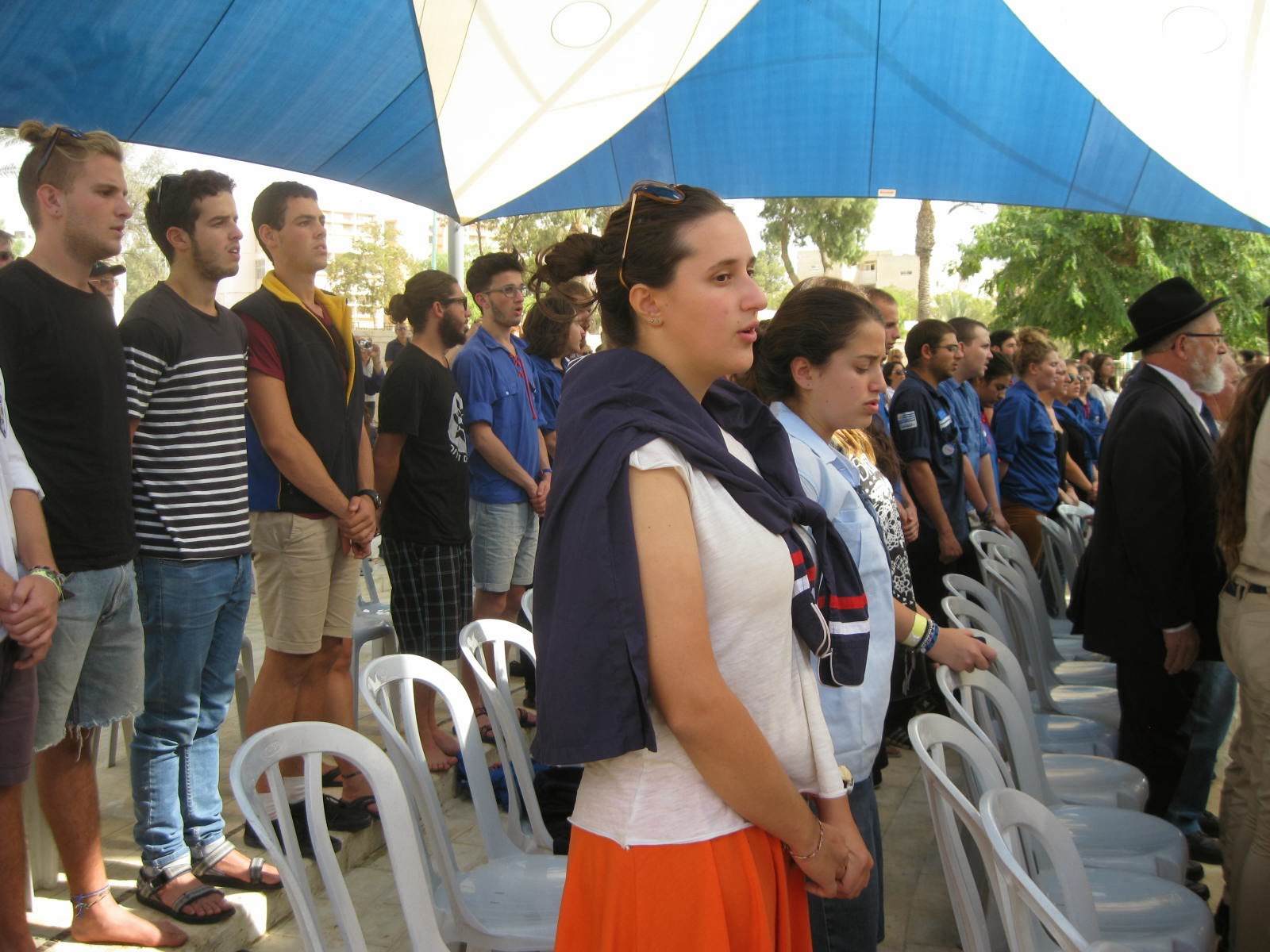
Many Zionist youth movements attended, as did classes of high school students.


Dr. Apple, Rabbi Emeritus of Sydney's Great Synagogue, was expected to give a memorial prayer but he spoke instead about the recent attack on five Jews at Bondi beach.


The Australian youth groups joined in singing Advance Australia Fair and Hatikva.


Please enlarge the sign to read the story of the famous battle, history's last great cavalry charge. 


The U.N. men from UNTSO and MFO  were happy to pose for anyone with a camera.
Israelis are not used to seeing fancy dress uniforms and medals.


Everyone then went across town to the Beersheba War Cemetery.
The Commonwealth War Graves Commission says their cemetery contains 1,241 Commonwealth burials of the First World War, 67 of them unidentified.

In the Light Horse charge on Beersheva, 31 Australians were killed.
At least 70 horses were also killed in the audacious battle. 


 Again there was the laying of wreaths.


I asked for a poppy and the digger asked  to put it by a soldier's grave.


I found a Jewish grave.
There are many more at the Jerusalem War Cemetery on Mt. Scopus.


 The morning's ceremonies concluded a block away, at Atatürk Plaza, at the obelisk.
Carved in its stone:

1914-1918
THIS MONUMENT IS DEDICATED TO 298 HONOURABLE TURKISH ARMY SOLDIERS FALLEN AT THE BE'ER SHEVA FRONT FOR THE SAKE OF THEIR COUNTRY


The distinguished representative of Turkey spoke (in English) about the martyrs who died defending the then-Ottoman town of Beer Sheva.
He was proud to see the old Turkish train station behind him, part of the famous Hijaz Railway,  being carefully restored as he spoke.

We stood for the Turkish and the Israeli national anthems. 


Wreaths were placed at the foot of the tall obelisk, which was built in 2002.


With the strained Israel-Turkey  relations in the last few years, it was very special to see the two flags flying side by side.


Let's hope Atatürk's motto, "Peace at home, peace in the world," will someday be true for all countries in the Middle East. 
.
For more see Australian blogger-teacher Hels' post http://melbourneblogger.blogspot.com.au/2013/10/australian-and-new-zealand-light.html