
.jpg)
A monastery garden, tended by the Sisters of Sion, Ein Kerem.
Clouds over the Jerusalem Hills for Sky Watch Friday.
.
.jpg)
 Something new in the quiet gardens of the Sisters of Zion in Ein Kerem!
 We're almost done with our walk in the Sisters of Sion convent in Ein Kerem, but you still have to see the cemetery.
 The deceased and their visitors have a great view over the convent wall to several other churches and monasteries in the Jerusalem Hills.
 The convent was built in 1860 and many of the Religious of Our Lady of Sion (and some of their friends) are buried here.
 Marie-Alphonse Ratisbonne died in 1884 and is buried in this place that he built and where he lived for several decades.
 His older brother had converted much earlier; Fr. Marie-Theodor Ratisbonne founded the monastic order and gave them a biblical verse as their foundational text.
Wikipedia says this about Theodor:
"In the 1820s, Ratisbonne joined a wave of apostasy in the French Jewish community triggered by a sense that the Jews could not achieve full integration in French society as long as they remained Jews. Ratisbonne reached the conclusion that there was a fundamental incompatibility between Judaism and French citizenship."
The rocks placed on Alphonse's grave in the traditional Jewish custom of showing respect always make me sad, thinking about these two ex-Jewish brothers.
 I love the old roof tiles like these in the garden of the Notre Dame de Sion convent.
 Like this precious little outbuilding!
 It sits next to one of the huge rain reservoirs that the Sisters of Sion have on the big walled property.
 Do you reckon the Rob Roy mixer from yesterday's post contributed some cement to these wall pillars a long time ago?
 Just inside the big perimeter walls.
 I came across this old machine near the little orchard inside the Sisters of Sion convent in Ein Kerem.
 It was exciting to read the boilerplate!
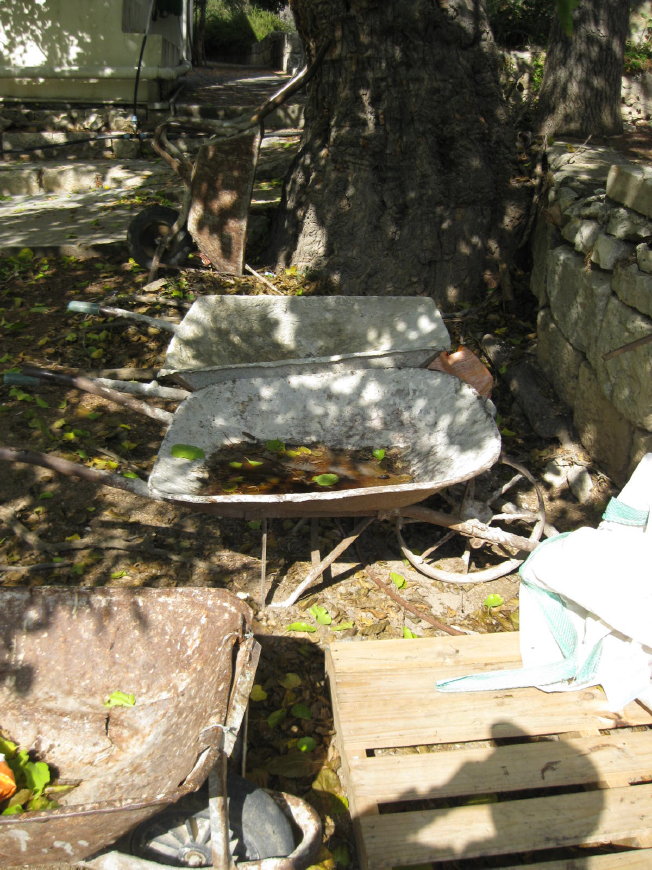 The wheelbarrow with a metal wheel looks to be something of well-used antique also.
 As you know from yesterday's post, I recently walked through the hill country over to the village of Ein Kerem.
 As the main entrance door says, Our Lady of Sion was built in 1861.
 This nice entrance is to one of the guesthouses.
 Not sure what this door leads to . . . .
 Near the cemetery, the nice old stones showing through.
 A storage place with a heart carved in the shutters.
 In the food garden, one of the few gateways through the thick outer wall.
 For James' "Weekend Reflections"--part of the garden of the Sisters of Zion reflected in some waiting window panes.
 More scenes of the 1860s church we first saw in yesterday's post.
 Unusual modern stations of the cross, simple and artistic.
 Reminders of Jewish roots.
 Some pews have nice fold-down kneelers.
 And just outside in the garden, a bench circle.
 Today we visited the convent of the Sisters of Zion in Ein Kerem.
 And looking straight down through the lectern, you can see the vaulted ceiling of the church.
 One of the regular high windows came through most clearly and bright.
 Don't you like the clean lines of the church, built back in the 1860s?
