Showing posts with label Yad HaShmona. Show all posts

Sunday, May 12, 2013

A message from the grave

.


  PSALM 103


1 Bless the Lord, O my soul,
and all that is within me,

bless his holy name.
2 Bless the Lord, O my soul,
and do not forget all his benefits—
3 who forgives all your iniquity,
who heals all your diseases,
4 who redeems your life from the Pit,
who crowns you with steadfast love and mercy,
5 who satisfies you with good as long as you live
so that your youth is renewed like the eagle’s.
6 The Lord works vindication
and justice for all who are oppressed.
7 He made known his ways to Moses,
his acts to the people of Israel.
8 The Lord is merciful and gracious,
slow to anger and abounding in steadfast love.
9 He will not always accuse,
nor will he keep his anger forever.
10 He does not deal with us according to our sins,
nor repay us according to our iniquities.
11 For as the heavens are high above the earth,
so great is his steadfast love toward those who fear him;
12 as far as the east is from the west,
so far he removes our transgressions from us.
13 As a father has compassion for his children,
so the Lord has compassion for those who fear him.
14 For he knows how we were made;
he remembers that we are dust.
15 As for mortals, their days are like grass;
they flourish like a flower of the field;
16 for the wind passes over it, and it is gone,
and its place knows it no more.
17 But the steadfast love of the Lord is from everlasting to everlasting
on those who fear him,
and his righteousness to children’s children,
18 to those who keep his covenant
and remember to do his commandments.


19 The Lord has established his throne in the heavens,
and his kingdom rules over all.
20 Bless the Lord, O you his angels,

you mighty ones who do his bidding,

obedient to his spoken word.

21 Bless the Lord, all his hosts,

his ministers that do his will.
22 Bless the Lord, all his works,
in all places of his dominion.
Bless the Lord, O my soul. 
.
.
Translation: NRSV 
Photos:
1. On the grave of an old couple from Finland, at the Finnish moshav, Yad Hashmona, in the Jerusalem Hills.
On the right side of the book is Psalm 103:1 in Finnish and Hebrew.
On the left is Matthew 6:33.

2. "Relief depicting an angel holding a book, Church at Belvoir (Kochav Hayarden), late 12th C, limestone. . . . The angel is probably St. Matthew." Israel Museum, Jerusalem.
Haaretz just published a free article, with photos and video,  about Belvoir, the Crusader fortress.
.

Tuesday, June 14, 2011

Vats and vineyards

.
Let's visit vats and vineyards for ABC Wednesday.

Click on the transparent sign to read names of the various vats.

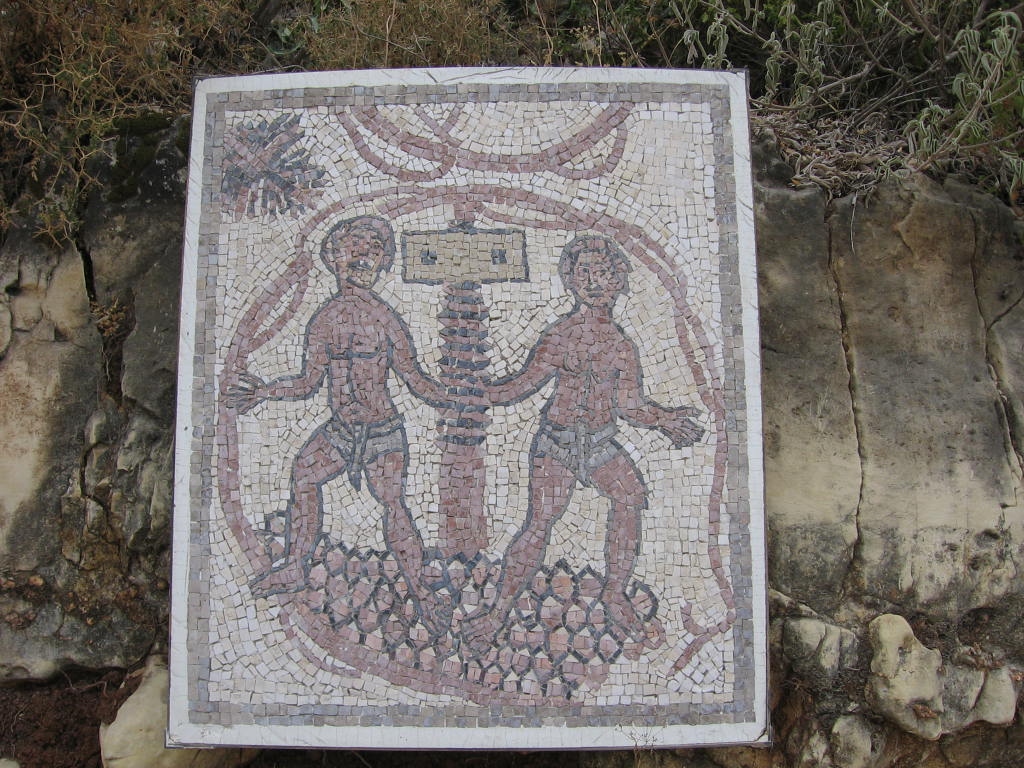
This is a reconstruction of what a winepress would have looked like in Byzantine times, about 1,500 years ago.
It is part of the Biblical Garden at Yad Hashmona.

As this mosaic picture shows, the treading floor was a large area, normally covered by mosaics, where the grapes were laid and crushed by the feet of the workers, extracting the juice.

A small hole in the center of the treading floor was for a secondary crushing of the grapes.

Juice flowed from the small filtering vat into the collection vats.

Workers went down the steps to collect the juice into vessels or to clean the vat.

Fermentation took place in the jars and a cool storage area, such as a cave, was used to store the wine.

During the Roman and Byzantine periods there were hundreds of winepresses in the fields, villages and cities of the Holy Land.

BibleWalks.com explains
. . . each Roman soldier consumed a liter per day, or 6,000 liters per day for one Legion stationed in the Galilee. The wine has medical advantages - killing bacteria and making the drinking water safer. The wine was often diluted with equal portion of water, and used as their drinking water, keeping the soldiers healthy (and happy). This may have been one of the Roman soldiers advantages in the battlefield. To supply this demand the wine was produced in a short period of a month or so, producing a low alcohol (4%) sour wine.

Thursday, May 26, 2011

Clouds and soon rain, in MAY??

.
For SkyWatch Friday, a cloudy sky over the hills, as seen from Moshav Yad Hashmona.

Israel expects a little rain this weekend. Very strange, this being late May, which is normally well into the dry season.

(We saw other parts of this village and their Biblical Garden in four previous posts. )
.

Sunday, April 10, 2011

Ethical living in 11 "easy" steps

.
Psalm 15, with some illustrations, for Robert's PsalmChallenge.
.
The Talmud, in Makot 23b-24a, explains that
"Rabbi Simlai said, '613 commandments were given to Moses. David came and reduced them to 11 (in Psalm 15).' "
.
This short psalm is the religious ideal of how a person should live.
.
A Psalm. Of David.

1 LORD, who may sojourn in Your tent, who may dwell on Your holy mountain?

.

2 He who walks blamelessly, who does what is right, and speaks truth in his heart;
3 who slanders not with his tongue, who has not done evil to his fellow, who has cast no slur on his neighbor.

.
4 In his eyes, a debased man is abhorrent, but those who fear the LORD he honors; if he vows to his detriment, he does not recant;
.

5 His money he does not lend at interest, and bribes against the innocent he does not accept.
He who does these things will not stumble.

.
.
Photos: The tent at Yad Hashmona Biblical Village in the Jerusalem Hills.
.

Monday, February 28, 2011

Happy Kalevala Day

.
To our Finnish friends let me say, happy Kalevalan päivä, suomalaisen kulttuurin päivä.
February 28 is the day of the Finnish national epic and Finnish culture.

I just happen to own a copy of that national epic, the Kalevala. (Even though I don't know the language.)
The folk material was compiled by Dr. Elias Lönnrot and was written down, for the first time, in 1830.
The book was published for the first time on this day in 1835.
.
Prior to that, it was all sung and kept active in the oral tradition.
Typically, two singers would link arms, face to face across a table, and sing to each other, challenging to see who knew more verses.

As explained in an earlier post, the Jerusalem Hills has a nice moshav (village) called Yad Hashmona that was founded by Finnish Christians.
The name means a memorial for the eight, in remembrance of the eight Finnish Jews who were surrendered to the Nazis.
It is very moving to read how the Yad Hashmona website explains that.
.
They have built a wonderful Biblical Garden that Israelis and tourists can visit.
The sign you see is glass, with the sky and clouds NOT reflected but showing through.
.
The view over the Jerusalem Hills (or Hills of Judea) goes on forever.
.
BTW, both C.S. Lewis and J.R.R. Tolkien drew from the Kalevala in their own works.
.
And this was our tour for That's My World. Shalom!
.

Saturday, April 3, 2010

Try to imagine

The view from inside a tomb, before the stone rolls and seals it.
.

Thursday, July 16, 2009

Did I smell RAIN??

.
Sweet-smelling hard wet rain fell for two minutes yesterday morning!!
 Enough to whet my appetite for more.
This was a treat because Israel normally has no rain from March or April until about October.
In Jerusalem summer is hot and dry (low humidity) and very long.

Here are some clouds over the Mountains of Judea (also called the Jerusalem Hills) as seen from a moshav a bit north of my moshav.
It is an interesting community called Yad HaShmona, founded by Finnish Christians.
.
The signs for their Biblical Garden are made of transparent glass. So what you see here is the actual blue of the sky and the clouds seen through the glass.
Great idea, eh?
.
I can show you more about the antiquities and installations of the Biblical Garden in the future. Right now I want to get this post in for SkyWatch Friday.
Meanwhile, if you just can't wait, read about Yad Hashmona at their website or at Wikipedia or see great aerial photos of their mountain at BiblePlaces.com.
UPDATE June 2014: Aviva Bar-Am writes about her nice visit to Yad Hashmona here
.
Jerusalem and the hills around her are full of surprises--a July rain, a Messianic moshav, and much much more.
.

Tuesday, September 23, 2008

Joel's J's

Today's ABC Wednesday meme in blogland features the letter J.

Jumpin' Jehoshaphat! How to choose just one or two J words when this whole blog is about J's?!
Jerusalem Hills, Jerusalem, Judea, Jewish State, Jews, Jacob, Jesus, John . . . just which photos to judge as fitting??
Jeepers! Hebrew does not even have a sound or a letter J. All these names you see here really begin with Y.

Between the Old City wall and the Mount of Olives lies the Valley of Jehoshaphat.
More commonly called the Kidron Valley, it has lots of olive trees

and LOTS of old graves.

In the short Biblical book of JOEL (3:1-2) God says "For behold, in those days and at that time, when I restore the fortunes of Judah and Jerusalem, I will gather all the nations and bring them down to the valley of Jehoshaphat, and I will enter into judgment with them there. . . ."
The prophet Joel is depicted in this statue at Yad HaShmona Biblical Garden:

He is quoting God in Joel 2:13: "Return to me with all your heart. . . and rend your hearts and not your garments."
This verse ends with the words very central to the liturgy of our High Holy Days, the Days of Awe culminating in the Day of Atonement: "Return to the Lord your God, for he is gracious and merciful, slow to anger, and abounding in steadfast love, and repents of evil."


.