Tuesday, November 5, 2013

From Qumran caves to your computer

.
Inspired by Reader Wil's ABC Wednesday post on Qumran today, I figure it is high time to share my Dead Sea scrolls  pictures from last February's Jerusalem International Book Fair.
The Israel Antiquities Authority mounted a nice exhibition on the DSS back then.
 
(You can click 2x to enlarge any photo below.)


 The equipment used in  conservation of the 2,000-year-old scrolls.


And the patient and skillful women who work on them.

As it says above
The arid climate of the Judean Desert [e.g. at Qumran] and the dark, remote caves preserved the scrolls for more than 2,000 years.
Upon removal from the caves in 1947, the scrolls were exposed to a steady process of deterioration.
They have suffered from exposure to light, residues of adhesive tape and other conservational interventions.
All took their toll on the fragile parchments and papyri.
In 1991 the Israel Antiquities Authority set up a climate-controlled storeroom and a state-of-the-art laboratory for the conservation and preservation of the scrolls, widely considered a universal cultural heritage.
Four conservators have been tasked with the mission of slowing the scrolls' steady deterioration and preserving them for posterity. 


Last December, as Bible History Daily reported,
 Israel Antiquities Authority, in collaboration with Google, launched The Leon Levy Dead Sea Scrolls Digital Library, a new website that allows visitors to view and search high-resolution images of the complete Dead Sea Scrolls archive online. The project uses the most advanced and innovative technologies available to image the entire collection of about 930 manuscripts, comprising thousands of Dead Sea Scrolls fragments, in high resolution and multiple spectra. Through this process, hundreds of images are now accessible to anyone, anywhere in the world over the web, with many thousands more on the way. Several hundred fragments are already viewable, and it is hoped that transcriptions and translations for many scrolls will soon be available as well.


You will enjoy the IAA's  new website, The Leon Levy Dead Sea Scrolls Digital Library.

See also the Israel Museum's website The Digital Dead Sea Scrolls.

How to Study a Dead Sea Scrolls Text is interesting, too.
.
.
(Linking to ABC Wednesday Q Day.)
.

Monday, November 4, 2013

Water Music


Two grandmas sit on the bench near one of Beer Sheva's many shpritzing fountains. 
To their right is the Samuel Rubin Music Conservatory.

Israel Arts Directory website informs us that it is a
Municipal Conservatory which teaches western music (keyboard, stringed instruments, wind instruments, music theory) to young people aged 6 to 18 years. The majority of its students are high-school students who attend the Conservatory several times each week to study music, working towards high-school matriculation. With its excellent auditorium the Conservatory is an important regional centre for musical activity. It is the home of the Israel Be’er Sheva Sinfonietta  and also hosts regular concert series, conferences, seminars, masterclasses and other activities.
 (For Our World Tuesday meme.)
.

Sunday, November 3, 2013

Alone in the cemetery

.

With many Christians marking All Saints' Day and then All Souls' Day this weekend, and with some countries celebrating the Day of the Dead at cemeteries,  I as a Jew felt a bit left out.
So I walked over to our  small Meitar cemetery, just to see  it for the first time.

There was a fresh burial, very moving, not expected.

I was the only living soul in the graveyard.
The sun set, the light faded, and a chill set in.
In the distance I heard  the automatic metal gate squeak  as it rolled shut across the entrance road.
. . .
But here I am,  blogging; so you know I found a way out and made it home.
.

Friday, November 1, 2013

Australian Light Horse annual commemoration in Beer Sheva

.
Yesterday I found my way through the streets of Beer Sheva  to the Park of the Australian Soldier.
My first time to see the annual commemoration and to see the new park, and both were very impressive.


The e-mail read "The Pratt Foundation and the Municipality of Be’er Sheva invite you to the commemoration of the 96th anniversary of the Battle of Be’er Sheva, marking the fall of the Ottoman controlled city of Be’er Sheva to ANZAC (Australian and New Zealand Army Corps) and British troops on 31 October 1917."


After morning tea the many guests took their seats and the ceremony opened with a long blast of a long and curling shofar.
The nice new Ambassador to Israel, H.E. Dave Sharma, gave a good speech about the great importance of the Battle of Beersheva.
BTW, he is Australia's youngest ambassador anywhere in the world.


Military representatives  of Australia, New Zealand, Israel, and the United Nations were there.
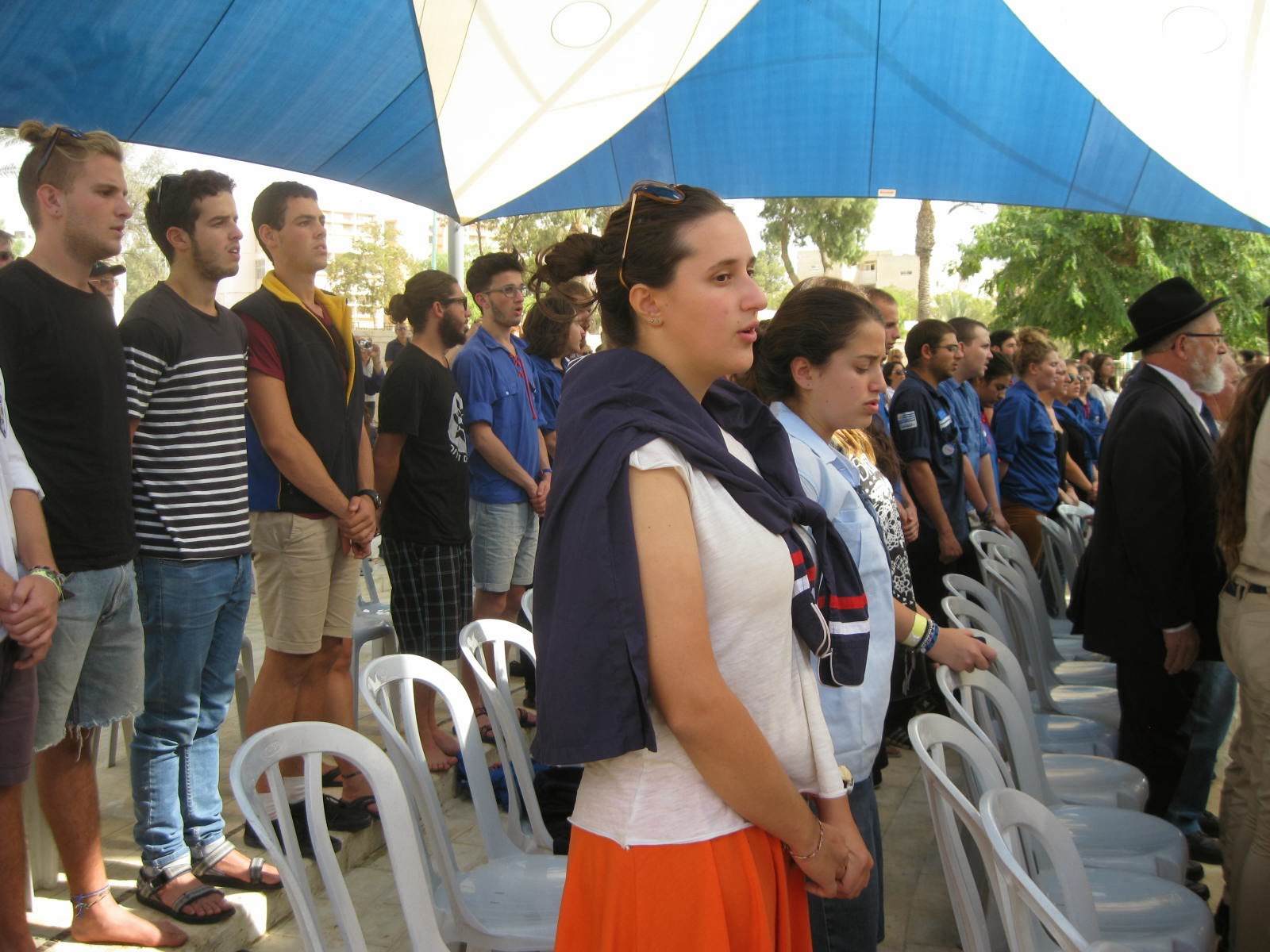
Many Zionist youth movements attended, as did classes of high school students.


Dr. Apple, Rabbi Emeritus of Sydney's Great Synagogue, was expected to give a memorial prayer but he spoke instead about the recent attack on five Jews at Bondi beach.


The Australian youth groups joined in singing Advance Australia Fair and Hatikva.


Please enlarge the sign to read the story of the famous battle, history's last great cavalry charge. 


The U.N. men from UNTSO and MFO  were happy to pose for anyone with a camera.
Israelis are not used to seeing fancy dress uniforms and medals.


Everyone then went across town to the Beersheba War Cemetery.
The Commonwealth War Graves Commission says their cemetery contains 1,241 Commonwealth burials of the First World War, 67 of them unidentified.

In the Light Horse charge on Beersheva, 31 Australians were killed.
At least 70 horses were also killed in the audacious battle. 


 Again there was the laying of wreaths.


I asked for a poppy and the digger asked  to put it by a soldier's grave.


I found a Jewish grave.
There are many more at the Jerusalem War Cemetery on Mt. Scopus.


 The morning's ceremonies concluded a block away, at Atatürk Plaza, at the obelisk.
Carved in its stone:

1914-1918
THIS MONUMENT IS DEDICATED TO 298 HONOURABLE TURKISH ARMY SOLDIERS FALLEN AT THE BE'ER SHEVA FRONT FOR THE SAKE OF THEIR COUNTRY


The distinguished representative of Turkey spoke (in English) about the martyrs who died defending the then-Ottoman town of Beer Sheva.
He was proud to see the old Turkish train station behind him, part of the famous Hijaz Railway,  being carefully restored as he spoke.

We stood for the Turkish and the Israeli national anthems. 


Wreaths were placed at the foot of the tall obelisk, which was built in 2002.


With the strained Israel-Turkey  relations in the last few years, it was very special to see the two flags flying side by side.


Let's hope Atatürk's motto, "Peace at home, peace in the world," will someday be true for all countries in the Middle East. 
.
For more see Australian blogger-teacher Hels' post http://melbourneblogger.blogspot.com.au/2013/10/australian-and-new-zealand-light.html
. 

Thursday, October 31, 2013

It takes balls to do this!

.
These are favorite photos from last winter  when I still lived in the Jerusalem Hills, the Hills of Judea. 
You will want to click a few times and enlarge them--you won't believe what you see!


The helicopter was hovering right next to the high tension wire high above the road in Soreq Valley!


And what's more--a man was sitting on a platform under the helicopter!


Can you see his legs dangling?
I watched the team work for hours, for several days in December and January.
I was amazed, impressed, scared, and always thinking "Glad I am not that man's mother."


Here you can see the man and the big orange balls that he was about to attach to the miles of  live high tension wires.

Today's City Daily Photo Theme Day is about heights,  so today is a fitting day to pay tribute to these brave men in the sky.

An Australian government website says that

Queensland-based Aeropower, which uses helicopters to provide airborne
electrical services to power companies, provides the Israel Electric Corporation with a range
of services including support for cable stringing (pulling out draw wires from structure to
structure), airborne line  maintenance services and live-line insulator washing on their overhead power lines.

Watch a video of these guys in action, if you have the guts.
. 

Wednesday, October 30, 2013

The sky, source of wonder

.

A Meitar sunset, last night, with birds.
At 4:55 pm,  so early. 


Why does the sun always look squishy the second before it disappears behind the hills?
.
This morning I heard real thunder and we had one minute of sprinkles!!
Our first since last spring! 

This evening  the grandkids  and I walked to the edge of town, to the edge of the desert, to spot the International Space Station going over!!
How exciting and moving!
You can sign up for alerts from NASA here. 
.
 On November 3 we in Israel will see a partial solar eclipse.  More info from the Starman of Mitzpe Ramon.
.
Linking to SkyWatch Friday.
.

Tuesday, October 29, 2013

Posters and politics

.

P is for posters and politics.
Last Tuesday  Israel had municipal elections.
Remember my post with the mirror on the billboard?  The message there was that "Kehila is actually YOU."
Well,  in my town  Avner Ben Gera, leading the Kehila list (~party),  will continue as head of Meitar Local Council for another five years.
The poster (shot through the bus window)  says that the good work will go on  because Meitar is in good hands.
The fence adds some strange stripes to Avner,  but obviously the majority of  residents of Meitar think he has earned his stripes and they voted accordingly.
.
.
(Linking to ABC Wednesday  where the introduction today is about protective vests for police dogs. Very interesting.)
.

Monday, October 28, 2013

From India to Israel--a big change

.

 For several days the blog has been showing Moshav Nevatim in the Negev desert.
Here is their Cochin Jewish Heritage Center.


Click to enlarge  and start to plan your  visit.

 The walls of the lecture and video room are covered with wonderful old photographs of the Cochin communities.
Here above are the young men of  Kehilat Ernakulam  over half a century ago.


The left photo is from 1952.
About then the Jews starting leaving India in order to immigrate to Israel.
Our guide at the museum emphasized that the different religious groups in India lived together  in sovlanut and savlanut, with tolerance and patience, and there was no anti-semitism.


And here the men are already at Nevatim, a moshav (a collective agricultural settlement) in the desert, working hard picking  apricots in the  1970s.
The Cochin Jews were also settled on four other moshavim when they made aliyah in the mid 1950s.
Nevatim had previously been abandoned and the group found primitive and difficult conditions on their arrival in 1954, and they were not used to working in agriculture.
But they were dedicated to the homeland of Israel and they took up the task of working hard to make their little patch of desert bloom.
.
(Linking to Our World Tuesday.)
.
UPDATE Nov. 12:  A new article appeared today, very interesting:
 http://www.timesofisrael.com/a-jewish-war-hero-and-the-last-vestige-of-a-dying-indian-community/
Lt. Gen. Jacob, an old hero living in New Delhi, says "India has always been very good to us. I am very proud to be a Jew, but am Indian through and through. I was born in India and served here my whole life; this is where I want die.”
“The only place I encountered anti-Semitism was from the British in their army,” he says. “Among Indians it does not exist.”
.

Sunday, October 27, 2013

Honoring the Torah, the elder, and the females

.
Here is more from our visit to the Cochin Jewish Heritage Center in Nevatim.
(Please see my last few posts for more about the Jews of India.)


"Torah case adorned with chains (tali or niyali) and Torah crown.
Parur and Ernakulam,
late 19th - early 20th century.
Case: wood covered with silver sheet.
Crown and chain: silver repousse."


"In honor of [the Simchat Torah holiday], a manara (elevated platform covered with a canopy and decorated with Torah ark curtains) is erected in the synagogue, upon which the Torah scrolls are placed."

 (Quotations are copied from the museum's signage.)


"The common practice of the community was to circle around the Torah ark seven times. . . .
The circling around was attended by songs from the Kolas, the songbook of the Cochin Jews, and by dancing before the Torah.
. . . The women participated more actively in this holiday than in others and even came downstairs to kiss the Torah.  The girls, moreover, were permitted to join in the Shevah Hakefot [the circling] alongside the boys.
. . .
At the conclusion of the day, all members of the community escorted the eldest member to his home, whereupon they received his blessing and then continued in the dancing and celebration."
.
Miri, our wonderful guide at the Heritage Center, said they still do all these in Nevatim, their moshav in the Negev where the museum is located.
.

Thursday, October 24, 2013

Moving up

.
In the previous posts we've been talking about the synagogue of Nevatim in the Negev,
the one built by the resident Jews,  who originally immigrated from Cochin, India.


Now come up the stairs to the women's section of the synagogue.
What surprised me to hear from Miri, our guide, was that in their Cochin tradition,  women have long been taught to read Torah!


So the Torah scroll in taken from the holy ark on the main floor and brought up to the upper gallery to this table  where the Torah portion of the day is chanted for all to hear--both the women in the balcony and the men below ("out of the depths I cried to You . . . ").


I am not saying that women chant the Torah on Shabbat (our guide did not say that), but with their learning it is natural for them to want to be close to the scroll.


The vertical blinds of the mechitsa screen  look quite see-through and easy to open, if the women are so inclined.  


Our tour group from Meitar learned a lot of good things at Nevatim, both in their synagogue and at their Cochin Jewish Heritage Center.
.
UPDATE: The Times of Israel just now published this article about a new historical novel about the Baghdadi Jews of Kolkata  (Kolkata/Calcutta  being on the opposite side of the Indian sub-continent from Cochin).
.

Tuesday, October 22, 2013

India in the Negev -- the synagogue

.
In the previous post we arrived at a small moshav/village in the Negev called Nevatim.
I promised to show you more than just the food. 

  (Photo credit: CC BY Wouter Hagens/Wikipedia public domain) 

But first I want you to see this top photo of the Paradesi synagogue in Cochin (or Kochi), India.
The Times of Israel, in its series "See in Cochin," says

This synagogue was first built in 1568 and is the oldest synagogue in India as well as the entire British Commonwealth. The interior is beautifully decorated with clear influence taken from the Indian trade routes of Europe, China, and the Middle East. This foreign influence is a direct reflection of the varying origins of the Jews of Kochi.
The Paradesi Synagogue is one of seven in Kochi, however it is the only one still functioning. The original synagogue was destroyed by the Portuguese in the 17th century and later rebuilt with the help of the Dutch.
I might add that only a few dozen Jews remain today in Cochin.
The rest immigrated to Israel, beginning in the early 1950s.
Wiki says Israel has over 70,000 Indian Jews; and our guide, Miri, said 6,000 Cochin Jews now live in Israel (counting those who "married in").


 Now look at the synagogue built by the Cochin Jews of Nevatim in Israel!
The same almost!

Standing by the bima is Mira, who welcomed our Meitar group and guided us in their Cochin Jewish Heritage Center and in their synagogue.


Here is the Torah ark (aron kodesh).


The view from up in the women's gallery.


Close-up of the doors of the holy ark.
(All my photos can be much enlarged with two clicks.)
.
In the next few days I will take you upstairs to where the women pray and tell you about a Cochin tradition that will surprise you.
.
Meanwhile, if you want more information se
 http://cochinsyn.com/page-cochin-heritage-ctr.html
http://en.wikipedia.org/wiki/Cochin_jews
 http://en.wikipedia.org/wiki/History_of_the_Jews_in_India
 http://www.timesofisrael.com/the-jewish-planet/cochin/locations/jewish-heritage-tour/
 http://www.cochin.org.uk/tourist-attractions/jewish-synagogue.html
 .
UPDATE Nov.16, 2013:  Prince Charles and his wife spent his 65th birthday today being welcomed in the Pardesi synagogue in Cochin.  See the video.

(Linking to inSPIREd Sunday meme.)
.