Saturday, March 24, 2012

Getting a Pullet Surprise

.
Look at the size of this chicken egg!
(A normal L size egg is on its right.)

I hard boiled it and what did I get?
A pullet surprise!

The veteran moshavnik in our village grocery explained that this abnormality can happen when a pullet (a young hen) is still a bit confused about this egg laying business.

Or, as Wikipedia explains it in big words, "Double-yolk eggs occur when ovulation occurs too rapidly, or when one yolk becomes joined with another yolk. These eggs may be the result of a young hen's reproductive cycle not yet being synchronized."

Once every household in this moshav ( [former] collective agricultural settlement) was required by the State to have a big hen house for egg production, like the one shown above.
Recently times have changed and this is no longer the case.
When I moved to this village in 2006 about a dozen were still functioning (albeit with foreign workers, not Israelis, doing the work).
Now there are just a handful of loolim, chicken runs.

And the ridiculous thing is that Tnuva Food Industries now has to import eggs from Turkey and other countries.
.
(This post, worthy of a Pulitzer Prize, is for Camera-Critters.)
.

Thursday, March 22, 2012

Steam chimneys and World Water Day

.
Our group was in Tiberias, and from afar we saw the tomb of Rabbi Meir the Miracle Worker.
(This is another instance of a "holy industry" that grows up around a holyman's tomb, as we saw in the post about Honi the Circle Drawer.)

At the base of Rabbi Meir's hill is an official park, Hamat Teverya National Park.
It is just across the street from the Sea of Galilee.

Hamat's hot springs have been in continuous use since ancient times.
Some 2,000 meters below the surface are 17 highly saline hot springs long renowned for their healing qualities.
The water can reach 60 degrees C or 140 F.
In the photo above you can see the steam escaping through steam chimneys.


Steam also was coming from this opening and water was flowing from the black pipe.
The water is cleaned and cooled to 33-40 C and then channeled north a bit, to the modern spas of Tiberias.

After use in the baths, the water is conducted to a Mekorot Water Company facility within the national park and from there to a channel that conveys it to the Jordan River south of the Sea of Galilee.
I noticed Mekorot was building something new there last week.

The worker bending rebar, and the black basalt ancient wall behind him, made me wonder which would last for more centuries--the metal or the stone.
.
Legend has it that when the sick begged King Solomon to find a cure for their ailments, the King ordered legions of demons to go down deep underground near the shore of the Sea of Galilee and heat the springs.
He then struck them deaf so they would never hear of his death and stop heating the springs.
And so the demons carry out his command to this very day.
.
Today, March 22, is U.N. World Water Day, although they concentrate on fresh water.
.

Wednesday, March 21, 2012

Taking a breather

.
I could have used a few deep breaths from those "medical oxygen" cylinders in the cart at Hadassah hospital yesterday. We were having another very unhealthy dust storm.

Instead I laughed at the scene of the guys chatting because it brought to mind the idiom to take a breather (meaning to take a short break from one's activities in order to relax).
.

Tuesday, March 20, 2012

A mopping-up operation

.
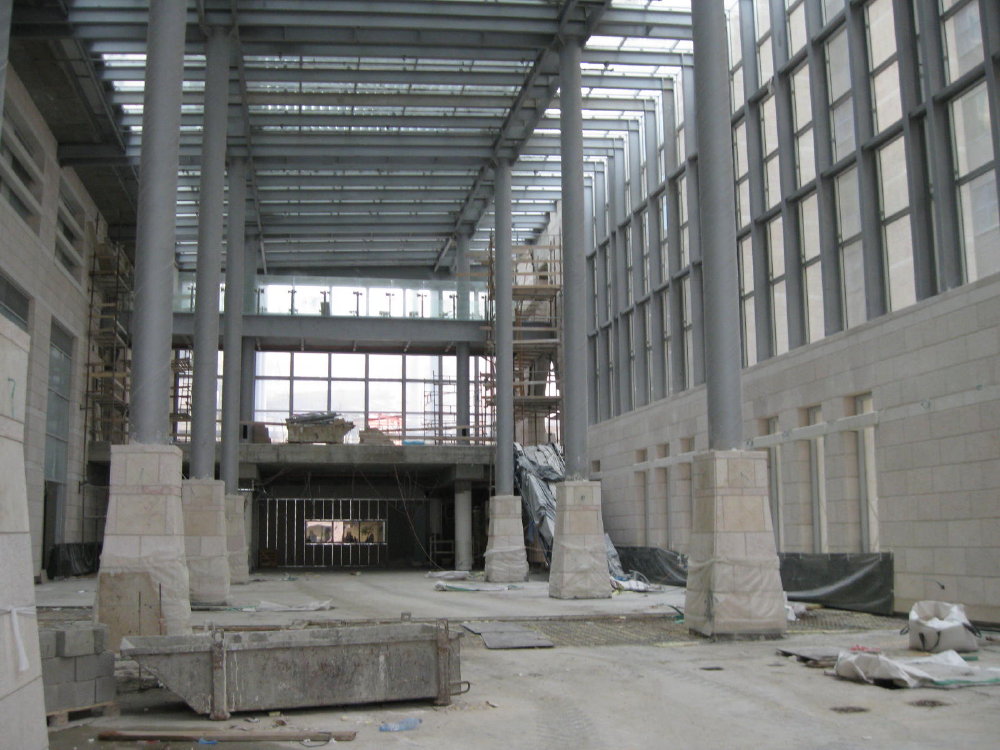
Today three workers were mopping the floor of the new atrium (although the "Caution" signs and the puddles did not deter many).

Just a few days ago part of the new hospital tower of Hadassah was dedicated.
Patients are already moving over to the Urology floor.
The grand dedication of the whole building is planned for October.

Here's how the same atrium looked last November!

I blogged then about the tour inside the construction area, led by the chief engineer (here and here).
It's quite a place and quite a pace!
.

Monday, March 19, 2012

Honi the Circle-maker

.
This religious boy with the fluffy peyot (side curls) took care of his little brother while his mother was inside praying; this was the first thing we saw when our tour group arrived at the site.

Tradition has it that Ḥoni the Circle-Drawer is buried in this tomb, not far from the graves of two of his grandsons.
Today it is near the town of Hatzor HaGlilit in the north of Israel.
.
The signs at the door directed men to the left and women to the right.

We reached a locked gate but the holes were just big enough to stick my lens through.


The camera captured the distant burial cave with its burning memorial candles.

Outside in the courtyard, a circle reminded us of the famous story.

See a cute animated video of Honi here.
Wikipedia explains it well:
"When God did not send rain well into the winter ..., he [Honi] drew a circle in the dust, stood inside it, and informed God that he would not move until it rained. When it began to drizzle, Honi told God that he was not satisfied and expected more rain; it then began to pour. He explained that he wanted a calm rain, at which point the rain calmed to a normal rain.
He was almost put into cherem (excommunication) for the above incident in which he showed "dishonor" to God. However, Shimon ben Shetach, the brother of Queen Shlomtzion, excused him, saying that he was Honi and had a special relationship with God."

Wiki also explains that "During the 1st century BC, a variety of religious movements and splinter groups developed amongst the Jews in Judea. A number of individuals claimed to be miracle workers in the tradition of Elijah and Elisha, the ancient Jewish prophets. The Talmud provides some examples of such Jewish miracle workers, one of whom is Honi ha-Ma'agel, who was famous for his ability to successfully pray for rain."

Honi was a zadik, a righteous man.
But zadik is sometimes translated "saint."
Then you get into terms like patron saints, pilgrimage, veneration of saints, intercession, devotees, shrines . . .
Remember, we are talking about Jews now, not Catholics.

The book Jews in Israel, contemporary social and cultural patterns talks of a "renewal of saint worship" in this country in recent years, citing Honi and others as examples.
If you look at the tombs of the zadikim in the North and South, you see how a whole "holy industry" has grown up around each one.
And pilgrims come by the busloads.
.
This is not the Judaism I grew up with in America; it is new (and strange) to me.
.
.
(A post for Taphophile Tragics, Our World Tuesday, and Monday Doorways.)
.

Saturday, March 17, 2012

Revitalization of a drained swamp--the Hula

.
On a cold and rainy day last week our tour guide took us to the Agamon Hula Ornithology (Bird Watching) and Nature Park.
It lies in the Great Rift Valley and is north of the Sea of Galilee.

At the big Visitor Center were some of the quiet modes of transportation permitted in this special nature reserve, like this family bicycle complete with a baby seat in the middle.

Our group of 37 would go in a safari wagon, seen here from the back.
The man on the tractor doubles as driver and guide.
At sensitive places he whispers into the microphone.

It had been raining a lot and we had to ford this flooded spot on the track.

A few rays of sunlight broke through and painted the distant hills of Naftali a bright green.

And created a rainbow too!

We sighted our first birds up over the papyrus.

A flock of small birds looked so pretty against the dark background of clouds and mountains.

Finally we came to the Crane Observatory where the standing cranes made a nice reflection for Weekend Reflections and Camera-Critters.
Go ahead, enlarge the photo, enjoy!

Our safari wagon sat quietly for a while, but when we inched forward, the cranes knew their limit and took off.
It was exhilarating to see and hear these big birds fly right past us!
.
Twice a year 500 million (!) waterfowl, birds of prey, and song birds from 400 species fly over this area on their great migration between Europe and Africa.
As the brochures says, "The crane is the king of the Hula. In the autumn more than 100,000 cranes fly over the Hula Valley and a quarter of them winter here and fill it with their cheerful uproar."
.
In the pre-State years many pioneers in this region got malaria from what was seen as "the malaria-ridden swamps of the Hula" and in the 1950 the Jewish National Fund/Keren Kayemet drained the lake.
Back then, projects like this were seen as part of the great Zionist endeavor of "redeeming the land." (See a good explanation here.)
.
However, the mistake of tampering with nature in the Hula Valley soon became apparent as newly dried underground peat deposits ignited into smoldering fires that defied all extinguishers' efforts and rendered much of the area unsuitable for cultivation.
And phosphates and nitrates in the earth were washed into the Sea of Galilee, polluting its water.
So the JNF/KKL went back and reflooded part of the valley in 1995 and annexed it to an existing nature reserve.

This is what some Israelis sarcastically call "redeeming the land from the redeemers."
.
For more details see Wikipedia and/or the Hula Reserve page.
The park that you see in my photos even has a Facebook page called Agamon Hula.
.
More about my 4-day guided tour in the North in the coming days.
Shalom!
.

Friday, March 16, 2012

Skywatching through the palms

.
Shalom, I'm back!
Have been up north on a 4-day guided tour, gathering photos and new knowledge for you and me.

Every evening when the bus pulled into our base, Kibbutz Degania Bet, there were a few blessed moments to unwind in a hammock before dinner and a lecture.

In the evening silence I skywatched as clouds drifted by and the sky turned pink above the date palm trees of the Jordan Valley.

Stay tuned for more pictures soon.
Shabbat shalom!
.
P.S./Update: The first photo was taken by blogger Reader Wil.
.

Sunday, March 11, 2012

See-through in the sun

.
A monk hurrying through the shadows of the Jerusalem's Old City lanes, past doors closed for Friday.
.
For Shadow Shot Sunday 2 and Monday Doorways.
.

The bloody sword of Doeg

.
For PsalmChallenge here is a dramatic painting illustrating Psalm 52.

You can enlarge the photo below and read the text in English and Hebrew.

I saw this beautiful copy of The Book of Psalms at a hotel art gallery (see more here).
In it each of the 150 psalms are illustrated by a different artist.
.
The story of Doeg the Edomite referred to in our psalm is recorded in I Samuel 22.
In his flight from Saul, David was given refuge and supplies by Ahimelech, a priest at the city of Nob. A herdsman named Doeg reported this to Saul, who subsequently ordered the massacre of all the priests in the city.
None of Saul’s servants would carry out the order except the informant himself.

16 And the king said, “You shall surely die, Ahimelech, you and all your father's house.” 17 And the king said to the guard who stood about him, “Turn and kill the priests of the Lord, because their hand also is with David, and they knew that he fled and did not disclose it to me.” But the servants of the king would not put out their hand to strike the priests of the Lord. 18 Then the king said to Doeg, “You turn and strike the priests.” And Doeg the Edomite turned and struck down the priests, and he killed on that day eighty-five persons who wore the linen ephod. 19 And Nob, the city of the priests, he put to the sword; both man and woman, child and infant, ox, donkey and sheep, he put to the sword.

I Samuel 22
.

Friday, March 9, 2012

Happy Shushan Purim

.
It's not every day that you see and hear religious boys being so exuberant on the city streets.

But today was Shushan Purim in Jerusalem, and these boys, some in costume, were fulfilling the mitsvah of being extra happy (and showing it) on the holiday of Purim.

They were walking along the Old City wall, in the direction of Jaffa Gate.
.

Tuesday, March 6, 2012

Homeward bound

.
H is for homeward bound.
My little Libby of the flowers and my daughter, Naomi, were here for a few nice weeks.
Right now they are homeward bound, to home in Sydney, Australia.
They should be landing right now, and I'll give a sigh of relief when they are back on earth.

They took off Monday night Israel time and arrive now, Wednesday morning Sydney time.
That's a lot of flying.
Australia is wonderful, but it's so awfully far away . . . .
.
.
For ABC Wednesday.
.

Monday, March 5, 2012

Masada Museum

.
This artist or scribe seemed to be painting or writing something on the sign outside the new (2007) Masada Museum.

It was very touching for me to go through the semi-dark exhibits for the first time.
Standing alone in the museum next to the life size statues, I felt very close to the people, both the Jewish zealots and also the Romans.
I even started to whisper to a few.

The end of the route and the end of the story was a lit case showing the 12 ostraca, the sherds with names written in ink, the lots by which were chosen the last rebels who would die by their own sword rather than become slaves for the conquering Romans.
This was the part that brought me tears, remembering them and all the 960 men, women, and children who chose death up on the fortress of Masada.

So it was a nice and needed lightening of heart when I exited and saw the guard dragging the outside statue guy in through the door just before closing time.
It made me laugh.
.
Here is a nice 5 minute video about Masada National Park.
.
(A post for Our World Tuesday and Monday Doorways .)
.

Sunday, March 4, 2012

Today's psalm--compact, together

.
With the persistent encouragement of Daily Athens Photo's Robert Geiss, the weekly PsalmChallenge has already covered one third of the Book of Psalms.
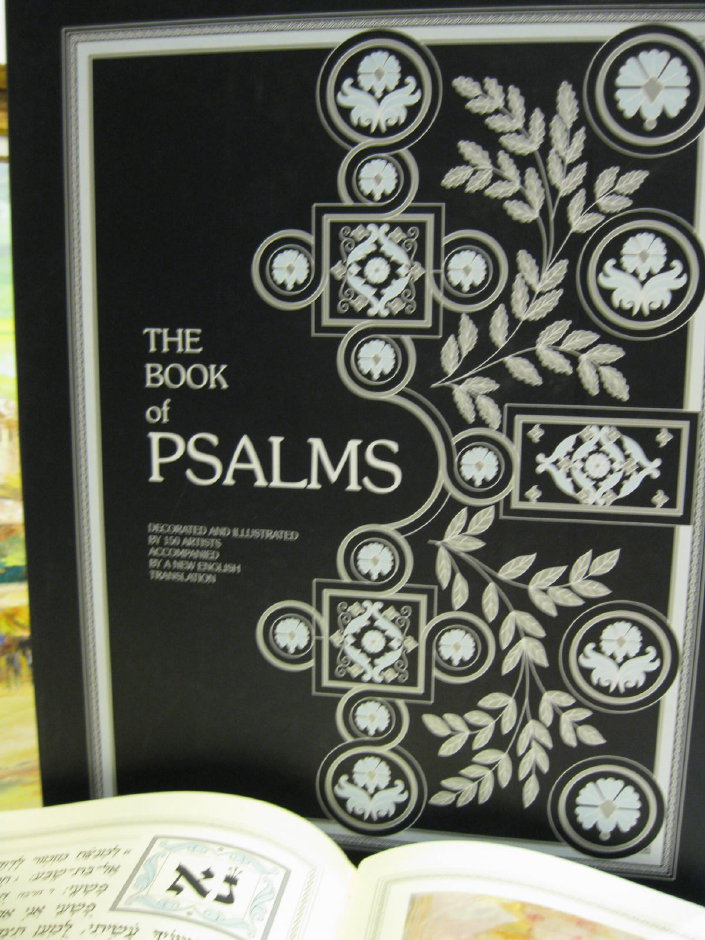
Today we arrived at Psalm 51.

You can simply enlarge the photo to read the English and/or Hebrew text and enjoy the awesome painted illustration of Psalm 51.

To my great joy this wonderful book was on display in an art gallery in our Le Meridien hotel at the Dead Sea.
.
"The Book of Psalms, decorated and illustrated by 150 artists accompanied by a new English translation" the front cover says.
It was printed in only 613 copies (like the 613 commandments in the Torah).
.
What a treasure.
.

Saturday, March 3, 2012

Tristramit

.
As you may have read previously, on Monday my visiting daughter and her toddler and I drove down to the Dead Sea for a scientific conference.

Tuesday I woke to the lovely sight of two birds strolling on the balcony of our hotel suite.
Grab the camera for a Camera Critters photo op.
It was 7:26, the sun was up, and the day quite clear.

By 3:30 it looked like this!
Brown air, hard to breathe. A major dust storm.

Down at the pool the wild wind was toppling everything not bolted down.
In this close-up of the bird on our railing, you can see the wind ruffling his feathers on the left side.
.
The bird in the last two photos with the orange tipped wings is a Tristram's Starling (aka Tristram's Grackle).
This species is named after Reverend Henry Baker Tristram, the Englishman who did a lot of exploring of the Dead Sea region between 1858 and 1872.
.

Friday, March 2, 2012

Wilderness & civilization reflected

.
Naomi, Libby, and I drove from Jerusalem down down down to the Dead Sea on Monday, when it was still fairly sunny and clear.
This photo for Weekend Reflections shows the light at 3:30 pm when the sun was getting low in the west.
The shadows of the mountains were reflected in the still waters of the Dead Sea, as was our destination, the tall white Le Meridien hotel at the Ein Bokek resort complex.
.
For how the weather totally changed in the next days, please see the earlier post.
.

Dust storms, flash floods, rain, and snow

.
Hello--I'm back!
We have been four days at over 400 meters below sea level.
My Naomi flew in from Australia and I got to take care of her little one while Naomi lectured and attended an engineering conference, all at a big hotel at Ein Bokek on the Dead Sea shore.

Strong winds blew up dust storms on three of our four days.
Yesterday we started the drive home, passing this little airstrip (enlarge to see the planes).
Across the sea (which you could hardly see), the sky was black and the Kingdom of Jordan was being treated to a rare snowfall.

Soon we passed Masada on the other side of the highway.

The road is between the Dead Sea on the east and tall cliffs on the west.
Eighteen normally dry riverbeds emerge from between these mountains.
When hard rain falls in Jerusalem or the Hebron Hills, the water collects in one or two or three of these wadis (you never know which it will be) and can suddenly come gushing out from the canyons under the little bridges built over the Dead Sea road.
But more often the flash floods rush over, not just under, the bridges.

Yesterday bulldozers were parked at the places most likely to flood.

Wow! We arrived just as the rolling brown water (enlarge the picture!) was starting to inundate the road and make its way to the Dead Sea!
The cars in front of us made it across just in time.

Naomi looked at the pole with potential depth markings of 0.5 meter, 1.0, and 1.5 meters, looked at our little toddler in the baby seat, and quickly (and wisely) turned the car in the opposite direction.

We drove south again, back in the direction of the hotels we had just left.
Luckily we did not encounter another flash flood; otherwise we would have been trapped in between two of them.

The only alternative was to climb up the Arad-Beersheba road.
The evaporating ponds where they mine potash and minerals from the Dead Sea water became visible way below, under a dramatic sky.

The road curved around and around as we ascended from minus 400 meters below sea level to about 500 meters above sea level.

What an adventure! It was our first time to see this powerful natural phenomenon with our own eyes.

Today, Friday, it snowed in Jerusalem. And even in my village for a few minutes.
March is acting like real winter.
.
.
A post for SkyWatch Friday, of course!
.