Sunday, October 17, 2010

Floodlights on the Citadel

.
We looked at this bridge in an earlier post for Louis' Sunday Bridges.
But that was in the daytime.

Take a look at night!!
The Tower of David (the Citadel) is even more glorious at night.
.
On the right is the 16th century gatehouse.
The dry moat was built earlier, probably in Crusader times (12th C.).
The moat originally reached the entrance and was partly spanned by a wooden drawbridge.
.
The people you see on the present wooden bridge were lined up waiting to go in to the sound and light show inside the courtyard.
.
Here is the continuation of the bridge up to the big heavy entrance gate.

The Citadel has something nice for Hey Harriet's Shadow Shots Sunday too.
.
Floodlit from below, the rusticated stones throw sharp shadows.
.
Rustication (leaving the center of the stone rough and projecting) has a military purpose.
It protects the joints of the masonry and when struck by projectiles, it is more likely than smooth masonry to dissipate their force by fracturing harmlessly.
.
Imagine yourself a Crusader attacking the Citadel, looking up at these tall walls with those fearsome arrow slits and machicolations!

That wall is on the left in this photo, the bridge and entrance are on the right, and in between, behind the low wall is a lovely garden with a bubbling fountain and benches and little trees.
The garden is my favorite secluded place for a picnic in Jerusalem's Old City.
.

Saturday, October 16, 2010

The cat who wanted to be an archaeologist

.
Cat, come out!
.
He was hiding from the blazing sun at Kursi, underneath the remains of the Byzantine church and monastery on the site where Jesus reportedly drove out a legion of demons from a man.
The demons went into some pigs instead.
.
I couldn't find any pigs to photograph for Camera-Critter Sunday, so this cat will just have to do.
.
UPDATE Dec. 16, 2015: A stone with a long Hebrew inscription was just found at Kursi, so Kursi may have been a Jewish town with a synagogue -- a surprise!
 .

Drawing water with grace

.
Continuing the topic of world water shortage, I'd like to draw your attention to a short video of a beautiful and smiling woman drawing water--so gracefully--from a well in Senegal.
The Heifer Blog posted it for Blog Action Day.
.
Heifer International is a great organization that gives livestock, training, and hope to needy families around the world.

Heifer Ranch volunteers, ca. 1997
.
You can see from this photo what fun it is to be a volunteer at the Learning Center at Heifer Ranch .
.
I worked and lived with young folks like these at the Ranch in Arkansas from 1996 to 2002 (that's me on the right).
The kids did mostly guiding and experiential education work with the thousands of visitors who come through the ranch every year.
I got to take care of livestock and teach young work-campers how we do chores, and sometimes I worked in the organic gardens.
.
You too can contribute to Heifer's noble work, with gifts of your time or your money.
Christmas, Chanuka, birthdays are coming. Give the gift of hope, buy an animal or a share of an animal, through the unique gift catalog.
.

Friday, October 15, 2010

Blog Action Day for Water

.
Blog Action Day this year chose WATER as the focus of attention for bloggers worldwide.

Here is my moshav (agricultural village) in the middle of the Jerusalem Hills.
The hills and even the valley around us are blessed with many ancient springs.
About two-thirds up the mountain there is even a Shvil HaMa'ayanot, the Trail of Springs.

When I moved to this region (from the Tel Aviv area) and started exploring in 2006, the spring-fed pools were full and on hot days hikers would jump in and cool off.
. But no more.
By 2007 these ancient irrigation pools were dry.
.
Israel is now in her 5th or 6th successive year of drought.
.
I have posted about the dangerously low level of the Sea of Galilee, which is a major source of drinking water, and about the rapidly shrinking Dead Sea.
On World Water Day I showed how my neighbors built a channel to capture rainwater.
.
But when you actually see how the aquifers, the springs, the pools right near home are drying up, it is shocking.
.
People, peoples, built these agricultural terraces on the hillsides and devised the irrigation systems thousands and hundreds of years ago.
The Jewish farmers in Temple times even managed to feed the thousands of pilgrims who came up to Jerusalem for the three annual pilgrimage festivals.

These Jewish farmers of two thousand years ago, and in recent centuries the Arab farmers, and the ancient peoples who preceded all of these, they would be so sad to witness the current dire situation.

If only it would rain . . .

UPDATE:  How to hike this area, plus an explanation of aquifer formation:
 http://inandaroundjerusalem.com/the_judean_mountains_west_of_jerusalem_-_overview_and_summary_of_hikes/hiking_on_the_shvil_hamaayanot_and_visit_to_yad_kennedy

P.S. The water photo is for James' meme, Weekend Reflections.
.

Thursday, October 14, 2010

A few Friday clouds

.
In honor of SkyWatch Friday, last Friday Jerusalem skies actually, finally, had some nice big clouds.
Still no rain (since last spring), but at least we had clouds to block the hot sun.
It is in the mid 30s C, that's the low 90sF, still.
.
I always smile to see modern communication equipment on top of very old buildings, like here atop the former St. John ophthalmic hospital on Hebron Street.
Today it is the Mt. Zion Hotel.

Or the two satellite dishes way up on the hundred year old bell tower of the (Anglican) Cathedral of St. George the Martyr.
The tower was built separate from the church to limit potential damage from earthquakes.
Today the structure contains staff housing.
.

Wednesday, October 13, 2010

So narrow

.
"Kol haolam kulo gesher tsar meod . . .
All the world is a very narrow bridge,
but the main thing is not to fear at all."
.
I will sing this Hebrew song when the last of the miners has come up.
May God bring them out from the earth and back into the world, to the light.
Their faith has kept them strong.
.

"On the tracks--don't play"

.
Electrifying news!
I was so happy to see this sign, at long last, near the end of Jaffa Street!
"The power-lines of the light rail in this section are electrified."
.
For years already this blog has been posting torn up Jerusalem streets, bulldozers, track-laying machines, bridge-building cranes, workers wading in wet concrete, and all the rest that goes into building a light rail.
.
This particular section was even planted with grass.
It runs along the northern wall of the Old City.
.

The trams might actually start running in April.
.
To prepare Jerusalemites for the big day, these signs are going up along the route.
Please enlarge the photo, read, and have a good laugh.
: )
Just remember--we have never lived side by side with a tram before.
.

Tuesday, October 12, 2010

Madaba mosaic map

.
Photo by Kay of Musings
.
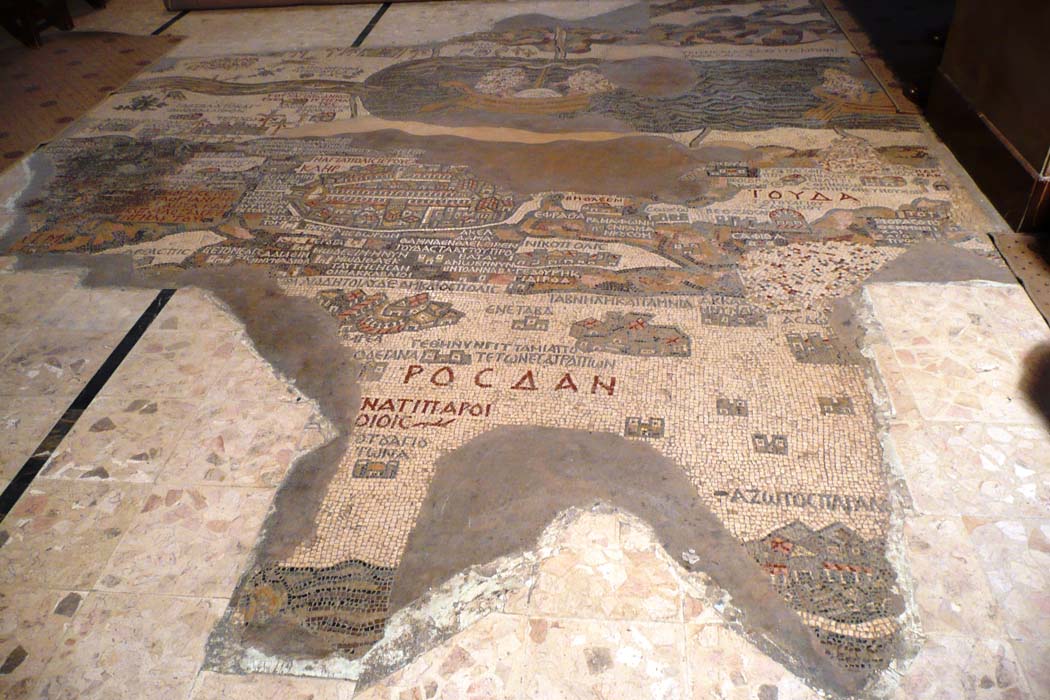
For ABC Wednesday M-Day let's look at the magnificent Madaba mosaic map.

Craftsmen made it from more than two million colored tesserae sometime between the years 542 and 570.
.
The photo above shows the surviving parts of the mosaic, in situ in the church in the Arab village of Medeba in Jordan, where it was rediscovered in 1892.
Kay, my friend in Hawaii, author of the fine blog Musings, was actually there and sent me this picture!
.
This photo shows our reproduction of the Jerusalem section of the map. It hangs near the Cardo in the Old City.


Yes, the same central Cardo that Israeli archaeologists in 1967 searched for and found (and later restored), based on this map! (It's the colonnaded road going across the map, starting at Damascus Gate on the left.)
.
This year archaeologists dug near the Jaffa Gate (at the bottom of the map) and were thrilled but not surprised to find the Decumanus (the Roman road which led up to the Cardo), shown with a sharp right angle here above.
.
And in 2006 my trowel was one of the lucky ones to first scrape through to the big beautiful paving stones of the Secondary Cardo (visible at the top of the map, its row of columns showing).
.


The Madaba mosaic is also a devotional map, so the most important church, the Holy Sepulchre, and also the Nea Church are distorted out of proportion to the rest of the city in order to show their conceptual importance for the Christians.


And naturally, the Byzantine Jerusalem depicted has the East on top.


Being the oldest surviving original cartographic depiction of the Holy Land, the Madaba map is famous and beloved in our country and you find it on postcards, ceramics, and all kinds of souvenirs.


But a few days ago I had to laugh to find it on a kneeling cushion in St. George's Anglican Cathedral in east Jerusalem!
.
I could go on and on about the fascinating history and value of this map.


But I recommend you play around with your mouse on this great 3D map with overlays.
.
And you can see the Greek Orthodox church in Jordan where the mosaic resides at BiblePlaces.com.
The Franciscans have a virtual tour of the Madaba map, based on the book by Piccirillo.
.

Have fun!
.

Monday, October 11, 2010

A gift of music

.
The That's My World meme, hosted by Klaus and his team, Wren, Sandy, Sylvia, Louise, and Fishing Guy, celebrates two years of blogger-guided tours today!
As a birthday gift I offer not the usual built environment but a joyous cultural event instead.
.
No, these are not Muslims at prayer.
They are singers taking their final bow!

While in Jerusalem Saturday night, I quite by accident chanced upon a free concert.
And beautiful and inspiring it was!
.
The Ranot Ensemble had come on their bus all the way from the Arava, Israel's southern desert, to perform in the church of Notre Dame de Jerusalem.
.
For the past 16 years the group's several dozen members volunteer their voices and hearts to keep alive the most beautiful and moving of Israel's and the world's songs.
.
During the day they work as computer scientist and mathematician, veterinary surgeon, librarian, laboratory technician in the dairy farm, tour guide, and farmer as residents of Kibbutzim Ketura, Lotan, Grofit, Yotvata, Samar, and Shaharut village.
.
I think the Ranot singers were invited especially for the meeting of the World Union of Catholic Women's Organisations that was taking place at Notre Dame.
.
The Jewish singers had no problem singing "Ave Maria"--in Latin--, standing under the big crucifix and the big statue of Mary and child.
(We have come a long way. )
.
When the singers moved into Gospel songs in English, women in the audience from Africa in their colorful dresses could not sit still. They stood up and clapped and swayed to the rhythm.
.
After many encores, the concert ended.
The Pontifical Institute Notre Dame of Jerusalem Center was beautiful by night.
The singers boarded their bus for the long ride home, home to the desert.
I went home with a song in my heart and I'm sure the hundreds of visitors from abroad did too.
.
Thanks to dedicated and idealistic people like the Ranot Ensemble the desert is blooming, not only with agriculture but with culture!
.
More about Ranot Vocal Ensemble with videos of their songs.
Ranot on YouTube and Facebook.
Map and website of the Eilot Region communities.
.

Sunday, October 10, 2010

Bridges and benches in the Garden Tomb

.
British General Charles Gordon literally lost his head at the hands of Mahdist rebels in the Sudan, in the ill-fated defense of Khartoum.

But in Israel he is better known for having "discovered" Gordon's Calvary.
Three holes in the cliff, when seen from afar, make it look like a skull, i.e. Golgotha in Aramaic, the "place of the skull" mentioned in the New Testament as where Jesus was crucified.

And just on the other side of where the fence now stands, Gordon discovered an ancient tomb.
He decided that this, and not the Church of the Holy Sepulchre, was the true place of the crucifixion and burial.

Most scholars do not agree.
But this did not stop popular Protestant piety from making the site, today called the Garden Tomb, into the most moving place for prayer and meditation for non-Catholic pilgrims.

Group after group stands in line to enter the small room of the tomb for a brief minute.

In any one of the many clusters of benches you can hear hymns rising, or sermons, or readings from the Gospels--in Finnish or Spanish or African languages or even English.

Several bridges make large parts of the garden handicapped accessible.
.
Here's a picture for both Louis' Sunday Bridges and the bench-blogging friends.
.
The old arches are more graceful than the modern straight lines.

The bench-groupings are everywhere, each with its own altar.

Each table is ready with the Communion elements.

The Garden is owned and administered by The Garden Tomb (Jerusalem) Association, a Charitable Trust based in the United Kingdom. There virtual tour is here.

The exit from the Garden Tomb is through the gift shop.

For pictures of inside the tomb and of the surroundings and of the huge cistern, see Sacred Destinations and BiblePlaces.com.

UPDATE: Dear readers, please see my clarification of some things in the Comments section.
.
(Linking to inSPIRED Sunday.)
.

Friday, October 8, 2010

A window, the sun, and Jerusalem

.
As you know from yesterday's post, I was at the Hebrew University Mount Scopus campus yesterday; and the prize at the end of sitting through eight hours of lectures was a glorious sunset.

The campus synagogue, dedicated in 1981, is part of the very spread-out Humanities Building.
You can recognize it here by the Chanuka menorah on its roof.
.
How would you like to pray facing this view of the Old City and beyond?!

At 5:10 the last rays of sun were bathing the interior with a warm glow.
.
Most synagogues in Israel and in the world face the east, toward Jerusalem.
The congregation here on Mt. Scopus had to face west in order to face the Temple Mount (where you see the gold Dome of the Rock), so architect Ram Carmi [remember my posts on his Supreme Court building?] had an idea.
He wanted a picture window in the front, but normally the holy ark containing the Torah scrolls is in the front.
He got around it by "splitting" the ark! There are two arks, one on each side.

And then, especially for James' Weekend Reflections, the sun set behind the far-away western skyline of Jerusalem and was reflected on the outside of the Hecht Synagogue picture window.
.
Shabbat shalom.
.

Thursday, October 7, 2010

Sunset over Jerusalem

.
Up on Mount Scopus, at the Hebrew University of Jerusalem, the day of special archaeology lectures began at 8:30.
The lecture hall was big, crowded, and had no windows.
The last presentations were starting at 5:00 pm, but something told me to get up and leave early.
.
Sure enough, I went out an emergency exit onto the terrace-roof and found this glorious sunset!
And a panoramic view to the north, west, and south of Jerusalem and beyond.
.
The tall mast of the Calatrava Bridge of Strings is visible in the setting sun, way over on the opposite side of the city.
.
Finally, summer is ending and there is something besides cloudless blue skies to offer to
SkyWatch Friday!
.

Wednesday, October 6, 2010

Bauhaus in Jerusalem

.
I realized that, living near Jerusalem, I naturally tend to post old stuff on the blog.
I like old stuff.
But maybe you would like to see some of our more modern buildings?

OK. So the blue sign on this one in Rechavia neighborhood says

"Bonem House -- Beit Bonem.
Designed by architect-engineer-artist Leopold Krakauer.
The house was built in 1935-36 for use of the Bonem family.
The building is considered an important example of modern Israeli architecture.
Preservation work was carried out in 2007 by Bank Leumi."
.
I think it serves now as a branch of the bank.
.
The wave of immigration from Germany in the 1930s brought many architects to Israel who had been influenced by the works of Le Corbusier, Walter Gropius, and the Bauhaus.
Here they had to take into consideration Jerusalem's climate, steep topography, and the prevailing construction in stone.
.
Artlog lists 25 Jerusalem houses and apartment buildings built in the International style.
If you like Bauhaus, you can click through the pictures of them.
.

Tuesday, October 5, 2010

Leaning on ladders

.
Do you like ladders?
Come have a laugh with these pictures in honor of ABC Wednesday L-Day.
.
Living in the Hills, we like our ladders long.
.
Part I: LADIES ON LADDERS
.
A brave friend on chapel-cleaning day.

A brave Russian Orthodox picking olives at Gorni Convent.
.
Our Tiberias excavation director about to photograph our square.
.
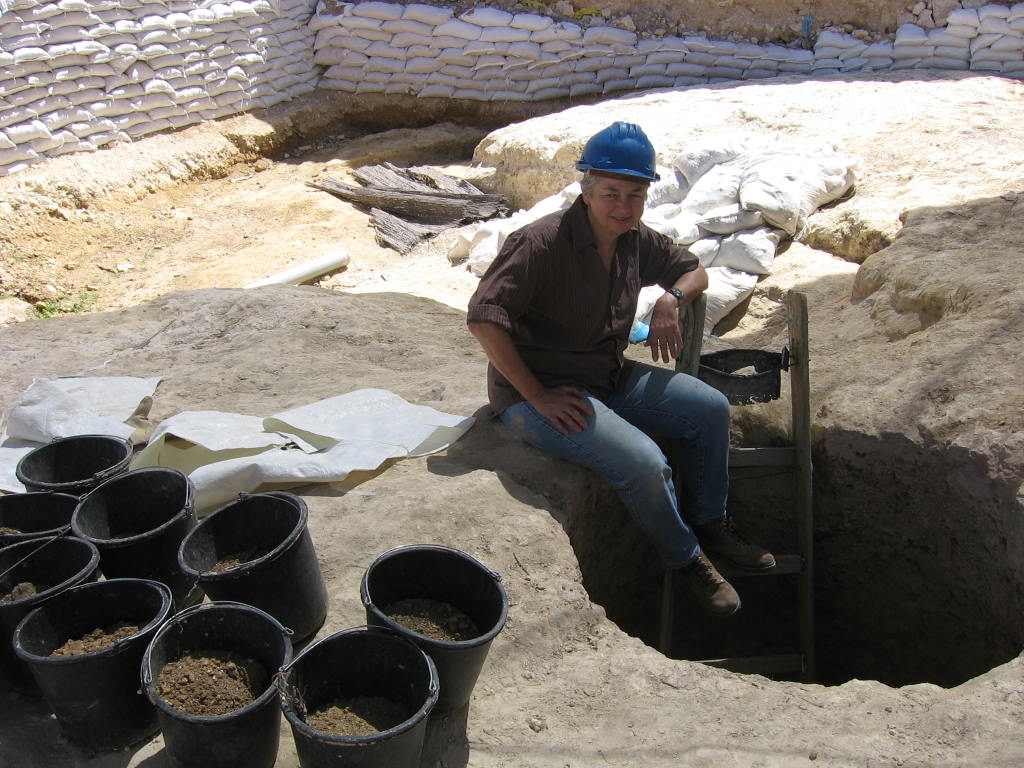
Hard-hatted me about to descend into a Canaanite shaft tomb in Jerusalem.
.
Part II: BOYS AND THEIR LADDERS
.
Before sun-up, the dig photographer at work at Tel Yarmouth.
.
The neighbor boy building a new roof.
.
"Plastering" over the straw bales in the neighbors' new straw bale house.
.
Part III: LEFT LADDERS
.
Under the window in the Church of the Holy Sepulchre, the famous ladder that none of the churchmen dares to move since the 19th century because of the Status Quo.
.
Night falls and the tired olive pickers leave their ladders.
.
Leaving little room between ladder and ceiling.
.
Silence and solitude, even for ladders!
View from the cemetery of the Sisters of Zion in Ein Kerem.
.
And to see the angels on the ladder of Jacob, please go back to an ABC post of two years ago.
.