Saturday, May 15, 2010

Black shadows of black basalt, all in a row

.
The Spring 2010 Tiberias excavation ended yesterday.
I'm back home in the Hills of Jerusalem.

But my memories (and photos) from the dig are still sharp in my head.
.
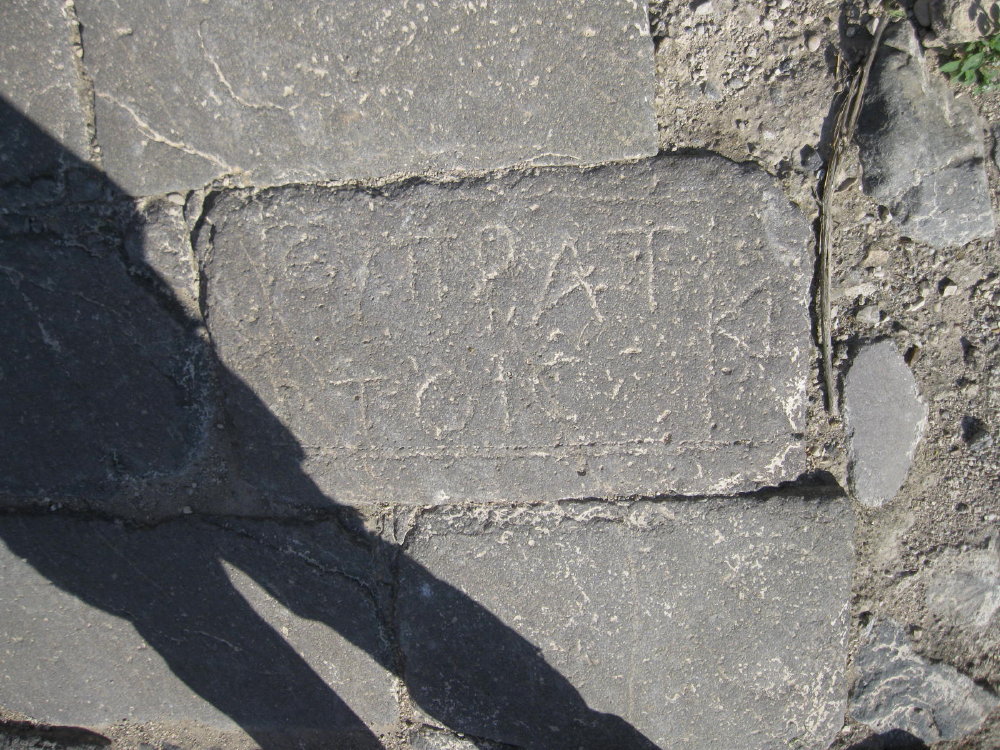
Passing this curb on the way to and from the dig site everyday used to make me laugh.
.
Something about the surfeit of basalt antiquities in Tiberias . . . . The municipality sticks the pieces anywhere they can find room (e.g. impaled on iron fences).
Something about the stubby little shadows of mid-afternoon just waiting for Hey Harriet's Shadows on Sunday.
.
And it made me smile that as a photo blogger I now am on constant look-out for interesting skies, benches, bridges, and critters for the various memes.
Funny how blogging changes us.
.

Friday, May 14, 2010

Aldo's Gelateria Italiana

.
After a hot afternoon visit to Susita National Park we dig volunteers stopped our convoy of three vehicles at a famous ice cream place near the Jordan River.
.
And luckily for James' Weekend Reflections, Janet appears reflected in the glass.
Janet is a Protestant minister serving a church in Ohio who fulfilled her dream of working at an excavation.
.
There were more fancy flavors on the other side.
A hard choice! But I never pass up coconut if I can find it.
.
The Hebrew sign says "Glidaria Italkit."
That would be a translation of the chain's name, Aldo's Gelateria Italiana.
.
Whatever you call it, the ice cream was cold and sweet on a hot day.
.

Thursday, May 13, 2010

Going up!

.
We Tiberias excavation volunteers were already hard at work at 6:13 a.m. last week when suddenly everyone started running for their cameras.
I, of course, thought "For SkyWatch Friday!"
A golden sunrise over the Sea of Galilee doesn't happen every day.
.
Now I am back home in Jerusalem, the scene of another rising into the sky some 2,000 years ago, according to Christian belief. A Son-rise.
Your Jewish friend wishes happy Ascension Day to all you Christians who celebrate today.
.

Wednesday, May 12, 2010

Jerusalem Day

.
May the white dove of peace come to nest and rest in Jerusalem.
.
Happy 43rd Jerusalem Day today.
.

Tuesday, May 11, 2010

Quieta non movere -- Don't move settled things

Latin proverbs are always good for the difficult Q Day of ABC Wednesday.

Quieta non movere means "Don't rock the boat" or "Let sleeping dogs lie."

But in the context of these photos from Susita, the proverb's literal translation is best:
"DON'T MOVE SETTLED THINGS."

The architectural elements toppled by the great earthquake of 749 are left in situ as a silent testimony to the devastation that put an end to the city of Susita / Hippos.

Some of the columns are of smooth granite imported from Egypt.
Granite was common in the construction of pagan temples
As we have seen in my two previous posts, Susita was at first one of the pagan cities of the Decapolis.

It is probably this city on the hill that Jesus sailed across the Sea of Galilee to.
The news of his driving the demons out of a man spread fast.
The next re-use of the temple columns was for Christian churches, 3 or 4 of which are excavated.
.
The flat foundation in the photo above has holes for posts of the Byzantine church's chancel screen.

Still half-buried quiet things. . .

Here the archaeologists just couldn't resist just a little reconstructing, it seems!

The pillar with remnants of unusual plaster decoration and the elaborate Corinthian capital begged to be set upright again after all these years.
.
Initial excavations were done in the early 1950s. But then Susita was right on the border with Syria and it must have been quite dangerous.
Digging was resumed in 1999.
Since then, teams from the universities of Haifa and of Warsaw have come every summer.
.
UPDATE Sept. 2014:  See http://blog.bibleplaces.com/2014/09/new-evidence-for-ad-363-earthquake-at.html

UPDATE Dec. 4, 2015: Don't miss this great BAR article on Sussita, with aerial photos!
.

Monday, May 10, 2010

Walking the Decumanus Maximus

.
For That's My World let me take you up to northern Israel, to the remains of a city that flourished from Hellenistic times until the earthquake of 749 CE.

At first it was a pagan city, like the other nine cities of the Decapolis.
In Byzantine times it turned into a center of Christianity.
.
This hill looked to the ancients like a mare's head and neck, so when they built a city on top of it in the 2nd century BCE, they named it Hippos or in Aramaic, Susita.
.
Our group of archaeology volunteers was given a guided field trip up there last Thursday.
.
We were careful to stay on the path on the one narrow ridge that leads up to Susita National Park. Up until the 1967 Six Day War, when Israel won the Golan Heights, this was where Syrian territory began.
Till today the old Syrian minefield is there.
.
It was thrilling to walk on the 2,000 year old road. I had to fight back tears. I was humming "The Appian Way" movement from Respighi's "The Pines of Rome."
.
These basalt pavers form the original Decumanus Maximus, the main east-west street.
.
Here the view is to the west. You can see a bit of the Sea of Galilee down below.
.
And the view to the east, to the Golan plateau.
.
Enlarge the photo to better appreciate the carvings in the local basalt stone.
.
An ancient game etched in stone.
.
An inscription inside a tabula ansata.
.
Oh! and don't you just love this?!
Masons' marks, the "signatures" of the men who cut the stones!
.
The Romans used their engineering skills to bring water UP to the city from springs lower down.
The water flowed through an aquaduct in the hills and then into these interlocking sections of pipe on the side of the Decumanus.
.
Note the size of the first opening . . .
.
and then the smaller second opening.
Going from large into small channel increases the pressure of the running water and makes it go higher up.
I should have checked with my engineer daughter first, but apparently this is now called Bernoulli's principle. I think the Roman's didn't have a name for it; they just DID it!
.
Come back during the week to see the churches of Susita. Shalom!
.
UPDATE Dec. 4, 2015:  See a great new  BAR article on the Susita dig, with aerial photos!
. 

Sunday, May 9, 2010

To the mothers

Hitgalmoot ("Embodiment") by Yifah Adir, at the Mamilla Mall
.
Wishing the joy and nachat of Mothers Day to my daughter in Sydney and my daughter-in-law in Los Angeles, the good mothers of my four dear grandchildren.
.
And Mothers Day blessings to all the moms in our blogging world.
.

Saturday, May 8, 2010

Excavation bird

.
A crested bird enjoying the late afternoon view over the Sea of Galilee, looking westward toward Tiberias.
For Camera-Critters Sunday.
.
The bird was sitting in the Forum, on what probably was the shrine or niche for the Imperial cult. Two thousand years ago it was the law to worship the Roman Emperor and the Empire in Greco-Roman cities.
On Thursday our group of archaeology volunteers had a guided field trip to the city-state (polis) of Hippos, also known in Aramaic as Susita.
The city on the hill in the Golan Heights flourished between the second century BCE and the seventh century CE. At first it was one of the ten pagan cities of the Decapolis.
Later, in Byzantine times, it became a Christian center.
.
During the week I will show you some of the the ruins of four of the wonderful churches of Susita.
.

Friday, May 7, 2010

Cool clear water vs. hot dusty digging

.
This is one of the all-too-numerous pay-for-entry beaches in Tiberias.
But at 5:28 in the morning, when we walked past it to our archaeological dig which is just across the street, the pool was still perfectly still--good for James' Weekend Reflections meme.
.
You can see both the Sea of Galilee and the sky all pink, getting ready to welcome the 6:05 sunrise over the Golan Heights.
.
Walking back to the hostel at 1:00 pm, after work, we would see a few brave souls speeding down the water slides into the pool.
.

Northern clouds

For SkyWatch Friday, here is the sky over Sea of Galilee and the Golan Heights, seen from a moving bus as the road winds down toward Tiberias. The city's elevation (or lack of it) is about 690 feet below sea level.
.
I was down there doing archaeology since Sunday.
Today I came home to my computer and back to the pleasures of blogging.
Shabbat shalom to you all.
.

Tuesday, May 4, 2010

Birdbath in Jerusalem

.
Bird butt reflected in bird bath.
.
This place is the wonderful Jerusalem Bird Observatory.
.

Sunday, May 2, 2010

Forgotten lentils

.
"Another old man came to see one of the fathers, who cooked a few lentils and said to him, 'Let us say a few prayers,' and the first one completed the whole Psalter, and the other brother recited the two great Prophets by heart. When morning came, the visitor went away, and they forgot the food."
.
(Source: the April 29 meditation at "Word from the Desert -- Meditations on the Orthodox Life from the Early Church Fathers, Ascetics, Saints and Righteous")
.

Saturday, May 1, 2010

Painting Jerusalem red for May Day

.

"Workers of the world--unite!"
Happy May Day.

This being the Jewish State, Israel had to have the rallies on April 30  because May 1 falls on the Sabbath this year.
This is what I found, quite by accident, at Zion Square yesterday afternoon.
The billboard on the makeshift stage says "WE ARE PAINTING JERUSALEM RED."

From afar I had heard drum rolls, slogan chanting, and cheering  and simply followed my ears.
What a surprise!

The red banner of the Scouts quotes Deuteronomy 16:20:
"JUSTICE, JUSTICE SHALT THOU PURSUE".

The crowd and the drums applauded the speeches. At least one speaker was an Arab Knesset member, probably from the Hadash party.

The signs and speakers and chants all called for equality among the sectors, a two-state solution, an end to privatization, a raise in the minimum wage, equality for women, etc. etc. All the  old Socialist values.

Besides the Scouts I saw other youth movements, like Hashomer Hatzair.
I think the black and red flag belongs to the Anarchists.  And Merez was there, of course.
.
You know, I remember when I moved to Israel in 1968 . . . at my Shomer Hatzair kibbutz (where I had 7 months of Hebrew ulpan) and then at the clinics of the Histadrut Kupat Holim, everyone would still address each other as "chaver" or "chavera" which was then the equivalent of the Soviet "tovarish," meaning Comrade.
.

Friday, April 30, 2010

Jerusalem's dearth of statues

.
After CDP bloggers chose statues for our Theme Day, I realized that it is almost impossible to find a statue of a person on the streets of Jerusalem.
Maybe it's the influence of the old biblical prohibition against making graven images.

The Tower of David Museum does have statues, however, as it must in order to show the history of Jerusalem. They are copies of the originals.
.
Here is the infamous emperor Hadrian.
.


One of those Roman soldiers who lived here in Jerusalem when they turned it into the pagan Aelia Capitolina.
.
Click here to view thumbnails for all participants and see what statues their cities offer.
.

Russian reflections

.
Here is one of the towers of the old (19th century) Russian pilgrim hostel reflected in the fountain in Sergei's Courtyard.

Even the upper "bowl" had the reflection, and fish as a bonus.
.
.

Thursday, April 29, 2010

Cloud Strider

.
Just after sunset last night this giant rose up on top of the mountain.

I saw a long-haired celestial being seemingly striding toward the right, trying to catch his or her bright halo!
Do you see that? Or something different?
.
We all have fun with the sky at Sky Watch Friday.
.

Root balls on Jaffa Road

.
For a long, long time Jerusalem's main street, old Jaffa Road, has been torn up [as in my post from November 2008].
Vehicle traffic was reduced to one congested lane and pedestrians had to walk just about single file along what remained of the sidewalk. Stores suffered.


Yesterday, in front of the Generali Building I was glad to see the street flat again, with the tracks for the future light rail already laid, and lots of room to walk.
.
Look! We are even going to get trees!
I hope someone makes places to plant them before their root balls dry up.
.
There were no workers in sight. Oi, hope no one grabs that axe!
.

Wednesday, April 28, 2010

Two bloggers meet

.
The Shabbat before last, one of my blog-friends became a RLF, a real life friend!
Robin and her husband and their two kids drove half way across the country (45 minutes) to come up to the Hills of Jerusalem to visit me.

Robin is the photographer and author of her always-interesting blog "Around The Island."

At the local monastery, sweet Maya drank cold water emerging straight from the rock.
Ein el-Habis is most likely the spring that John the Baptist also drank from.

Itai and Maya took a seat next to the friars' new aviary.
The bench is new as well.
 You just have to weld some scrap metal posts, saw some wood and attach it, and voila--a bench that cost nothing.

Thanks for your visit, Robin. I had a great time with you and your family.
It's really fun to know you all in person now!
.
The one other blogger-friend who became a RLF is Ann of "Sydney Meanderings."
A year ago she took me on "a wander" through her wonderful city. Thanks Ann!
That seems so far away now and like such a long time ago.
.
I wonder who the next will be . . .
.

Tuesday, April 27, 2010

Counting the omer with objects of the spirit

.
Omer and Objects of the Spirit -- for O Day at ABC Wednesday.

I saw this at the Jewish art museum at Hechal Shlomo in Jerusalem and was delighted to learn that it is a modern, artistic version of an omer calendar!
The acrylic on wood creation is called Saphyr, Sefirat haOmer counter [sefira means "counting" in Hebrew].
American artist Tobi Kahn made it in 2002.
.
Saphyr is a 7 x 7 sculptural grid with 49 pegs that mark the 49-day interval between the holidays of Passover and Shavuot, between the commemoration of the Exodus from Egypt and the giving of the Torah at Mount Sinai.
This 49-day period begins on the second day of Passover – when an omer , or measure of barley, was offered at the Temple in Jerusalem – and ends on the day the wheat harvest began. Symbolically, the time between the two holidays traces the path from physical freedom (the Exodus) to spiritual freedom attained by the acceptance of the Torah.
.
Special calendars are used to count off the seven weeks of the omer.
.
Since the destruction of the Temple in 70 CE, we can no longer bring the offering.
Instead, we now "count the omer" each night during this period by saying a blessing and enumerating the day.
.
The omer also became a time of semi-mourning during which many observant Jews refrain from cutting their hair, listening to music, or celebrating marriages.
After nightfall tonight, we will recite "Today is twenty-nine days, which is four weeks and one day of the omer." That means you can see many men in my village, who normally are clean-shaven, with quite a beard by now.
.
The mourning is normally associated with a 2nd century plague said to have decimated the "24,000" disciples of Rabbi Akiva who died "because they did not treat each other with respect."
.
It has been suggested (at the Jewish Museum in New York website) that "Each peg on Kahn's counter is unique, but they all fit together as a whole, their combined form suggesting the rooftops of a village. The dark color of the work reflects the mood of the omer period."
.
The interior of each of the compartments, designed to hold the sculpted counting pegs, is painted gold to symbolize the spiritual journey embodied in the interval between the two holidays of Passover and Shavuot.
.
Richard McBee, talking about "Reinventing Ritual at The Jewish Museum," offers this:

"The wooden pegs are sculpted in unique shapes, each a different miniature sculpture that in its own way represents the uniqueness of each day as we perform G-d's commandments. Here counting becomes a physical act, forcing us to feel the difference of each day and place it in the next slot. This very uniqueness comes together as we count. The counting of the Omer represents the relationship between a person and his or her community. Beginning with one, we become an ordered multitude. Kahn's message is direct: each day and each person counts."
.
Monday, April 26, 2010

More about Jerusalem's ANZAC dead

.
Let us continue yesterday's ANZAC Day commemoration post.

So many Commonwealth soldiers died in the battles to push the Ottoman Turks out of Eretz Israel (then known as Palestine) during World War I.

There are British military cemeteries in Gaza, Beersheva, Ramla, and Haifa, and several in Jerusalem.

In yesterday's post we saw the Australian Memorial just outside the gate of the Jerusalem War Cemetery.
.
At the opposite end of the central avenue of the lovingly cared-for cemetery is a chapel.
Its interior is dedicated to the soldiers of the New Zealand Expeditionary Force who fell in Sinai and Palestine, 1916-1918.
.

"From the uttermost ends of the earth" indeed!

Above the lintel is St. George slaying a dragon.

The graves of 24 Jewish soldiers are grouped more or less together.
.
This tombstone was the only one of the cemetery's 2,515 tombstones on which visitors had put a pebble, the Jewish custom for paying respects.
The Jewish graves had little wooden star of David markers with the symbolic Australian poppy on them.
.
Rabbi Raymond Apple, rabbi emeritus of the Great Synagogue of Sydney, was at the ANZAC Day ceremony yesterday to read appropriate prayers and Psalms.
(I believe he made aliyah to Israel in 2006, following his retirement.)
.

I like what this family had chosen to inscribe on the stone of Lance Corporal M.I. Trachtenberg, age 36:
"Scholar of St. John's College, Cambridge. Beloved by all."
.
For That's My World , this week my heart has been much with the Australian world.
On the joyous extreme--the birth of an Australian granddaughter named Libby (meaning "my heart" in Hebrew) in Sydney, and on the solemn side--the commemoration of ANZAC Day in Jerusalem.
.