Showing posts with label Dead Sea scrolls. Show all posts

Tuesday, November 5, 2013

From Qumran caves to your computer

.
Inspired by Reader Wil's ABC Wednesday post on Qumran today, I figure it is high time to share my Dead Sea scrolls  pictures from last February's Jerusalem International Book Fair.
The Israel Antiquities Authority mounted a nice exhibition on the DSS back then.
 
(You can click 2x to enlarge any photo below.)


 The equipment used in  conservation of the 2,000-year-old scrolls.


And the patient and skillful women who work on them.

As it says above
The arid climate of the Judean Desert [e.g. at Qumran] and the dark, remote caves preserved the scrolls for more than 2,000 years.
Upon removal from the caves in 1947, the scrolls were exposed to a steady process of deterioration.
They have suffered from exposure to light, residues of adhesive tape and other conservational interventions.
All took their toll on the fragile parchments and papyri.
In 1991 the Israel Antiquities Authority set up a climate-controlled storeroom and a state-of-the-art laboratory for the conservation and preservation of the scrolls, widely considered a universal cultural heritage.
Four conservators have been tasked with the mission of slowing the scrolls' steady deterioration and preserving them for posterity. 


Last December, as Bible History Daily reported,
 Israel Antiquities Authority, in collaboration with Google, launched The Leon Levy Dead Sea Scrolls Digital Library, a new website that allows visitors to view and search high-resolution images of the complete Dead Sea Scrolls archive online. The project uses the most advanced and innovative technologies available to image the entire collection of about 930 manuscripts, comprising thousands of Dead Sea Scrolls fragments, in high resolution and multiple spectra. Through this process, hundreds of images are now accessible to anyone, anywhere in the world over the web, with many thousands more on the way. Several hundred fragments are already viewable, and it is hoped that transcriptions and translations for many scrolls will soon be available as well.


You will enjoy the IAA's  new website, The Leon Levy Dead Sea Scrolls Digital Library.

See also the Israel Museum's website The Digital Dead Sea Scrolls.

How to Study a Dead Sea Scrolls Text is interesting, too.
.
.
(Linking to ABC Wednesday Q Day.)
.

Wednesday, August 22, 2012

Symbolic and functional shpritzim

.
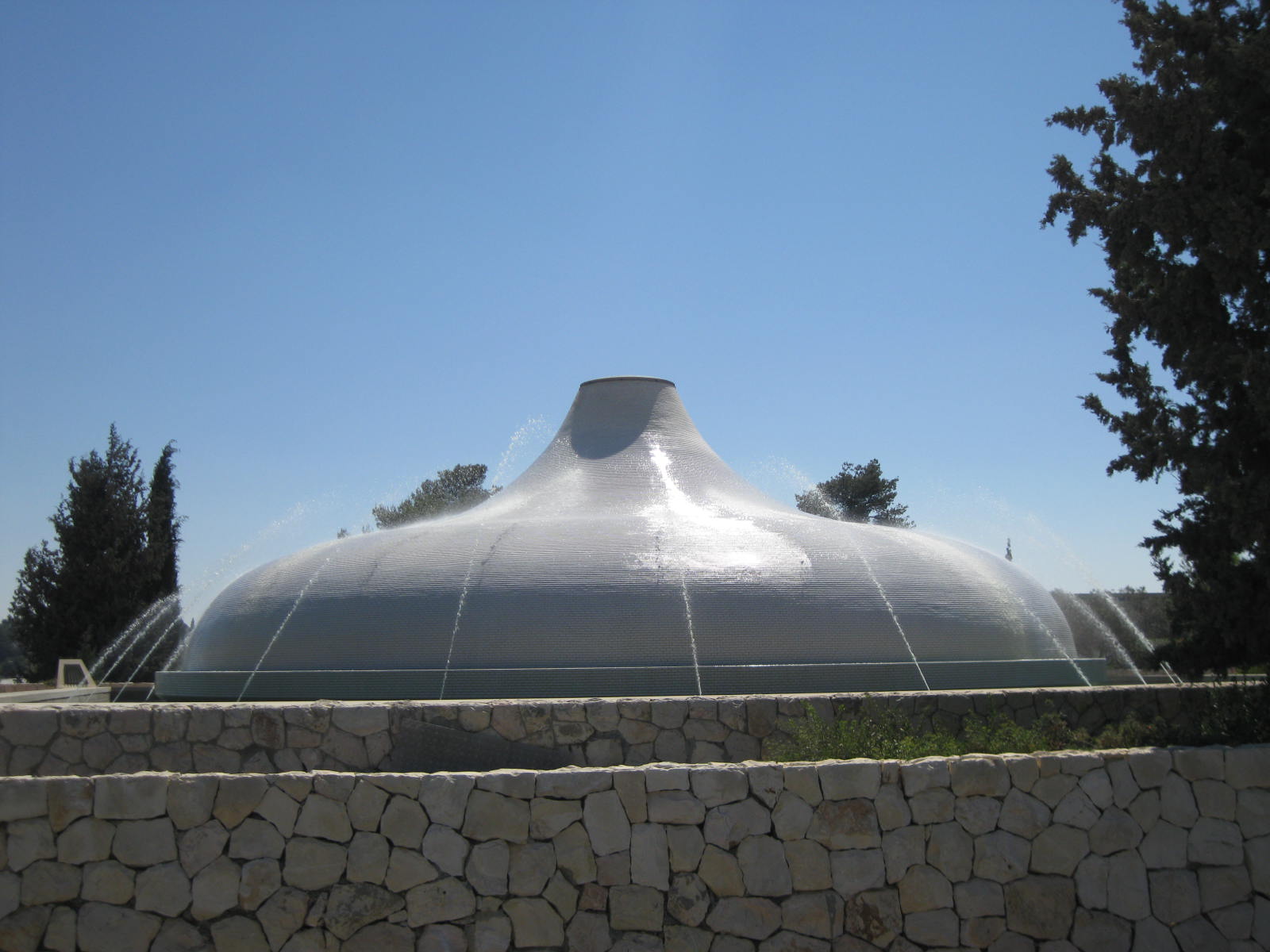
During this hot Jerusalem summer, with every day in the 30s C, I envy the dome of the Shrine of the Book (of Dead Sea Scrolls fame) which gets a constant shower of cool water to keep the glazed terra cotta tile cladding from overheating.
.
In this extremely interesting article about the Shrine of the Book, I learned that
Link
Kiesler [the U.S. architect] himself intended for this to feel like a purification of sorts, akin to the mikvah, the ritual bath practice that originated with the Essenes before being adopted by mainstream Judaism. This is also reflected in the fountains that play against the dome.
Like the fact that the space is underground, the water feature also contributes to the maintenance of a cool interior in the extreme Jerusalem heat---and also likely contributes to wear on the tiles, necessitating their eventual replacement and repair.

More photos are at http://jerusalemhillsdailyphoto.blogspot.co.il/2010/08/reflecting-on-apocalyptic-imagination.html.
.

Saturday, February 26, 2011

Jerusalem stair shadows

.
Thanks to Israel's strong sunlight, we have many crisp shadows.
Here are two stair-y shadows for Shadow Shot Sunday.

At the Israel Museum, the little inner courtyard next to the Shrine of the Book (of Dead Sea scrolls fame).
.

Franciscan monastery "St. John BaHarim" (Hebrew for "in the hills") in Ein Kerem.
The sign next to the door says "Byzantine tombs used as olive press and warehouse during Early Arab Period."

Someday I'll have to find the monk who has the key to all these antiquities places that are under lock and key and beg to see them.
.

Friday, August 13, 2010

Reflecting on the apocalyptic imagination

.
The jets of cooling water are reflected,

and so is the tall basalt wall.
.
Since joining James' group at Weekend Reflections, I am glad for all the reflections I can find.

The dome and the wall [but not the Franciscan friar] comprise the Shrine of the Book at the Israel Museum.
.
Underground, beneath the dome and the wall, are fragments of the Dead Sea Scrolls, a copy of the Great Isaiah scroll, letters written by Bar Kochba, the thousand-year-old Aleppo Codex, and an exhibition of relevant antiquities.
.
The dome is shaped like the lids of the jars in which the scrolls were discovered, in caves, in the desert, at Qumran.
.
Some collected ideas on the symbolism of the architectural sculpture:

The contrasting elements of white dome and black wall allude to the War Rule scroll.
The Essenes, the sect at Qumran, thought themselves to be the holy elect of Israel, the Sons of Light, who would at the end of time engage in a catastrophic war with the enemies of Israel, the Sons of Darkness.
.
The sprayed water represents purity. The monastic Jews of Qumran were frequent mikva-dunkers.
.
(The WizeGuide, in contrast, says "[T]he water spraying the dome . . . was merely meant to prevent the disintegration of the white tiles and the glue that keeps them in place . . . .")
.
The WizeGuide Jerusalem, Step by Step book also suggests that
"While the striking juxtaposition between these geometric shapes aptly reflects the extremism of the Judean Desert sect, it is also reminiscent of the People of Israel's passage from exile to revival."
.
Please enlarge this to see how the Shrine of the Book complex is laid out.
.
Shabbat shalom.
And Ramadan kareem to the Muslim blogger-friends.
.

Tuesday, June 9, 2009

Returning in an urn


.
The story of the urn begins at the prestigious École biblique et archéologique française de Jérusalem. On March 31 I was privileged to attend part of their Qumran Day, a day of lectures in memory of John Strugnell.
Since the discovery of the Dead Sea Scrolls the scholars at the School of Biblical and Archeological Studies have been deeply involved in the translation and interpretation of the texts. The original Scrolls team was appointed in the early 1950s by Jordan. (The Ecole is on Nablus Road in East Jerusalem, formerly Jordanian territory.) Young Strugnell came to the Scrolls Project in 1955 from Oxford. By 1987 he was editor-in-chief.

Photo courtesy of Fr. Jean-Michel de Tarragon

Strugnell taught at Harvard School of Divinity, but he spent his summers working on the scroll fragments at the Ecole Biblique. So it seemed right that after his death, late in 2007, his ashes would be brought from the United States to Jerusalem.
The Ecole is with the Priory of St. Stephen. Its monks are the teachers. The Dominicans are the Order of Preachers.
Here in the photo (courtesy of Fr. Jean-Michel) the brothers sing from the rite (in Latin and French) as a schola (choir) in the burial place.

Photo by Fr. Jean-Michel
Holy water was sprinkled toward the place of the entombment.


Photo by Fr. Jean-Michel
In the urn--John Strugnell's ashes.

Inside the wall in the crypt are the mortal remains of the deceased Brothers. The body is placed in a simple wooden casket. The marble marker bears the Brother's name, date of birth, date of monastic profession of vows, and date of death.

The present Dominican monastery (from the late 19th century) is built over remains of a 5th century Byzantine monastic complex. Back then the dead were buried in these ancient tombs cut in the rock. The body was buried. Cremation is not and was not allowed in Judaism and it took centuries for Christianity to begin to allow it.

You photo bloggers will enjoy meeting Brother Jean-Michel de Tarragon, here shooting with the big camera.
After getting his PhD (on Ugaritic Religious Cuneiforms Texts) at the Sorbonne, he came here and made Jerusalem his home. Until recently he served as the Prior of St. Stephen's Priory.
When he is not in a class teaching, he does photography for the institute.
He is also very enthusiastic about his project of converting between 15,000 and 18,000 glass plate negatives (from the really old-fashioned cameras) into digital pictures on compact disc.
St. Stephen's has accumulated the world's biggest private collection of old photos of Israel.
.
Amazing to see the 19th and early 20th century photos of life here in this land! The country is lucky to have Frere Jean-Michel in Jerusalem.
___________________________________________________
Interesting stuff:
A Jerusalem Post article about Professor Father Tarragon and the monastery
Ecole Biblique website in French and English
A new critique by Geza Vermes on the controversy surrounding both Strugnell and the handling of the translation and publication of the DSS
Photo of Qumran caves where the scrolls were discovered
.