Showing posts with label construction. Show all posts

Monday, November 14, 2016

Men and their Mercedes

.

So after living in a women's monastic community for any length of time (I've been here 12 days now), you start to miss seeing men around. (UPDATE:  Just kidding, kinda. I speak for myself alone; I'm sure the nuns are fine with it.)
This morning, on our desert day, I walked out and into the little village nearby.
The man was unloading his huge black shiny MERCEDES truck and I actually stopped to ask if I might take a picture of it.
He thought I wanted him to pose.


He snapped the cement platot (English?) onto the crane's cables,


and up it went.


The worker waiting to fit it into place on the new house actually walked UNDER it.
Oi.
/

Tuesday, November 25, 2014

Cement to build a nation

.

I am always fascinated when seeing the Nesher factory from afar.
At night it is lit up like a big city.


"The company's flagship plant in Ramle near Tel Aviv is one of the world's largest and leading factories in terms of production capacity, advanced production technology and preserving the environment," their website says.
"During 80 years the company has produced 125 million tons of cement, which among other things, has been used in the construction of 4 million homes."
Nesher has three factories in Israel.
"Nesher supplies most of the cement needs of Israel and the Palestinian Authority and also exports cement and clinker."

Clinker? Who every heard of clinker?  Not me.
.
For ABC Wednesday,  T is for tons and tons of cement.
.
And I just clicked on Nesher's Hebrew website and found they offer tours for families and groups during Chanuka vacation!
Register at http://www.nesher.co.il/visit_center.htm
During the whole year 2013 some 26,000 came to their Visitors Center.

Monday, November 17, 2014

Build your house wisely [if you can afford a house]

.

On Friday  Meitar's gym was full of young couples.


As the stacks of booklets prove, it was a lecture and exhibit day on the subject Build Your House Wisely--in Meitar and Carmit, 2014.


Wouldn't it be fun to have a samples case like this full of little floor tiles?


My grandchildren would love to play with such samples.


This is probably as close as I'll ever get to the beautiful (and costly) imported material.
But at least I learned the name Klinker (see about clinkers in Wiki).
.
Here is a short video becrying the skyrocketing prices of plots for homes in the now being built new neighborhood of Meitar, like three times more than in 2008.
Even if you don't speak Hebrew, you can see our Council Head (mayor) and my town of Meitar.
.
(Linking to Our World Tuesday.)
.

Tuesday, September 2, 2014

The shpritz truck

.

As seen from the Meitar to Beer Sheva bus this morning.

This stretch of  dusty Negev desert near the road  surely hadn't felt water since our last rain which was on May 8.
The ground must have been thrilled to get this spray of water today.
I didn't have the heart to tell the earth that soon it would be covered forever with new pavement.
.

Thursday, August 21, 2014

Roadside browsers

.

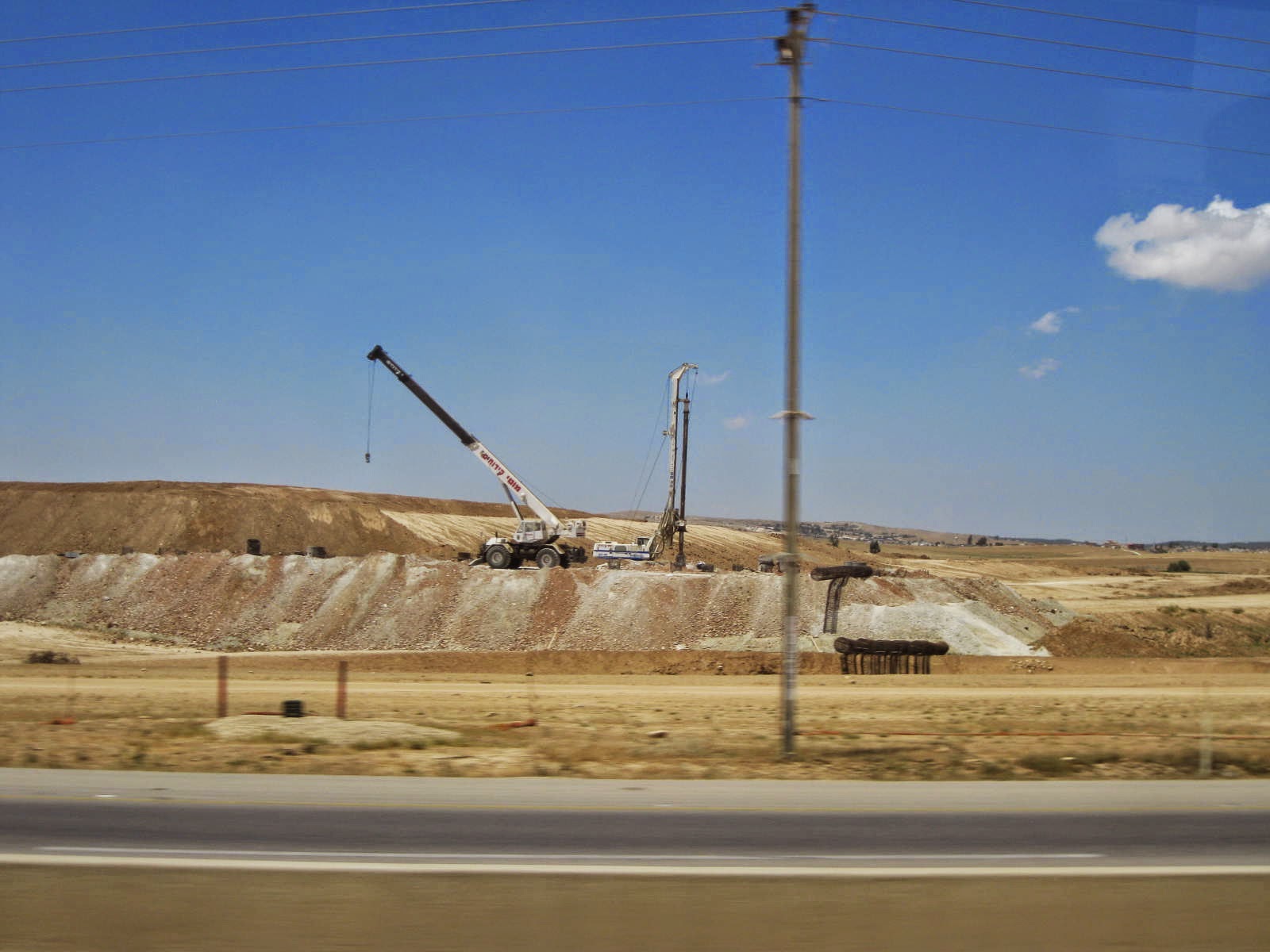
Lots of road construction going on between Meitar and Beer Sheva.


But that doesn't keep the goat herds from coming quite near the construction sites and the busy highway.
Enlarge the photo to see the goats browsing
.
Linking the clear hot summer sky to SkyWatch Friday.
UPDATE:  Here's a nice sheep + shepherds video (from the rainy season, when fields are green.
.

Thursday, January 30, 2014

Good-bye desert, hello new neighborhood

.
Oi veh, I knew it had to come sooner or later.
This month they started chopping up the desert to add a new neighborhood to Meitar.
(Meitar is a planned community, begun in 1984, and it expands according to plan.)


Enlarge the photo; see all those sections of pipe just waiting to become underground infrastructure?


Dust is flying as the diggers dig and the dump trucks dump.


Meanwhile they make a whole new landscape.


The new piles look like a field of giant molehills made by some giant burrowing mole.
Kind of unreal.


Bottoms up--there goes another load of several tons of good earth.
Sigh . . .

.
(The big blue sky over the former big desert joins SkyWatch Friday.)
.

Wednesday, September 18, 2013

The First Station (of the train, not of the Cross)

.
While over at Hels' excellent "Art and Architecture, mainly" blog,  I learned a lot from her post "Saving an Ottoman-era railway station in Jerusalem."

It made me realize that I still need to show you my last photos of the work in progress, back in April.
Later in the spring the First Station was opened to the public as an entertainment and cultural venue, so now my pictures are history. 


The end of the line!
Built in the 19th century, the rail line from Jaffa on the coast ended here in Jerusalem's German Colony.


Looking in the other direction, you see the actual rails don't extend very far anymore.
The were covered over in nice wood and bricks and made into a  bike + walkers' path extending for miles. 


 The venerable old train station was saved from the decay that had begun when this rail line to Jerusalem was closed in 1998. 
(Today the Israel Rail again reaches Jerusalem, but ends at a new modern and ugly station.)

The day I passed by, the workers were building a big wooden deck for the expected visitors to the new venue.
Enlarge the photo to see the cute "luggage wagons" soon to be kiosks.


Rebar was laid before concrete was pored.


A fancy fence, a sign of things to come.
.
For background of the station and the railroad you can see my 2011 post "Shadows and decaying elegance."
And for a laugh, see the misspelled traffic sign that briefly hung at the end of the tracks until it was discovered by bloggers and newspapermen and became a laughing stock.

All about the new "Place for food and culture"  at their website, http://www.firststation.co.il/en/.
.
.

Monday, July 15, 2013

Like a tropical island in a sea of construction

.

I wandered around a neighborhood in Jerusalem that was new to me, in the Talpiot area.
I even wandered into a construction zone,  since there was no one  guarding the entrance.
The abyss was deep and abrupt; hope they get a fence and gate or a guard soon!

But I couldn't tear myself away from the exciting scene.
Look at the island they left, complete with three trees! 


The big backhoe went on chomping away at the rocky earth.

You can enlarge both pictures, click two times, to see what not long ago was underground. 

Wondering why that island has been spared  . . .
And what will be built around it . . . 
.
(Linking to Our World Tuesday.)
.

Monday, July 8, 2013

Devouring Nature

.

While on a bus trip from Jerusalem to Beersheba today  I saw  the massive Highway One upgrade underway.
It was my first time to see it and I was shocked.

The 2.5 billion shekel project is supposed to improve safety and journey time between Sha'ar Hagai (Bab el Wad) and the entrance to Jerusalem.
But meanwhile  huge machines are destroying the forest and tearing apart the mountain on the south side and are destroying  nature in the valley on the north side.

To learn about the grandiose plans read this article.
This will go on for YEARS. 

Drivers are asked to use alternate routes, but the people  who live along the way and have no choice but to exit onto Highway One are suffering from the disruption and congestion.
It is our major Jerusalem-Tel Aviv highway (and to points beyond as well). 
.
(Linking to Our World Tuesday.)
.

Wednesday, January 2, 2013

A time to cast away stones, and a time to gather stones together ...

.
Around  2005 they had to temporarily move Jerusalem's  65-ton Calder sculpture a few blocks away so they could build an underground car park for the future light rail passengers.
The terminus of the tram would be right there, on top of Mt. Herzl.


On the night of  March 12, 2008 two huge cranes slowly moved it back (in three pieces) to Holland Square,  the original location, the one that the artist had chosen.
See a slideshow of how they did it at the Jerusalem Foundation website.

In the following months it got a fresh coat of Calder red, a stone plaza with stone benches was built, and lights were installed.
Enlarge the picture above to see it being worked on in 2008.

Eventually everything was in place, neat and tidy; but it never attracted  people.
Everything was steel, stone, and concrete.


Guess what!  This is how it looks NOW, for the last few months!
Everything is torn up again.
I have no idea what the plan is.
Apparently something greener, softer, shadier, and more inviting.
.
Meanwhile the small crew of Arab workmen built themselves a wood and plastic shelter, a booth where they can have a smoke, boil some Turkish coffee, and warm up.
And then go out and dismantle the plaza some more. 
The winter wind can be fierce up there when it sweeps in from the valley. 


The deep Soreq Valley cuts through the Jerusalem Hills.
Some say that the sculpture, called "Homage to Jerusalem--Stabile," is meant to mimic the contours of the hills.


 Here are the American artist-engineer Alexander Calder's initials and the year he created this stabile.
(Oh, and there's the tram in the station, too.)
His sculpture  was installed in Jerusalem the next year, 1977, but Calder did not live to see that fine moment.

I hope we will all live long enough to see the completion of all the digging and re-digging and construction and balagan (mess, chaos) along Herzl Boulevard.
.
(More posts about the Calder are here.)
.
Tuesday, March 20, 2012

A mopping-up operation

.
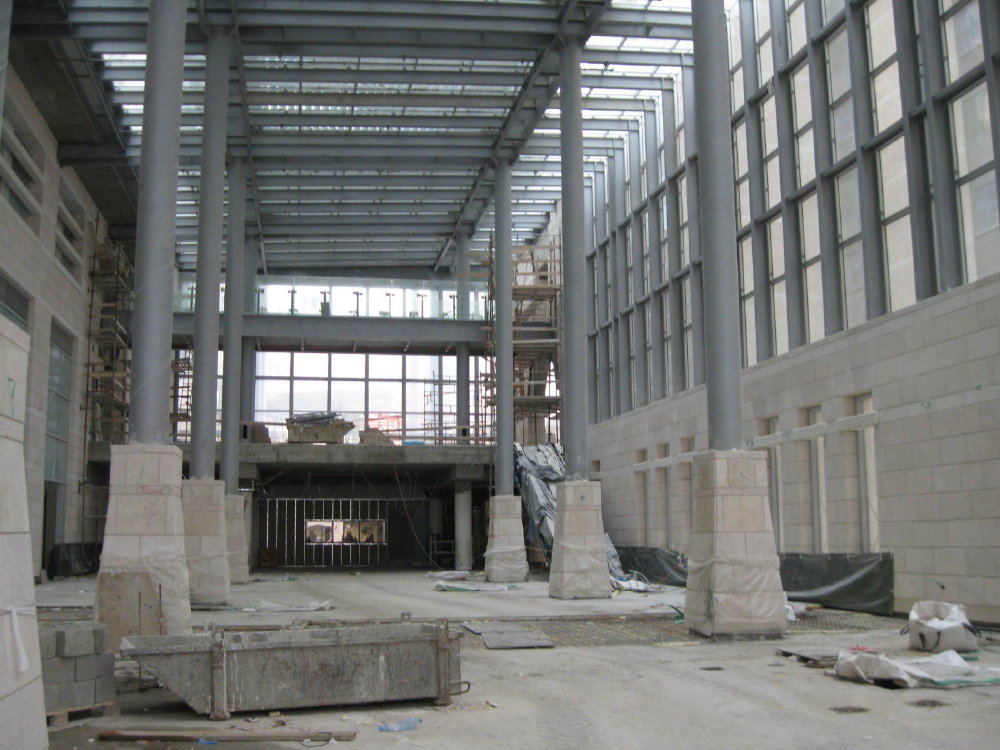
Today three workers were mopping the floor of the new atrium (although the "Caution" signs and the puddles did not deter many).

Just a few days ago part of the new hospital tower of Hadassah was dedicated.
Patients are already moving over to the Urology floor.
The grand dedication of the whole building is planned for October.

Here's how the same atrium looked last November!

I blogged then about the tour inside the construction area, led by the chief engineer (here and here).
It's quite a place and quite a pace!
.

Monday, January 2, 2012

More construction

.
A friend and I were wandering around the Abu Tor neighborhood yesterday, looking for the beginning of the Sherover Promenade.
But first we just HAD to check out a huge pit!
Well, the door was open and there was no guard there to chase us away.
.
The signboard announced the construction of the Sherover Culture Center.
I see now in Haaretz that the groundbreaking ceremony was only just last November.

The article says the center will
occupy an area of 13,000 square meters and include more than 10 movie theaters as well as galleries, a restaurant, cafe, stores, multipurpose auditoriums and an underground parking garage. The Sherover Foundation has promised that the stores will be of a cultural nature, selling books, music and design products, rather than "mall-like" retail establishments . . .
And unlike most cultural and entertainment institutions in Jerusalem, the center will be open on Shabbat.

Neighbors appealed to the District Planning and Building Committee against it but lost.
The committee determined that the petitioners were motivated by NIMBY (an acronym for "not in my backyard" considerations).

I am sure the neighbors in the building visible in the top of the photo are not happy with the prospect.
They are the Silent Clarisses, a Catholic order founded by St. Francis and St. Clare of Assisi.
The Poor Claire Monastery has been there for over a hundred years.


(I should be so poor! The huge monastic complex today sits on prime Jerusalem real estate.)
.
.
A post for Our World Tuesday and Monday Doorways.
.

Monday, December 5, 2011

Botnar Auditorium (I think)

.
For Monday Doorways (also Our World Tuesday), notice the little door between the two ... umm ... strange structures.
This is from last month, after they put in the pretty flowers.
It is part of the Hebrew University medical school at Hadassah Ein Kerem.


For the longest time I watched the curved things being built but had no idea what they would become.
Here is an early shot from March 2008.


Some concrete was poured in June 2009.
Meanwhile the normal building in back was finished, the Octav and Marcela Botnar Research Building.

The beginnings of a "roof" were visible in July 2010, next to many tall stacks of yellow-wrapped Isocam rock wool.
I never saw more than three workers down there, and they always seemed a bit hesitant and confused; like, "WHAT are we supposed to build??"

.
I don't blame them. Who ever saw such a thing!
.

Wednesday, August 10, 2011

Location, location

.
An unusual view of the famous old YMCA from the back.
The tall tower and the dome are part of the Y.
In back of it you see the venerable old King David Hotel.

But what's the big new building going up next to the YMCA?
The round sign on the fence says King David's Crown.
.

The eight-story crown-shaped residential building will have 200 apartments with underground parking and a tunnel to a new sports complex being constructed by the YMCA.

A 1.25-acre park designed by Israeli sculptor Adani will be artistically illuminated at night and include waterfalls and canals. It will be open to the public, they say.

Here's King David's Crown and the Y seen from the other side, from Keren Hayesod Street.
.
Take a virtual tour of the project at their website.
Look at these prices for an apartment, in millions of shekels!
.
Other posts about the YMCA are here and here.
.

Sunday, July 17, 2011

The unique retaining/acoustic walls explained

.

Readers were so interested in Begin Expressway's unique acoustic walls that appeared in yesterday's post (in my photo facing the opposite direction from this photo by the builders).
.
So I kept digging and finally found some answers to your questions.
The Gash website has close-ups of the combined retaining/acoustic walls. Take a look.
.
The engineers explain:

Begin Road connects Jerusalem's entrance coming from 443 highway and its south-west neighborhoods.
Gash engineers designed a three-span bridge and acoustic walls with unique architectural cross-sections.
Acoustic barrier semi-roofing shape

The height of the wall and its shape was determined by taking under consideration an acoustic defense line at the edge of the traffic lanes instead of at the margins of the road as usual. As a result the wall's height was lowered from 12-13 meters to 8.5 meters.
Its arch shape was developed in order to reflect the noise sound back to the road.
The structure consists of modules of projecting beams covered with arch-shaped membranes made of 8 cm concrete. The beams also support prefabricated plated serves as a retaining wall for the back landscape's filling.
.

Friday, July 8, 2011

A towering crane and its reflection

.
(This photo is more fun when enlarged.)

Waiting for a bus at Hadassah Ein Kerem Medical Center is never boring.
I can always watch a tall crane in action.
Hadassah is forever building something.
.
The other morning I had a bonus--a reflection for James' Weekend Reflections meme.
And there were workers on that suspended scaffold on the left!
Oi, they are brave.
.
This new tower is going to be for hundreds of badly needed additional hospital beds.
.
Shabbat shalom, sei gesund (be well).
.

Tuesday, May 31, 2011

Destruction, reconstruction, and construction

.
In 1928 Arab entrepreneurs financed the construction of the Palace Hotel on Jerusalem's Agron Street. The hotel was the most luxurious in the Middle East, with elevators, a central heating system, and even private bathrooms – practically unheard-of at the time.
.
From 1935 it was leased to civil and military units of the British Mandatory government.
Later, the Israeli Ministry of Industry and Trade used it.
Eventually it was closed down.
.
Now it is being turned into the Waldorf-Astoria Palace Jerusalem Hotel.
.
It was gutted and the historic and beautiful facade was preserved.
Enlarge the photo above and marvel at how they dug the construction pit under the outer shell!
.
I have been following its progress since 2008.
.
See how the shell wraps around three sides and the new construction starts in the middle?
.
This shot from last March shows how the old and new walls have been joined together.
The original Arabic inscriptions, intricate stone carvings, and decorative arches are being fully restored.
.
For the nitty-gritty on the Palace then and now, read here.
.
A similar project is going on for the old Saidoff Houses. See http://jerusalemhillsdailyphoto.blogspot.com/2010/10/where-history-meets-luxury.html
and
http://jerusalemhillsdailyphoto.blogspot.com/2010/10/saving-old-stones.html
.
And for more about the ubiquitous construction in Jerusalem you can click on my label "construction."
.
For ABC Wednesday, T is for Theme Day.
Yes, it is our monthly City Daily Photo group's Theme Day, today about "Under construction."
Click here to view thumbnails for all participants.
.

Wednesday, January 26, 2011

Italian tiles on a Russian roof in Ein Kerem

.
So many of you liked the Gornensky Convent that I give you more today.
Please see yesterday's comments for answers to questions raised.
.
Enlarge and see that the cathedral's domes were still black in 2007.
You can see the perimeter walls that circle the huge Russian complex.
All those tall dark cypress trees are on the convent grounds.
.
April 2009--scaffolding all around and the cathedral domes were plated with gold-colored metal. (Not sure what it is exactly.)
Photo snapped from the bus I take to go into Jerusalem, seen on top of the hill.
.
From inside Gornensky, you see the village of Ein Kerem (now part of Jerusalem) nestled in the valley of the Jerusalem Hills.
The top of the ridge on the far horizon is already the West Bank.
.
When I visited the convent in October they were building some small new building.
.
Italian bloggers especially, enlarge the photo and read the fine print!
Those are stacks of Territalia terracotta roof tiles. Their website says they export a lot of them to the Middle East.
The Cunial family has been making tiles for 120 years and they now produce 25 million tiles per year.
Don't you love that logo of a tortoise with a shingled shell?
.