Showing posts with label Nachman. Show all posts

Sunday, February 27, 2011

Praise, even on a van roof

.
For these joyous photos I selected the "happier" verses of Psalm 9, as a contribution to Robert's Psalm Challenge.
The entire psalm can be enjoyed, in both English and Hebrew, at Mechon Mamre in a more classic translation than the one used below.


2. I acclaim You, LORD with all my heart; I tell all Your wonders.
3. I rejoice and exult in You, singing a hymn to Your name, O Most High.
. . .
11. Those who know Your name trust You, for You do not abandon those who seek You, O LORD,
12. Sing a hymn to the LORD, who stays in Zion; declare His deeds among the peoples.
. . .
14. Have mercy on me, O LORD . . .
15. so that in the gates of the Daughter of Zion I might tell all Your praise, I might exult in Your deliverance.
. . .
The minute I came out of the big blue Binyaney HaUma convention center (site of the Book Fair), I heard "spiritual" techno music blaring over on a major Jerusalem road.
Emerging from the pedestrian tunnel under the road, I was delighted to find two young Na Nachs!
.
One was on the van roof trancing to trance music ("a type of electronic dance music with repetitive rhythms, aiming at a hypnotic effect").
The other was dancing around a table with Na Nach items: their signature tasseled white kipot, bracelets and amulets, stickers, books.
.
This newest of the Hasidic sects, a subgroup of Breslover Hasidim colloquially known as the Na Nachs, believes in praising God with joy and making Judaism happy and fun.
.
The mantra that you see on the van is written or stuck on every public place imaginable. See my collection and explanation of their graffiti at my post The Ubiquitous Nachman of Uman.
More at my label "Nachman."
.
Wikipedia talks about Na Nach here and in more depth here.
France 24 gives photos and info in "Na Nach Jews: religion, tradition, and techno music."
.
Shalom and a happy Sunday to all!
.

Friday, October 1, 2010

Na nach

.
The most widespread graffito in Israel has to be the one about Rabbi Nachman of Breslov.
The mantra (written in Hebrew in the photo) is "Na, nach, nachma, Nachman me-Uman."

For the explanation of this phenomenon please see my earlier post, The Ubiquitous Nachman.

You can see more examples of graffiti in Jerusalem, including inside the Church of the Holy Sepulchre (!), under my label "graffiti."
.
City Daily Photo community members are sharing their graffiti today for our monthly Theme Day.
Click here to view thumbnails for all participants .
.

Sunday, July 25, 2010

The whole world is a narrow bridge

.
A narrow bridge over the flowing spring-fed waters of Ein Gedi,
.
Back in the 18th century, mystic Rabbi Nachman of Breslov taught
"Know! A person needs to cross a very narrow bridge, but the most important thing is not to be afraid."

And till today we sing the song:

The whole world
is a very narrow bridge
a very narrow bridge
. . .
And the main thing to recall
is not to be afraid,
not to be afraid at all.

In Hebrew:

Kol ha'olam kulo
Gesher tsar me'od
Gesher tsar me'od
Gesher tsar me'od -

Kol ha'olam kulo
Gesher tsar me'od
Gesher tsar me'od -

Veha'ikar - veha'ikar
Lo lefached -
lo lefached klal.

Veha'ikar - veha'ikar
lo lefached klal.

If you'd like to get swept up in the enthusiasm of the singing, here is a little video on YouTube.
.

Friday, July 2, 2010

In the Footsteps of the Ba'al Shem Tov

.
"In the Footsteps of the Ba'al Shem Tov" is a wonderful new exhibition that just opened at the Jewish National and University Library in Jerusalem, at the Givat Ram campus.
.
It marks 250 years since the death of the Ba'al Shem Tov, the great mystic considered the founder of Hasidic Judaism, and 200 years since the passing of his great-grandson, Rebbe Nachman of Breslov.


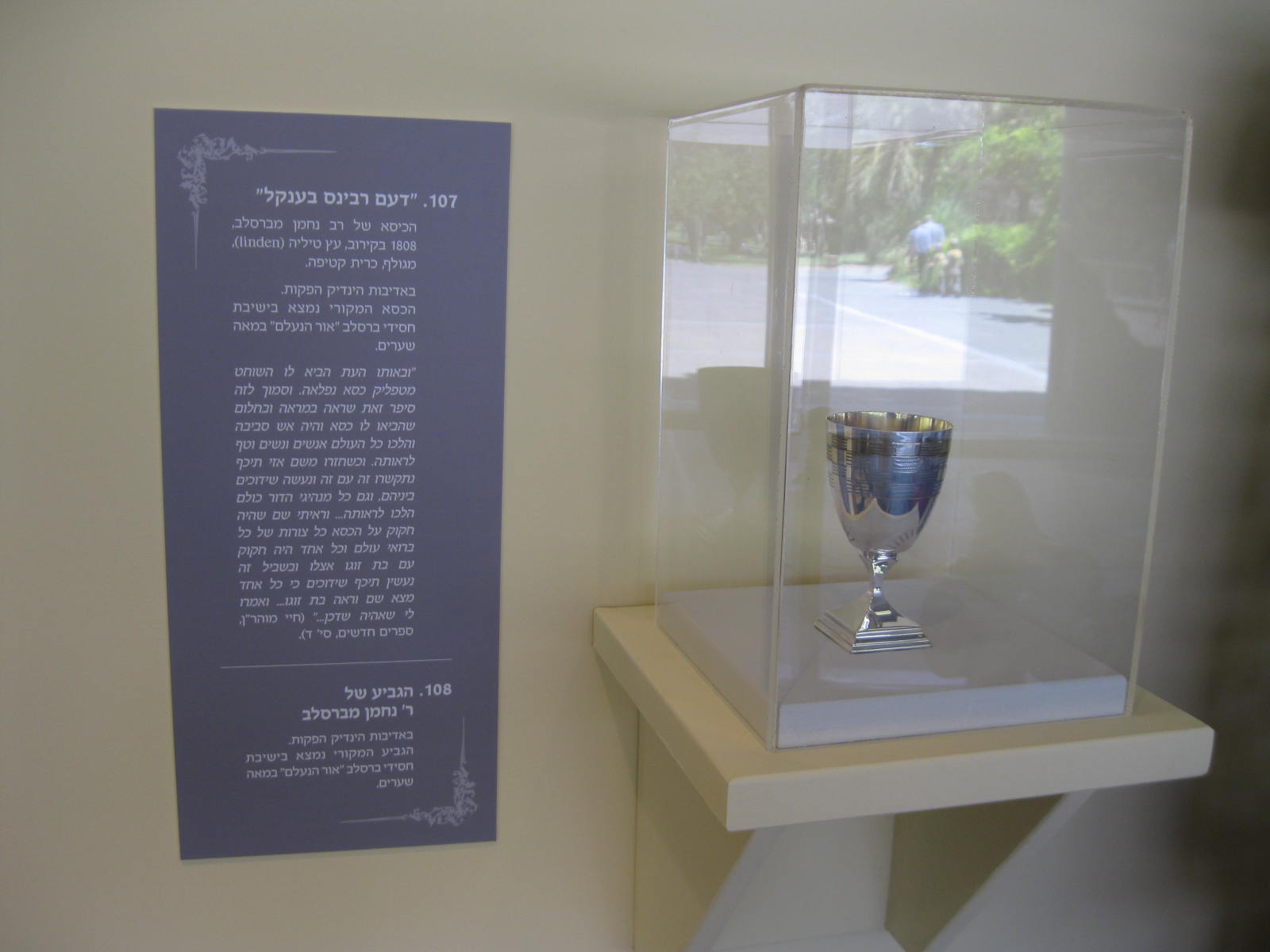
For James' Weekend Reflections there is something reflected in this copy of Rabbi Nachman's kiddush cup.
And a man followed by a boy, walking outside, are reflected in duplicate in (and by?) the display case.
.
With a bit of reflection under it, this is a faithful copy of the original chair of Reb Nachman which was carved in about 1808.
For the amazing story of how it was saved from destruction, please see
http://www.breslov.org/aboutbreslov/thechair.html.
.
It is told that shortly after the shohet of Teplik (in the Ukraine) finished carving the chair and presented it to Nachman as a gift, that night Reb Nachman dreamed (or had a vision) that someone brought him a throne, surrounded by fire.
Everyone, men, women, and children, came to see it. Engraved on that throne were all the world's creatures, along with their mates.
And as the people turned to go, bonds were formed between them and marriages were arranged at once, for each had been able to find his mate.
And in the dream Reb Nachman sat down on the chair, and all at once he found himself flying through the heavens, and before him he saw Jerusalem, glowing like a jewel in the distance. It was indescribably beautiful, and as he approached it, he woke up.
.
. . . And they told him he would be a matchmaker.
.

Tuesday, December 9, 2008

The Ubiquitous Nachman of Uman

.
Today's letter for ABC Wednesday is U. So it should not seem unusual for us to post about the ubiquitous Nachman of Uman, Ukraine.
.
Nachman of Breslov (1772-1810), a great-grandson of the Baal Shem Tov, was the founder of the Breslov (or Bratslav) branch of Hasidic Judaism.
.
" The Breslov approach places great emphasis on serving God through the sincerity of the heart, with much joy and living life as intensely as possible.
Its Hasidim see Torah life as the means to a joyful existence, and their approach to worship is very personalized and emotional, with much clapping, singing, and dancing. . . .
Besides the regular daily services in the synagogue, Rebbe Nachman advised his followers to engage in hitbodedut (literally, "self-seclusion") on a daily basis.
In this distinctively Breslov practice, the individual Hasid engages in a free-flowing verbal communication with God for one hour a day.
During hitbodedut, the individual pours out his thoughts and concerns in his mother tongue, as if talking to a close personal friend.
The goal is to establish a close, personal relationship with God and a clearer understanding of one's personal motives and goals."
(from Wikipedia)

Wiki claims that "A few Breslovers also use a form of mantra meditation by repeating a word or phrase over and over. . . .
A small group of modern-day Breslovers use the Na Nach Nachma mantra, which is based on the Hebrew letters of Nachman's name.
This mantra was not used by Rebbe Nachman himself, but was taught in the 20th century by Rabbi Yisroel Ber Odesser.
However, this group is not part of mainstream Breslov, and is rejected by most adherents."

I think Wiki is underestimating.
Judging from the ubiquitous graffiti, printed signs, and Na Nach kipot all over the place, there must be MANY who believe in the power of the mantra. In Jerusalem, at least, and in Tsfat for sure.
One of the results of reciting and writing the mantra, so they say, will be the hastening of the coming of the messiah.
.
Every time you add one more syllable: Na, nach,, nachma, nachman me-uman.
.
Uman, in the Ukraine, is where Rebbe Nachman is buried. Every Rosh Hashanah tens of thousands of Breslovers make a pilgrimage to his grave.
If you want to know more about how this mantra was revealed in a mysterious "Letter from Heaven," please read here.
.
Meanwhile, be happy!
.