Showing posts with label historical photos. Show all posts

Wednesday, January 4, 2017

"In Basel I founded the Jewish State."

.
For ABC Wednesday, Z is for Zionism.


While I was volunteering at the monastery in Switzerland, a nun-friend took me to Basel on the train and guided me around the beautiful city for a whole day.
We made it into a kind of Zionist "pilgrimage."
We walked over to the Grand Hotel Les Trois Rois, also known in German as Hotel drei Könige, famous since at least 1681.


This is where Theodor Herzl stayed while he chaired the First Zionist Congress in 1897.


Perhaps this balcony is where he stood when the famous photograph was taken of Herzl gazing over the Rhine and into the future, envisioning a future homeland for the Jewish People.


Indeed, the wide river flows right next to the hotel.


The meetings of the First Zionist Congress took place in the ballroom of the Stadtcasino, another famous building in Basel.
(It is closed for now, undergoing renovations.)


It was here that the Basel Declaration was formulated and Hatikva adopted as the Zionist anthem.


On September 3, 1897,  Dr. Theodor Herzl wrote in his journal:

"Were I to sum up the Basel Congress in a word - which I shall guard against pronouncing publicly - it would be this:  At Basel I founded the Jewish State.  If I said this out loud today l would be greeted by universal laughter. In five years perhaps, and certainly in fifty years, everyone will perceive it."
.

Wednesday, February 3, 2016

The 3-dimensional illusion in historical photos

.

For ABC Wednesday, D is for Dina in 3-D glasses.


Dozens of glasses wait for visitors and pupils who come to the Open Museum in Omer.


You can't see them properly, of course, but here are some examples of the big three-dimensional photographs taken in Eretz Israel in the late 19th century.
Here above is Jerusalem's Jaffa Gate when it still had the Ottoman clock tower just outside the Old City wall (the tower was soon torn down by the British in 1922).


This is labeled "Ancient Fountain of the Virgin, Nazareth, Palestine."
It was fascinating to gaze at these pictures; I felt like I was really "in" the scene, mingling with the women and children. 


Fallahin plowing.


"Tiberias, a town of Jewish fisherman, Sea of Galilee"


Please click on the photo and then once again.
You can read how stereographs were made and how American publishing house Underwood and Underwood produced and sold the set about Eretz Israel in 1900, focusing mostly on the Christian market.
.

Sunday, March 9, 2014

What is it?

.

Beer Sheva's Old City is a strange mixture of crumbling "old" early 20th century Ottoman Turkish buildings, renovated houses, and new structures.
But this castle-like place is the strangest place I've seen so far.
In September it was still being worked on.
I'll have to go see what it turned out to be, if I can find that little street again.

The Municipality has started investing in renewal of the Old City.
Let's see if it will attract more visitors and shoppers.
.
UPDATE: 

Beersheba ca. 1900
Photo by American Colony-Jerusalem Photo Dept.
(Collection is now in the Library of Congress)

 Some history from Wikipedia:
The Ottomans, who had controlled Palestine since the 16th century, took an interest in Beersheba in the late 19th century.[7] At the beginning of the 19th century, European pilgrims to Palestine described Beersheba as a barren stretch of land with a well and a handful of Bedouins living nearby. Towards the end of the 19th century, the Ottomans built a police station in Beersheba in order to keep the Bedouin in check.[8] 
They built roads and a number of small buildings from local materials which are still standing today. A town plan, created by Swiss and German architects, called for a grid street pattern,[9] a pattern which can be seen today in Beersheba's Old City. All houses built during that period were of one story, and the two-story police station towered above them. 
Most of the residents at the time were Arabs from Hebron and the Gaza area, although Jews also began settling in the city. Many Bedouin abandoned their nomadic lives and built homes in Beersheba.
 .
(Linking to Our World Tuesday and  Whimsical Windows, Delirious Doors.)
.

Monday, November 11, 2013

.
A SOLDIER
OF THE GREAT WAR
KNOWN TO GOD
.

The Beersheba War Cemetery contains 1,241 Commonwealth burials of the First World War, 67 of them unidentified.

 More about the cemetery from the Commonwealth War Graves Commission:
Country: Israel and Palestine (including Gaza)
Identified Casualties: 1173

By October 1917, General Allenby's force had been entrenched in front of a strong Turkish position along the Gaza-Beersheba road for some months, but they were now ready to launch an attack with Beersheba as its first objective. On 31 October, the attack was carried out by the XXth Corps . . . on the west, and the Desert Mounted Corps on the east. That evening the 4th Australian Light Horse Brigade charged over the Turkish trenches into the town.

The cemetery was made immediately on the fall of the town, remaining in use until July 1918, by which time 139 burials had been made.
It was greatly increased after the Armistice when burials were brought in from a number of scattered sites and small burial grounds.

The cemetery in 1917 or 1918.
.
(Glass stereotype dry plate  photo by the American Colony Photo Department.
Library of Congress )
.
.
(Linking to Our World Tuesday.)

Monday, October 28, 2013

From India to Israel--a big change

.

 For several days the blog has been showing Moshav Nevatim in the Negev desert.
Here is their Cochin Jewish Heritage Center.


Click to enlarge  and start to plan your  visit.

 The walls of the lecture and video room are covered with wonderful old photographs of the Cochin communities.
Here above are the young men of  Kehilat Ernakulam  over half a century ago.


The left photo is from 1952.
About then the Jews starting leaving India in order to immigrate to Israel.
Our guide at the museum emphasized that the different religious groups in India lived together  in sovlanut and savlanut, with tolerance and patience, and there was no anti-semitism.


And here the men are already at Nevatim, a moshav (a collective agricultural settlement) in the desert, working hard picking  apricots in the  1970s.
The Cochin Jews were also settled on four other moshavim when they made aliyah in the mid 1950s.
Nevatim had previously been abandoned and the group found primitive and difficult conditions on their arrival in 1954, and they were not used to working in agriculture.
But they were dedicated to the homeland of Israel and they took up the task of working hard to make their little patch of desert bloom.
.
(Linking to Our World Tuesday.)
.
UPDATE Nov. 12:  A new article appeared today, very interesting:
 http://www.timesofisrael.com/a-jewish-war-hero-and-the-last-vestige-of-a-dying-indian-community/
Lt. Gen. Jacob, an old hero living in New Delhi, says "India has always been very good to us. I am very proud to be a Jew, but am Indian through and through. I was born in India and served here my whole life; this is where I want die.”
“The only place I encountered anti-Semitism was from the British in their army,” he says. “Among Indians it does not exist.”
.

Thursday, April 18, 2013

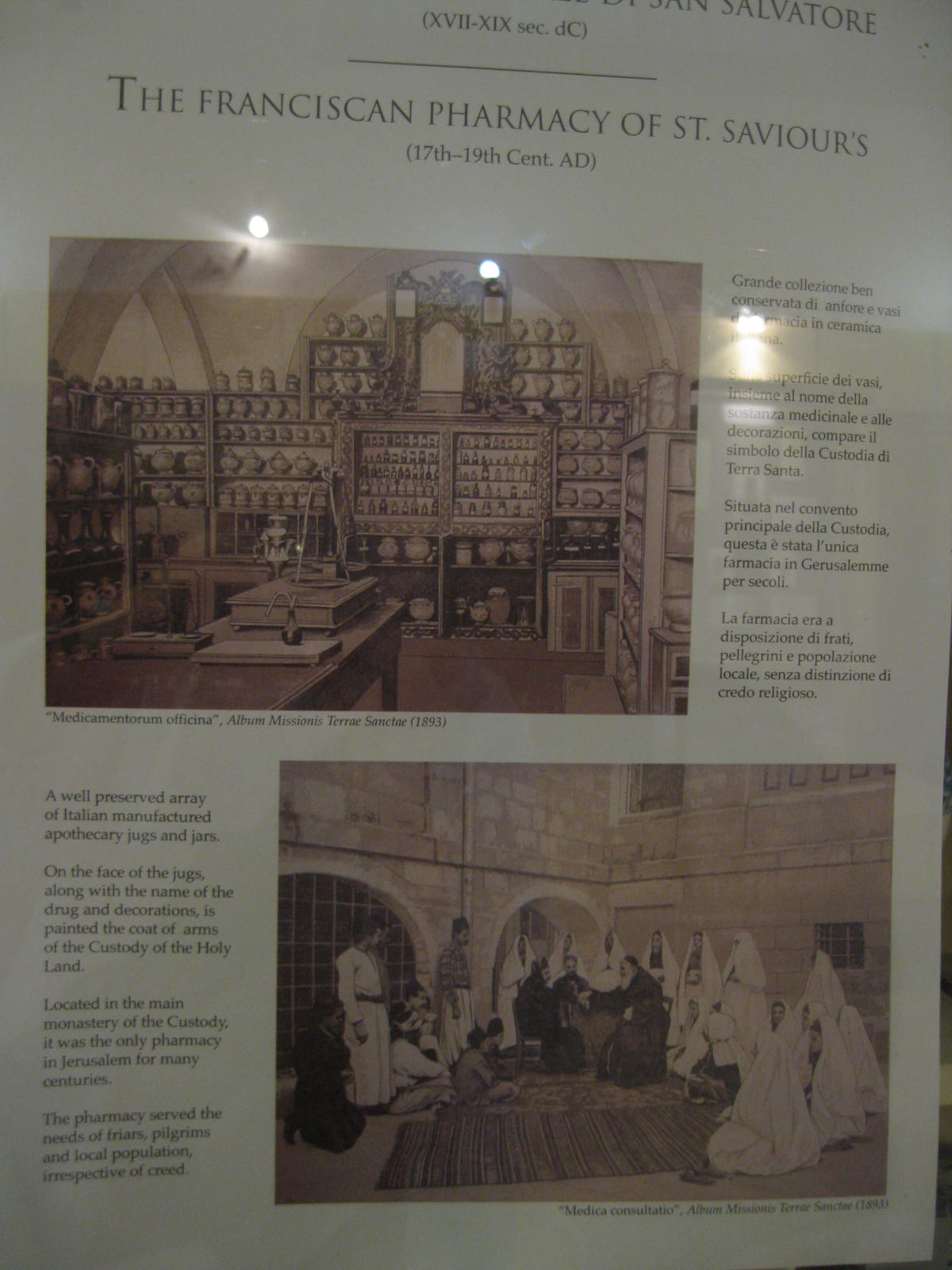
Hundreds of centuries-old apothecary jars!

.
(All photos can be enlarged with a click, then one more click.)


In yesterday's post we talked about the Studium Biblicum Franciscanum Museum, located on the Via Dolorosa, in the Flagellation Monastery,  near the Lions Gate.

One of its unique treasures is the Pharmacy of St. Saviour's Monastery.


Here is how the Custody of the Holy Land website describes it:
 "The Pharmacy of St. Saviour's Monastery in Jerusalem dates back to as early as 1620. However its real development  must be attributed to Fr Anthony Menzani of Cuna (1650 - 1729) - a friar physician and pharmacist. 
It was described as one of the finest pharmacies in the Christian world at that time. 
Fr Anthony worked tirelessly practicing his medical art day and night. But he also loved his pharmacy. After many years work Fr Anthony invented and formulated the well renowned "Balsam of Jerusalem' which was an important remedy for various ailments for about two centuries in Europe and the near East."

"Commissioned by the Custody of the Holy Land to the firm of Boselli in Savona, near Genoa in Italy, the collection was embellished by supplementary pieces coming from Venice. The Savona pots are dated from the middle of the 17th century up to the 19th century. 
Many of them have the firm's mark on the bottom (a hawk with crown) and also the signature: "Giacomo Boselli Savona 1791". On the face of the jugs, along with the name of the drug and decorations, are painted the coat of arms of the Custody of the Holy Land and that of the Republic of Genoa."


Here is the Lion of St. Mark, the symbol of Venice.


The photos from 1893 are so nice.

Today's Franciscans describe their former pharmacy in the sign:
. . .
Located in the main monastery of the Custody, it was the only pharmacy in Jerusalem for many centuries.
The pharmacy served the needs of friars, pilgrims and local population, irrespective of creed.
 -------------------
If you'd like to delve into the fascinating details, there is an article for you at Jerusalem Balsam website called
Franciscans Medical, An Early Glimpse at Western Medicine in Jerusalem 1700-1840:
The Case of the Jews and the Franciscans Medical Activity, by Zohar Amar and Efraim Lev.
-------------------
See also my posts about the  Materia Medica in the History of Jerusalem  exhibit that is or was at Shaare Zedek Hospital:
 http://jerusalemhillsdailyphoto.blogspot.co.il/2011/07/for-good-for-blessing-for-healing-and.html
and
http://jerusalemhillsdailyphoto.blogspot.co.il/2011/07/concocting-cure.html
.

Friday, March 15, 2013

King David awaits Obama

.

Jerusalem's King David Hotel  anxiously awaits the arrival on Wednesday of President Obama and his entourage of hundreds.
Every room of the prestigious hotel is in fact booked for them. 


Recently I was delighted to find this huge historical  photo covering  a whole wall in the lobby.
It shows Ragheb Bey al-Nashashibi, Arab mayor of Jerusalem 1920-1933, inaugurating the new King David Hotel tennis courts on June 13, 1931.
 .