Showing posts with label history. Show all posts

Wednesday, January 18, 2017

The Great Synagogue of Basel

.

The Great Synagogue of Basel was built in 1868.


But, it says on the plaque, the first synagogue of Basel existed already in 1200.


A friend took me to Basel on a cold gray day in December.
We looked at the exterior of the impressive building but everything was locked up.
It was a Shabbat afternoon and not a soul was to be seen.


But we can learn from the Jewish Virtual Library website that

the Great Synagogue is a national landmark.  The synagogue, first built in 1868, was expanded and renovated several times over the past century-and-a-half. The Great Synagogue, at Leimenstrasse 24, houses two synagogues, a choir, mikveh, and is beautifully designed. Next door to the synagogue is the community center, library, and day school.
That website, by the way, tells the not always happy history of Jews in Switzerland since the Middle Ages;  very interesting, and not what you'd expect.


The nice website of the Basel Jewish Community, however, paints a rosy picture of today's Jewish situation:

Around 2000 Jews live in and around Basel, a dynamic commercial and industrial city with a rich culture and located in the heart of Europe. Founded over 200 years ago, the Israelitische Gemeinde Basel (IGB) is one of the largest Jewish communities in Switzerland. It is equipped with all the necessary organizations and a well-developed infrastructure. The community is an institution under public law, and legally on equal terms with the churches. As a so-called united community, the IGB includes Jewish members of any religious orientation. It is run according to the rules of the Halacha.
While the majority of the members of the IGB identify with a non-practicing direction of Judaism, there is still a vibrant religious life in this Community. Daily Shacharith as well as Minchah and Ma’ariv services are carried out. Before the Shacharith service, a Daf Yomi takes place daily. On almost all shabbat mornings, the Synagogue Choir Basel contributes to the service. The IGB is one of the few communities in Europe, in which all shabbat as well as Yom Tov services are led by a full-time and professional chazan [cantor].


You can click on my photos a few times to see the details.
And don't miss  panoramic views of the interior at Synagogues360.
.
UPDATE: The building has undergone many changes in its long history, including the addition of the two domes.   Here is how it looked in 1930:

.
(Linking to inSPIREd Sunday,  ABC Wednesday and Our World Tuesday.)
.

Wednesday, January 4, 2017

"In Basel I founded the Jewish State."

.
For ABC Wednesday, Z is for Zionism.


While I was volunteering at the monastery in Switzerland, a nun-friend took me to Basel on the train and guided me around the beautiful city for a whole day.
We made it into a kind of Zionist "pilgrimage."
We walked over to the Grand Hotel Les Trois Rois, also known in German as Hotel drei Könige, famous since at least 1681.


This is where Theodor Herzl stayed while he chaired the First Zionist Congress in 1897.


Perhaps this balcony is where he stood when the famous photograph was taken of Herzl gazing over the Rhine and into the future, envisioning a future homeland for the Jewish People.


Indeed, the wide river flows right next to the hotel.


The meetings of the First Zionist Congress took place in the ballroom of the Stadtcasino, another famous building in Basel.
(It is closed for now, undergoing renovations.)


It was here that the Basel Declaration was formulated and Hatikva adopted as the Zionist anthem.


On September 3, 1897,  Dr. Theodor Herzl wrote in his journal:

"Were I to sum up the Basel Congress in a word - which I shall guard against pronouncing publicly - it would be this:  At Basel I founded the Jewish State.  If I said this out loud today l would be greeted by universal laughter. In five years perhaps, and certainly in fifty years, everyone will perceive it."
.

Saturday, October 11, 2014

First feast day today for St. John XXIII

.
Today is the first-ever Catholic feast day for newly-canonized Pope St. John XXIII.

He was pope from 1958 to 1963, and Israeli flags were lowered to half mast when he died.
Last year, for the 50th anniversary of his death, Jerusalem hosted a wonderful conference which brought together top scholars and high-ranking clergy from Israel and the world.
You can enlarge the photos 2x and perhaps you will recognize the names and faces of some of the speakers.


International Conference: Honoring the memory of Pope John XXIII
The Shoah, the Jewish People & the State of Israel
Day long conference covering topics such as: Roncalli and the Shoah, Roncalli and the Establishment of the State of Israel, John XXIII, Vatican II and Nostra Aetate, and The Legacy of John XXIII for Catholic-Jewish Relations – Europe & the World


See the program of the seminar here, including a video of President Peres' thoughts on "The Good Pope," as Roncalli was popularly known.


The large audience got to see the hour-long prize-winning Israeli film "I Am Joseph, Your Brother."

 (Read more about the time the Pope first spoke that  Biblical verse to his Jewish guests.)

The movie's website begins
During the 1960s, Pope John XXIII met with a delegation of Jews and said, "I am Joseph Your Brother" marking the beginning of a new relationship between Jews and Catholics. Inspired by the visit of Pope John Paul II to Israel in 2000, I am Joseph, Your Brother assesses and reflects on the changes that have occurred in the often difficult and turbulent relationship that has existed for centuries between Jews and Christians, Judaism and Catholicism, and more recently, between the State of Israel and the Vatican.


Some of the pearls I remember well from that day:

When the Church assigned Angelo Giuseppe Roncalli to several Eastern European countries during World War II,  he was able to save up to 100,000 Jews from the hands of the Nazis, mostly through what some call "Operation Baptism."

One speaker predicted that when history gets straightened out, Israel may someday have streets named for Pope John XXIII and he will finally be included in Yad Vashem's Righteous of the Nations.

On June 3,  the official day of his death, our Knessent last year  held a special session on Roncalli.

A woods has been named for him in the Galilee, near Mt. Precipice.

It was this pope who convened the Second Vatican Council from which came Nostra Aetate. 
.
I must say, in the last decades Catholic-Jewish relations have come a long way, in both directions.
.
The Saint of the Day website gives these hopeful last words from Saint John XXIII:
On his deathbed he said: “It is not that the gospel has changed; it is that we have begun to understand it better. Those who have lived as long as I have…were enabled to compare different cultures and traditions, and know that the moment has come to discern the signs of the times, to seize the opportunity and to look far ahead.” 
.

Sunday, August 3, 2014

First World War -- 100 years ago, in Gaza

.
Today marks 100 years since the outbreak of World War I.

Many do not realize that thousands, many thousands, of young Commonwealth soldiers who were killed in that war are buried in Israel.
The Commonwealth War Graves Commission maintains four cemeteries in our region.

One is in Ramleh, not far from Ben Gurion Airport.
Recently I posted about the British Cemetery in Beer Sheva  here and also about the yearly  Australian Light Horse commemoration.
Please see ANZAC Day for my posts about the World War I cemetery in Jerusalem.


But the fourth cemetery is one I will never be able to visit.
It is in Deir al-Balah in central Gaza.
So here are two photos from the Commonwealth War Graves Commission website, on the Find A Cemetery page.


Gaza War Cemetery contains 3,217 Commonwealth burials of the First World War, 781 of them unidentified. 
Second World War burials number 210. There are also 30 post war burials and 234 war graves of other nationalities.

The CWGC gives this:

Historical Information

Gaza was bombarded by French warships in April 1915. 
At the end of March 1917, it was attacked and surrounded by the Egyptian Expeditionary Force in the First Battle of Gaza, but the attack was broken off when Turkish reinforcements appeared. 
The Second Battle of Gaza, 17-19 April, left the Turks in possession and the Third Battle of Gaza, begun on 27 October, ended with the capture of the ruined and deserted city on 7 November 1917. 
Casualty Clearing Stations arrived later that month and General and Stationary hospitals in 1918.

Some of the earliest burials were made by the troops that captured the city. About two-thirds of the total were brought into the cemetery from the battlefields after the Armistice. The remainder were made by medical units after the Third Battle of Gaza, or, in some cases, represent reburials from the battlefields by the troops who captured the city. Of the British Soldiers, the great majority belong to the 52nd (Lowland), the 53rd (Welsh), the 54th (East Anglian) and the 74th (Yeomanry) Divisions.

During the Second World War, Gaza was an Australian hospital base, and the AIF Headquarters were posted there. Among the military hospitals in Gaza were 2/1st Australian General Hospital, 2/6th Australian General Hospital, 8th Australian Special Hospital, and from July 1943 until May 1945, 91 British General Hospital. There was a Royal Air Force aerodrome at Gaza, which was considerably developed from 1941 onwards.
.
(Linking to Our World Tuesday.)
.

Wednesday, June 11, 2014

The Struma synagogue and museum

.
Here is another of the three  Beer Sheva synagogues we heard about during Israel Heritage Preservation Week. 
Last week for Shavuot  I blogged about its beautiful Torah scrolls and the colorful tablets of the Ten Commandments glass door.


The bima, where the Torah scroll is unrolled and chanted, is in the center.


But the pulpit is right in front of the aron kodesh, the Torah ark.


The pews are forward-facing, typical for Ashkenazi synagogues (and not like the ones we saw in yesterday's post.


Arie Raiter, President of the Struma Museum and Synagogue, one of the founding members of the congregation, told us all about the history of the building.

If you look at the photos again, you might see that the front of the sanctuary has like the ribs of a ship's bow and along the side walls are "portals," like windows of a ship.

One story made the biggest impression on me (members of the tour group, Israel heritage lovers, also rolled their eyes):
Once he caught two neighborhood boys throwing stones at the windows. 
He asked them "How can you do such a thing to a synagogue which is named in memory of the holy Jewish martyrs of the sunken ship Struma?!"
But they didn't know what he was talking about. 
He took one to the boy's school and confronted his teacher; to Arie's dismay, the teacher had never heard of the Struma.
He then went to the school principal but  was shocked that even she did not know the Struma.


I think that is when he saw the need to put up explaining signs outside and also to make a library of Holocaust books and a history museum about the Struma on the top floor of the synagogue.

The 1942  sinking of the "illegal" immigrant ship was a tragic and seminal event which shaped the ethos of the not-yet-independent state of Israel.
For the founding generation of Israel it signaled their mission to reach a position of strength so that such injustices against Jews could never again be carried out. 
But it is a modern tragedy that younger generations apparently are not being taught about the Struma and its lesson for us. 

Here is the short version from Yad Vashem Shoah Resource Center:

On December 12, 1941, 769 Jews boarded the Struma in the Romanian
port of Constanta. They had been witness to the massacre of Jews in
Bessarabia and Bukovina, and were desperately trying to escape Europe. The
Struma's first stop was to be Istanbul, Turkey---despite the fact that the
passengers had no visas for Turkey. The boat was hardly seaworthy, and
barely reached Istanbul. When it finally arrived, the passengers were not
allowed to disembark. For ten weeks, they were restricted to the boat. The
Turks refused to transfer them to a transit camp on land, even though the
camp would have been funded in complete by Jewish organizations. In
addition, nothing could convince the British authorities to admit these refugees
into Palestine, because they did not want to set a precedent for similar
escapes.
On February 23, 1942 the Turkish authorities took matters into their own
hands: they towed the old ship to the open sea, without fuel, food, or water.
Within hours, the ship was torpedoed, most probably by a Soviet submarine
that mistook it for an enemy German ship. All but one refugee drowned.

-------------------
 But I suggest you read the full story at http://www.jewishgen.org/romsig/Strumah.html
or at
http://en.wikipedia.org/wiki/Struma_disaster

And another telling of the Struma history  is more emotional and thought-provoking regarding Israel's future:
http://sarahhonig.com/2012/02/24/another-tack-lessons-from-the-floating-coffin-another-tack-lessons-from-the-floating-coffin/
 .
(Linking to inSPIRED Sunday.)
.

Friday, August 23, 2013

Walking over ancient history

.

The newly redeveloped  Beersheva Central Bus Station gets a lot of foot traffic.
But the floor is clean and shiny enough to reflect the signs of Burger Ranch, CocaCola, and Little Switzerland.
Good for James' Weekend Reflections.


This special part of the floor is right next to one of the entrances to the bus station.


Look what's under the glass floor--antiquities!!
Found a year or two ago just one or two feet below surface, in a rescue dig! 


 "For Byzantine Beersheba, this was it,"  according to Dr. Daniel Varga, excavation director for the Israel Antiquities Authority, who conducted the dig. "This was the heart of the Byzantine city, right here. Two Byzantine churches were built within a radius of 300 meters from here, and right over there was the Roman military camp."

The bustling Byzantine city of Beersheba was home to several thousand people and a popular stopping place for Negev travelers.
Surprisingly, most of the rooms were empty with no signs of destruction, suggesting that the residents left the area of their own accord.
 The Byzantine site is remarkably well preserved due to centuries of abandonment following Arab invasions in the seventh century C.E. and recent coverage by the old bus station itself.
(The Muslim conquest of Palestine was completed in 640.)

The dig information here comes from Travelujah and Bible History Daily articles from 2012.
.
P.S.  See my post on the Roman Tenth Legion  for a similar way of preserving antiquities under glass, under Jerusalem's International Convention Center. 
.

Tuesday, April 23, 2013

An amazing historical video for St. George's Day!

.

 City Daily Photo group is having a Theme Day on the subject of England's St. George's Day, which is today.
See how other bloggers illustrated the day at the CDP website.

St. George's Cathedral may be the closest thing we have to an old English church in Jerusalem.

Dedicated in 1898, the Cathedral of St. George the Martyr, mother church of the Anglican/Episcopal Diocese of Jerusalem, is home to both an Arabic-speaking and an English-speaking congregation.
It is on Nablus Road in east Jerusalem.
Enlarge the photo and see what's atop the bell tower.  : )
The  interior of the church is in my earlier posts about the organ and about the British symbols; and there's one about the attached guesthouse.
.
But what I really really want you to see is this amazing little  96-year-old movie of British General Allenby walking into the Old City through  Jaffa Gate to the stairs of the Citadel on December 11, 1917!
.
There he accepted the Turkish surrender of Jerusalem, ending 400 years of Ottoman rule in the Holy Land.
At the 1 minute mark you even see Lawrence of Arabia! 
Then the troops marched down Jaffa Street in the New City. 

The music of the video is the rousing hymn  sung in England especially on St. George's Day:
"And did those feet in ancient time" also called "Jerusalem" --which is an amazing story in itself! 
See the words here.   
Did Jesus really set foot in England?! 
.
.
(Linking to Whimsical Windows, Delirious Doors meme.)
.

Thursday, April 18, 2013

Hundreds of centuries-old apothecary jars!

.
(All photos can be enlarged with a click, then one more click.)


In yesterday's post we talked about the Studium Biblicum Franciscanum Museum, located on the Via Dolorosa, in the Flagellation Monastery,  near the Lions Gate.

One of its unique treasures is the Pharmacy of St. Saviour's Monastery.


Here is how the Custody of the Holy Land website describes it:
 "The Pharmacy of St. Saviour's Monastery in Jerusalem dates back to as early as 1620. However its real development  must be attributed to Fr Anthony Menzani of Cuna (1650 - 1729) - a friar physician and pharmacist. 
It was described as one of the finest pharmacies in the Christian world at that time. 
Fr Anthony worked tirelessly practicing his medical art day and night. But he also loved his pharmacy. After many years work Fr Anthony invented and formulated the well renowned "Balsam of Jerusalem' which was an important remedy for various ailments for about two centuries in Europe and the near East."

"Commissioned by the Custody of the Holy Land to the firm of Boselli in Savona, near Genoa in Italy, the collection was embellished by supplementary pieces coming from Venice. The Savona pots are dated from the middle of the 17th century up to the 19th century. 
Many of them have the firm's mark on the bottom (a hawk with crown) and also the signature: "Giacomo Boselli Savona 1791". On the face of the jugs, along with the name of the drug and decorations, are painted the coat of arms of the Custody of the Holy Land and that of the Republic of Genoa."


Here is the Lion of St. Mark, the symbol of Venice.


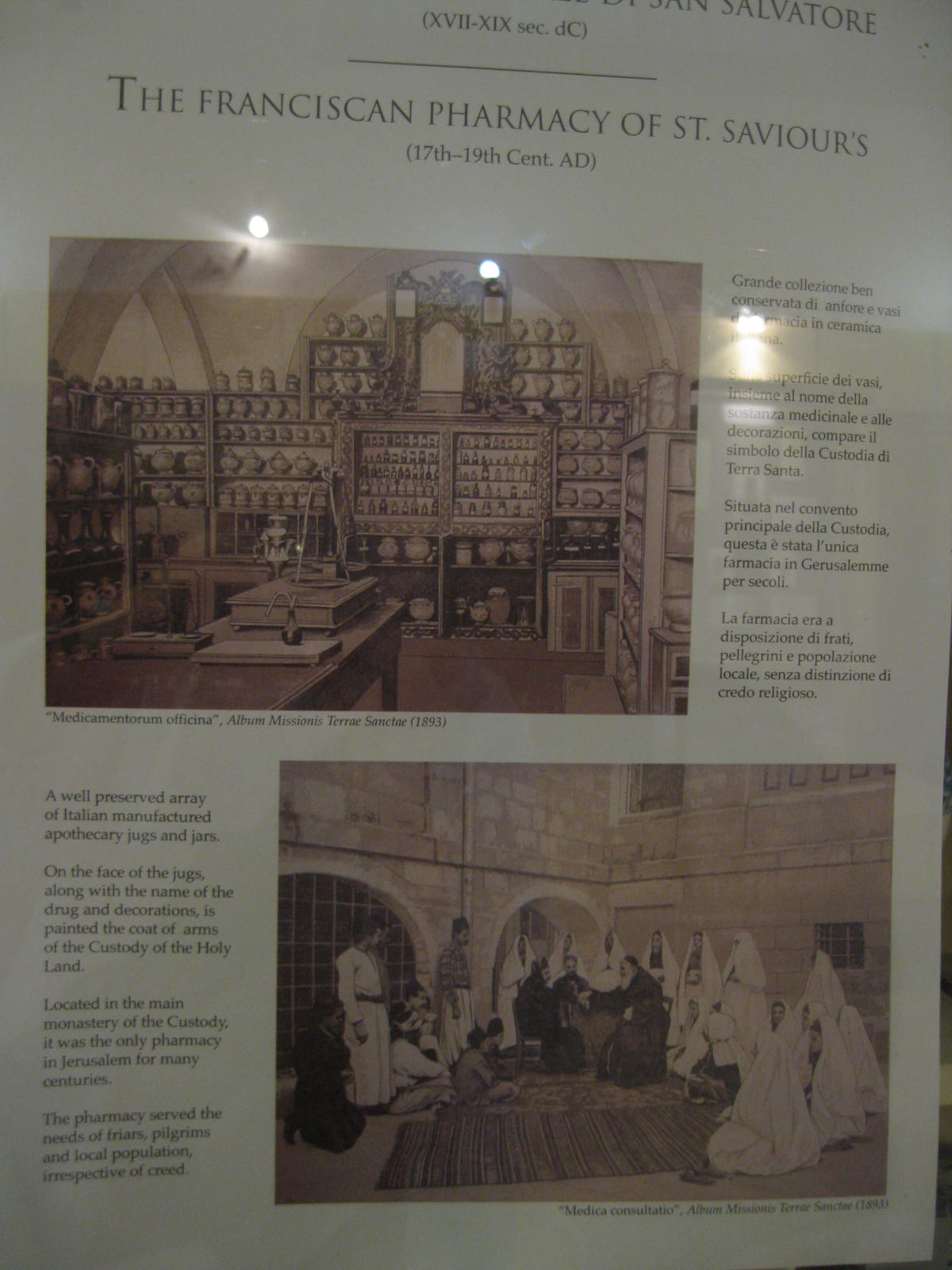
The photos from 1893 are so nice.

Today's Franciscans describe their former pharmacy in the sign:
. . .
Located in the main monastery of the Custody, it was the only pharmacy in Jerusalem for many centuries.
The pharmacy served the needs of friars, pilgrims and local population, irrespective of creed.
 -------------------
If you'd like to delve into the fascinating details, there is an article for you at Jerusalem Balsam website called
Franciscans Medical, An Early Glimpse at Western Medicine in Jerusalem 1700-1840:
The Case of the Jews and the Franciscans Medical Activity, by Zohar Amar and Efraim Lev.
-------------------
See also my posts about the  Materia Medica in the History of Jerusalem  exhibit that is or was at Shaare Zedek Hospital:
 http://jerusalemhillsdailyphoto.blogspot.co.il/2011/07/for-good-for-blessing-for-healing-and.html
and
http://jerusalemhillsdailyphoto.blogspot.co.il/2011/07/concocting-cure.html
.

Monday, January 7, 2013

"Jew, speak Hebrew!" **

.
(** Slogan in the language battle of the Jews in pre-State Israel)


Google gave us a new doodle today in honor of  155 years since the birth of Eliezer Ben-Yehuda, the father of modern spoken Hebrew.

The doodle incorporates some of the words he coined:
glida  meaning ice cream
buba for doll
millon meaning dictionary, from the root milla, word.

Even before Theodor Herzl envisioned a Jewish State, even before the whole Zionist Movement,  Eliezer Ben-Yehuda was a visionary.
The word of God came to him in the 1870s at Kasr il Yahud, the crossing point of the Israelites through the Jordan River into the promised land.

"A clear, incandescent light flashed before my eyes

and a mighty inner voice sounded in my ears:

‘the resurrection of Israel on its ancestral soil.’"

 "The Jewish People [Am Yisrael]  in its own land and in its own language," became the young man's driving force and he moved from Europe to Jerusalem in 1881.

His grandson, Rabbi Ben-Yehuda, now living in the USA, summarizes thus:
Eliezer Ben-Yehuda, a pre-Zionist visionary and pioneer of Jewish national renaissance and resettlement in Eretz-Yisrael, was a writer, lexicographer, newspaper editor, teacher (first to teacher an entire curriculum in Hebrew) and statesman. He founded "Va'ad Halashon" - the parent of today's Academy of the Hebrew Language and the National Hebrew Library. He authored the "Ben-Yehuda Dictionary and Thesaurus of the Hebrew Language, Ancient and Modern" . . . , a seventeen volume tome that is the most complete Hebrew language research tool in existence. He is recognized as "the man who revived the Hebrew Language."
 I am just now discovering that Eliezer Ben-Yehuda the grandson has a wealth of little-known inside information available about his famous grandfather:
For the biography book see http://fulfillment-of-prophecy.com/
and for articles on his webpage go here.
You can also watch the Rabbi giving a fascinating lecture on his grandfather to a group of Christian Zionists,  in five segments, starting here.

And for some music try Chava Albertstein's singing of the modern song about Eliezer Ben-Yehuda that every Israeli child knows.
.
.
(A post for Our World Tuesday.)

Thursday, December 6, 2012

One more door opened!

.
Another impressive place in the German Colony, on Lloyd George Street, is the big convent of the Sisters of St. Charles Borromeo.
Solid, locked gates are always a challenge; but yesterday I gathered my courage and rang the bell of this intriguing place.
No one spoke on the intercom, no one buzzed me in.
I just looked at the top of the ST. CHARLES (GERMAN) HOSPICE gate  and said into space:  "Hello . . . ?"


I tried the door and lo and behold a nun in white was standing there, and she said "Guten Tag."
I asked her about their policy of renting rooms to tourists, in case I have guests in the future.
We went inside to the desk and she gave me a card, told me the rates, and apologized that I could not see the place because renovations are going on now.


Below I offer you information copied from the guest house website.
It is sad to think of the German nuns and monks of Jerusalem having been interned during World War II, here in this convent; but we were a British Mandate then, and the British did what they thought they had to do.
It was in 1893 when the first Sisters came to the Holy Land and opened an infirmary and a dispensary in the German Colony, Jerusalem. These were the beginnings of St. Charles Convent. Apart from nursing the sick and old people, the Sisters took care of orphans and homeless children by offering them shelter and giving them a good education. In 1905 the Sisters could move into their new convent building, the original part of the present St. Charles Convent. In 1934 the first Holy land pilgrims were given accommodation and were offered meals for groups and from this source of income could be financed school, boarding and shelter for poor children.
World War II entailed hard times for the German Convent. All German Sisters in Palestine as well the Benedictines of the Dormition Abbey in Jerusalem were interned in St. Charles Convent. In addition, British officers occupied a number of rooms. After the war, the Sisters took on another work of charity; they offered shelter to German Jews who had survived the Holocaust in concentration camps and had emigrated to Israel.
In the years to come St. Charles Convent saw an ever increasing flow of pilgrims who wanted to visit and worship the Lord in Jerusalem, the heart and origin of our Christian faith. The traditional hospitality of the Sisters of St. Charles Borromeo makes their guests feel at home in the peaceful atmosphere of the house and in the friendly and comfortable rooms. Apart from their various activities the Sisters run a kindergarten and a pre-school class in the building next to the convent.


- 50 Rooms
- Full Board
- Dining Room
- Parking also for Buses
- Soft Drinks
- Chapel
- Elevator
- Garden
- Heating
- TV only in Salons
- Public Telephone
- Payment in Cash
.
(A post added to Toby's Whimsical Windows, Delirious Doors.)

Tuesday, November 27, 2012

Tractor as trellis

.

I always wondered what the top of the old mosque looked like, the one built over Mary's Spring in Ein Kerem.
So I trudged up the steep winding narrow lanes to a vantage point way above.

You can enlarge the photo and find the Church of the Visitation and Gornensky Convent beyond the mosque. 


But the true treasure I discovered parked next to an ancient terrace wall, at the side of the narrow lane!
"Tractor as trellis" would be perfect for today's ABC Wednesday.


I sat on a rock near the tractor, ate my peanut butter sandwich, and tried to imagine the life the tractor had many decades ago.
.

Monday, October 22, 2012

Happy birthday Augusta Victoria

.

Someone very important has a birthday today!
She is Auguste Victoria, yes--the Empress--wife of Kaiser Wilhelm II.

I know because I liked the new Facebook page of  the Kaiser (from which the old photo is borrowed), in which he shares their journey to Jerusalem in 1898.


When  Jerusalemites  hear Augusta Victoria, we normally think of this Arab hospital atop the Mount of Olives.
Click on the photo and then once again to see the name on the entrance gate.


 The hospital has a front door you wouldn't believe!
Augusta Victoria  was built in 1907-10 as a hostel for Christian pilgrims and as a rest home for the German population in Eretz Israel.
Many of the materials were imported from Germany.
It was the first building in the country to have electricity, powered by a diesel generator.


 The adjoining Lutheran church has a Kaisersalle with a beautiful old fireplace.
See the crests and names of  the Kaiser and the Kaiserin?

The Kaiser's Hall is often a venue for conferences and lectures.

You are welcome to see my posts about the Augusta Victoria complex, including the huge bells in the belfry, here.

The reason "Kaiser Wilhelm" is journaling his trip on Facebook is because next week the Tower of David museum will be opening an exhibition about his visit in Jerusalem as covered by the journalists of 114 years ago.
.
.
(This is a contribution to Our World Tuesday and Whimsical Windows, Delirious Doors.)
.


Wednesday, August 29, 2012

The Yemin Moshe windmill works once more!

.
Two months ago Jerusalem's Montefiore windmill was all wrapped up and minus its dome.

Next to it parts were waiting to be put up--gears and wings and wooden bow things.
Click on the photo and then click again to find all the exciting details.

It is exciting to see new life for our windmill because the last time it ground wheat was 119 years ago!

It was put back in working order using replica parts made in Britain to the designs of the Holman Company of UK that built the original mill in 1857.
The parts were shipped to experts for assembly in Holland and then transported for final fitting to the mill in Jerusalem.
.
The funding of the restoration and the operating and maintenance expenses for the first few years--some 5 million shekels ($1,250,000)--was raised by the Jerusalem Foundation, Christians for Israel (Dutch Friends from Holland), The Prime Minister's Office, the Ministry of Tourism, and the Jerusalem Municipality.

And here is a picture from August 14. Isn't she beautiful?!
.
Tonight was the festive rededication of the windmill.
Sorry I could not be there.

Soon, some say, the sails will be turning and flour will be produced and the bread made from it will be sold to visitors.
The mill will operate five days a week at set hours and will effectively become the only working mill in Israel.
The Jerusalem Foundation website says

Inside the mill, the historic four story structure will be restored as it looked when the flour mill was active. There will be four floors: a "Flour Floor" - at the entrance to the mill, the "Mill Floor," on the second floor, which held the heavy millstones, and the "Seed Floor" on the third level, where sacks of grain were emptied into large containers and placed on the fourth floor, the "Dust Floor" at the top.

Visitors coming to the mill will be able to enter at the ground floor, look at the flour milling process and watch a short movie about the establishment of the windmill and [19th century] Jewish settlement outside the Old City walls.
I can hardly wait! I have never seen the inside of a windmill.

The wonderful blog "Israel's History--A Picture a Day" has good information and historic photos of the mill, including one showing how the British army blew up a Haganah sniper's nest at the top of the windmill in 1948.
.
UPDATE #2: The wonderful The Real Jerusalem Streets blog shows first-hand coverage of the dedication ceremony with all the VIPs.

UPDATE:
Watch videos:
The architects explain the history of the windmill and plans for its future.
Hoisting the cap and wings into place.
The first turning, August 28!
.