Showing posts with label hospital. Show all posts

Monday, March 30, 2015

Look alikes: who are you

.

Mandarin or clementine?


Anemone or poppy? 


Guinea pig or hamster?
-
These are all part of a new campaign at Beer Sheva's Soroka University Medical Center.
They are posted along the covered walkways where patients are taken from one hospital building to another on gurneys or wheelchairs.
Medical personnel are reminded to follow the hospital's patient identification and verification procedures carefully.
And the patient is urged to insist that medical personnel identify him by his full name and identity number.
"Mistaken identity can lead to tragedy!" is the message.
.
Let's hope everyone is paying attention.
.
(Linking to Our World Tuesday and signs, signs.)
.

Wednesday, March 25, 2015

Helicopters to Soroka Hospital today

.

While at Ben-Gurion University today I chanced to see two big IDF helicopters landing at Soroka hospital, which is right across the street.
 Here above is the landing.


And then the take-off.
I don't know where the wounded came from; there was no word of any incident in the news.


The helipad is just a big fenced-in patch of grass in between hospital buildings.
You can see the windsock on the roof. 


During the 50 days of fighting with Gaza last summer this was, sadly, a very busy place.
.
UPDATE: I see now some statistics from the director of the hospital
During Operation Protective Edge, as in previous rounds of fighting in the South, Soroka Medical Center was at the forefront of treating the wounded. Life-saving teams at Soroka cared for the majority of the soldiers wounded during the operation. In the 50 days of warfare, 1,263 casualties received treatment, among them 777 soldiers and 486 civilians, of whom 53 were seriously injured.
There were more than 60 helicopter landings on the hospital's helipad, evacuating the wounded from the Gaza Strip.
.

Saturday, September 27, 2014

Autoclaves and dedicated personnel + bonus rap video

.
As explained in the previous post, Shaare Zedek medical center offered two well-guided tours of their engineering and logistics facilities last week.
Today I'll show you their sterilization unit.


The hospital recently spent 20 million shekels (almost five and a half million dollars) to upgrade to this Swedish  Getinge Automation System.
Here some 50 of us curious Israelis were standing in the "dirty room" to which the used medical instruments are brought.

 
Wash-carts are put into these sophisticated "dish-washers."


Even a whole trolley can go through for disinfection.


The wash cycle in action.


The in-charge staff responsible for keeping everything sterile.
They did, however, allow us tourists to cross over into the "clean room" without suiting up in gowns, hats, and booties.


Every scissors and surgical instrument must be arranged in order, counted, and accounted for.
You know the old "joke" about surgeons forgetting something inside the patient . . . 


 Another machine.
With so many people clustered around our guide in such small quarters, it was hard for me to see and hear everything, to take notes and to photograph at the same time.
Why do the tallest and widest men always rush to the front and stay there, instead of giving the others a chance to see better? -- I really should work on improving my elbowing skills. 


It was Friday noon and all the non-essential staff were already on their way home to prepare for the Sabbath.
Shaare Zedek is a religious hospital.


The end product is carefully wrapped, labeled, and coded packages of germ-free instruments ready to be sent to the proper wards.
.
DON'T MISS this funny rap video about the importance of hand-washing starring Shaare Zedek hospital doctors and nurses!!! 
.
Friday, September 26, 2014

Shaare Zedek's smokeless smokestack

.

The smokestack of Shaare Zedek hospital is cold and clean and useless.
It once carried particles and smoke high up (and hopefully away)  into Jerusalem's sky.
But nowadays, in our era of increasing greenness, the huge medical center uses a closed circuit system of pipes instead.

It would cost millions to take the chimney down, so up it stays.
Which is a shame because it can be seen for miles and miles around.
An eyesore, in my opinion. 
Not to mention that for many Jews any tall and stark chimney is a grim reminder of the Shoah (see my post "O the Chimneys").


Last week Jerusalem had her annual Houses From Within weekend.
One of the guided tours I took into normally inaccessible places was a walk down to and through the kishkes (the innards) of Shaare Zedek.
It was led by Gadi,  Director of Logistics and Engineering.
The tour was offered twice last Friday and about 100 curious Israelis learned a lot that day. 

I will show you more in the coming days. 

(Linking to SkyWatch Friday.)
.

Wednesday, July 2, 2014

Soroka hospital

.

 A side entrance of the huge Soroka Medical Center in Beer Sheva.


The hospital serves the Negev, the southern region of Israel.
.

Wednesday, July 20, 2011

"For good, for a blessing, for healing, and for life"

.
Bar-Ilan University, Yad Ben-Zvi institute, and Shaare Zedek Hospital have put together a fascinating exhibit in the entrance hall of the hospital.
.
It is called Materia Medica in the History of Jerusalem.
.
Please enlarge the photo to read about this exhibit of traditional medical substances down through the ages.
.
I'll be showing you different examples over the coming weeks.
.

Friday, May 27, 2011

A reflection behind bars

.
The venerable building reflected in another old, but not so famous, house was once Sha'are Zedek Hospital.
The hospital moved to a larger facility in 1980.
After renovations were completed in 1999, the Israel Broadcasting Authority moved in.
.
I took the picture for James' Weekend Reflections.
.
Shabbat shalom to all.
.

Monday, January 10, 2011

An Arab hospital in a German fortress

.
We have seen some pictures of the Lutheran church at Augusta Victoria on Mt. Scopus; but today, for the That's My World tour, let's walk around the hospital part of the compound.
.
We can enter through the gate house.
Kaiser Wilhelm II built the huge complex, completed in 1910, naming it after his wife, the Empress.
.
It was built as a hostel for Christian pilgrims and as a rest home for the German population in Eretz Israel.
Many of the materials were imported from Germany.
It was the first building in the country to have electricity, powered by a diesel generator.
.
Step in and be greeting by a fantastic doorway!
.
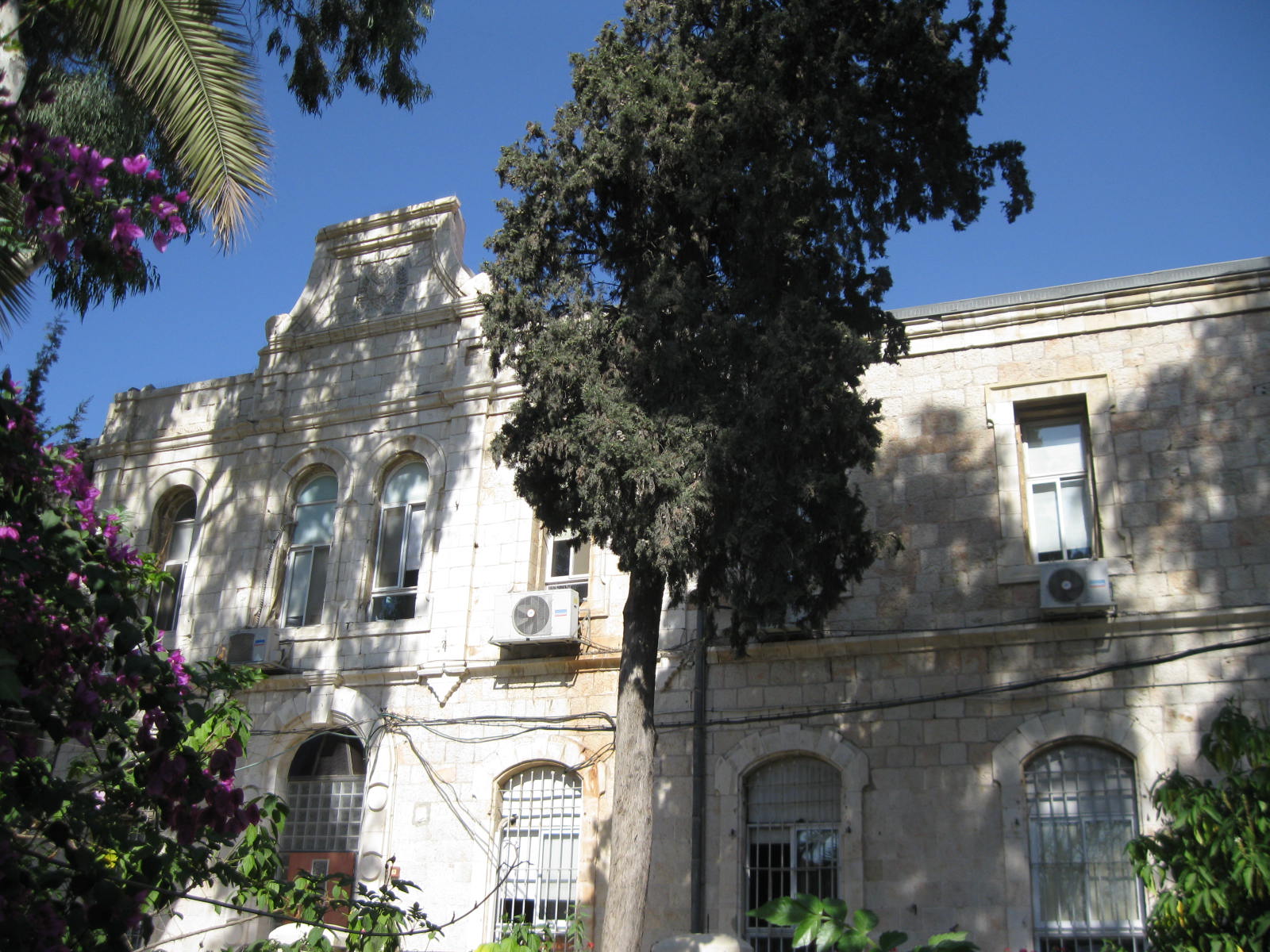
I had to remind myself that I was entering an Arab hospital and not an old castle in Germany!
.
Victory.

Trampling out the evil creatures.
.
You don't often see gargoyles in Jerusalem!
.
Here is the back of the building, which was fashioned as a medieval German fortress.
.
During the last century it passed through many different hands.
.
The Turkish army headquartered here from 1914 until they surrendered to the British in 1917.
Then it became General Allenby's HQ.
From 1920 to 1927, Augusta Victoria was the official residence of the British High Commissioner of the Palestine Mandate.
After damage from the big 1927 earthquake was repaired, it was converted to a hospital during World War II for the British forces.
From 1948 to 1967 it became under UN control in the buffer zone of Mount Scopus, but was actually a hospital for the Jordanian army.
.
In the Six Day War of 1967 the second floor was destroyed by shelling between the Israeli paratroopers 55th Brigade and the Arab Legion.
After Israel's victory Augusta Victoria was incorporated into the unified city of Jerusalem, and today it is a 161-bed hospital serving parts of the Arab population.
.
More photos and information at their website, Wikipedia, and BibleWalks.com.
.

Monday, December 27, 2010

A haunted house in Jerusalem?

.
You ready for a creepy story for today's That's My World tour?
.
I had always wondered about this secretive historic building on Jaffa Street in central Jerusalem.
Thinking to get a photo from the back I walked into the parking lot.
A guard came running, asking me "What's this?!" and sent me and my camera away.

Next I peered through the locked front gate in the old embellished stone arch marked District Health Office.

From these signs I assumed this was the location of the travelers clinic where you can get immunizations for southeast Asia, India, Nepal, etc.
These are the destinations favored by our young men and women for a year of freedom following their long compulsory army service.

As I was leaning on the locked gate and peering into the dimness, a buzzer buzzed and I just about fell inside.
An armed guard searched my bag and questioned me.
He said I could take a few pictures but NOT to enter the building.
.
What is IN there, I started wondering.
Sorry for the blurriness. I must have been shaking by then from the creepiness of the place and my desire to get out quickly.
What you are supposed to be seeing and being duly impressed by is the emblem of the Ottoman Empire on top of the building.
.
Only later, safely back home, did I learn the truth about this building!
Here it is, as told in the Yad Ben-Zvi guidebook, Jerusalem, a walk through time:
"In 1882 a Christian Arab youth, the only child of a wealthy family, was about to marry. His delighted parents built for the couple a magnificent house where the wedding would be held, decorated it for the happy event, and invited all their friends and acquaintances.
.
But a terrible blow descended on the family: the groom died on the eve of his nuptials.
.
The parents, who were unable to come to terms with the enormity of the disaster, decided to hold the ceremony, no matter what.
They dressed the dead groom in his festive garb and seated him on a chair in the hall next to the bride who was wearing her wedding gown.
The guest and the mother circled around the couple and danced.
At the end of the dance, a terrible cry issued from the mother's thoat, she tore her clothes and fainted.
That very day the groom was buried.
.
The house remained empty for a long time, since the rumors of evil spirits and curses drove away potential purchasers.
Only at the end of the nineteenth century did the Ottoman Jerusalem Municipality decide to buy the building and turn it into a city hospital [called 'Baladiyeh']. "
.
The British used the building, which had since been given a second storey, for their District Health Office from 1918 to 1948.
And since '48 Israel has done the same.
Apparently the Ministry of Health has offices and labs inside "the dead groom's house." Although we will never know . . .
.

Sunday, September 12, 2010

Grand Priory of the Hospitaler Knights . . .

.
A cat enjoys the shadow of a flagpole in the Old City of Jerusalem, providing fodder for both Camera-Critters and Shadow Shot Sunday.

Please enlarge the photo to read the history!
.
The complex in back of this stone is called the Muristan (bimaristan meaning "hospital" in Persian).
After the Hospitaler knights left their headquarters on the Temple Mount, they took up residence in the Muristan.
The order was founded during the First Crusade and is also known as the Order of St. John.
These knights, entrusted with caring for the health of Crusaders and pilgrims, built a hospital here.
.
As you can learn from the inscription, "the Grand Priory in the British Realm" followed their example in more recent times.
.

Sunday, October 11, 2009

Saints and Hansen's in Hawaii and Jerusalem

.
Mazal tov! Congratulations to Hawaii. Their first saint was canonized in Rome this morning by Pope Benedict XVI.
Father Damien came to Hawaii in 1864. Saint Damien spent many years ministering to the leper colony on Molokai.
But no one tells his story more movingly than Cloudia at Comfort Spiral in her post today.

Nineteenth century Jerusalem also had what were then (mistakenly) called lepers, and they were housed behind this meter-thick stone wall in Talbieh.
Talbieh was not the prestigious neighborhood it is today. It was on the pale of settlement, subject to attacks by bands of robbers.
This one little gate was therefore the only entrance to the compound.

Jesus Hilfe (the Jesus Help Asylum) was established in 1887 by the city's Protestant community.
(Another source says that Jesus Hilfe was the name of the builder.)
It was designed by Conrad Schick, a German missionary and self-taught architect.
.
The Herrenhut Brotherhood of the Moravian Church ran the facility between 1887 and 1950. Staff came from Europe to care for the patients, who were mostly Moslems, although there were some Christians and a few Jews. The German Deaconess sisters were devoted to treating the suffering ones.


Rabbi Aryeh Levin (1886-1969) was our Jewish version of a saint. He is called The Tsadik (the saintly one) of Jerusalem.
He was one of the few brave enough to set foot inside the hospital.
He voluntarily came to visit the sick regularly, it is said, and especially on Rosh Hashana when he would blow the shofar.

Each floor had access to its own toilet via a bridge.
.
A cure did not exist back then, so care of the patients was based on the accepted principles of hygiene, fresh air, proper nourishment, physical activity, and spiritual support.
.
Norwegian Dr. Gerhard Hansen identified the leprosy bacillus in 1879. Since then the disease has been known by the less ominous name of "Hansen's Disease."
In 1948, following the establishment of the State of Israel and the division of Jerusalem between Jordan and Israel, the asylum found itself on the Israeli side of the city. Some of the patients and staff left, moving to an asylum in the Arab village of Silwan.
.
In 1950 the Moravian Church sold the entire compound to the Jewish National Fund and the Israel Ministry of Health took over the running of the place and renamed it the Hansen Government Hospital.
.
With the development of an effective cure for Hansen's Disease, patients were gradually rehabilitated and discharged. The last in-patients left the hospital in 2000.
As you can see in the photo, the mezuzah is gone from the doorpost and most of the buildings are abandoned.
.
Part of the site now serves as an outpatient clinic and learning center for the disease, the incidence of which has dropped significantly.  [See update below!]

Rivka Regev, the daughter of the hospital’s veteran general physician, lives in the compound to this day.
In the old days, the inhabitants tended a vegetable garden, fruit trees, and some livestock for their own needs.
The biblically inspired garden had a system of wells, channels, and four big cisterns.

 See the new plantings?!
.
Volunteers from Israel and abroad, supported by the Society for the Protection of Nature, hope to "restore the old garden, to cultivate a biblically-ecologically organic sound garden of healing herbs and to invite the community to participate in maintaining the garden through educational activities for school children, the elderly and people with special needs."
.
Rivka Regev is the living spirit behind the vision of reclaiming the wilderness.
Schick's elegant architectural treasure appears on the list of buildings intended for preservation under the auspices of the Society for Preservation of Israel Heritage Sites.
Nothing seems to be moving in that direction yet, but let us hope and pray that "Jesus Hilfe" will be saved.
.
2 good articles about Hansen's Hospital:
.
Links about St. Damien: Catholic News Service
Damien Blog with video of today's Canonization Mass
.
UPDATE: "In 2009, the Unit became the responsibility of Hadassah Hospital ... and the Hansen Hospital has moved to another historic building - Hadassah's  Beit Habriut at 24 Strauss Street. Following a government decision in May 2009, the Hansen Hospital compound - designated for preservation - was transferred to the Jerusalem Municipality Culture and Art activities in November of 2011."
See more at Hadassah's article

Guided tours are available and there are photographic exhibitions inside.
In fact,  photographers who first went in and recorded their impressions with much feeling are the ones who brought public attention to the building's plight and moved it closer toward preservation.
.
Here is more about the artifacts now on display.

And the most comprehensive and entertaining telling of the Hansen's story is at this blog:
http://israelightly.wordpress.com/2013/05/31/the-hansen-compound-from-leper-hospital-to-multimedia-art-center/
.

Monday, March 23, 2009

Conflict transformation

.
For full impact click on the photo and read the writing on the wall.

It's a good thing that the inscription on this building is safely hidden behind a tall stone wall, a sliding metal gate, and a security guard. An ultra-Orthodox Jewish neighborhood is just a block away.

What the historical building plaque posted outside the wall says is rather tame and lackluster in comparison, pointedly.

The English Mission Hospital was completed in 1897 and the doctors served all the different peoples of Jerusalem. The rabbis were dead-set against any Jew entering the doors of a Christian hospital.

But since the early 1960s the Anglican International School Jerusalem is housed here.
The school cat who came right over for a cuddle shows just how friendly the atmosphere is.
The place is old and beautiful. For their 100th anniversary the stones were cleaned with sandblasting.

The school has grades K-12, all taught in English. The student body is made up of 20-25% Palestinians, a handful of Jews, and the rest from the consular corps.

Speaking of foreign diplomatic families . . . this is especially for blog-buddy Catherine Mark-Beasant who writes about her years at the Anglican School decades ago in this interesting and touching post.
.
The sundial quotes the Song of Songs in the Bible: "Until the day break and the shadows flee away."
And some shadows did flee away during the ten weeks I participated in a weekly Slim Peace group in this classroom behind the arch. All women. A few Arabs, a few Jews, a nun, a nutritionist, a facilitator, and a film-maker. Ostensibly coming together to discuss better nutrition and healthier living, but much more than that.
.
What's your world like? You too can share it every Monday night with the bloggers at That's My World , or just come for a visit. Shalom!
.

Thursday, February 28, 2008

Helpful helicopters


Not one but two helicopters landing at Hadassah. The hospital is now building a bigger helipad atop its tall emergency medicine building. I am always saddened seeing such copters fly over my house, wondering who has been hurt, and where, and why.
.