Showing posts with label Hebrew University. Show all posts

Sunday, February 24, 2013

Nimrod and "venahafoch hu"

.
(All photos can be much enlarged)

 I first heard of Nimrod at the archaeology exhibition called "The Early Years, The 70th Anniversary of the Museum for Jewish Antiquities Institute of Archaeology, Hebrew University, Mt. Scopus."
He was revolving on a screen, the photography produced by the Computerized Archaeology Laboratory.


Then last week I saw the real thing, for the first time!

Nimrod had been commissioned for the Hebrew University but was rejected and ended up here at the Israel Museum instead. 
What a story!


First I'll give you the story as told by the University's Archaeology Institute (I think they begin by talking about the early 1940s, the pre-State days):
The Hebrew University commissioned  the first version of the Nimrod statue from Israeli sculptor Yitzhak Danziger.
The planned sculpture was to be placed at the entrance to the Museum for Jewish Antiquities, however the order was cancelled and the completed sculpture never reached the University.

The statue depicts young and naked Nimrod, the hunter, carrying a bow on his back and a falcon on his shoulder.
Danziger drew his inspiration from the ancient Near Eastern cultures and the description in Genesis 10:8-9:  "Cush also begot Nimrod, who was the first man of might on earth. He was a mighty hunter by the grace of the Lord."


The shape is reminiscent of ancient Egyptian statues and its name is connected to the Mesopotamian heritage.
Nimrod is a corruption of the name of the Assyrian god Ninurta.
The Nubian sandstone from which the statue was carved conjures an image of exotic cultures. 


The ancient Near Eastern sources of inspiration for the statue and their conception of a young and daring figure were viewed by many as an aspiration to identify with proto-Jewish sources.
For this reason the statue was considered a symbol of the movement of Young Hebrews, called "The Canaanites," which emerged in Palestine at the end of the 1930s.

The mention of Nimrod as a negative figure in Jewish midrash, as well as the bold creativity of the sculpture, its unorthodoxy, and perhaps even overt sexuality are what caused the University to reject its inclusion in the museum over seventy years ago.

Today, the Nimrod statue stands at the entrance to the Israeli Art Wing in the Israel Museum.

Now, if you still have patience, please click on the sign and read how  the art history folks at the Israel Museum tell the same story but with a very different emphasis.
Especially the part about
. . . In the 1940s a group of intellectuals calling themselves "Young Hebrews" identified closely with this sculpture.
Dubbed "Canaanites" by their opponents, they connected to the ancient cultures of the land and called for a total break with Judaism and Jewish history.
Nimrod became a symbol for many youngsters at the time, as the most extreme expression of a native identity based solely on this geographic heritage. 
 .
And the final outcome? -- as it says many times in the Book of Esther, read today on Purim, "Venahafoch hu" -- just the opposite happened.
.

(This post links to Weekend Reflections and Whimsical Windows, Delirious Doors.)

Tuesday, January 8, 2013

Celestial cartography at Hebrew University

.
Shalom from Israel where this week's weather is wet, wild, and windy.
Tune in tomorrow to see if Jerusalem really gets the expected snow!


Meanwhile, for ABC Wednesday,  Z is for zodiac.

But this, that I found on the wall of the National Library of Israel, is more than just a zodiac;  it is a famous example of celestial cartography from 1515.
It is a reproduction of Albrecht Dürer's woodcut called  Imagines coeli Septentrionales cum duodecim imaginibus zodiaci, a star chart of the Northern hemisphere sky with images of the 12 zodiacal constellations.

In the corners are four historical astronomers:  Aratus of Cilician Soli, Ptolemy, Marcus Manilius, and Al-Sufi.

You can click once on the photo and then click again, to see it much enlarged.

Fascinating details about Albertus Durer's star charts are told in Electrum Magazine

What other treasures lie in these big locked drawers of the National Library's Map Room?
Only the librarian knows for sure.
.

Wednesday, December 12, 2012

Nobel Prize winners

.
Well, the Nobel Prizes have all been awarded for this year.
Wouldn't it be a great miracle if next year's Peace Prize could go to someone in the Middle East?


Meanwhile, if you walk up the ramp at one entrance to the Hebrew University Mt. Scopus campus, you  pass photos of the university's many Nobel Laureates.
Or in Hebrew, ha-Nobelistim.
Including  Prof. Albert Einstein.

The best part is the big question mark hanging at the end.
How many students and teachers passing by dream of seeing their photo there someday?
.
.
(A post for the meme Signs, Signs.)
.


Monday, November 12, 2012

Pyramids here and there

.
 Yigal Arnon Square?
It is funny to call a pyramid a square. ;-)

Water runs down from the top of the cylinder.
Often a crow sits on it and drinks.

It's a little oasis in the middle of Hebrew University's white stone buildings on Mount Scopus.


On Saturday night an Egyptian TV show hosted radical Salafist Jihadi  sheikh and scholar Morgan El-Gohary  and he called for the destruction of Egypt's pyramids and the Sphinx because they "were once worshiped and could be worshiped again."

He proudly  recounted  how he participated in the blowing up of the Buddha statue in Afghanistan in 2001 when he  fought along with the Taliban.

If you don't believe me, see ahramonline
.
.
(For Our World Tuesday meme.)
.

Saturday, November 3, 2012

Alfred Nobel, Albert Einstein, and Isis

.

Did you ever wonder what's on the other side of  Albert Einstein's 1921 Nobel Prize medal?
Here it is, just in time for Weekend Reflections.

It shows the Genius of Science revealing Nature, in the form of the goddess Isis.
She is emerging from the clouds holding a cornucopia.
Surrounding the image are the Latin words for "Inventions enhance life which is beautified by art."


The diploma that was awarded along with his medal acknowledges Einstein's contribution to theoretical physics.

For its translation and for clear images of the medal and the diploma, please see this page from the Hebrew University's Einstein Archives Online.

"Einstein’s General Theory of Relativity was, at that time, still controversial and members of the Swedish Academy avoided the issue by granting him the prize for his groundbreaking contribution to the understanding of the Photoelectric Effect. Some of them did support General Relativity, but a mere eclipse was not enough proof for all committee members to risk their reputations on Einstein’s new theory."  (source)
.
These items (replicas, I assume) are currently exhibited  in the ground floor corridor of the Hebrew University Medical School which is at Hadassah Ein Kerem campus.
The Nobel Prize display cases are between the med school and the hospital.
Maybe they are meant to give inspiration to the hard-working med students as they rush by. 
.
P.S.  I'll add an interesting story in the comments section.
.

Friday, October 26, 2012

A window to the past

.

The Institute of Archaeology at the Hebrew University on Mount Scopus gave a wonderful tour this morning.
More about that in the coming days.
.
In the Museum for Jewish Antiquities I was leaning over, trying to read in the glass  display case about the 1931-35 excavations in Samaria, and a reflection kept getting in my way.
Then I realized it must be a sign from James and it wanted to join in his Weekend Reflections.
.
It was one of many high windows, with a graceful grate and a tree branch.
But why the light became bands of pink and pale blue, this I don't understand.
.
The historic building, built in 1941 in the International style, has a magic all its own, even without the fantastic treasures inside.
.
Maybe today's persistent colored reflection was like a window to the past.
.

Thursday, August 4, 2011

When printing took some effort

.
We have come a long way since this Alexandra iron handpress was made in London in 1730.

It has a place of honor in the front window of our National Library at the Hebrew University of Jerusalem.
.

Friday, July 1, 2011

Swords into ploughshares, in mirror image

.
On an upper floor of Israel's National Library there was a reflection just waiting to be captured for James' Weekend Reflections!

The huge stained glass window caused the reflection.
Mordechai Ardon made this triptych in the early 1980s, inspired by the prophetic vision of peace in Isaiah 2:2-4.
More details in an earlier post.
.
Shabbat shalom, Sabbath peace, to all.
.

Sunday, June 26, 2011

The People of the Book

.
I blogged about Israel's National Library before, with its stained glass windows (some of the largest ever made) that show Isaiah's vision of eternal peace (here and here).
.
But this morning the library was the scene of something totally different:
a giveaway of 30,000 books, free!
The photo above I took a half hour before the books were brought out, but hundreds of people were already standing around the tables outside, securing their places.
.
I didn't have strong enough elbows or long enough arms to get first choice at the books.

When the poor library workers couldn't get through to the tables, they put boxes on the ground.
The crowd pounced on each new box.
Sort of like a feeding frenzy.
.
The non-fiction books were either extras or material that the library could not use, books that had been donated to the library over the years.
Most were in English, with some in Russian, German, French, and Hebrew.
.
The Jewish National and University Library website says this "donation to the public" will go on for four days or until all the books are gone.
More of the story at the Jerusalem Post.
.
Among the throng were mothers with babies strapped to them, men in wheelchairs, religious and secular, students and older folks.
"The People of the Book."
.

Monday, January 24, 2011

Jerusalem above and below

.
Enlarge the photo and you can see a guide with arm outstretched and his two tourists looking and listening.
.
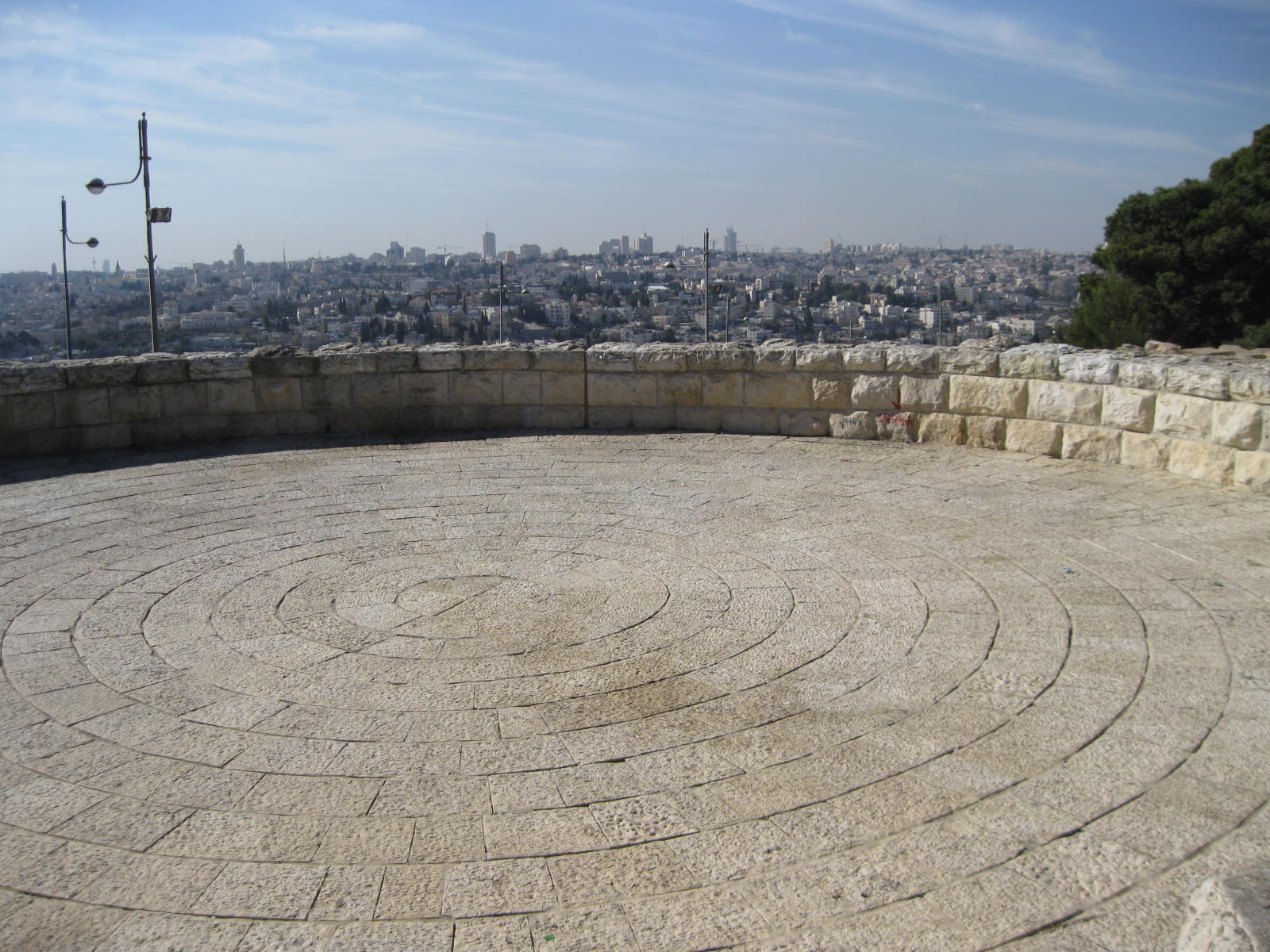
They are standing on this observation plaza, and the guide is pointing to the vast stretch of Jerusalem to the west.
.
Just below is the donors' wall with names of those who contributed for the construction of this corner of the university.
Behind the trees are the outer buildings of the Mount Scopus campus of the Hebrew University of Jerusalem.
.
At the foot of the modern outlook I was surprised to find ancient burial caves.
I counted some ten or eleven kokhim.
Actually, the whole ridge of Mount Scopus was a huge necropolis for the dead of Jerusalem some 2,000 years ago.
I'm glad the excavators and conservation people found a nice way to preserve this part of the cemetery and even integrate it into its new surroundings.
.
Here ends today's tour for That's My World Tuesday. Shalom!
.

Friday, January 14, 2011

A reflection of Creation

.
"GENESIS" by Israeli artist Belu-Simion Fainaru
1997. Jerusalem stone, glass, light bulbs
Loan of artist to Hebrew University, Mt. Scopus campus
.
I quote the sign near it:

"How to look at the scuplture Genesis by Belu-Simion Fainaru"
--------------------------------------------------------------
"Genesis is a structure reminiscent of a house, perhaps of a tomb of a Tzaddik, or even an ossuary. It is too small to be a house however, and the feature that most signifies the idea of a home, a door by which to enter, is missing.
.
There are windows permanently illuminated from within, but they do not look like the windows we are familiar with. In fact, their unusual shapes arouse the question: what are they meant to be?
If we look carefully, we see these are Hebrew letters, from aleph to vav, each representing one day in the week of creation.
. . .
We realize the letters are written backward.
The only way to see them correctly is to look at their reflection on the floor.
In order to encompass all the days of creation one has to encircle the sculpture completely.
.
Just as it is impossible to enter the sculpture to see the letter-windows properly, it is also impossible to fully fathom the depth of creation.
Our understanding will always be a mere reflection of the act itself."
.
A profound piece for James' Weekend Reflections, I believe.
.
To read about the importance of the artwork's venue, please click on the sign above.
The Bima it refers to was posted previously here.
.
Shabbat shalom, peace to you all on this Sabbath when God rested from his creating.
.

Friday, October 8, 2010

A window, the sun, and Jerusalem

.
As you know from yesterday's post, I was at the Hebrew University Mount Scopus campus yesterday; and the prize at the end of sitting through eight hours of lectures was a glorious sunset.

The campus synagogue, dedicated in 1981, is part of the very spread-out Humanities Building.
You can recognize it here by the Chanuka menorah on its roof.
.
How would you like to pray facing this view of the Old City and beyond?!

At 5:10 the last rays of sun were bathing the interior with a warm glow.
.
Most synagogues in Israel and in the world face the east, toward Jerusalem.
The congregation here on Mt. Scopus had to face west in order to face the Temple Mount (where you see the gold Dome of the Rock), so architect Ram Carmi [remember my posts on his Supreme Court building?] had an idea.
He wanted a picture window in the front, but normally the holy ark containing the Torah scrolls is in the front.
He got around it by "splitting" the ark! There are two arks, one on each side.

And then, especially for James' Weekend Reflections, the sun set behind the far-away western skyline of Jerusalem and was reflected on the outside of the Hecht Synagogue picture window.
.
Shabbat shalom.
.

Saturday, July 24, 2010

College cats

.
What an ingenious way to provide clear cool water to the many cats that roam the Hebrew University campus!
.
If you click on this photo you can just see the cat's tongue licking the water trickling out of the ancient pithos.
The jar is slightly, cunningly, slanted.
It is filled with broken up old roof tiles (like those on the ground), I guess so if some heavy bird were to land on it for a bath, it would not tip over.
.
On these boiling hot summer days, a good water source for animals in so important.

Cats feel safe and right at home on the Givat Ram campus.
Plenty of food left over from the students' picnics on the lawns; plenty of migrating and stay-at-home birds to try to catch; no beasts of prey; and only friendly people around.
.
Everyone sitting under their vine and fig tree, and none shall make them afraid.
.
Sounds like a Biblical prophetic vision come true!
.
.
For the friends of animals and animal friends at Camera-Critters Sunday.
.

Friday, July 2, 2010

In the Footsteps of the Ba'al Shem Tov

.
"In the Footsteps of the Ba'al Shem Tov" is a wonderful new exhibition that just opened at the Jewish National and University Library in Jerusalem, at the Givat Ram campus.
.
It marks 250 years since the death of the Ba'al Shem Tov, the great mystic considered the founder of Hasidic Judaism, and 200 years since the passing of his great-grandson, Rebbe Nachman of Breslov.


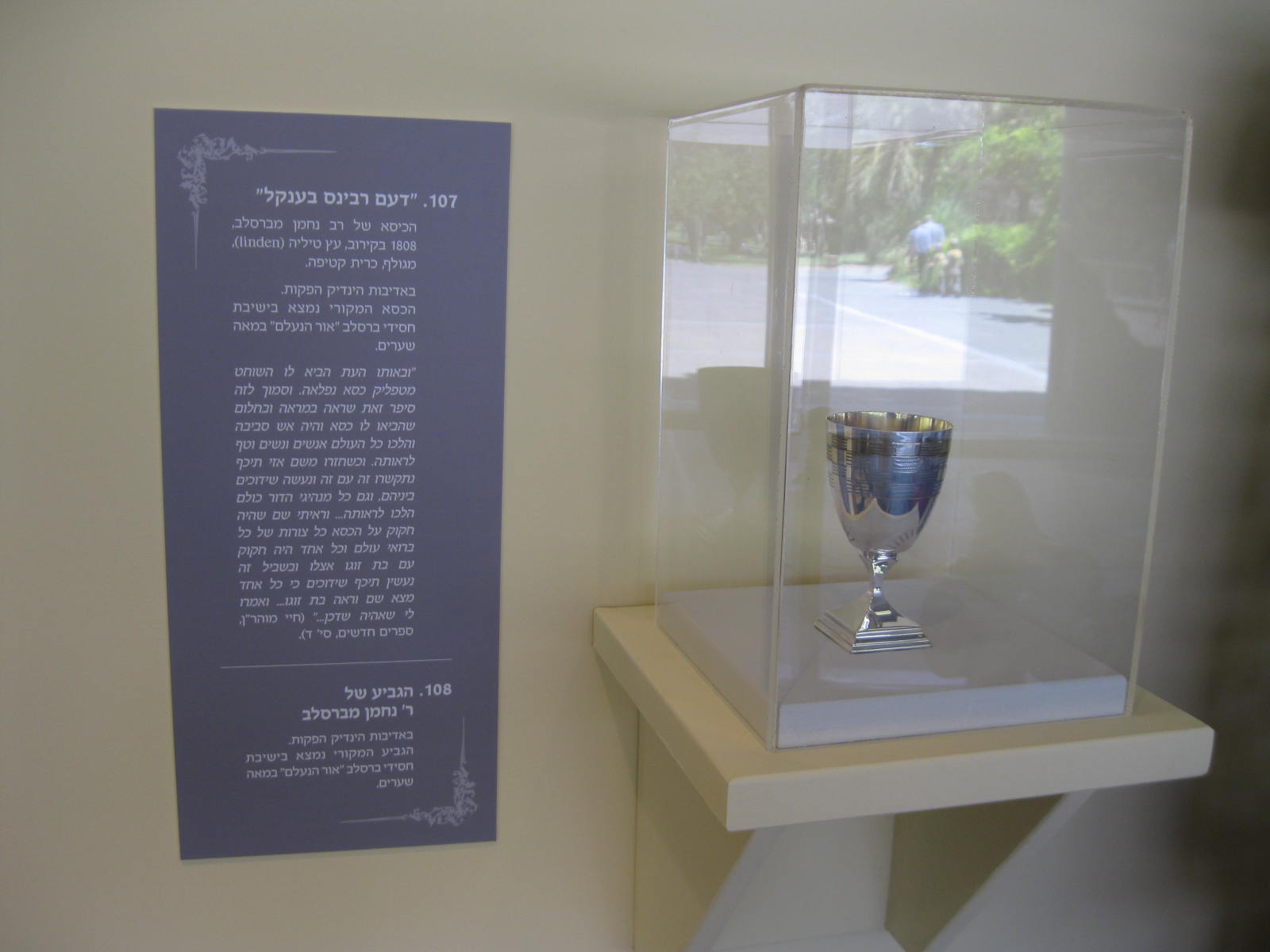
For James' Weekend Reflections there is something reflected in this copy of Rabbi Nachman's kiddush cup.
And a man followed by a boy, walking outside, are reflected in duplicate in (and by?) the display case.
.
With a bit of reflection under it, this is a faithful copy of the original chair of Reb Nachman which was carved in about 1808.
For the amazing story of how it was saved from destruction, please see
http://www.breslov.org/aboutbreslov/thechair.html.
.
It is told that shortly after the shohet of Teplik (in the Ukraine) finished carving the chair and presented it to Nachman as a gift, that night Reb Nachman dreamed (or had a vision) that someone brought him a throne, surrounded by fire.
Everyone, men, women, and children, came to see it. Engraved on that throne were all the world's creatures, along with their mates.
And as the people turned to go, bonds were formed between them and marriages were arranged at once, for each had been able to find his mate.
And in the dream Reb Nachman sat down on the chair, and all at once he found himself flying through the heavens, and before him he saw Jerusalem, glowing like a jewel in the distance. It was indescribably beautiful, and as he approached it, he woke up.
.
. . . And they told him he would be a matchmaker.
.

Wednesday, June 30, 2010

Stained glass reflected in glass

.
Reflected in a showcase displaying old maps at the National Library of Israel is Mordechai Ardon's great work of stained glass.

It makes an entire wall at the Hebrew University of Jerusalem.
Measuring 16 x 6 meters/yards, this creation is among the largest stained glass windows ever made.
The theme is the prophet Isaiah's vision (Isaiah 2:2-4) of eternal peace at the End of Days.
.
An earlier post explains the rich symbolism and gives a closer view.
.
City Daily Photo's July 1 theme day is Reflections.
Click here to view thumbnails for all participants
.

Tuesday, April 20, 2010

Naomi, nu? News?

.

"Nursing Corner" says the sign on this wooden booth at the Hebrew University.
I guess some mothers appreciate a little privacy.
.
In time for ABC Wednesday, N words are much on our mind now.
Words like nursing, neonate/newborn, nativity, natal . . .
.
Naomi, my daugher, my neshama, will give birth any day now to her third lovely child. In Australia, their new home.
.
Naomi, never-ending source of nachat!
The Jewish nachat is that calm sense of pride and joy and pleasure brought on by the achievements of your offspring.
No lack of nachat from my nice children, God bless them.
.

Sunday, March 7, 2010

Back to nature

.
In yesterday's post I said the Hebrew University has many places that even little kids can enjoy.
Some readers assumed that meant dedicated playgrounds, but actually I showed only an art installation and the Nature Walk. Maybe I should explain better, with some more pictures.

The wooden Nature Walk goes just above rocks and plants, the same terrain that was there when construction of the university's second campus in Givat Ram began in 1953.
It loops around for a long walk or jog. It is wheel chair and stroller friendly.
You can walk your dog there--or your grandsons (like I did last year).

You feel like you are in the wilderness. It is so quiet. Almost no one to be seen.
Some corners of the elevated walkway have benches.
At several points there are stairs down to the ground.
That is what I meant, that little kids know how to explore and enjoy any place by using their imagination. They loved roaming down on the earth.
Eyal looked on as Dean examined the porcupine quill he had just found. A rare find!

Why did Dean climb the boulder? Because it was there!

And then we found a mysterious red mark that invited the three of us to observe and interpret it.
.
All this was much more fun than playing on swings and seesaws!
.

Saturday, March 6, 2010

Shadows at play

.
The Givat Ram campus of the Hebrew University Jerusalem has many places that even little kids (and their grandma) can enjoy.

Hopefully Hey Harriet and her "shadowy" group at Shadow Shot Sunday will enjoy the long shadows too.

Two brothers and two shadows holding hands.
The Nature Walk boardwalk goes over the boulders and natural vegetation in a still un-built part of the university.
.

Friday, February 12, 2010

Bench music

.
For RuneE of Visual Norway's "Bench on Friday," here are some boys on a bench.

Grandsons Dean and Eyal were here visiting from Australia almost a year ago.

The benches are in the center garden of the round Belgium House, Beit Belgia, on the campus of Hebrew University of Jerusalem.
A nice little hotel where visiting faculty can stay.
.

Friday, October 16, 2009

A reflecting bench

.
Israel Antiquities Authority, Hebrew University Department of Archaeology, and the Moriah Construction Company yesterday gave a whole day of lectures about current and recent digs in and around Jerusalem. Over fifty of them (digs, not lectures)!
Lectures and some discussion from 8:30 am to 6:00 pm.
That is a lot of sitting.

The best presenters were the three archaeologists with whom I have been privileged to dig in the last few years.

Near the lecture hall I found this piece of art.
Its bench is available for sitting . . .

. . . if you don't mind the strangeness of sitting on a mirror!
.
.
This will fit nicely into both our Friday bench meme (see more at RuneE's Virtual Norway) and the reflection meme (visit James' Newtown Area Photo).
.
Shabbat shalom and bon weekend to all.
.