Showing posts with label Isaiah. Show all posts

Sunday, April 1, 2018

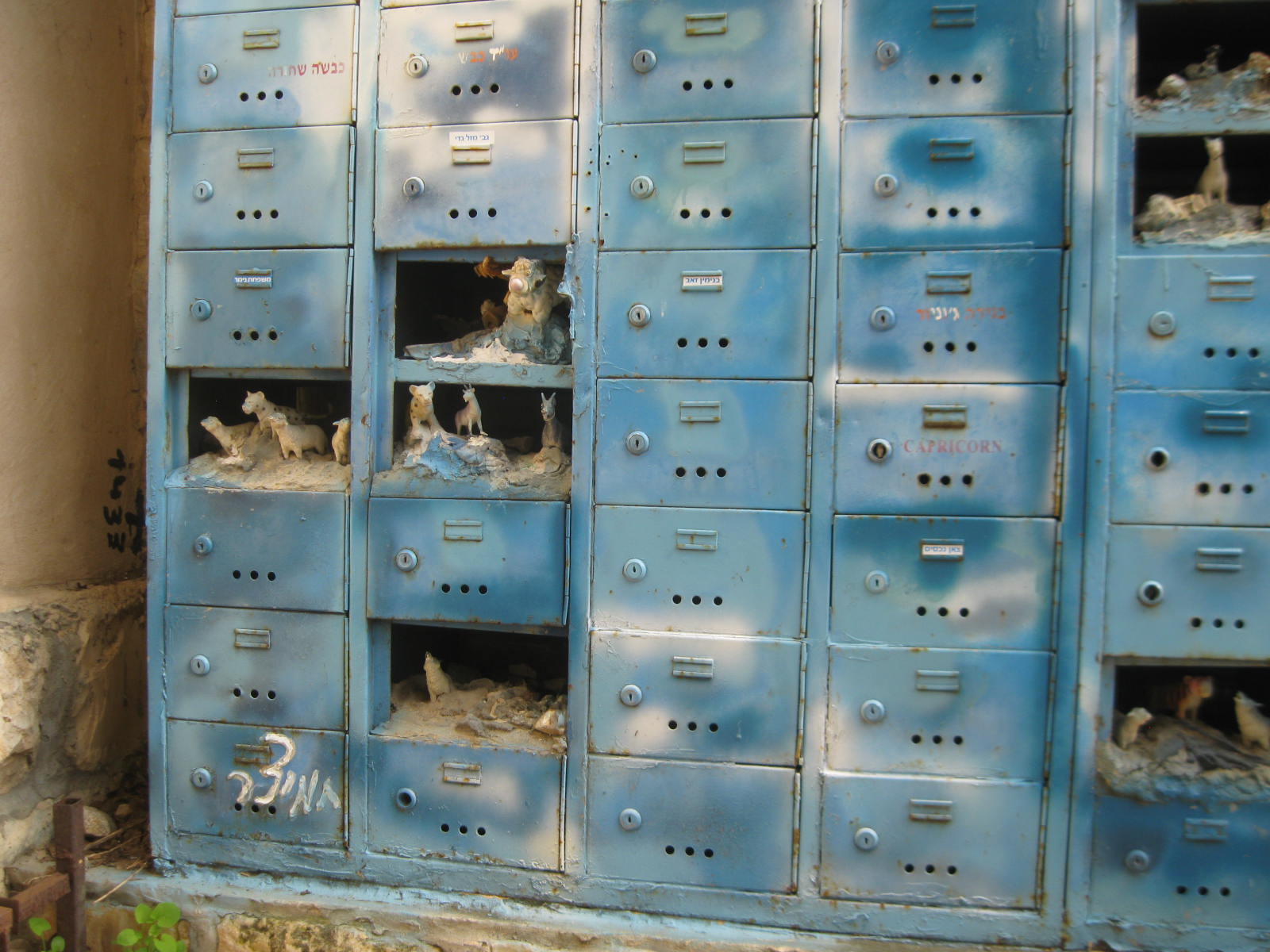
Isaiah's prophecy in a blue mail box


ONE COLOR is our challenge for today's City Daily Photo bloggers' Theme Day. 
This blue "artwork" is signed in the lower corner by Israeli artist Dan Chamizer
He lives in Ein Hod, an artists' colony at the foot of Mount Carmel. 


The funny part is that right next to it are the actual post boxes for the residents of the village. 


The title on top explains why certain animals inhabit the boxes.
"Doar Acharit HaYamim" means Post at the End of Days, meaning, how it is supposed to be --allegorically -- in the future Messianic Era. 

The prophet Isaiah says in chapter 11, verse 6 that


The wolf will live with the lamb, and the leopard will lie down with the kid, and the calf and the young lion will graze together, and a little child will herd them. 
You can see this verse in the famous Isaiah scroll of the ancient Dead Sea Scrolls here:
http://dss.collections.imj.org.il/isaiah?id=11:6

Happy Easter and happy Pesach to you all! 
.

Friday, August 4, 2017

Being comforted on Shabbat Nachamu

.
Click to enlarge for the beautiful window details


Shabbat Nachamu begins this evening.

After going down to the depths on Tisha B'Av, mourning the destruction of the Temple and of Jerusalem [in my 9 B'Av posts], we are brought back to the light by Isaiah's visions of a better future.
He tells us that Jerusalem has paid the price for her sin and is now forgiven.

The haftorah, Isaiah 40:1-26, begins "Nachamu, nachamu ami . . ."
God is telling his prophets to console his people:

" 'Comfort, oh comfort my people,' says your God.
'Speak softly and tenderly to Jerusalem . . .' "

Are they not lovely and welcome words?!

The other verses are equally lovely and well-known.
You can chose your preferred translation of the Isaiah chapter:
"The Message" in modern English or NIV or the translation used by Chabad or the Hebrew with classic old English.

The painted stained glass window is exhibited at Hechal Shlomo museum of Jewish art in Jerusalem.
It was made in England in 1907, one of twelve windows that graced a synagogue in Manchester.
It is based on sketches made by 19th century pilgrims to the Holy Land.

Shabbat shalom!
.

Tuesday, March 1, 2016

Meitar = tent cords for lengthening

.

The yellow part of this sculpture symbolizes the cord of a tent.
This cord or rope is known in Hebrew as a meitar.
Meitar is the name that was chosen for my town when it was first planned in 1984.  


The prophet Isaiah told us to
 Enlarge the place of thy tent, and let them stretch forth the curtains of thy habitations, spare not; lengthen thy cords, and strengthen thy stakes. 
 הַרְחִיבִי מְקוֹם אָהֳלֵךְ, וִירִיעוֹת מִשְׁכְּנוֹתַיִךְ יַטּוּ--אַל-תַּחְשֹׂכִי; הַאֲרִיכִי, מֵיתָרַיִךְ, וִיתֵדֹתַיִךְ, חַזֵּקִי.
  --  (Isaiah 54:2)

You can even see the tent and cord expressed in our logo.

The vision of Meitar's founders was to build a mixed community, a mix of  all kinds of Jews (Ashkenazim, Sepharadim, religious, and non-religious) and even some Muslim Bedouins, with all working and living together in a constructive and warm community spirit.
Openness and acceptance--it is our way of "enlarging the place of our tent" and make it welcoming, with true desert hospitality.
It is an enlarging of our own heart, too.

This is what makes me feel that Meitar, a little town in the Negev desert,  is the place where I belong.

And this is today's challenge for March 1 Theme Day in our City Daily Photo community; see where other bloggers around the world feel at home at City Daily Photo.

Play with Google Maps, especially Earth map, to see how Meitar is kind of in the middle of nowhere.  :-)
Shalom!
.

Wednesday, June 30, 2010

Stained glass reflected in glass

.
Reflected in a showcase displaying old maps at the National Library of Israel is Mordechai Ardon's great work of stained glass.

It makes an entire wall at the Hebrew University of Jerusalem.
Measuring 16 x 6 meters/yards, this creation is among the largest stained glass windows ever made.
The theme is the prophet Isaiah's vision (Isaiah 2:2-4) of eternal peace at the End of Days.
.
An earlier post explains the rich symbolism and gives a closer view.
.
City Daily Photo's July 1 theme day is Reflections.
Click here to view thumbnails for all participants
.

Sunday, May 17, 2009

Coresh Street, Jerusalem

Blogger Meead has done it again--a great post showing the tombs of the kings in Shiraz, Iran--exquisite tombs cut into the cliff walls! AND he combines it with the Bible story of Daniel in the lions' den and even finds a connection to Jerusalem. Don't miss it!
.
Last Tuesday a friend and I were (almost) running across town to reach the Pontifical Mass in time. Then I spotted a street sign and exclaimed "WAIT, I have to take this picture for Meead!"
Who is Coresh, you ask? Coresh or Koresh is Hebrew for Cyrus.
So who is Cyrus, you might ask? None other than the founder of the Persian Empire.
But let Ronald L. Eisenberg, author of The Streets of Jerusalem, tell it:
.
"Coresh (Cyrus) . . . (reigned 559-529 B.C.E.) was one of the great conquerer-kings of the ancient world. When Cyrus took Babylon in 539, he found the descendants of the Jews who had been led into captivity by Nebuchadnezzar decades earlier. In keeping with his general policy toward all conquered peoples, and his respect of native religions and customs, Cyrus permitted the Jews to return to the Land of Israel. According to Isaiah (45:1 ff), who clearly foretold the defeat of Babylon at the hands of the Persian conqueror, Cyrus was the Divine instrument of redemption, 'anointed' by God to save Israel and enable the people to return to their land and rebuild the Temple."
.

Saturday, March 22, 2008

For Good Friday


And for the Christian friends on Good Friday, one of the "Servant Songs" of Isaiah.