Showing posts with label Temple. Show all posts

Thursday, October 9, 2014

"No man shall appear before the Lord empty-handed" on Sukkot

.

While walking through the Jewish Quarter in the Old City,  I had to smile at this man.
I asked him if it was a heavy burden, carrying the Temple into Jerusalem.
He gave a kind smile and said no.

He agreed to a photo and was about to set the model on a bench so I could snap a picture.
I said "No, no, wait!  The best part is how you carry it!"
.
Today and all week we celebrate Sukkot.
Sukkot is one of the three festivals that were celebrated (until the destruction of the Second Temple in 70 CE) with mass pilgrimage to the Temple in Jerusalem and are therefore known as the “pilgrimage festivals.” (See more here.)

 Deuteronomy 16 instructs us about the pilgrimage up to Jerusalem and the Temple:

13 “You shall keep the feast of booths seven days, when you make your ingathering from your threshing floor and your wine press; 14 you shall rejoice in your feast, you and your son and your daughter, your manservant and your maidservant, the Levite, the sojourner, the fatherless, and the widow who are within your towns. 15 For seven days you shall keep the feast to the Lord your God at the place which the Lord will choose; because the Lord your God will bless you in all your produce and in all the work of your hands, so that you will be altogether joyful.
16 “Three times a year all your males shall appear before the Lord your God at the place which he will choose: at the feast of unleavened bread, at the feast of weeks, and at the feast of booths.  
They shall not appear before the Lord empty-handed; 17 every man shall give as he is able, according to the blessing of the Lord your God which he has given you.
.
(Linking to Whimsical Windows, Delirious Doors.)

Sunday, December 16, 2012

Even the bird finds a home

.
For Sunday's PsalmChallenge, graciously hosted by Robert Geiss of daily athens photo.

(My photos below can be enlarged with a click and then another click.)

PSALM 84
1. For the leader; on the gittith. Of the Korahites. A Psalm.

2. How lovely Your dwelling place, O LORD of hosts!
3. My soul longs, even wastes away, for the courts of the LORD; my heart and my flesh sing with joy to the living Deity.


4. Even the bird has found a house, and the swallow a nest for itself in which to set its young—near Your altars, O LORD of hosts, my King and my God.
5. Happy are those who abide in Your house; forever they praise You.  Selah.


6. Happy is the man whose refuge is in You. Roadways in their heart,
7. those who pass through the Valley of Baca, covered by the early rain, regard it as a spring, even as pools.
8. They go from rampart to rampart, each appearing before God in Zion.


9. LORD, God of hosts, hear my prayer; give ear, O God of Jacob.  Selah.
10. Behold our shield, O God; look upon the face of Your anointed.


11. Truly, better one day in Your courts than any thousand [elsewhere]; I choose to be at the threshold of God’s house over residing in the tents of wickedness.
12. Truly, sun and shield is the LORD God; the LORD bestows favor and glory; He does not withhold His bounty from those who go with integrity.

13. O LORD of hosts, happy is the man who trusts in You.
<><><><><><><><><><><><><><><><><><>

Translation: Rabbi Benjamin Segal.  See also his notes on the text.
.
Photos:
1.  Psalm 84 from the early 9th century Stuttgart Psalter!!
2.  One of many springs in the Hills of Jerusalem.
3.  A "shield of David" (magen David) entitled "Mah tovu" by Helene Jacubowitz Mamilla mall.
4.   The Second Temple,  in the Holyland model which is now at the Israel Museum.
.
(The Temple goes to Whimsical Windows, Delirious Doors meme.)
.

Friday, September 28, 2012

A sukkah at the tram terminal!

 .
Look!
CityPass, the consortium that (tries to) run the new Jerusalem light rail, just gave us somewhere new  to sit at their  Mt. Herzl terminal!
No . . . not more shaded benches at the station;  that would be seen as pampering us, giving ALL of us relief from the 34 C heat.
No . . . not more seats on the tram; they wouldn't want ALL of  us to get used to having a place to sit  (let alone enough room to stand) in the packed trams.


 No . . . it is a SUKKAH they gave us, a temporary booth in which to sit and preferably eat  during the week-long holiday of Sukkot!

The soft walls say "To all the light rail passengers and to all the House of Israel--happy holidays and happy travels."

Inside a sign says it was generously donated by  Sukkot Yerushalaim, the sukkah producers, who claim it is not only kosher, not only kosher lemehadrin, but rather KOSHER LEMEHADRIN MIN HAMEHADRIN.
That's like super-duper kosher!


 Printed on the sides are paintings of Jerusalem.
The one above, at the Western Wall, is the only modern one.
(But notice how the Muslim Dome of the Rock is somehow missing. hmm...)


Throngs of pilgrims would come up to Jerusalem for Sukkot  in biblical times.
Here they are walking toward the Jaffa Gate.


 Here pilgrims are walking toward the Mercy Gate, from the east.
The picture quotes Psalm 122, "Our feet are standing at your gates, O Jerusalem." 


 The Temple is near as they converge from the south.


So many priests, some with trumpets, some tending to the sacrifices!

You might enjoy enlarging this photo to get an idea of how the Temple courtyard might have looked. (Click a second time on the photo that opens up.)


And after you have fulfilled the mitsvah of eating in the sukkah you can sing Birkat Hamazon, the blessing after the meal.
A kosher "roof" covering of a sukkah must let us see the stars at night, hence these "drops of sunlight" falling through the top and onto the walls.

Actually, this could be a good picture for Shadow Shot Sunday meme. 
.
These verses from Deuteronomy 16 explain the three great pilgrimage festivals, when Jews from all over the world would make the journey to Jerusalem and walk up to the Temple Mount:

 "Safeguard the month of standing grain so that you will be able to keep the Passover to God your Lord, since it was in the month of standing grain that God your Lord brought you out of Egypt at night...Then count seven weeks for yourself. From the time that you first put the sickle to the standing grain, you must count seven weeks. You shall then celebrate the festival of Shavuot to God your Lord, presenting a hand-delivered offering according to the extent of the blessing that God your Lord has granted you...When you bring in the products of your threshing floor and wine vat, you shall celebrate the festival of Sukkot for seven days...Three times each year, all your males shall thus be seen in the presence of God your Lord in the place that He will choose: on the festival of matzahs, on the festival of Shavuot, and on the festival of Sukkot...
You shall not appear before God empty-handed."

.

Sunday, May 22, 2011

Answers in the day of trouble

.
For Daily Athens' weekly PsalmChallenge, here is the uplifting Psalm 20.
The Hebrew + English text can be found here.
.
1 To the choirmaster. A Psalm of David.
The LORD answer you in the day of trouble! The name of the God of Jacob protect you!
.
2 May he send you help from the sanctuary, and give you support from Zion! 3 May he remember all your offerings, and regard with favor your burnt sacrifices! [Selah]

4 May he grant you your heart's desire, and fulfill all your plans! 5 May we shout for joy over your salvation, and in the name of our God set up our banners!
May the LORD fulfill all your petitions!

6 Now I know that the LORD will help his anointed; he will answer him from his holy heaven with mighty victories by his right hand. 7 Some boast of chariots, and some of horses; but we boast of the name of the LORD our God. 8 They will collapse and fall; but we shall rise and stand upright. 9 O LORD save! May the King answer us on the day we call.*
.
.
Photos:
The tetragrammaton: YHWH, the letters of God's ineffable name
Sacrificial altars of the Second Temple, Aish Hatorah model
From the Museum of Islamic Art
.
*The Vulgate, the early Latin version of the Bible, translates the last verse as
"O Lord, save the king! Answer us when we call."
From here comes the phrase "God Save the King [or Queen]," a rallying cry to the support of the monarch and the nation's forces.
.

Sunday, January 30, 2011

Make your way straight before me

.
Presenting Psalm 5 for the weekly PsalmChallenge over at Daily Athens.
.
7. But as for me, in the abundance of your lovingkindness will I come into your house;
וַאֲנִי--בְּרֹב חַסְדְּךָ, אָבוֹא בֵיתֶךָ
.
I will bow down toward your holy temple in awe of you.
אֶשְׁתַּחֲוֶה אֶל-הֵיכַל-קָדְשְׁךָ, בְּיִרְאָתֶךָ.
.

.
9. O LORD, lead me in your righteousness
because of them that lie in wait for me;
make your way straight before my face.
.
יְהוָה, נְחֵנִי בְצִדְקָתֶךָ--לְמַעַן שׁוֹרְרָי; הושר (הַיְשַׁר) לְפָנַי דַּרְכֶּךָ
.
Photos are of the model of Jerusalem as many believe it looked in 66 CE, in the Second Temple Period.
The model now resides at the Israel Museum.
.
Grandson Dean is on the path.
.
Here is the text of Psalm 5 with a different translation:

1. For the leader; on Nehiloth1. A psalm. Of David.

2. Give ear to my words, O LORD; consider my utterance.
3. Listen to the sound of my cry, my King and God, for I pray to You.
4. LORD, hear my voice in the morning; in the morning I turn to2 You, and wait.
5. For You are not a God who desires wickedness; evil cannot sojourn with You;
6. wanton men cannot endure in Your sight. You hate all evildoers;
7. You destroy those who speak lies; a man of blood and deceit the LORD abhors.
8. But I, through Your abundant love, enter Your house; I bow to Your holy temple in awe of You.
9. O LORD, lead me along Your righteousness because of my foes; make Your way straight before me.
10. For there is no sincerity in their mouth; their innards - destruction; their throat is an open grave; their tongue slippery.
11 Hold them guilty, O God; let them fall by their own counsels; because of their many crimes cast them out, for they defy You.
12 But let all who take refuge in You rejoice; may they ever sing in jubilation as You shelter them; and let those who love Your name exult in You.
13. For You surely bless the righteous man, O LORD, encompassing him with favor as with a shield.
.

Saturday, July 24, 2010

Listening and learning

.
Kristine and Mark didn't notice they were covered in little checkerboard shadows that were just right for Shadow Shot Sunday.
My visiting friends were too engrossed in listening to the audio guide.

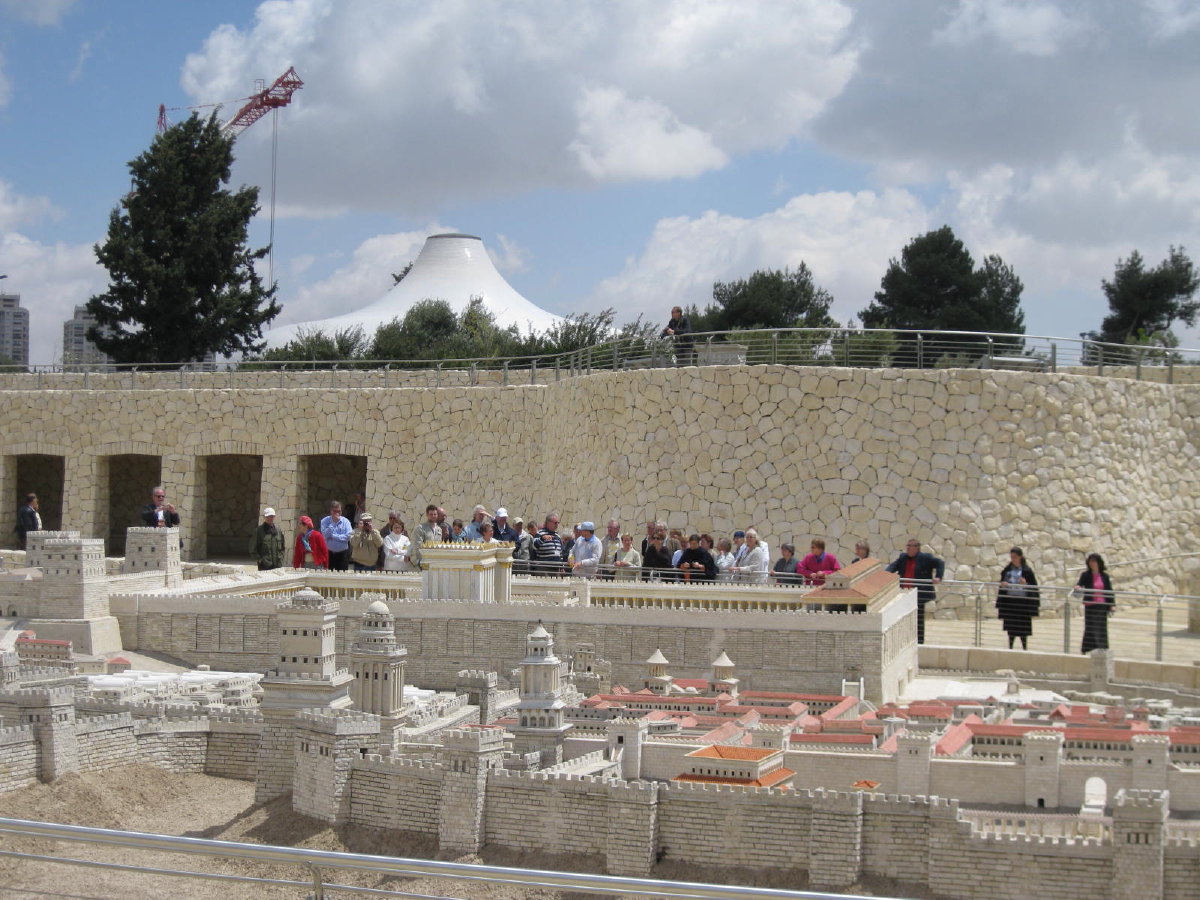
This is what they were looking at and hearing about--the Holyland model of Jerusalem as it may have looked in the year 66 C.E.
The model now resides at the Israel Museum.
The museum's white Shrine of the Book, of Dead Sea scrolls fame, is visible just behind the model.
The square building on the left horizon is Israel's Knesset
.
Please click to read about the model.

Visitors stand and gaze in wonder at the size and majesty of the Second Temple.
.

Tuesday, July 20, 2010

Appropriate for Av 9

.
For today's ABC Wednesday let "A" be for Av, for today is Tisha B'Av, the 9th day of the Hebrew month of Av.

As we saw in the previous post, this is a sad day on which many Jews fast and mourn the destruction of ancient Jerusalem and of her First and Second Temples.

Recently I explored the Romema neighborhood with its grand old houses, begun in 1921.

Something about this building--maybe the open door with the star of David or the sunlight on the old tiles or a sense of mystery--beckoned me to enter and go up the stairs.
.
The house seemed to be shared by four families now.
Four apartments.

But what surprised and moved me even more was what I found on the wall, near the ceiling.
The Hebrew on the tiles translates to
A REMEMBRANCE OF THE DESTRUCTION [i.e. of the Temple]
IF I FORGET YOU O JERUSALEM, LET MY RIGHT HAND FORGET HER CUNNING [Psalm 137:5].
.
The famous Psalm 137 illustrated!
.
"By the waters of Babylon, there we sat down and wept,
when we remembered Zion.
On the willows there
we hung up our harps.
For there our captors required of us songs,
and our tormentors, mirth, saying,
'Sing us one of the songs of Zion! . . . ' "
.
This is so appropriate for today, Tisha B'Av, the day on which the Temple was destroyed and following which many of Jerusalem's Jews were taken to exile in Babylon!
.
When I returned home from Romema, I Googled and made yet another moving discovery!
Aviva Bar-Am wrote this about this same house:
"Following the fall of the Second Temple, sages of the period declared that every new building must carry a reminder of that destruction: an unpainted area measuring one cubit by one cubit . . . . Many religious Jews take this edict literally and leave an unplastered or black square on their walls. The picture you see embedded into the wall of Fishman-Maimon’s residence--ceramic tiles showing the River of Babylon, harps and weeping willows--[is one of these]."
.
Furthermore, our Museum of Italian Jewish Art shows an example in carved marble and says,
"Writings of this kind were common in Germany and Poland, while in Italian synagogues, as well as private houses, part of a wall was usually left unplastered in order to remember the destruction of the Temple."
.
So . . . we remember and do not forget.
.
UPDATE 2014: 
Another nice explanation is here, at Jewish Treats.
.

Tuesday, March 16, 2010

Incitement

.
For ABC Wednesday "I" Day, I find it incredible, the rumor that led to today's riots on the eastern side of Jerusalem.
.
Incitement by the Islamic Movement in Israel and by Hamas urged Palestinians to make a "Day of Rage" and to defend al-Aksa mosque (on the Temple Mount) from a perceived approaching Jewish take-over.
They told the people that after last night's dedication of the Hurva (see previous post) Synagogue, which is in the Jewish Quarter of the Old City, the Jews would enter the (Muslim-administered) Temple Mount and lay a cornerstone for the Third Temple.
.


Believe me, this little play model of the Third Temple (with my reflection like cherub wings) displayed in the window of a gift shop in the Jewish Quarter is the closest thing to a real-life Temple that we will ever see in Jerusalem.
No one is going up to the Temple Mount to rebuild the Temple.
.
This little note next to the model--I think it is very funny.
It is a joke!
Everybody chill.
.

Saturday, October 18, 2008

Camels and oxen

.
Oi veh, I thought, how am I going to tie in animals with my Sukkot theme this week?? It is, after all, time for our bloggers' weekend meme centered at Camera-Critters. So I started reading up, and sure enough, there are at least two animal connections!

The Talmud, in Sukkot 2.3, says,

"If one erects his sukkah on the top of a wagon (though it is on the move) or on the deck of a ship (where it is exposed to gales), it is valid and they may go up into it on the festival. If he made it on the top of a tree, or on the back of a camel, it is valid, but they may not go up into it on the festival . . . ."

And why, I hear you asking, may we not be in the sukkah on the camel on the first day of Sukkot, when work is forbidden? It is because of a side reason. The Sages enacted a gezera (a rabbinical decree) against riding on animals on Shabbat and the holidays, out of concern lest a rider unwittingly break off a branch as he rode along an overgrown trail, and that (the breaking of the branch) would be a violation of a melacha (an activity regarded as work which a Jew must not do on the Sabbath). Got it?


Photo courtesy of Gerald Johnson at Heifer Ranch, Arkansas

A Chabad website explains how oxen are connected to Sukkot's message of universal peace:
"When the Jewish people rejoice, our hearts go out to the whole world.
In the days of the Holy Temple in Jerusalem, the Sukkot Festival offerings included seventy oxen, corresponding to the seventy nations -- in prayer for their well-being, and for peace and harmony among the nations of the world."

Saturday, August 9, 2008

Tisha B'Av today

Tonight and tomorrow is Tisha B'Av, the 9th of Av, the saddest of days in the Hebrew calendar, a day of fasting and mourning. Both the First Temple (833-423 B.C.E.) and the Second Temple (349 B.C.E.-69 C.E.) were destroyed on this date.
You can see how big and magnificent the Temple Mount was in the model below. Please click to enlarge the photo.
This famous model on a scale of 1:50 shows the Second Temple and the city of Jerusalem in the year 66 C.E. The Jewish Revolt against the Romans had not yet begun.
The model was recently moved from the former Holyland Hotel to the Israel Museum. The white dome at the top of the photo is the Shrine of the Book where the Dead Sea Scrolls are on view. The building on the far left is the Knesset.


More about the model here and here. A short and interesting summary of Tisha B'Av is here at the Chabad website. The Reform Jewish perspective can be found on the fine Velveteen Rabbi blog. Many other ideas about Tisha B'Av here, presented by the Orthodox Union.

I will post more tomorrow, God willing, here at Jerusalem Hills about tonight's reading of Lamentations. I myself do not fast on this day and am not in favor of building an actual Third Temple. I do observe the day in my own way.