Showing posts with label Susita. Show all posts

Tuesday, May 11, 2010

Quieta non movere -- Don't move settled things

Latin proverbs are always good for the difficult Q Day of ABC Wednesday.

Quieta non movere means "Don't rock the boat" or "Let sleeping dogs lie."

But in the context of these photos from Susita, the proverb's literal translation is best:
"DON'T MOVE SETTLED THINGS."

The architectural elements toppled by the great earthquake of 749 are left in situ as a silent testimony to the devastation that put an end to the city of Susita / Hippos.

Some of the columns are of smooth granite imported from Egypt.
Granite was common in the construction of pagan temples
As we have seen in my two previous posts, Susita was at first one of the pagan cities of the Decapolis.

It is probably this city on the hill that Jesus sailed across the Sea of Galilee to.
The news of his driving the demons out of a man spread fast.
The next re-use of the temple columns was for Christian churches, 3 or 4 of which are excavated.
.
The flat foundation in the photo above has holes for posts of the Byzantine church's chancel screen.

Still half-buried quiet things. . .

Here the archaeologists just couldn't resist just a little reconstructing, it seems!

The pillar with remnants of unusual plaster decoration and the elaborate Corinthian capital begged to be set upright again after all these years.
.
Initial excavations were done in the early 1950s. But then Susita was right on the border with Syria and it must have been quite dangerous.
Digging was resumed in 1999.
Since then, teams from the universities of Haifa and of Warsaw have come every summer.
.
UPDATE Sept. 2014:  See http://blog.bibleplaces.com/2014/09/new-evidence-for-ad-363-earthquake-at.html

UPDATE Dec. 4, 2015: Don't miss this great BAR article on Sussita, with aerial photos!
.

Monday, May 10, 2010

Walking the Decumanus Maximus

.
For That's My World let me take you up to northern Israel, to the remains of a city that flourished from Hellenistic times until the earthquake of 749 CE.

At first it was a pagan city, like the other nine cities of the Decapolis.
In Byzantine times it turned into a center of Christianity.
.
This hill looked to the ancients like a mare's head and neck, so when they built a city on top of it in the 2nd century BCE, they named it Hippos or in Aramaic, Susita.
.
Our group of archaeology volunteers was given a guided field trip up there last Thursday.
.
We were careful to stay on the path on the one narrow ridge that leads up to Susita National Park. Up until the 1967 Six Day War, when Israel won the Golan Heights, this was where Syrian territory began.
Till today the old Syrian minefield is there.
.
It was thrilling to walk on the 2,000 year old road. I had to fight back tears. I was humming "The Appian Way" movement from Respighi's "The Pines of Rome."
.
These basalt pavers form the original Decumanus Maximus, the main east-west street.
.
Here the view is to the west. You can see a bit of the Sea of Galilee down below.
.
And the view to the east, to the Golan plateau.
.
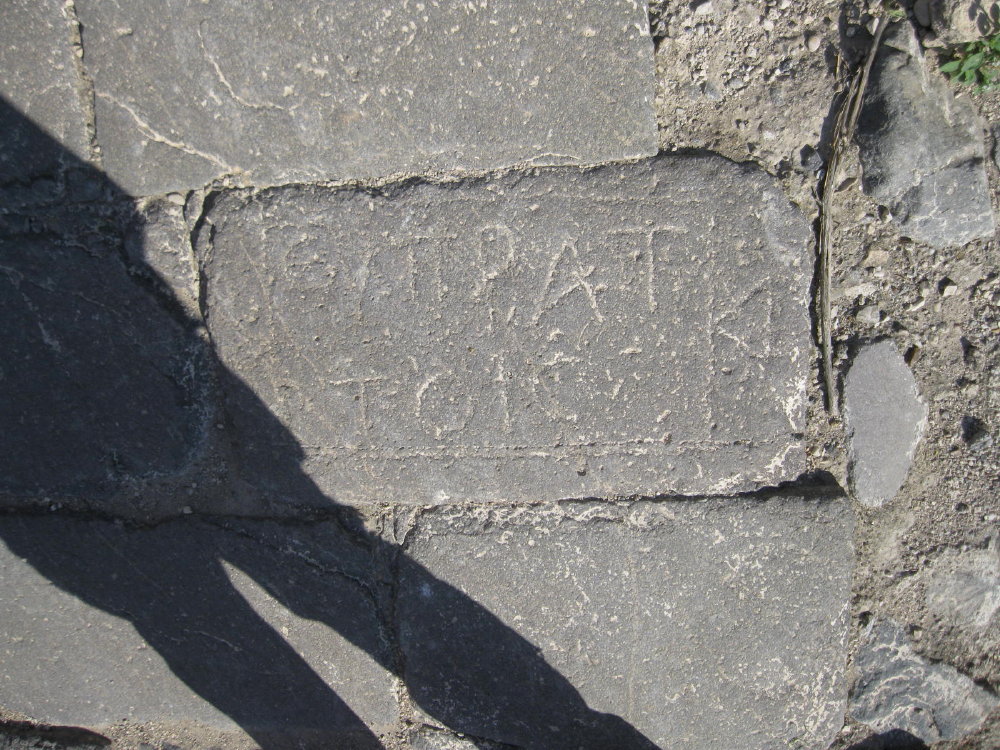
Enlarge the photo to better appreciate the carvings in the local basalt stone.
.
An ancient game etched in stone.
.
An inscription inside a tabula ansata.
.
Oh! and don't you just love this?!
Masons' marks, the "signatures" of the men who cut the stones!
.
The Romans used their engineering skills to bring water UP to the city from springs lower down.
The water flowed through an aquaduct in the hills and then into these interlocking sections of pipe on the side of the Decumanus.
.
Note the size of the first opening . . .
.
and then the smaller second opening.
Going from large into small channel increases the pressure of the running water and makes it go higher up.
I should have checked with my engineer daughter first, but apparently this is now called Bernoulli's principle. I think the Roman's didn't have a name for it; they just DID it!
.
Come back during the week to see the churches of Susita. Shalom!
.
UPDATE Dec. 4, 2015:  See a great new  BAR article on the Susita dig, with aerial photos!

Saturday, May 8, 2010

Excavation bird

.
A crested bird enjoying the late afternoon view over the Sea of Galilee, looking westward toward Tiberias.
For Camera-Critters Sunday.
.
The bird was sitting in the Forum, on what probably was the shrine or niche for the Imperial cult. Two thousand years ago it was the law to worship the Roman Emperor and the Empire in Greco-Roman cities.
On Thursday our group of archaeology volunteers had a guided field trip to the city-state (polis) of Hippos, also known in Aramaic as Susita.
The city on the hill in the Golan Heights flourished between the second century BCE and the seventh century CE. At first it was one of the ten pagan cities of the Decapolis.
Later, in Byzantine times, it became a Christian center.
.
During the week I will show you some of the the ruins of four of the wonderful churches of Susita.
.