.
An Ethiopian clergyman at the entrance to the Ethiopian Orthodox church that is within the Church of the Holy Sepulchre.
.
(For ABC Wednesday's E day.)
.
Showing posts with label Ethiopians. Show all posts
Wednesday, February 12, 2014
Tuesday, February 12, 2013
Ethiopian Jews at Jerusalem International Book Fair
.
There was some lively singing and Ethiopian shoulder-shaking dancing going on this afternoon at the Jerusalem International Book Fair!
The traditional Ethiopian music came before and after talks by young Rabbi Sharon Shalom, author of From Sinai to Ethiopia, and Shira Shatu, a Mandel Fellow writing her thesis on the aliyah of Ethiopian Jews to Israel.
The event was to honor the 20th anniversary of the Israel Association for Ethiopian Jews.
Refreshments were compliments of the Canadian Embassy.
I love the International Book Fair, held every two years!
You never know what you are going to discover there.
.
(For ABC Wednesday, E is for Ethiopian Jews.)
.
There was some lively singing and Ethiopian shoulder-shaking dancing going on this afternoon at the Jerusalem International Book Fair!
The traditional Ethiopian music came before and after talks by young Rabbi Sharon Shalom, author of From Sinai to Ethiopia, and Shira Shatu, a Mandel Fellow writing her thesis on the aliyah of Ethiopian Jews to Israel.
The event was to honor the 20th anniversary of the Israel Association for Ethiopian Jews.
Refreshments were compliments of the Canadian Embassy.
I love the International Book Fair, held every two years!
You never know what you are going to discover there.
.
(For ABC Wednesday, E is for Ethiopian Jews.)
.
Thursday, January 31, 2013
Ethiopian ceremonial umbrellas
.
Joining in the City Daily Photo group's UMBRELLA Theme Day.
Visit the nice new portal to see how bloggers from around the world are interpreting this theme.
My photos (which you can enlarge with a click, then another click) are from Jerusalem Day, May 21, 2009.
Now in May Israel has no rain, so the umbrellas you see above are not for keeping dry.
As I understand it, they are meant to show honor to a person or object.
These men praying in their ancient Gez language are kesim, Jewish spiritual leaders of the Ethiopian community.
But Ethiopian Orthodox Christians also use these colorful fringed and embroidered umbrellas.
I have seen them called liturgical parasols and also ceremonial umbrellas.
The relatively new ceremony, now held every year on Mount Herzl, is called "The National Ceremony for Ethiopian Jews who perished on their way to Israel."
President Peres had praise for this isolated community that managed to survive 3,000 years of The Exile in the mountains of Ethiopia.
He lauded their unending dream to return to Israel, which they called "Eretz Jerusalem," the Land of Jerusalem.
There were several big operations to bring masses of Ethiopian Jews home.
Peres talked mostly about Operation Moses, 1984-5.
One out of every three Ethiopian Jews who started the trek, on foot, over the mountains and then through the desert of Sudan to the temporary refugee camps, in other words 4,000 of those people, died before they could be air-lifted to Israel.
This kes came to the podium, opened his ceremonial umbrella, and spoke from the heart, without a written speech, in the spoken language Amharic.
His whole family died on the long way to Israel.
.
For full coverage of this event and for more about Ethiopian Jews, please see my post With Ethiopian-Israelis on Jerusalem Day.
Joining in the City Daily Photo group's UMBRELLA Theme Day.
Visit the nice new portal to see how bloggers from around the world are interpreting this theme.
My photos (which you can enlarge with a click, then another click) are from Jerusalem Day, May 21, 2009.
Now in May Israel has no rain, so the umbrellas you see above are not for keeping dry.
As I understand it, they are meant to show honor to a person or object.
These men praying in their ancient Gez language are kesim, Jewish spiritual leaders of the Ethiopian community.
But Ethiopian Orthodox Christians also use these colorful fringed and embroidered umbrellas.
I have seen them called liturgical parasols and also ceremonial umbrellas.
The relatively new ceremony, now held every year on Mount Herzl, is called "The National Ceremony for Ethiopian Jews who perished on their way to Israel."
President Peres had praise for this isolated community that managed to survive 3,000 years of The Exile in the mountains of Ethiopia.
He lauded their unending dream to return to Israel, which they called "Eretz Jerusalem," the Land of Jerusalem.
There were several big operations to bring masses of Ethiopian Jews home.
Peres talked mostly about Operation Moses, 1984-5.
One out of every three Ethiopian Jews who started the trek, on foot, over the mountains and then through the desert of Sudan to the temporary refugee camps, in other words 4,000 of those people, died before they could be air-lifted to Israel.
This kes came to the podium, opened his ceremonial umbrella, and spoke from the heart, without a written speech, in the spoken language Amharic.
His whole family died on the long way to Israel.
.
For full coverage of this event and for more about Ethiopian Jews, please see my post With Ethiopian-Israelis on Jerusalem Day.
Wednesday, April 4, 2012
Holy Week, midweek
Tuesday, February 15, 2011
Ethiopian Church exterior
.
For That's My World and also ABC Wednesday, E is for Ethiopian Church--exterior.
.
If you walk down the narrow lane just outside Jerusalem's Old City to No. 10 Ethiopia Street,
you will find the (Ethiopian Orthodox) Ethiopian Church.
It was built in stages between 1874 and 1901.
The Bible says (I Kings 10:1-6) that the Queen of Sheba traveled to Jerusalem in a great caravan to visit King Solomon.
According to Ethiopian tradition, the Ethiopian royal dynasty began with a union between Solomon and the Queen of Sheba.
Our symbol, the Lion of Judah, also became the emblem of the Ethiopian kingdom, but with the addition of a cross and crown.
When you come to visit, you may have to ask to have the church unlocked.
Here in the picture a nun smiles as the monk removes his shoes and opens the door for us.
.
Please come back tomorrow to see the surprising interior.
It is Jerusalem's only circular church sanctuary.
.
For That's My World and also ABC Wednesday, E is for Ethiopian Church--exterior.
.
If you walk down the narrow lane just outside Jerusalem's Old City to No. 10 Ethiopia Street,
you will find the (Ethiopian Orthodox) Ethiopian Church.
It was built in stages between 1874 and 1901.
The Bible says (I Kings 10:1-6) that the Queen of Sheba traveled to Jerusalem in a great caravan to visit King Solomon.
According to Ethiopian tradition, the Ethiopian royal dynasty began with a union between Solomon and the Queen of Sheba.
Our symbol, the Lion of Judah, also became the emblem of the Ethiopian kingdom, but with the addition of a cross and crown.
When you come to visit, you may have to ask to have the church unlocked.
Here in the picture a nun smiles as the monk removes his shoes and opens the door for us.
.
Please come back tomorrow to see the surprising interior.
It is Jerusalem's only circular church sanctuary.
.
Labels:
ABC Wednesday,
church,
Ethiopian Church,
Ethiopians,
flags,
lion,
MyWorld Tuesday
Tuesday, September 21, 2010
Speak softly
.
I took a tour myself yesterday and for That's My World I'll pass it on to you.
.
The subject of the 3-hour tour was "The People of Jerusalem's Old City."
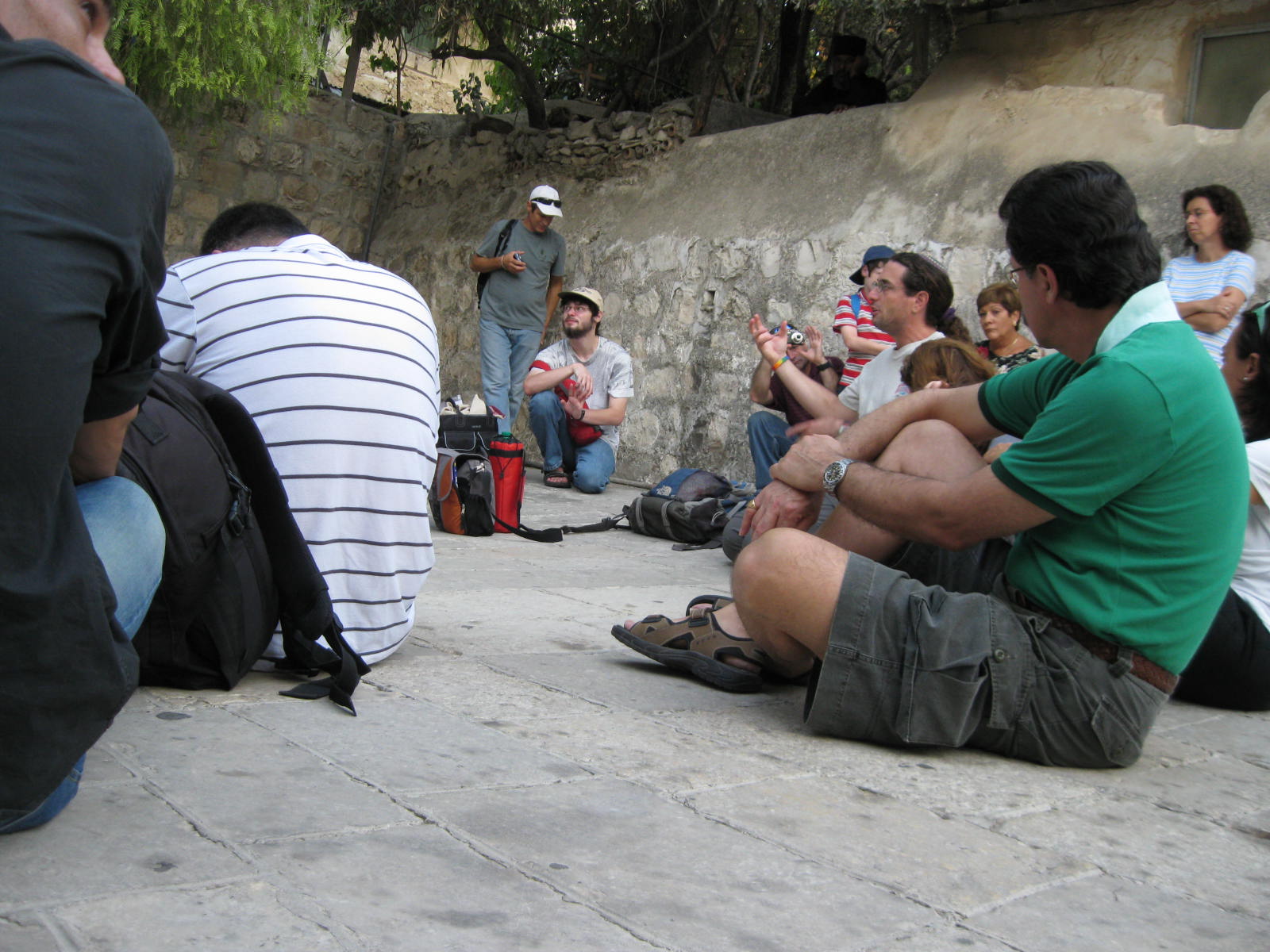
It was sponsored by the Interfaith Encounter Association.
Our guide, shown in the photo above, was educator Jared Goldfarb.
.
A large group showed up for the English-speaking tour.
From Jaffa Gate we walked to the Armenian Quarter, then to the Jewish Quarter (pictured above).
The wooden hut you see is a sukkah for the coming holiday of Sukkot.
After hearing Jared's explanation of the situation of Muslims in the Muslim Quarter, we entered the Christian Quarter.
We ended up on the roof of the Holy Sepulchre for the final presentation, about the Christian minority.
Jared (here with hand in the air) lowered his teaching voice out of respect for the Ethiopian monks who live in tiny cells on the roof.
.
See the dark figure above looking down on us?
.
The monk seemed amused and curious.
I suspect he sees many many tour groups there every day but not many that sit on the ground and speak softly.
.
Happy International Day of Peace!
.
I took a tour myself yesterday and for That's My World I'll pass it on to you.
.
It was sponsored by the Interfaith Encounter Association.
Our guide, shown in the photo above, was educator Jared Goldfarb.
.
A large group showed up for the English-speaking tour.
From Jaffa Gate we walked to the Armenian Quarter, then to the Jewish Quarter (pictured above).
The wooden hut you see is a sukkah for the coming holiday of Sukkot.
We ended up on the roof of the Holy Sepulchre for the final presentation, about the Christian minority.
Jared (here with hand in the air) lowered his teaching voice out of respect for the Ethiopian monks who live in tiny cells on the roof.
.
See the dark figure above looking down on us?
.
I suspect he sees many many tour groups there every day but not many that sit on the ground and speak softly.
.
Happy International Day of Peace!
.
Labels:
Ethiopians,
guides,
Holy Sepulchre,
MyWorld Tuesday,
Old City,
peace,
Sukkot
Wednesday, September 1, 2010
A baby goes to market
.
My favorite picture from Jerusalem's huge outdoor market, Shuk Mahane Yehuda.
.
City Daily Photo bloggers have our monthly Theme Day today and the subject is open air markets.
Click here to view thumbnails for all participants.
.
My favorite picture from Jerusalem's huge outdoor market, Shuk Mahane Yehuda.
.
Click here to view thumbnails for all participants.
.
Thursday, May 21, 2009
With Ethiopian-Israelis on Jerusalem Day
.
Jerusalem Day today, a national holiday, marking what is called the liberation and reunification of Jerusalem in the 1967 Six Day War.
There were many events in town, many different ways to celebrate and to remember.

My choice was to be at a moving ceremony with these kesim.
A kes is a religious leader of Ethiopian Jewry. Here they are singing the prayers in their holy language, Gez.

I sat among these Ethiopian-Israelis.
Jerusalem Day today, a national holiday, marking what is called the liberation and reunification of Jerusalem in the 1967 Six Day War.
There were many events in town, many different ways to celebrate and to remember.
My choice was to be at a moving ceremony with these kesim.
A kes is a religious leader of Ethiopian Jewry. Here they are singing the prayers in their holy language, Gez.
I sat among these Ethiopian-Israelis.
Please click to enlarge and read.
Part One is above,
and Part Two is here.
Part One is above,
Today's relatively new yearly ceremony is called "The National Ceremony for Ethiopian Jews who perished on their way to Israel."

President Peres had praise for an isolated community that managed to survive 3,000 years of The Exile in the mountains of Ethiopia, unlike the Jews of Nineveh, China, and some parts of India who disappeared.
He lauded their unending dream to return to Israel, which they called "Eretz Jerusalem," the Land of Jerusalem.

This kes came to the podium, opened his ceremonial umbrella, and spoke from the heart, without a written speech, in the spoken language Amharic. His whole family died on the long way to Israel.
The new Minister of Immigrant Absorption also spoke (Hebrew with a Russian accent).
President Peres had praise for an isolated community that managed to survive 3,000 years of The Exile in the mountains of Ethiopia, unlike the Jews of Nineveh, China, and some parts of India who disappeared.
He lauded their unending dream to return to Israel, which they called "Eretz Jerusalem," the Land of Jerusalem.
There were several big operations to bring masses of Ethiopian Jews home.
One place you can learn about it, as told by the immigrants themselves, is here.
And if you have four minutes please watch a video about the 1991 Operation Solomon in which 14,000 were rescued in 36 hours of continuous airlifts. If your eyes stay dry, let me know.
.
Peres talked mostly about Operation Moses, 1984-5.
One out of every three Ethiopian Jews who started the trek, on foot, over the mountains and then through the desert of Sudan to the temporary refugee camps, in other words 4,000 of those people, died before they could be air-lifted to Israel.
This kes came to the podium, opened his ceremonial umbrella, and spoke from the heart, without a written speech, in the spoken language Amharic. His whole family died on the long way to Israel.
The new Minister of Immigrant Absorption also spoke (Hebrew with a Russian accent).
I learned that Israel now has 120,000 Ethiopians and a third of them are Sabras (native-born).
But earlier a man had sung a song in Amharic.
I could only understand the muffled sobs of the women next to me and a groan and a sigh from the men sitting behind me.
There was the religious part--a reading of Psalms, the recital of Kaddish, the cantor singing El Maleh Rachamim.
I could only understand the muffled sobs of the women next to me and a groan and a sigh from the men sitting behind me.
Then came the laying of wreaths by the VIPs, including the Ambassador of Ethiopia.
I wonder how he felt about all this.
Saturday, March 7, 2009
More women of Jerusalem
.
Do yourself a favor: click to enlarge this photo and enjoy the braids of this Ethiopian beauty.
Her finger is pressing an earphone which I like to think is an iPod, judging by her slight swaying movements.
Several guards are always stationed at each of the four main entrances to the huge Shuk Machaneh Yehuda outdoor produce market. With big automatic rifles slung over their shoulder.
A Wikipedia article begins thus: "The Israel Border Police ( מִשְׁמַר הַגְּבוּל, Mishmar HaGvul) is the military branch (gendarmerie) of the Israeli Police. It is also commonly known by its Hebrew abbreviation Magav (Hebrew: מג"ב), meaning border guard, whilst its members are colloquially known as Magavnikim (Hebrew: מג"בניקים). Border Guard is often used as the official name of the Israel Border Police in English."
Like the young woman in the picture, most of the male and female magavnikim standing all day by the shuk look bored, and rightfully so. Let's hope the situation stays that way, nice and quiet with no terrorism.
Thursday, October 30, 2008
Togetherness
Wednesday, May 21, 2008
R is for . . .
Rough deciding which R words to select for ABC Wednesday. So I'm going to try your patience and offer random Rs from Jerusalem and the Jerusalem Hills. Ready?
Ringable bells under roof of the Lutheran Church of the Ascension--Augusta Victoria on the Mt. of Olives.
Rotunda of the Ethiopian Church (Eastern Orthodox) near the center of Jerusalem.
Rotunda of the Church of the Holy Sepulchre in the Old City.
Rainbow peace icon in the Lutheran Church of the Redeemer, Old City.
For other bloggers' ideas of R photos go to Mrs. Nesbitt's Place.
.
For other bloggers' ideas of R photos go to Mrs. Nesbitt's Place.
.
Labels:
ABC Wednesday,
church,
Ethiopians,
Holy Sepulchre,
icons
Thursday, March 27, 2008
Marking time
Subscribe to:
Posts (Atom)
.jpg)
.jpg)


