Showing posts with label vineyards. Show all posts

Saturday, June 30, 2018

Red roses in the green vineyards

.

Roses planted in a vineyard??
If you are from rural Italy or France or California you probably know about this tradition.
But it was news to me when our tour guide pointed it out on June 12, just as the scene was quickly  disappearing from the bus window.
We were traveling through the Jerusalem Hills, west of Jerusalem.

He explained the roses as an early warning system.
Roses are more susceptible to the same type of fungal disease (e.g. powdery mildew and downy mildew) than the grapevine. 
So if there are signs of trouble on the roses the farmer knows that action needs to be taken soon or the grapevines will be infected next. 

I later read on a European website


Another reason I have heard is that in addition to being a ‘canary’ when the vines were worked with draft horses or oxen,  roses encouraged them to turn properly at the end of the rows because of their thorns, ensuring that the working animals weren’t tempted to cut a corner and damage the last vine.
Or this from Australia:

". . . many a vineyard manager would smile at this quaint romantic notion. Their job is more sophisticated than watching the roses bloom. In these days of modern technology roses are planted at the rows end for purely cosmetic reasons, but don't let that spoil another great story...
Some time ago in the Hunter Valley in New South Wales I quizzed one of the “old timers” in the area about the same issue. His response left me wondering whether or not he was “having a lend of me”.In the early days of grape growing, before any mechanisation, the vineyard work was completed using horses and horse pulled equipment. The best source of strong “draught horses” were the local coalmines where any pulling work involved horses.Sadly the distance underground was so far that the horses used were stabled in areas deep underground and, while they were very well cared for, their eyesight eventually became a casualty of the environment. The period horses were kept underground was mercifully short but permanent damage to their vision occurred. As the horses were “traded out” the local farmers and grape growers sought to utilise their great strength and stamina, particularly working with ploughs in vineyards where the rows were quite narrow.
Now the reason for the roses at the ends of the rows, as explained by this particular veteran, was to let the ‘blind’ horses know when they reached the end and it was time to turn. Roses in the Hunter Valley constantly bloom almost all year. I was never able to convince myself either way with his story; Australians can be very straight-faced when “spinning a yarn”. I will leave it up to you to decide."
UPDATE: See more in the Comments section  about the "pit ponies," the horses, mules, and ponies which worked in the dark coal mines of many countries for more than two centuries.

Saturday, February 20, 2016

Vineyards in the Brook of Soreq

.

Just before the train to Jerusalem enters the canyon between the mountains, you see some vineyards.


At least I think those are grapevines.
Hard to get a clear picture from a speeding train with dirty windows.
You can enlarge the photos and take a closer look.
The train travels through the Valley of Soreq, and the Hebrew word soreq  is the grapevine itself in Genesis 49:11, Isaiah 5:2, and Jeremiah 2:21.  (See more about that in the Comments.)
.
(Linking G for grapes to ABC Wednesday.)
.

Tuesday, June 9, 2015

Viticulture at Latrun Monastery

.

There, you see?
Rows and rows of grape vines.


Beyond the vineyard is an ancient Crusader fortress on the hill.
(Click on the photo and then once again to see the fort better.) 


It's beautiful country in central Israel.
The Trappist monks at Latrun monastery  harvest the grapes and then make and sell their wine.
.
V is for viticulture, viniculture, vineyards, and Vitus vinifera (the common grape vine) for ABC Wednesday.
.

Tuesday, February 24, 2015

Green grape leaves, stuffed

.

For ABC Wednesday  G  is for grape leaves, stuffed and ready to go in the oven!

Elma, the new special hotel I've been telling you about, believes in the "eat locally" philosophy.
And there is certainly no lack of grape leaves in Zichron Ya'akov

After becoming the patron of the struggling pioneers who started the moshava Zichron in 1882,  Baron Edmond James de Rothschild a few years later helped establish the first winery in Israel, Carmel Winery, together with a bottling factory, in Zichron Ya'akov.
 In 1892 the grapevines succumbed to phylloxera, but after a brief set-back, American seedlings resistant to the parasite were grown and the winery began to flourish.
Today you can tour the active winery and see one of the huge wine cellars that were carved into Mt. Carmel over a century ago.
This short video shows  a bit of charming Zichron and the new Center for Wine Culture

* Elma's website is a work in progress, and the hotel/arts complex itself is nearing completion and its official opening.
.

Thursday, December 11, 2014

International Mountain Day

.
Today is International Mountain Day .
This year's theme is Mountain Farming about which the FAO says, "Here we have an opportunity to raise awareness about how mountain agriculture, which is predominantly family farming, has been a model for sustainable development for centuries."


I like to remember my years in Switzerland, where mountains are mountains and farms are farms!
The slopes of the Jura Mountains, near the French border,  are covered with vineyards.
Lots of wine-making there.


In the Alps most of the mountain farming that I saw was for hay-making.
In the brief summers, green meadows are heaven for  cows, sheep and goats, and even deer.
And of course for hikers too! 
.
(Linking to SkyWatch Friday.)
.

Saturday, November 17, 2012

Vineyards in the Jura

.
The Psalms take on added power during times of danger and of fierce fighting, like  now.

For Psalm Challenge, here is Psalm 80.
(My beloved Swiss photos can be enlarged with a click or two.)

  For the leader; on shoshanim, eduth; of Asaph. A psalm.

1Give ear, O Shepherd of Israel, you who lead Joseph like a flock! You who are enthroned upon the cherubim, shine forth
2before Ephraim and Benjamin and Manasseh. Stir up your might, and come to save us!
3Restore us, O God; let your face shine, that we may be saved.
4O Lord God of hosts, how long will you be angry with your people’s prayers?
5You have fed them with the bread of tears, and given them tears to drink in full measure.
6You make us the scorn of our neighbors; our enemies laugh among themselves.
7Restore us, O God of hosts; let your face shine, that we may be saved.


8You brought a vine out of Egypt; you drove out the nations and planted it.
9You cleared the ground for it; it took deep root and filled the land.
10The mountains were covered with its shade, the mighty cedars with its branches;
11it sent out its branches to the sea, and its shoots to the River.
12Why then have you broken down its walls, so that all who pass along the way pluck its fruit?
13The boar from the forest ravages it, and all that move in the field feed on it.

14Turn again, O God of hosts; look down from heaven, and see; 

have regard for this vine,
15the stock that your right hand planted.


16They have burned it with fire, they have cut it down; may they perish at the rebuke of your countenance.
17But let your hand be upon the one at your right hand, the one whom you made strong for yourself.
18Then we will never turn back from you; give us life, and we will call on your name.
19Restore us, O Lord God of hosts; let your face shine, that we may be saved.
.
.
Translation: NRSV New Revised Standard Version, c. 1989

Photos:
Vines and vineyards on the Jura Mountains, near Lake Neuchatel, Switzerland.
Israel does have vineyards but I have not yet visited them. 
.

Tuesday, June 14, 2011

Vats and vineyards

.
Let's visit vats and vineyards for ABC Wednesday.

Click on the transparent sign to read names of the various vats.

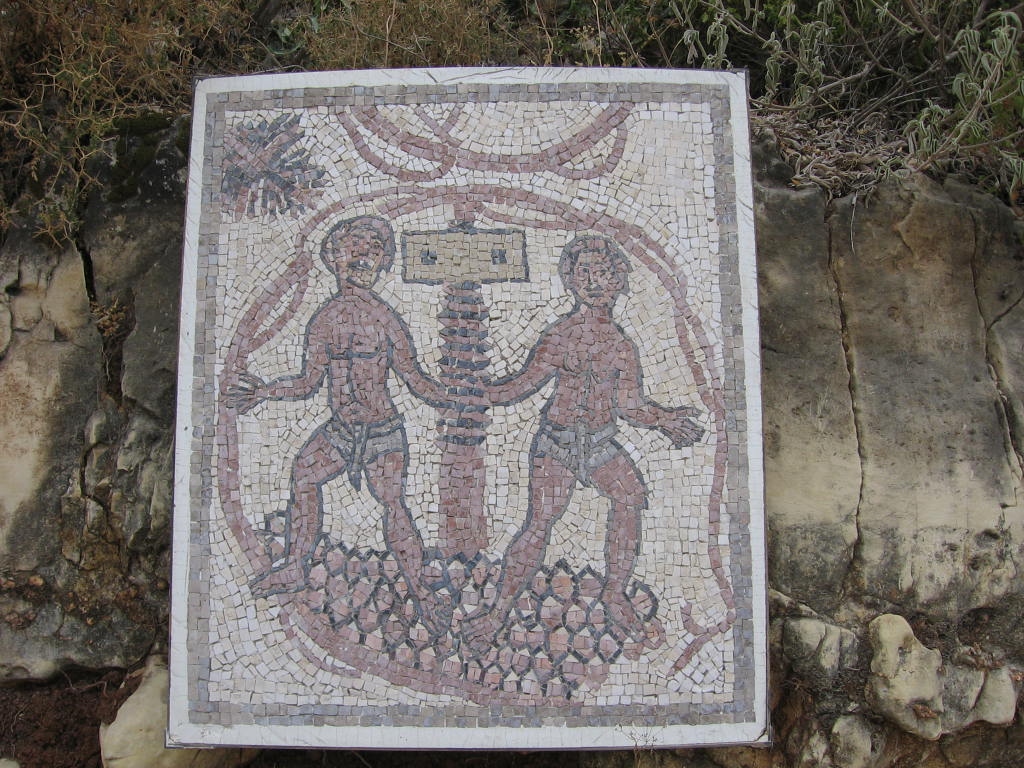
This is a reconstruction of what a winepress would have looked like in Byzantine times, about 1,500 years ago.
It is part of the Biblical Garden at Yad Hashmona.

As this mosaic picture shows, the treading floor was a large area, normally covered by mosaics, where the grapes were laid and crushed by the feet of the workers, extracting the juice.

A small hole in the center of the treading floor was for a secondary crushing of the grapes.

Juice flowed from the small filtering vat into the collection vats.

Workers went down the steps to collect the juice into vessels or to clean the vat.

Fermentation took place in the jars and a cool storage area, such as a cave, was used to store the wine.

During the Roman and Byzantine periods there were hundreds of winepresses in the fields, villages and cities of the Holy Land.

BibleWalks.com explains
. . . each Roman soldier consumed a liter per day, or 6,000 liters per day for one Legion stationed in the Galilee. The wine has medical advantages - killing bacteria and making the drinking water safer. The wine was often diluted with equal portion of water, and used as their drinking water, keeping the soldiers healthy (and happy). This may have been one of the Roman soldiers advantages in the battlefield. To supply this demand the wine was produced in a short period of a month or so, producing a low alcohol (4%) sour wine.

Wednesday, August 5, 2009

Dancing in the vineyards in the moonlight

.
Happy Tu B'Av, the Jewish holiday of love!

Last night the full moon signaled the beginning of the 15th day of the month of Av.
Originally a post-biblical day of joy, Tu B'Av served as a matchmaking day for unmarried women in the second Temple period.

In the glow of a full summer moon, young women, robed in white, would dance in the fields outside the walls of Jerusalem. The men would follow in hopes of finding a bride

(Modern Israel does have vineyards, but I couldn't find any close to Jerusalem; so permit me to post my pictures from Switzerland instead.)
.
We read in the Talmud, in Tractate Ta'anit:
.
Rabbi Shimon ben Gamliel said "Israel has no days as festive as the 15th of Av and Yom Kippur....," and adds "On these days, the young maidens of Jerusalem would emerge in the streets wearing borrowed white clothing [so as not to embarrass the poor who did not have garments of their own]. They would form a circle (and dance) in the vineyards. What would they say (while they danced)? 'Young man, lift up your eyes and appreciate whom you are selecting (to marry). Don't look at our beauty. Instead, look at the family (from which we descend).'
After the fall of Jerusalem in 70 C.E. this minor festival went almost unnoticed for many centuries.
But in the past few decades the non-religious Jews in the State of Israel have brought Tu B'Av back to life as a time to celebrate love and enjoy music festivals. It is even becoming something like the Valentine's Day known to other countries, red roses, gifts and all.
Or at least so they tell me . . .
.

Thursday, August 21, 2008

Moon over the vineyards

Last Friday I watched from my street how the full moon rose over our neighbors on top of the mountain. Those lights are an army base located in Moshav Ora. The moshav has grown since it was founded by new immigrants from Yemen in 1950. There must be a thousand inhabitants up there today.
The full moon signaled the beginning of Tu B'Av, the 15th day of the month of Av on our lunar calendar. Originally a post-biblical day of joy, it served as a matchmaking day for unmarried women in the second Temple period. The Mishnah says Tu B'Av was a very happy day for the people of Israel because "the daughters of Jerusalem go out dressed in white and dance in the vineyards. What were they saying: Young man, consider whom you choose (to be your wife)."

After the fall of Jerusalem in 70 C.E. this minor festival went almost unnoticed for many centuries. But in the past few decades the non-religious in the State of Israel have brought Tu B'Av back to life as a time to celebrate love and enjoy music festivals. It is even becoming something like the Valentine's Day known to other countries, gifts and all.
Sorry, I have no picture of dancing virgins in white dresses. But here at least is a vineyard for you.
(The Jerusalem Hills have some good winemakers, e.g. Domaine du Castel.)


A blogger favorite--Sky Watch Friday--starts tonight at http://skyley.blogspot.com/.
Feast your eyes on their skies.