
Showing posts with label mail. Show all posts

Sunday, April 1, 2018

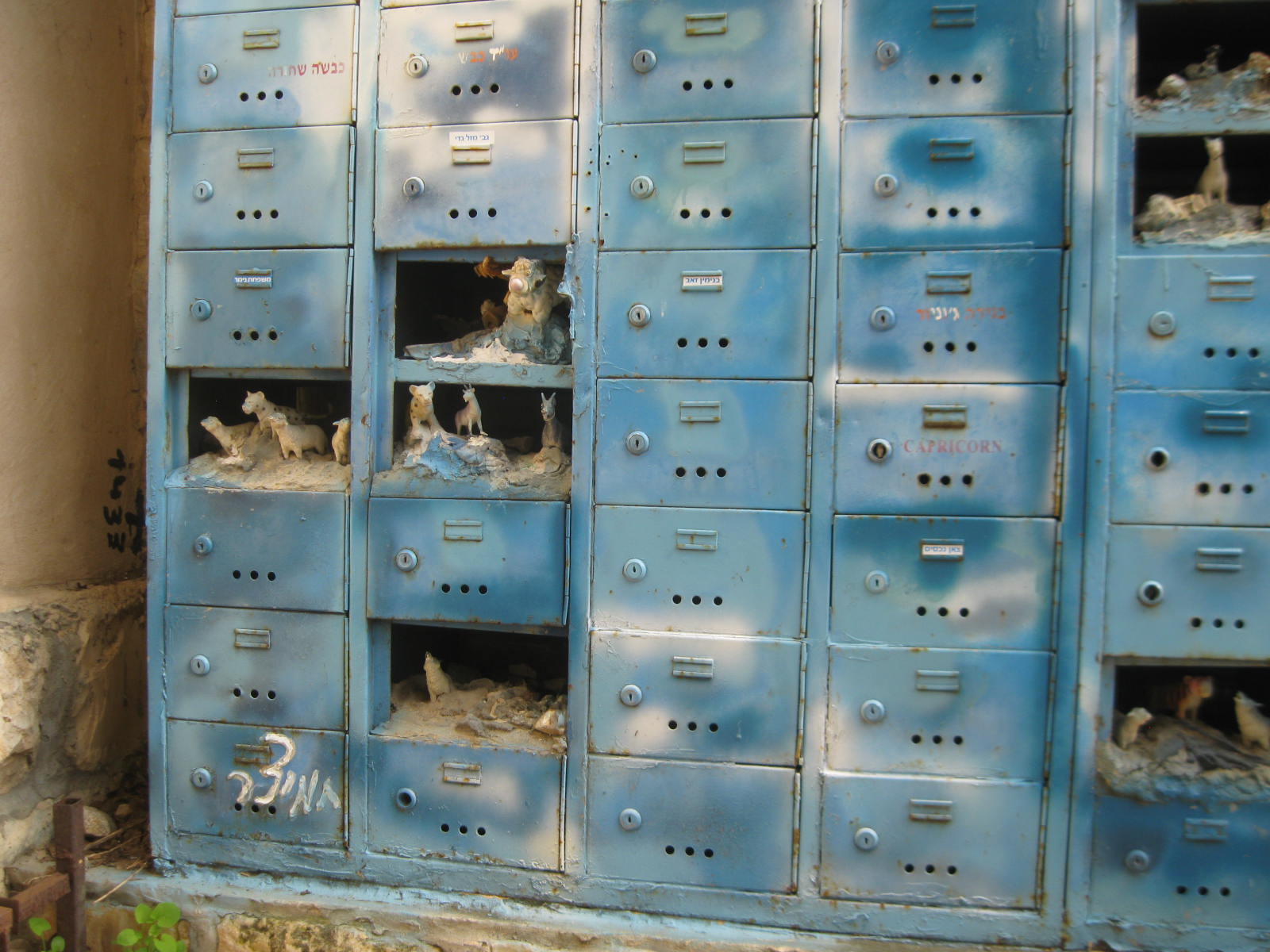
Isaiah's prophecy in a blue mail box


ONE COLOR is our challenge for today's City Daily Photo bloggers' Theme Day. 
This blue "artwork" is signed in the lower corner by Israeli artist Dan Chamizer
He lives in Ein Hod, an artists' colony at the foot of Mount Carmel. 


The funny part is that right next to it are the actual post boxes for the residents of the village. 


The title on top explains why certain animals inhabit the boxes.
"Doar Acharit HaYamim" means Post at the End of Days, meaning, how it is supposed to be --allegorically -- in the future Messianic Era. 

The prophet Isaiah says in chapter 11, verse 6 that


The wolf will live with the lamb, and the leopard will lie down with the kid, and the calf and the young lion will graze together, and a little child will herd them. 
You can see this verse in the famous Isaiah scroll of the ancient Dead Sea Scrolls here:
http://dss.collections.imj.org.il/isaiah?id=11:6

Happy Easter and happy Pesach to you all! 
.

Sunday, September 29, 2013

Centralized mail

.

The houses here in Meitar do not have mailboxes.
Every family has to go check its own little box at one of two distribution places  at the center of town.
My landlady's post box, which I share, is on the highest row and my arm just barely reaches into it when I stand on my toes. 
Meitar has grown to  something like 7,500 residents so you can imagine how many rows of ta-ei chaluka boxes there are.

We  have a (literally)  hole-in-the-wall post office, way too small, and only a few people can fit inside.
If the line is long you have to wait outdoors.
The governing Local Council has promised  a proper post office will be built by April.
.
(Linking to Whimsical Windows, Delirious Doors.)
.

Tuesday, October 9, 2012

Mailboxes--museum pieces

.

Mailboxes at the museum, from modern times back to Mandate days, being inspected by my motivated grandkids.

(That's right, it is M Day at ABC Wednesday.)

The philatelic museum  recounts the history of  postal service in the Land of Israel  from the mid-19th century until the founding of the state in 1948.
On display are envelopes, letters, rare stamps, photographs, posters, mailboxes, and telephones.
There's even a shiny red mail truck from 1949.

It's part of  Museum Eretz Israel in Tel Aviv.
.
Some posts about the mail in Jerusalem --see here.
.
UPDATE Oct. 10:  How strange!  It turns out that the day of my mailbox post was World Post Day
.

Saturday, April 30, 2011

Victims of progress

.
The main streets of Jerusalem and sometimes even the sidewalks got torn up to have track laid for the new light rail.
These poor victims of the tram-building have been here next to Safra Square on Jaffa Road for several years.
It makes me sad every time I walk by and see antique mailboxes on the ground like this.
.

The cast-iron pillar boxes are reminders of Israel's British Mandate past.
Quite a few are still in service in Jerusalem.
Our modern collection boxes are still red, but rectangular and boring.
.
These two uprooted mailboxes let me notice for the first time what is written on the bottom:
McDowall, Steven & Co. Ltd.
London and Falkirk
This was a firm of Glasgow-based iron founders.
The company's roots extend back to the early 19th century.
.
City Daily Photo bloggers are posting their favorite mailboxes for our May 1 Theme Day.
Click here to view thumbnails for all participants
.
To visit Jerusalem's Main Post Office, a big building built by the British in 1938, click here.
An artist's telling of Israel's history is in murals up to the ceiling!
.
To read about the former Imperial Austrian Post Office in Jerusalem's Old City, see my post here.
.

Monday, July 27, 2009

Imperial Austrian Post Office

.
Welcome to Omar ibn al-Khattab Square, just in from the Jaffa Gate, in the Old City, in Jerusalem.
The building on the right is the Swedish Christian Study Centre, but from 1857 to the 1890s it housed the United States Consulate.

Next to the Swedes is another old building whose roof you see on the left of the photo.

Since 1965 the Christian Information Centre, run by the Franciscans, is housed there. Drop in to ask about the Christian holy places or hours of prayer services, to get brochures and maps or to buy books, etc. Right now they are hosting a big exhibit about the journeys of Paul, made for the Catholic Year of Paul which just ended.

But as the plaque says, from 1859 to 1914 this same building was the AUSTRIAN IMPERIAL POST OFFICE.
Their international postal service was pretty primitive, but it was much more efficient and trustworthy than the existing Ottoman post.
Following the Austrian's lead, similar postal services were then established by France, Russia, Germany, and Italy.
You can read the fascinating story of the building and the P.O. at the Jerusalem Municality website. Their source, verbatim, is Jerusalem, a walk through time, Yad Ben-Zvi's Walking-Tour Guide.
When World War I broke out, the Ottoman authorities closed Jerusalem's foreign post offices, except for the German and Austrian military mail services, thus ending the Austrian public postal service in the city.
The Post Office used to look like this around the turn of the century.
The photo is from Wikimedia Commons.
.
Starting tonight the weekly tours will be leaving from That's My World. Click to join a few.
Hope you enjoyed this little tour in the Old City. Shalom!
.

Sunday, February 15, 2009

Know hope

.

The main streets of Jerusalem are all torn up (see Jaffa Road here), having track laid for the new light rail.
Sometimes even part of the sidewalk gets dug up.
Today I saw these latest victims next to Safra Square.

The cast-iron pillar boxes are reminders of Israel's British Mandate past.
There are quite a few still in service in Jerusalem.
These two uprooted mailboxes let me notice for the first time what is written on the bottom:

McDowall, Steven & Co. Ltd.
London and Falkirk

I see from the Web that this was a firm of Glasgow-based iron founders.
The company's roots extend back to the early 19th century.

Oh, and can you see the nice graffiti next to the heart? -- KNOW HOPE
.