Showing posts with label market. Show all posts

Tuesday, December 31, 2013

Time vs. timeless

.

Please click once or twice to see the details!
.
It is a tradition of the City Daily Photo group for bloggers to select and post our Photo of the Year on January 1. 
I chose this one for several reasons. 

It is from a hot day in August,  when I was standing in the shade of the spice seller's umbrella at Beer Sheva's Bedouin market.
I found it fascinating to be standing next to these two Bedouin women.
The old one was deciding which smooth pebbles and which chunks of incense to buy to take home to her tent or hut and she was consulting or haggling with the seller in Arabic. 

It hit me that yes! -- now I was really living in the Negev, home to some 200,000 Bedouin. 
 (I had just moved from the green Jerusalem Hills area down to the town of Meitar.)

And yes! -- the Negev was once part of the ancient Incense (or Spice) Route.
As in a mirage I started imagining caravans of camels traversing the deserts, laden with frankincense and myrrh!

. . . Which brings us to this season, now winter, when the three Magi are en route to Bethlehem carrying exactly those good-smelling gifts (so according to Christian tradition), arriving on Epiphany.

And just now, when much of the world (but not so much Israel) is watching the clock tick down to midnight and reflecting on the passing of time  and wondering what future time will bring,  I look at this photo and realize the image that many Bedouin still exude -- one of timelessness
.
Wishing you all a blessed new year.
.

Friday, June 7, 2013

Naturally sweet

.

After all these years of blogging about sugar cane in Israel, I finally decided to taste it!
Here's the man pouring my freshly pressed sugar cane juice.
The juice store  is in the covered part of the open air Mahane Yehuda market. 


Ten shekels for a small glassful.
That means this bundle is worth hundreds.


The stiff cane gets a good strong squeezing.


Here's what was left.
This is the length of a cane that  it took to extract  my small glass of juice.
Very sweet.
.

Tuesday, April 16, 2013

Celebrating Independence Day via Internet TV

.

Nuts!
That's what I said today when the Independence Day Air Force fly-over was cancelled for Jerusalem.
We had such heavy winds and cloud cover and only 15 degrees C.
The rest of the country had better weather and did get to see the planes, however.
At least I have my dramatic photos of the planes from a year ago. 

So for ABC Wednesday N is for nuts, but for Nature too.
Some 1.3 million Israelis flocked to parks and forests today to barbeque and celebrate.

For me, N is also for nachat,  that special feeling of being proud of those you love.
We had so much of nachat over these two days, the Day of Remembrance and then our 65th Independence Day.
First, the twelve torches that were lit on Mt. Herzl by 14 Israelis who have done much (as I wrote in yesterday's post). 
Then the 120 outstanding young soldiers who were honored at the official residence of President Peres this morning.
To see their bright faces and to hear some of their stories of service and attitude made me kvell (to feel overflowing nachat), as if I were their mother.
Actually we all feel that  all the soldiers are our children.

Then at noon youth from all over the world competed in the annual Bible contest.
So young yet they know the Tanach so well.

And tonight I watched the awarding of the Israel Prizes to the older scholars and teachers and researchers and builders of our country.

So many citizens who have given so much to our people. 
So inspiring.   God bless them!
.

Monday, March 11, 2013

A heavy yoke

.

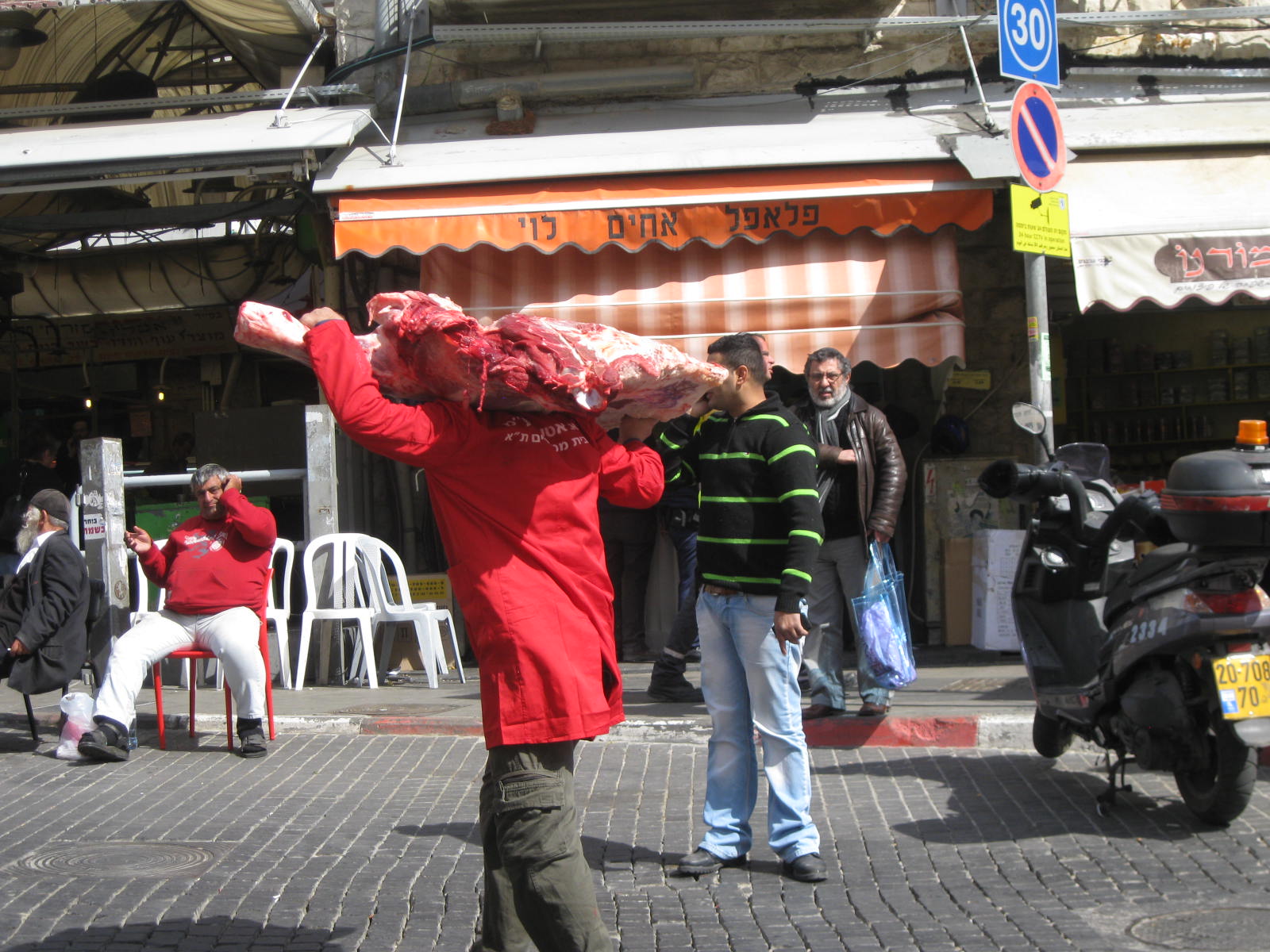
Meat delivery day at Shuk Machane Yehuda, Jerusalem's open-air produce market.
.
.
(For Our World Tuesday)
.

Friday, February 22, 2013

Making merry in the shuk

.

Purim is on Sunday, and Shushan Purim will be celebrated in Jerusalem on Monday. 


But the entire Hebrew month of Adar is meant to have extra joy in our lives.
So these religious boys came singing and dancing in the middle of the the market, Shuk Machane Yehuda, a few days ago, to everyone's delight.

For more about the holiday please see my previous Purim posts.

Shabbat shalom and chag sameach! 
.

Monday, January 21, 2013

Egg toss at Bibi and Shelly

.
A crowd was forming as I came out of  Shuk Mahane Yehuda market this afternoon.


Most of the onlookers were religious yeshiva boys.

 Some had long twirled side-curls and some had short tucked-behind-the-ear peot.
Nevertheless, I worked my way closer to the center to see what was going on.

 Two young seculars were wearing goggles and T shirts bearing pictures of two of the major candidates in tomorrow's national elections; the one above had Bibi (Netanyahu) in the crosshairs.

 This one, wearing Shelly (Yacimovich, Labor), was trying hard to explain that the people were invited to throw an egg at the candidate they disliked the most.
They had trays with 60 eggs ready on the pavement.


OK, the boy takes aim, the victim guards his betsim (eggs) . . .


 . . . and splat!  egg yellow on his chest, broken shell on his hand!


Strewn on a black cloth under the eggs were voting slips (yes, we still vote with a paper petek placed inside a paper envelope), and they were all of the Shas party (religious Sephardic Jews).
There was even a glossy picture of their head rabbi on the ground. Oi.

Then the Israeli crowd dynamic came into play.
A woman walking by yelled "Why do you make our sidewalk filthy with all those Shas papers?!  Disgusting!!"
Some young men in black shouted back "So you will have another reason to hate us."

Then an older man saw the egg-throwing in the crowded place (already spilling over onto the tram tracks) and said he was calling the police (as he took pictures with his cell phone).
Then the mood changed.
The previously-amused religious young men started chanting "Smolanim hachutsa, smolanim hachutsa" --meaning "Out with the left-wingers!"

The two in white packed up their eggs and got out of there.
.
There has been plenty of mud-slinging in this election campaign, but I have never heard of egg-slinging, till today.
.
For a nice piece about how the candidates always visit "Jerusalem's iconic fruit market" and how the sellers see them, read in The Times of Israel.
.
(Post links to Our World Tuesday.)

Wednesday, November 7, 2012

Sugar cane and the etrog medicine man

.

You don't often see sugar cane in Jerusalem.
But two weeks ago these bundles caught my eye in the bazaar of the Old City.


And then in Mahane Yehuda market, there they were again!
The sign says 15 shekels for one kilo of fresh sugar cane.
A small glass of its juice, with a little lemon and ice added, will cost you 10 shekels.
A big glass is 18 shekels.


The pre-cut sections stood in the bucket, ready to be fed into the juicer below.

This is at the stall of the famous Uzi-Eli, the etrog medicine man.
He makes concoctions to improve your health and happiness.
I just now learn from Wikipedia that he came from Yemen in 1950 and is a 3rd-generation healer.
You will enjoy this little  video about him.
.
In medieval times the Galilee had many sugar mills.
If, like me, you never realized what a sugarloaf is, my earlier post has a picture of sugarloaves  and some history of sugar cane in Israel.
.

Wednesday, September 26, 2012

Breaking the fast by breaking bread

.

Here in Jerusalem Yom Kippur ended at 6:07 pm.
As  the 26-hour no-food no-water fast came to an end, all thoughts turned toward food and drink.

Fortunately, on my last visit to the shuk (Mahane Yehuda market), I stocked up on special bread at the tiny bakery on Jaffa Street.

The growing line of customers waited patiently and with understanding  as dark smoke started escaping from the oven and the baker/seller opened the door and dashed inside.
He quickly peeled the round  Bukharan bread from the ceiling and brought out a stack.

Then he took some kind of long, flat, stiff breads off the sides of the oven. (Next time I'll ask what they are called.)
It is a mystery to me how the loaves just stick to the oven and don't fall.
.

Monday, September 10, 2012

Fresh pomegranate juice

.
This nice man at Jerusalem's Machane Yehuda open-air market was happy to press me some sweet pomegranate juice today.

See?! Here is comes!
.
As our grandmothers always said, "Kos briut!" (a glass full of good health!).
.
The shuk is full now with big red pomegrantes because it is a symbolic food for Rosh Hashana, the Jewish new year starting this Sunday evening.
.
.
(This little look into the huge fresh produce market is for Our World Tuesday meme.)
.

Tuesday, June 5, 2012

Useful and utterly unassuming

.
U is for USEFUL and that's what this man's craft is.
You see him sharpening my little Fiskars scissors from Finland, the pair I've been using constantly for twenty years.
Every few years I walk to the back of Shuk Machane Yehuda market and am happy to find the man in his humble booth, still ready to work.

When at the end he lifted his nose from the grindstone, so to speak, his kind eyes had the hint of a smile.
Then he resumed his reading of the Hebrew prayerbook, which I had interrupted.

We had exchanged a total of five words:
"Efshar?" meaning CAN YOU [sharpen this]?
"Mutar?" meaning MAY I? as I showed him my camera.
"Kama?" How much?
"Shmoneh" Eight [shekels]
"Toda!" Thank you!

Only these few words; but sometimes two people of few words, both utterly unassuming, can have the best communication between them.
.
.
(This post joins the unending ABC Wednesday meme.)
.

Saturday, February 11, 2012

Cutting through a big wheel

.
The steel of the two-handled knife is shiny enough to reflect -- MORE cheese!
--for James' "Weekend Reflections."
.
At Basher's, Machane Yehuda market, Jerusalem, a must-see delicacy store.
.

Friday, January 20, 2012

Hot sahlab / salep at the shuk

.
Get your hot sachlab, only eight shekels!
Or-- just feast your eyes on the beautiful old-style hot-pot container for free.

Also in shuk Machane Yehuda market was this sleek modern container of sachlab.
But here they added the English sign "Hot salep."
.
Salep is the original Turkish name of the hot sweet porridge or beverage that has been loved in the lands of the Ottoman Turkish Empire for centuries.
In what is now Israel, it became known by its Arabic name, sachlab.

The salep flour is made by grinding the dried tubers of a certain type of orchid; and indeed, sachlab or sachlav means orchid in both Arabic and Hebrew.
.
For four servings you'll need
4 cups milk
4 teaspoons sugar
1 teaspoon salep powder
1 tablespoon rosewater
1 teaspoon cinnamon

Now click over to the beautiful Turquoise Diaries and see how inviting hot salep looks in the cups of my favorite Turkish blogger.
.

Thursday, December 29, 2011

Woodcraft construction kits

.
Look at all these Woodcraft model kits for sale at the Shuk Machane Yehuda market!

It could be fun to try to put one together.

They start out as a light flat pack, easy to mail.
I'd love to send some to my grandsons, but Australia is very particular about what kind of wood and organic materials come into its borders.
The model kits would probably end up in quarantine or worse.
.

Wednesday, December 7, 2011

The Jew and his violin

.
The young Hasid's extreme inwardness and intensity and his soulful music stopped me in my tracks.
It was Friday and I should have been hurrying, like everyone else, to buy food in the market and get home before Shabbat.
But I was drawn in, mesmerized by his playing; I could not move away.
Suddenly all the hustle and bustle of the shuk disappeared for me; there was only him.


For some reason a municipal inspector appeared and told him he could not play here.
He kept playing, didn't miss a note.
The official said, "Too bad then, I have to write you a ticket."

I went closer and dropped some shekels in his violin case, maybe to help cover the fine.
Without a word to the evil inspector, the boy moved back a dozen steps--and resumed his music.
Still he played with eyes down, almost closed; only when he sensed children watching did he look up at them momentarily with a twinkle in his eye and a shy smile.

I remembered seeing a strange and powerful movie decades ago about the Seer of Lublin.
This young Jew and his violin had the same kind of mystical magic, as if . . . if he played just a little longer it would bring the redemption, the messiah.

Suddenly he looked up, straight at me.
I hope he couldn't see the tears.

What is it with Jews and the violin?

.

Friday, November 4, 2011

Friday fish

.
A good catch at the Mahane Yehuda market.
Enlarge the photo to see the expression on the poor fish's face.


While fishing for a title for this post, I remembered reading that the Bishops of England and Wales decided to re-establish the practice of fish on Fridays, effective September 16, 2011.

The Bishops said that they “wish to re-establish the practice of Friday penance in the lives of the faithful as a clear and distinctive mark of their own Catholic identity.”
.

I wonder if you could call the traditional eating of gefilte fish on Friday night (Erev Shabbat) a part of our Jewish identity. hmm . . .
But I think the Bishops meant that abstaining from meat on Fridays and having fish instead is what, for many years, made Catholics feel special and set apart.
Come to think of it, the Hebrew word kadosh, holy, actually means "set apart."
.

Wednesday, September 28, 2011

Wishing you a sweet new year 5772

.
So many different ways to market honey, even inside an Eiffel Tower!
Enlarge the photo and also find cute little wheeled honey carts [oops, I almost said "honey wagon" but that means something totally different].


Tonight at the festive Rosh Hashana table everyone will dip a slice of apple in honey, say the Hebrew blessing for fruit, and then add the special New Year blessing:

"May it be your will, Eternal our God, that this be a good and sweet year for us."

I wish the same to you, my good friends around the world.
.

Wednesday, September 21, 2011

Sesame Street?

.
Any food with sesame on it is good in my book.

The unusual arrangement of the oblong sesame-covered bagelach caught my eye at this basta (food stand) at Shuk Mahane Yehuda market.

The yellow paper on the wall tells us what time Shabbat began last Friday.
Just a few minutes after 6 p.m.
It is still hot in Israel and it feels like summer still, but the days are getting shorter and shorter--a sure sign of autumn.

Thursday, August 11, 2011

Ezeh keta!

.
Form [sic] 9:00 to 18:00 only public "transpotraion" is allowed on this congested section of Agrippas Street in central Jerusalem.
Well, at least the Hebrew original is OK, almost.
I wonder how the Arabic translation fared on this big sign.
.
Let's send it to the Signs, Signs meme--and maybe back to the printer too.

This is what the street looks like.
Standing or creeping buses as far as the eye can see.
It doesn't look like the private cars noticed the sign prohibiting them.
.
Until a few months ago, most of this traffic went along the wider Jaffa Street.
But then came the new tram and most of Jaffa St. was closed to vehicles.
Agrippas is a mess.
.

Thursday, August 4, 2011

Fun in the fromagerie

.
When stood on edge, cheese wheels really do look like wheels!

One of my favorite memories from Switzerland--Gruyere!

Welcome to the Shuk Mahane Yehuda store of "BASHER, The King of Cheese."
.
The hole-y Swiss Emmental was tagged "special price" but I didn't see how much it cost because I was having too much fun just taking pictures.
And I'm sure all these imported luxury cheeses are beyond my budget anyway.

Cheesemaking is such an art and such hard and satisfying work. (This I know from working a year and a half in the cheese dairy of an Israeli sheep farm.)
That's why I was so excited to see the nearly one thousand kinds of cheese in this fromagerie today!

Their website says that Eli Basher travels every month to Rungis, the famous wholesale food market at the outskirts of Paris, to select the cheeses.
Of course, he has plenty of great Israeli cheese and dairy products too.

The store has just been renovated and now it is very open and even more inviting.
.

Wednesday, June 15, 2011

From manna to challah

.

Tomorrow it will be time to stock up from the stacked up loaves of challah.
You can see signs of their braided shape on the fallen paper.
If you like challah with sesame seeds, enlarge the photo.
.
At the Sabbath table two challot are held together and the Hamotsi bread blessing is said over both.
This is in remembrance of our 40 years in the desert when each morning the Israelites found manna on the ground, encased in two layers of dew to preserve its freshness.
.
But on Saturday, the Holy Sabbath day, no manna fell from heaven.
Instead, the people would gather a double portion on Friday.
.
Moses explains this in Exodus 16:22-26.
.