.
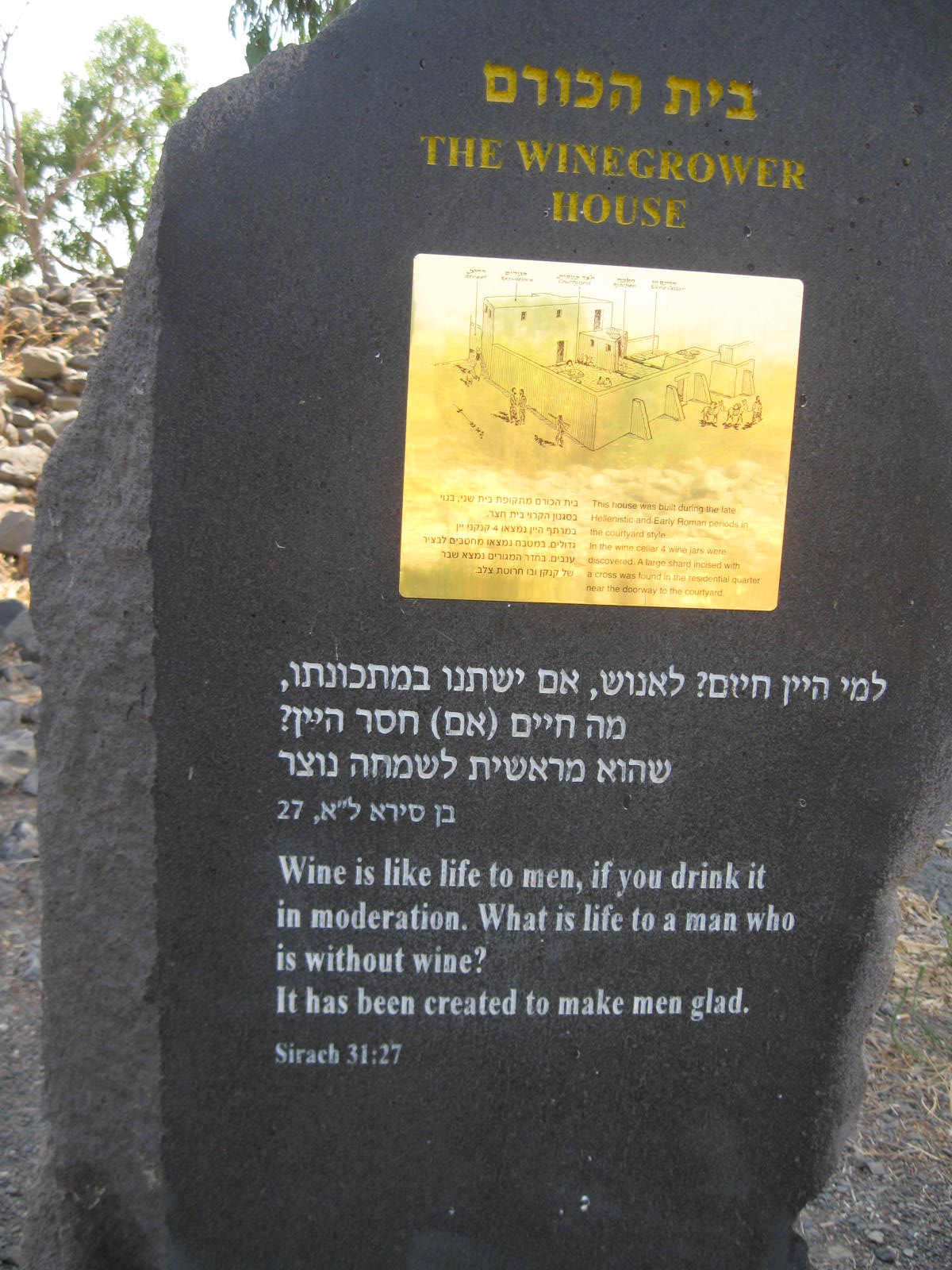
For ABC Wednesday, W is for wine and woe at Bethsaida.
The winegrower's house was given an appropriate passage from the Apocryphal book Sirach.
The famous verse Luke 10:13, "Woe to you, Chorazin, woe to you, Bethsaida . . ."
I took part in the early excavations of Bethsaida back in the early 1990s.
The site has come a long way since then and is open to pilgrims and tourists.
The dig is still underway, still directed by Dr. Rami Arav.
If you are ever near the Sea of Galilee, pay a visit.
But watch your step, the town may still be cursed. :/
.
More pictures of Bethsaida at my earlier post.
.
(Linking to signs, signs.)
.
Showing posts with label archaeology. Show all posts
Tuesday, June 16, 2015
Tuesday, January 13, 2015
Βασίλειος Τζαφέρης z"l
.
Israel has lost another of her veteran archaeologists.
Vassilios Tzaferis died at the age of 78.
You can see many nice photos of him at work in this Greek article.
Tzaferis was a monk before becoming an archaeologist.
Here's how he himself tells it:
But in my opinion his most moving discovery was this heel bone with a spike.
It now has a place of honor in the Israel Museum.
Please see my earlier post to understand how the foot was nailed sideways to the cross.
In a 1985 BAR article Tzaferis told this:
.
Israel has lost another of her veteran archaeologists.
Vassilios Tzaferis died at the age of 78.
You can see many nice photos of him at work in this Greek article.
Photo from Biblical Archaeology Society
Tzaferis was a monk before becoming an archaeologist.
Here's how he himself tells it:
Indeed, Tsaferis Tzaferis wrote extensively about monks and monasteries in the Byzantine period, and he served as director of excavations and surveys at the Israel Antiquities Authority from 1991 to 2001.Archaeology was not in my mind nor in my parents’ minds when, in 1950, at the age of 14, I departed the island of Samos, Greece. The destination for my migration was Jerusalem to study theology and become a monk in the Greek Orthodox Patriarchate. Six years later, when I was 20, my father’s desire was fulfilled when I undertook the vow of monasticism and was ordained deacon in a solemn ceremony at the Church of the Holy Sepulchre.As a deacon and an obedient member of the “Holy Sepulchre Brotherhood” of the Patriarchate, I was sent to serve the Greek Orthodox Church in Nazareth. Two years later, in 1958, I applied for higher theological studies at the University of Athens, but the then-Patriarch Benedictos had a much different idea: Instead, he urged me to complete my academic education in Biblical studies at the Hebrew University of Jerusalem. For my B.A. studies, I chose the history of ancient Israel and archaeology. For my M.A. and Ph.D. degrees, classical archaeology was my field of specialization.
But in my opinion his most moving discovery was this heel bone with a spike.
It now has a place of honor in the Israel Museum.
Please see my earlier post to understand how the foot was nailed sideways to the cross.
In a 1985 BAR article Tzaferis told this:
Rest in peace, Vassilios Tzaferis. Thanks for all you have done in the Holy Land.From ancient literary sources we know that tens of thousands of people were crucified in the Roman Empire. In Palestine alone, the figure ran into the thousands. Yet until 1968 not a single victim of this horrifying method of execution had been uncovered archaeologically.In that year I excavated the only victim of crucifixion ever discovered. He was a Jew, of a good family, who may have been convicted of a political crime. He lived in Jerusalem shortly after the turn of the era and sometime before the Roman destruction of Jerusalem in 70 A.D.
.
Friday, June 27, 2014
Archaeologist Yuval Peleg z"l
.
In May 2012 this top archaeologist, Yuval Peleg, was our guide for a Yad Ben Zvi Institute tour to the Inn of the Good Samaritan and to the monastery of St. Martyrius.
We learned so much that afternoon.
Here above he is explaining the big rolling (or sealing) stone at the gate.
The Martyrius site was discovered in 1982 when the city of Ma'ale Adumim was being built. Now it is right in the middle of town.
To our shock and sadness, Yuval Peleg was buried this morning in his hometown, Ma'ale Adumim.
Yesterday he and several Palestinian workers were beginning to investigate a cave near Sebastia in the West Bank when big rocks rolled down the hill and crushed him.
May he rest in peace and may God comfort his young family, now suddenly in mourning.
The profession will miss Yuval and his big smile.
I could write a small book on my own almost-brushes with death at various expeditions around Israel over the years.
Archaeology, at least for those of us who actually work with pickax and turia, is a profession fraught with danger.
Maybe that is part of what makes it so exciting.
.
(Todd Bolen's blog has more links about the accident and about Peleg.)
.
In May 2012 this top archaeologist, Yuval Peleg, was our guide for a Yad Ben Zvi Institute tour to the Inn of the Good Samaritan and to the monastery of St. Martyrius.
We learned so much that afternoon.
Here above he is explaining the big rolling (or sealing) stone at the gate.
The Martyrius site was discovered in 1982 when the city of Ma'ale Adumim was being built. Now it is right in the middle of town.
To our shock and sadness, Yuval Peleg was buried this morning in his hometown, Ma'ale Adumim.
Yesterday he and several Palestinian workers were beginning to investigate a cave near Sebastia in the West Bank when big rocks rolled down the hill and crushed him.
May he rest in peace and may God comfort his young family, now suddenly in mourning.
The profession will miss Yuval and his big smile.
I could write a small book on my own almost-brushes with death at various expeditions around Israel over the years.
Archaeology, at least for those of us who actually work with pickax and turia, is a profession fraught with danger.
Maybe that is part of what makes it so exciting.
.
(Todd Bolen's blog has more links about the accident and about Peleg.)
.
Sunday, December 29, 2013
Last chance to see Herod the Great, The King's Final Journey
.
I don't know how many hundreds of thousands of Israel Museum visitors have viewed the Herod exhibition since it opened early this year.*
I wish it could stay forever but on January 4, Herod the Great, The King's Final Journey will close.
The banners are all I can show you of the artifacts on display, because the no photography rule was strictly enforced and there were guards everywhere inside the rooms of the exhibition.
You can see the man on duty at the entrance is a no-nonsense guy.
Well, OK, this is the one picture I sneaked before being told to go check my bag.
These are the frescoed walls from Herod's Throne Room, in his Third Palace in Jericho.
The scrolling light words on the floor say
On the book cover is the truncated cone of the Herodion in the Judean desert.
An old photo shows archaeologist Ehud Netzer z"l on site many years ago.
As the museum website summarizes --
Also see how Silvia Rozenberg, co-curator with Dudi Mevorah, explains in two minutes how they worked on this tremendous exhibition for four years.
Herod the Builder would be proud of them.
.
*UPDATE: Haaretz answers my question today (Jan. 1):
"This past Saturday, some 3,500 people checked out the exhibition and almost 440,000 visitors have passed through since it opened in February – a record for a single show at the Israel Museum, which expects the overall number of guests to reach 450,000 by closing day."
.
I don't know how many hundreds of thousands of Israel Museum visitors have viewed the Herod exhibition since it opened early this year.*
I wish it could stay forever but on January 4, Herod the Great, The King's Final Journey will close.
The banners are all I can show you of the artifacts on display, because the no photography rule was strictly enforced and there were guards everywhere inside the rooms of the exhibition.
You can see the man on duty at the entrance is a no-nonsense guy.
Well, OK, this is the one picture I sneaked before being told to go check my bag.
These are the frescoed walls from Herod's Throne Room, in his Third Palace in Jericho.
The scrolling light words on the floor say
The King is dead.
King Herod died in his palace in Jericho in April of 4 BCE.
His body was laid out on a golden bier encrusted with gems.
Wrapped in purple, with a crown on his head and a scepter beside his right hand, he departed for his final journey from Jericho to Herodium accompanied by his family, army, and servants.
At Herodium the mausoleum and sarcophagus he had prepared for himself awaited him.
We invite you to join us on the King's final journey. . . .
On the book cover is the truncated cone of the Herodion in the Judean desert.
An old photo shows archaeologist Ehud Netzer z"l on site many years ago.
As the museum website summarizes --
The first exhibition entirely dedicated to Herod the Great, Israel’s greatest builder and one of the most controversial figures in Jewish history. Large reconstructions and new finds from Herod’s palaces in Herodium, Jericho, and other sites are on display. Exhibited to the public for the very first time, these artifacts shed new light on the political, architectural, and aesthetic influence of Herod’s rule (37–4 BCE). Herod’s tomb – discovered at Herodium after a 40-year search by the late Prof. Ehud Netzer of the Hebrew University – holds pride of place. The exhibition is held in memory of Prof. Netzer, who fell to his death in 2010 on the site of his discovery.Have a gallery tour here.
Also see how Silvia Rozenberg, co-curator with Dudi Mevorah, explains in two minutes how they worked on this tremendous exhibition for four years.
Herod the Builder would be proud of them.
.
*UPDATE: Haaretz answers my question today (Jan. 1):
"This past Saturday, some 3,500 people checked out the exhibition and almost 440,000 visitors have passed through since it opened in February – a record for a single show at the Israel Museum, which expects the overall number of guests to reach 450,000 by closing day."
.
Labels:
archaeology,
doors,
Herod,
Israel Museum,
Our World Tuesday
Monday, September 9, 2013
2 bundles of gold treasure dug up near Temple Mount!
.
What the Hebrew University is calling the Menorah Treasure was shown to the public for the first time today.
It was discovered in the Ophel, in the circled part of my photo, outside the southeastern part of the Temple Mount wall.
With two clicks you can enlarge the picture a lot.
UPDATE: Hebrew U. has just put up a video about the discovery!
http://www.youtube.com/watch?v=JYsjPFnmAmQ&feature=youtu.be
What the Hebrew University is calling the Menorah Treasure was shown to the public for the first time today.
It was discovered in the Ophel, in the circled part of my photo, outside the southeastern part of the Temple Mount wall.
With two clicks you can enlarge the picture a lot.
UPDATE: Hebrew U. has just put up a video about the discovery!
http://www.youtube.com/watch?v=JYsjPFnmAmQ&feature=youtu.be
Woohoo!!
Buried treasure found in Jerusalem announced today!!
OMG, it is so beautiful!
And 1,400 years old!
See the gold at
and also http://www.haaretz.com/archaeology/.premium-1.545965
I just wonder how archaeologist Eilat Mazar and the dig volunteers were able to keep it secret since April, when they discovered the treasure!
Friday, August 23, 2013
Walking over ancient history
.
The newly redeveloped Beersheva Central Bus Station gets a lot of foot traffic.
But the floor is clean and shiny enough to reflect the signs of Burger Ranch, CocaCola, and Little Switzerland.
Good for James' Weekend Reflections.
This special part of the floor is right next to one of the entrances to the bus station.
Look what's under the glass floor--antiquities!!
Found a year or two ago just one or two feet below surface, in a rescue dig!
"For Byzantine Beersheba, this was it," according to Dr. Daniel Varga, excavation director for the Israel Antiquities Authority, who conducted the dig. "This was the heart of the Byzantine city, right here. Two Byzantine churches were built within a radius of 300 meters from here, and right over there was the Roman military camp."
The bustling Byzantine city of Beersheba was home to several thousand people and a popular stopping place for Negev travelers.
Surprisingly, most of the rooms were empty with no signs of destruction, suggesting that the residents left the area of their own accord.
The Byzantine site is remarkably well preserved due to centuries of abandonment following Arab invasions in the seventh century C.E. and recent coverage by the old bus station itself.
(The Muslim conquest of Palestine was completed in 640.)
The dig information here comes from Travelujah and Bible History Daily articles from 2012.
.
P.S. See my post on the Roman Tenth Legion for a similar way of preserving antiquities under glass, under Jerusalem's International Convention Center.
.
The newly redeveloped Beersheva Central Bus Station gets a lot of foot traffic.
But the floor is clean and shiny enough to reflect the signs of Burger Ranch, CocaCola, and Little Switzerland.
Good for James' Weekend Reflections.
This special part of the floor is right next to one of the entrances to the bus station.
Look what's under the glass floor--antiquities!!
Found a year or two ago just one or two feet below surface, in a rescue dig!
"For Byzantine Beersheba, this was it," according to Dr. Daniel Varga, excavation director for the Israel Antiquities Authority, who conducted the dig. "This was the heart of the Byzantine city, right here. Two Byzantine churches were built within a radius of 300 meters from here, and right over there was the Roman military camp."
The bustling Byzantine city of Beersheba was home to several thousand people and a popular stopping place for Negev travelers.
Surprisingly, most of the rooms were empty with no signs of destruction, suggesting that the residents left the area of their own accord.
The Byzantine site is remarkably well preserved due to centuries of abandonment following Arab invasions in the seventh century C.E. and recent coverage by the old bus station itself.
(The Muslim conquest of Palestine was completed in 640.)
The dig information here comes from Travelujah and Bible History Daily articles from 2012.
.
P.S. See my post on the Roman Tenth Legion for a similar way of preserving antiquities under glass, under Jerusalem's International Convention Center.
.
Friday, July 12, 2013
Woe to you, Bethsaida ...*
.
I leaned over to take the "street" sign at eye level and out popped a reflection!
For James' Weekend Reflections, of course.
Here is another shiny sign, this one reflecting rocks and August (2012) dryness.
The site is Bethsaida, of New Testament fame, located on the northern tip of the Sea of Galileee.
You can enlarge the photo twice and read about its history.
Look, they even found the city gate at the end of the street!
I worked two seasons digging there in the early 90s.
Even my then-teenage daughter took part in one of those expeditions.
We volunteers slept in straw huts ("bungalows") in nearby Katzrin, together with bugs and scorpions. (Ugh, better to forget that part.)
I had not been back up to Bethsaida since then, and I was so impressed at the archaeological progress (on-going) and the unique signage and visitor paths.
I remember having to swing a pickaxe to break up the concrete floor of a Syrian bunker so we could dig down to lower strata.
In the photo above I see that long-time director Dr. Rami Arav chose to leave one bunker in situ.
Syrian troops were up there on the Golan Heights, shooting down on Israel, until the 1967 Six Day War.
Not much shade at the site, but this tree offered some, complete with a bench.
The sign says "To a shaded meditation place."
Meditate on all what Bethsaida has seen over the millennia . . .
.
* My post title comes from Matthew 11:21 .
.
I leaned over to take the "street" sign at eye level and out popped a reflection!
For James' Weekend Reflections, of course.
Here is another shiny sign, this one reflecting rocks and August (2012) dryness.
The site is Bethsaida, of New Testament fame, located on the northern tip of the Sea of Galileee.
You can enlarge the photo twice and read about its history.
Look, they even found the city gate at the end of the street!
I worked two seasons digging there in the early 90s.
Even my then-teenage daughter took part in one of those expeditions.
We volunteers slept in straw huts ("bungalows") in nearby Katzrin, together with bugs and scorpions. (Ugh, better to forget that part.)
I had not been back up to Bethsaida since then, and I was so impressed at the archaeological progress (on-going) and the unique signage and visitor paths.
I remember having to swing a pickaxe to break up the concrete floor of a Syrian bunker so we could dig down to lower strata.
In the photo above I see that long-time director Dr. Rami Arav chose to leave one bunker in situ.
Syrian troops were up there on the Golan Heights, shooting down on Israel, until the 1967 Six Day War.
Not much shade at the site, but this tree offered some, complete with a bench.
The sign says "To a shaded meditation place."
Meditate on all what Bethsaida has seen over the millennia . . .
.
* My post title comes from Matthew 11:21 .
.
Friday, March 29, 2013
A 1st C. nail in a foot bone
.
A heel bone with a spike driven through it.
Found inside a 1st century ossuary in a burial cave in Jerusalem.
Our only archaeological evidence (so far) of a crucifixion.
The Israel Museum sign for this gruesome discovery says
You can watch a live telecast on your computer soon of the Way of the Cross of Good Friday, from the Colosseum of Rome, at http://www.vatican.va/video/index.html
Pope Francesco will preside.
The meditations for each station of the cross were written this year by Lebanese Christians.
It starts a little after 21.05 Rome time (7.05 in Sydney, 13.05 in California, 10.05 in Hawaii).
Afterwards it will be available on video at the same Vatican Player website.
The printed Way of the Cross meditations are online now. Very appropriate for the Middle East.
.
.
A heel bone with a spike driven through it.
Found inside a 1st century ossuary in a burial cave in Jerusalem.
Our only archaeological evidence (so far) of a crucifixion.
The Israel Museum sign for this gruesome discovery says
In a burial cave in north Jerusalem, an ossuary was discovered inscribed with the name "Yohohanan son of Hagkol.".
The iron nail embedded in the right heel bone indicates that Yehohanan was put to death by crucifixion, the torturous and humiliating method used by the Romans to execute rebels, murderers, and thieves.
Even though thousands of people were executed in this manner, this is the only archaeological evidence that has reached us.
. . .
The bones of the deceased allow us to reconstruct the method used for his crucifixion:
his legs were nailed to the sides of the crucifixion post, while his hands were tied or nailed to the crossbar.
You can watch a live telecast on your computer soon of the Way of the Cross of Good Friday, from the Colosseum of Rome, at http://www.vatican.va/video/index.html
Pope Francesco will preside.
The meditations for each station of the cross were written this year by Lebanese Christians.
It starts a little after 21.05 Rome time (7.05 in Sydney, 13.05 in California, 10.05 in Hawaii).
Afterwards it will be available on video at the same Vatican Player website.
The printed Way of the Cross meditations are online now. Very appropriate for the Middle East.
.
.
Monday, March 4, 2013
Strings of figs
.
Care for a fig?
A carbonized fig?
They are strings of figs carbonized by fire in antiquity.
Ekron, 13th century BCE.
At the Israel Museum.
.
Care for a fig?
A carbonized fig?
They are strings of figs carbonized by fire in antiquity.
Ekron, 13th century BCE.
At the Israel Museum.
.
Sunday, February 24, 2013
Nimrod and "venahafoch hu"
.
I first heard of Nimrod at the archaeology exhibition called "The Early Years, The 70th Anniversary of the Museum for Jewish Antiquities Institute of Archaeology, Hebrew University, Mt. Scopus."
He was revolving on a screen, the photography produced by the Computerized Archaeology Laboratory.
Then last week I saw the real thing, for the first time!
Nimrod had been commissioned for the Hebrew University but was rejected and ended up here at the Israel Museum instead.
What a story!
First I'll give you the story as told by the University's Archaeology Institute (I think they begin by talking about the early 1940s, the pre-State days):
Now, if you still have patience, please click on the sign and read how the art history folks at the Israel Museum tell the same story but with a very different emphasis.
Especially the part about
.
(This post links to Weekend Reflections and Whimsical Windows, Delirious Doors.)
(All photos can be much enlarged)
I first heard of Nimrod at the archaeology exhibition called "The Early Years, The 70th Anniversary of the Museum for Jewish Antiquities Institute of Archaeology, Hebrew University, Mt. Scopus."
He was revolving on a screen, the photography produced by the Computerized Archaeology Laboratory.
Then last week I saw the real thing, for the first time!
Nimrod had been commissioned for the Hebrew University but was rejected and ended up here at the Israel Museum instead.
What a story!
First I'll give you the story as told by the University's Archaeology Institute (I think they begin by talking about the early 1940s, the pre-State days):
The Hebrew University commissioned the first version of the Nimrod statue from Israeli sculptor Yitzhak Danziger.
The planned sculpture was to be placed at the entrance to the Museum for Jewish Antiquities, however the order was cancelled and the completed sculpture never reached the University.
The statue depicts young and naked Nimrod, the hunter, carrying a bow on his back and a falcon on his shoulder.
Danziger drew his inspiration from the ancient Near Eastern cultures and the description in Genesis 10:8-9: "Cush also begot Nimrod, who was the first man of might on earth. He was a mighty hunter by the grace of the Lord."
The shape is reminiscent of ancient Egyptian statues and its name is connected to the Mesopotamian heritage.
Nimrod is a corruption of the name of the Assyrian god Ninurta.
The Nubian sandstone from which the statue was carved conjures an image of exotic cultures.
The ancient Near Eastern sources of inspiration for the statue and their conception of a young and daring figure were viewed by many as an aspiration to identify with proto-Jewish sources.
For this reason the statue was considered a symbol of the movement of Young Hebrews, called "The Canaanites," which emerged in Palestine at the end of the 1930s.
The mention of Nimrod as a negative figure in Jewish midrash, as well as the bold creativity of the sculpture, its unorthodoxy, and perhaps even overt sexuality are what caused the University to reject its inclusion in the museum over seventy years ago.
Today, the Nimrod statue stands at the entrance to the Israeli Art Wing in the Israel Museum.
Now, if you still have patience, please click on the sign and read how the art history folks at the Israel Museum tell the same story but with a very different emphasis.
Especially the part about
. . . In the 1940s a group of intellectuals calling themselves "Young Hebrews" identified closely with this sculpture.And the final outcome? -- as it says many times in the Book of Esther, read today on Purim, "Venahafoch hu" -- just the opposite happened.
Dubbed "Canaanites" by their opponents, they connected to the ancient cultures of the land and called for a total break with Judaism and Jewish history.
Nimrod became a symbol for many youngsters at the time, as the most extreme expression of a native identity based solely on this geographic heritage.
.
.
(This post links to Weekend Reflections and Whimsical Windows, Delirious Doors.)
Labels:
archaeology,
Canaanites,
Hebrew University,
Israel Museum,
reflection,
sculpture,
windows
Saturday, November 24, 2012
Honey from the rock
.
Beautiful Psalm 81 is for the Sunday PsalmChallege inspired by brave Robert Geiss at daily athens photo. Please pay him a visit.
~~~~~~~~~~~~~~~~~~~~~~~~~~~~~~
3. Take up a song, and apply the drum, the sweet sounding lyre and harp.
Beautiful Psalm 81 is for the Sunday PsalmChallege inspired by brave Robert Geiss at daily athens photo. Please pay him a visit.
~~~~~~~~~~~~~~~~~~~~~~~~~~~~~~
For the leader. on the gittith. Of Asaph.
2. Ring out joyously to God our strength; shout out for the God of Jacob.
3. Take up a song, and apply the drum, the sweet sounding lyre and harp.
4. Blow the horn on the new moon, on the full moon for our feast day.
5. For it is a statute for Israel, an ordinance of the God of Jacob;
6. He imposed it as a testimony upon Joseph when he went forth from the land of Egypt.
– I am listening to a language I do not know –
7. “I relieved his shoulder from the burden, his palms were freed from the basket.
8. In distress you called and I delivered you; answering you from thunder’s covert; testing you at the waters of Meribah. Selah.
9. Listen, My people, and I will call you to testify, Israel, if you would but listen to Me:
10. 'You shall not have in your midst a foreign god; you shall not bow to an alien god.
11. I am the LORD your God Who brought you up out of the land of Egypt'—open wide your mouth, and I will fill it.
12. But My people did not listen to My voice, Israel did not yield to Me;
13. so I set him free with their stubborn heart, that they could follow their own counsels.
14. O that My people would listen to Me, that Israel would follow My ways!
15. At once I would subdue their enemies, against their foes bring back My hand.”
16. Those who hate the LORD shall cringe before Him; their doom will last forever.
17. But He would feed him the finest wheat: “So I will sate you with honey from the rock.”
~~~~~~~~~~~~~~~~~~~~~~~~~~~~~~~~~~~~~~~~~~~~~~~~~~~
Translation: Rabbi Benjamin Segal
Photos:
1,2. A miracle harp strung with invisible sensors at the Jerusalem Science Museum. Granddaughter Libby was playing beautiful music.
3. First century BCE Hebrew inscription: "Lebeit hateki'a" -- "To the place of trumpeting."
This stone block fell from the parapet at the southwestern corner of the Temple Mount to the street below during the destruction of the Temple.
The trumpeting may have announced the new moon, or Shabbat, or festivals.
4. A stone fountain spout. Italy, 1000-1300 CE. Bible Lands Museum, Jerusalem.
.
Friday, October 26, 2012
A window to the past
.
The Institute of Archaeology at the Hebrew University on Mount Scopus gave a wonderful tour this morning.
More about that in the coming days.
.
In the Museum for Jewish Antiquities I was leaning over, trying to read in the glass display case about the 1931-35 excavations in Samaria, and a reflection kept getting in my way.
Then I realized it must be a sign from James and it wanted to join in his Weekend Reflections.
.
It was one of many high windows, with a graceful grate and a tree branch.
But why the light became bands of pink and pale blue, this I don't understand.
.
The historic building, built in 1941 in the International style, has a magic all its own, even without the fantastic treasures inside.
.
Maybe today's persistent colored reflection was like a window to the past.
.
The Institute of Archaeology at the Hebrew University on Mount Scopus gave a wonderful tour this morning.
More about that in the coming days.
.
In the Museum for Jewish Antiquities I was leaning over, trying to read in the glass display case about the 1931-35 excavations in Samaria, and a reflection kept getting in my way.
Then I realized it must be a sign from James and it wanted to join in his Weekend Reflections.
.
It was one of many high windows, with a graceful grate and a tree branch.
But why the light became bands of pink and pale blue, this I don't understand.
.
The historic building, built in 1941 in the International style, has a magic all its own, even without the fantastic treasures inside.
.
Maybe today's persistent colored reflection was like a window to the past.
.
Labels:
archaeology,
Hebrew University,
Mt. Scopus,
reflection
Wednesday, October 24, 2012
Cute? Conversation piece? Macabre humor?
.
Oi veh, now I've seen everything!
Remember those large ancient coffins from Deir el-Balah in Museum Eretz Israel and also those in the Israel Museum?
I showed you the pictures for Taphophile Tragics meme.
The Deir el-Balah cemetery was south of Gaza, a stronghold established by the Egyptians on the main route from the Nile Delta to Canaan.
Now, for only $37, you can have a 7 inch/ 18 cm high coffin pencil holder for your desk!
The clay adaptation of the real coffins comes with a certificate of authenticity from the Israel Museum.
If you don't believe me take a look at
http://www.judaicawebstore.com/-anthropoid-cofflin-pencil-holder-adaptation-deir-el-balah-13th-century-bce-P1134.aspx#
.
Oi veh, now I've seen everything!
Remember those large ancient coffins from Deir el-Balah in Museum Eretz Israel and also those in the Israel Museum?
I showed you the pictures for Taphophile Tragics meme.
The Deir el-Balah cemetery was south of Gaza, a stronghold established by the Egyptians on the main route from the Nile Delta to Canaan.
Now, for only $37, you can have a 7 inch/ 18 cm high coffin pencil holder for your desk!
The clay adaptation of the real coffins comes with a certificate of authenticity from the Israel Museum.
If you don't believe me take a look at
http://www.judaicawebstore.com/-anthropoid-cofflin-pencil-holder-adaptation-deir-el-balah-13th-century-bce-P1134.aspx#
.
Tuesday, October 23, 2012
O is for opus sectile
.
Opus sectile is my O word for today's ABC Wednesday meme.
Opus sectile is an art technique that was popularized in the ancient and medieval Roman world.
Materials such as marble, glass, and mother of pearl were cut and inlaid into floors and walls to make a picture or pattern.
The material was cut into thinnish pieces, polished, and trimmed further according to the chosen pattern.
My first three photos are of a display at last month's 13th Annual Studies of Ancient Jerusalem Conference in Jerusalem.
Remember how I told you about the sifting project, sifting rubble from the Temple Mount?
Well, that's how these opus sectile fragments were found.
It is believed that the tiles above are from Herodian times, some 2,000 years ago, from Herod's expansion and repaving of the Second Temple courtyards.
I think it was sifting staff member Frankie Snyder who made the above "puzzles," one a known pattern from Byzantine times and one from a Crusader church.
Enlarge the photo and see how the actual stone pieces are inserted into the painted model.
I was so impressed!
Here is an opus sectile floor in situ.
It is in the Herodian Quarter (Wohl Museum) in the Jewish Quarter.
The affluent Jewish house from 2,000 years ago is one of six such houses discovered and excavated in 1969-1983.
Their design was influenced by the Hellenistic-Roman style.
Here in between our shadows is a partially-uncovered opus sectile floor at Susita (Hippos) in the Golan Heights.
If you want to learn the language of regular mosaics (not opus sectile), the Getty Conservation Institute and the Israel Antiquities Authority developed a wonderful
Illustrated Glossary in pdf.
.
Opus sectile is my O word for today's ABC Wednesday meme.
Opus sectile is an art technique that was popularized in the ancient and medieval Roman world.
Materials such as marble, glass, and mother of pearl were cut and inlaid into floors and walls to make a picture or pattern.
The material was cut into thinnish pieces, polished, and trimmed further according to the chosen pattern.
My first three photos are of a display at last month's 13th Annual Studies of Ancient Jerusalem Conference in Jerusalem.
Remember how I told you about the sifting project, sifting rubble from the Temple Mount?
Well, that's how these opus sectile fragments were found.
It is believed that the tiles above are from Herodian times, some 2,000 years ago, from Herod's expansion and repaving of the Second Temple courtyards.
I think it was sifting staff member Frankie Snyder who made the above "puzzles," one a known pattern from Byzantine times and one from a Crusader church.
Enlarge the photo and see how the actual stone pieces are inserted into the painted model.
I was so impressed!
Here is an opus sectile floor in situ.
It is in the Herodian Quarter (Wohl Museum) in the Jewish Quarter.
The affluent Jewish house from 2,000 years ago is one of six such houses discovered and excavated in 1969-1983.
Their design was influenced by the Hellenistic-Roman style.
Here in between our shadows is a partially-uncovered opus sectile floor at Susita (Hippos) in the Golan Heights.
If you want to learn the language of regular mosaics (not opus sectile), the Getty Conservation Institute and the Israel Antiquities Authority developed a wonderful
Illustrated Glossary in pdf.
.
Saturday, October 20, 2012
Dean and Dina do archaeology
.
It's National Archaeology Day today in many parts of the world.
Click on the map to find activities to attend in your area.
Israel is not participating but that's OK--every day is an archaeology day in The Holy Land!
I'll show you what grandson Dean and I did when he came to visit in July.
We rose with the sun, took two buses to Mount Scopus, and walked way over to these stairs.
At the bottom, in Tsurim Valley, you see our destination, the long black tent.
On the horizon to the left is the Dome of the Rock on the Temple Mount.
Please click on the photos you want to see in closer detail.
I had booked (and paid for) Dean and me to work four hours at the sifting project, officially called the Temple Mount Antiquities Salvage Operation.
Just one Swedish family showed up; but on some days a big group or dozens of volunteers will come to work.
First a nice staff archaeologist welcomed us and talked about the history of Jerusalem and about the sad need for such a sifting project.
In what at first looked like the Western Wall, "stone" by "stone" was rotated to reveal posters full of information for our guide's lecture.
Each one chooses what he hopes to be the lucky bucket and pours the wet material onto the screen.
Dean loved hosing it down with a pressure sprayer.
Wet sifting (see video!) is much more revealing than the old method of shaking the dry material back and forth in the sifter.
I was proud of how my 8-year-old patiently and conscientiously examined each piece, looking for interesting finds.
Into the white plastic cups at the edge we sorted any pieces of pottery, plaster, glass, bone, metal, mosaic stones, and worked stones.
We didn't find any coins, seals, or jewelry, but the warm personal encouragement and teaching from Yuval was a treasure in itself.
Everyone would combine their finds into sorting buckets.
Then at the end of each 2-hour stint we all gathered at the exhibition tables and compared our finds of the day to pieces that had been found during the past ten years.
Orderly arrangement from First and Second Temple periods to Roman, Early Islamic, Mamluk and Ayyubid, Crusader, and Ottoman periods, all the way to Israel statehood days.
Despite the heat, Dean wanted to continue till early afternoon.
We each took home a nice certificate to remind us of Dean's first initiation into archaeology.
I'm hoping he will want to work in the field when he is a bit older, just like his grandmother.
Happy National Archaeology Day from Jerusalem!
.
The Smithsonian has an article, albeit somewhat misleading and with some mistakes, about how the Muslim Waqf used bulldozers to dig into the Temple Mount and build a new mosque, illegally. Tons of excavated earth was just dumped in the Kidron Valley. This is why our salvage sifting of it is necessary.
.

It's National Archaeology Day today in many parts of the world.
Click on the map to find activities to attend in your area.
Israel is not participating but that's OK--every day is an archaeology day in The Holy Land!
I'll show you what grandson Dean and I did when he came to visit in July.
We rose with the sun, took two buses to Mount Scopus, and walked way over to these stairs.
At the bottom, in Tsurim Valley, you see our destination, the long black tent.
On the horizon to the left is the Dome of the Rock on the Temple Mount.
Please click on the photos you want to see in closer detail.
I had booked (and paid for) Dean and me to work four hours at the sifting project, officially called the Temple Mount Antiquities Salvage Operation.
Just one Swedish family showed up; but on some days a big group or dozens of volunteers will come to work.
First a nice staff archaeologist welcomed us and talked about the history of Jerusalem and about the sad need for such a sifting project.
In what at first looked like the Western Wall, "stone" by "stone" was rotated to reveal posters full of information for our guide's lecture.
Each one chooses what he hopes to be the lucky bucket and pours the wet material onto the screen.
Dean loved hosing it down with a pressure sprayer.
Wet sifting (see video!) is much more revealing than the old method of shaking the dry material back and forth in the sifter.
I was proud of how my 8-year-old patiently and conscientiously examined each piece, looking for interesting finds.
Into the white plastic cups at the edge we sorted any pieces of pottery, plaster, glass, bone, metal, mosaic stones, and worked stones.
We didn't find any coins, seals, or jewelry, but the warm personal encouragement and teaching from Yuval was a treasure in itself.
Everyone would combine their finds into sorting buckets.
Then at the end of each 2-hour stint we all gathered at the exhibition tables and compared our finds of the day to pieces that had been found during the past ten years.
Orderly arrangement from First and Second Temple periods to Roman, Early Islamic, Mamluk and Ayyubid, Crusader, and Ottoman periods, all the way to Israel statehood days.
Despite the heat, Dean wanted to continue till early afternoon.
We each took home a nice certificate to remind us of Dean's first initiation into archaeology.
I'm hoping he will want to work in the field when he is a bit older, just like his grandmother.
Happy National Archaeology Day from Jerusalem!
.
The Smithsonian has an article, albeit somewhat misleading and with some mistakes, about how the Muslim Waqf used bulldozers to dig into the Temple Mount and build a new mosque, illegally. Tons of excavated earth was just dumped in the Kidron Valley. This is why our salvage sifting of it is necessary.
.
Subscribe to:
Posts (Atom)


.jpg)
.jpg)
.jpg)
.jpg)
.jpg)
.jpg)
.jpg)
.jpg)
.jpg)
.jpg)
.jpg)
.jpg)
.jpg)


.jpg)
.jpg)
.jpg)
.jpg)
.jpg)
.jpg)
.jpg)
.jpg)