Showing posts with label Romema. Show all posts

Monday, November 28, 2011

Improving with the years

.
This newly planted (or maybe newly severely pruned) tree caught my eye several years ago while I was doing my first roam of the Romema neighborhood.

The sandy yard belonged to a house that was being renovated.
Out with the old-fashioned doors!
(Little did I know that in 2011 there would be a Monday Doorways for this photo.)


The house was impressive, even then.
A metal roof, even!


Recently I passed it again; this time the place was surrounded by green.
The name of the landscapers is proudly posted on the fence.


Enter the gate if you dare.
Judging by the sign on the door, this huge house is a private one-family residence. Wow . . .
.
Romema is near the western entrance to Jerusalem.
Founded in 1921, it was the first Jewish neighborhood built during the period of British rule and was planned as an exclusive residential neighborhood.

You know, now as I reread an excellent article by Aviva Bar-Am, I see that this house was built by the initiator of the Romema project.

She writes,
"Romema was intended as a splendid neighborhood of 24 houses, far from the noise of the town and situated between the Arab villages of Lifta and Sheikh Bader. Yet in the end, apparently for lack of money, just over a dozen beautiful buildings were constructed.
The initiator of the Romema project was attorney Yom-Tov Hamon, an expert in Ottoman law and land ownership issues, who was often asked to arbitrate disputes between Arab landowners in the region. When there was a disagreement about ownership of the land on this hill, Hamon decreed that the plot should be sold, thus making it available for a Jewish neighborhood."
.
More about this fascinating area are under my label "Romema."
.

This post joins tonight's Our World Tuesday.

Wednesday, October 12, 2011

Two very different sukkot

.
Happy Sukkot!
Tonight starts the week-long festival when we are supposed to eat and dwell in sukkot, temporary "booths" or "tabernacles."
.
This purple one is the most unusual sukkah I saw today in my little walk around the Jerusalem neighborhood Romema.
It's in the passageway that leads to the Central Bus Station.
The pattern on the fabric may have to do with the fact that the sukkah probably was put up by the owners of the shop there that sells India clothes from Goa.


The more typical sukkah for the more orthodox Jews has wooden sides with some palm branches on top.
The black cat was sleeping in the warm rays of the sun.
The cat's car looks muddy because we had rain last night, the second rain of the season.
.
Actually this is the only week of the rainy season that we don't want rain, as it would damage the pretty decorations in the sukkah.


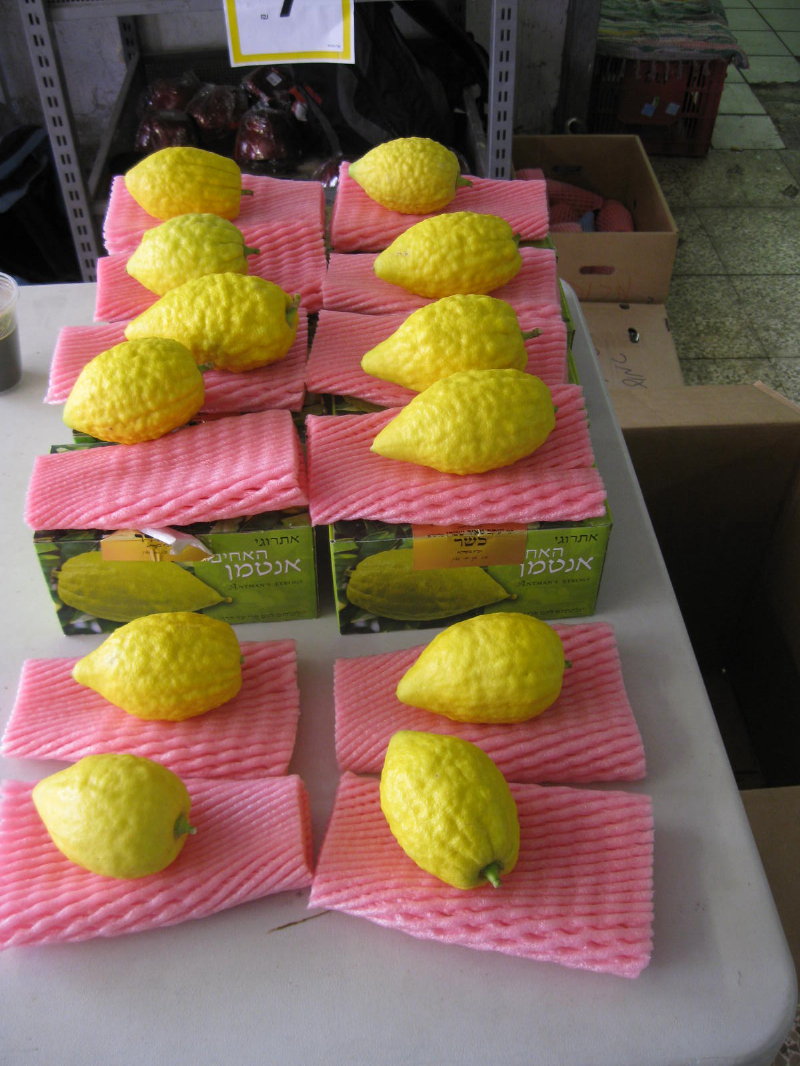
The etrog is part of the "four species" (palm frond, myrtle and willow branches, and etrog) needed for the Sukkot ritual blessing.

At Judaism 101 you can learn everything you every wanted to know about this strange fruit, the etrog. And about Sukkot too.

This year I didn't make it to the special four species market, but you can see my photos from previous years among the Sukkot posts.
.
Moadim lesimcha--happy holiday!

.

Tuesday, July 20, 2010

Appropriate for Av 9

.
For today's ABC Wednesday let "A" be for Av, for today is Tisha B'Av, the 9th day of the Hebrew month of Av.

As we saw in the previous post, this is a sad day on which many Jews fast and mourn the destruction of ancient Jerusalem and of her First and Second Temples.

Recently I explored the Romema neighborhood with its grand old houses, begun in 1921.

Something about this building--maybe the open door with the star of David or the sunlight on the old tiles or a sense of mystery--beckoned me to enter and go up the stairs.
.
The house seemed to be shared by four families now.
Four apartments.

But what surprised and moved me even more was what I found on the wall, near the ceiling.
The Hebrew on the tiles translates to
A REMEMBRANCE OF THE DESTRUCTION [i.e. of the Temple]
IF I FORGET YOU O JERUSALEM, LET MY RIGHT HAND FORGET HER CUNNING [Psalm 137:5].
.
The famous Psalm 137 illustrated!
.
"By the waters of Babylon, there we sat down and wept,
when we remembered Zion.
On the willows there
we hung up our harps.
For there our captors required of us songs,
and our tormentors, mirth, saying,
'Sing us one of the songs of Zion! . . . ' "
.
This is so appropriate for today, Tisha B'Av, the day on which the Temple was destroyed and following which many of Jerusalem's Jews were taken to exile in Babylon!
.
When I returned home from Romema, I Googled and made yet another moving discovery!
Aviva Bar-Am wrote this about this same house:
"Following the fall of the Second Temple, sages of the period declared that every new building must carry a reminder of that destruction: an unpainted area measuring one cubit by one cubit . . . . Many religious Jews take this edict literally and leave an unplastered or black square on their walls. The picture you see embedded into the wall of Fishman-Maimon’s residence--ceramic tiles showing the River of Babylon, harps and weeping willows--[is one of these]."
.
Furthermore, our Museum of Italian Jewish Art shows an example in carved marble and says,
"Writings of this kind were common in Germany and Poland, while in Italian synagogues, as well as private houses, part of a wall was usually left unplastered in order to remember the destruction of the Temple."
.
So . . . we remember and do not forget.
.
UPDATE 2014: 
Another nice explanation is here, at Jewish Treats.
.

Tuesday, June 8, 2010

Urban ugliness

.
Undaunted by the dumpster's name, meaning Mr. Mouse, I went exploring in a back alley bordering on Jerusalem's industrial area, near old Romema.

Utterly unsettling was the graffito prompted by the wooden beam.

Ugh, what was this place??

Who had lived inside?

Unexpected was this piece of unusual urban ugliness!
.
Unwittingly though, it turned out to be useful for ABC Wednesday's U Day.
.

Monday, July 13, 2009

A building meant for rabbis

.
The first time I saw this enormous monotonous building on Torah Mitzion Street, I really wondered about its history.
Now I know a little more, but I still wonder . . . about the lives of those many families of pious Jews who live inside.
The shikun, meaning apartment block or housing project, was erected in 1945 to house rabbis who had survived the Holocaust and who had made it from Europe to Jerusalem, probably with nothing but the shirt on their back.
However, it soon became populated with all kinds of refugees and needy people, not just rabbis.

In the first photo you see (especially if you click) a white dome. It is the roof of this synagogue, called Beit Knesset Beit Aharon [of] Shikun HaRabbanim.
The man with his hand on his ear is talking on his cell phone, in case you wondered.

The dedicatory plaque praises several generous and upstanding men who gave money to build the synagogue.
.
The neighborhood is called Romema, near the western entrance to Jerusalem. Founded in 1921, it was the first Jewish neighborhood built during the period of British rule and was planned as an exclusive residential neighborhood.
Maybe in a future post I can show you some of the dozen original stately houses, very beautiful.
.
The funny story of how the Arab mayor surrendered Jerusalem to two British army cooks in 1917 on the then-desolate hill that would become Romema is in an earlier post.
.
Many bloggers wish to guide you around their favorite places, every Tuesday-Wednesday at That's My World. Go for a visit, or join us by sharing your own post. Just sign in at Mr. Linky.

Monday, December 8, 2008

The keys to the city--take them already!

 .
December 9 is the anniversary of a major event in Jerusalem's modern history, but I doubt if anyone will think of it. The only reason I know is because of my explorations this week.
I found a tall office building and from a top (10th) floor window was lucky to get this view to the west. The huge building with the long blue windows is the new Central Bus Station.
But what was that little circular park in back of it??


I went down and discovered this little playground, but no name.
But across the street was a tiny sign on an old wall that said Kikar Allenby, meaning Allenby Square. Aha!

And an old monument! Its inscription reads:
"NEAR THIS SPOT THE HOLY CITY WAS SURRENDERED TO THE 60th LONDON DIVISION 9th DECEMBER 1917.   ERECTED BY THEIR COMRADES TO THOSE OFFICERS, N.C.O.'s AND MEN WHO FELL IN FIGHTING FOR JERUSALEM."

If you click to enlarge this photo and contemplate the figures etched in stone, you may see hooded Crusader knights with shield and sword!! Like these British soldiers they, too, conquered Jerusalem (in 1099).
But wait . . . I always heard that General Allenby accepted the Turks' surrender at the Citadel, just inside the Jaffa Gate, in the Old City. So, back home, I asked the Google god to help in my quest for answers.
Here, written by Aviva Bar-Am in her Jerusalem Post article "Authentic Romema," is (one version of) the amazing story:
.
"In the wee hours of December 9, 1917, two British army cooks from the 60th London Division left their Jerusalem base in search of fresh eggs and vegetables for their commander. Less than six weeks had passed since Commonwealth troops had breached the Turkish lines in Israel for the first time and conquered Beersheba; earlier that very morning the British had captured Jerusalem from the Turks, as well.
As the cooks walked through a deserted field on an exposed hill, they were accosted by a number of residents anxious to surrender the city. Among them were four policemen, several youths, the Jerusalem mayor Hussein Selim el-Husseini and a photographer from the American Colony.
Upon sighting British soldiers, the Jerusalemites lifted their arms. They held a white sheet that had been hastily torn off one of the beds at the American Colony’s hospital. Attached to a broom handle, the sheet was the Jerusalemites’ makeshift flag of truce. The mayor then handed the cook and his aide a tender of capitulation, explaining that the Turks had fled the city.
.
When the soldiers returned to base, they told their commander what had happened. He was so upset that the ’ceremony’ had taken place without him, that he ordered the mayor to return to the hill, and conducted a second surrender. However, that officer’s commander was furious that he hadn’t been present at either surrender, so he held a third ceremony on the same spot.
.
But General Sir Edmund Allenby, commander in chief of the British-Anzac Egyptian Expeditionary Force, was unimpressed by the three surrenders. On December 11, 1917, he entered the Old City of Jerusalem and conducted yet another capitulation ceremony. Unfortunately, the mayor was unable to attend — he is said to have contracted pneumonia after standing on the exposed hill for the three previous ceremonies and to have died soon afterward.
.
Ignoring the location and circumstances of the fourth and final surrender, soldiers of the 60th London Division decided to erect a three-meter-high monument near the original site in 1920."
.
For more photos and stories from around the world visit the friendly blogger-tour guides at our new That's My World Tuesday. Free tours! No tipping, except maybe to leave a comment. :)
.
UPDATE Sept. 2014:  A photograph of the surrender to the two British soldiers is now here!
UPDATE July 2019: More about the famous surrender photo --see here. 
.