Showing posts with label sukkah. Show all posts

Saturday, September 29, 2012

A moveable feast, oil on wood

 .

Sukkot ("the Feast of Tabernacles") begins Sunday evening.
Here is a sukkah very different from the one I showed you yesterday.
It is so unique, in fact, that it is a museum piece, on display inside the Israel Museum


Here is the story the museum gives:

In the 19th century, Naftali and Zili Deller commissioned a local painter to paint [in oil paint]  the walls of their sukkah.
Their son Abraham Deller and his wife Sofie erected the sukkah in the courtyard of their home in Germany every year until the Nazis came to power. In 1937 the sukkah was smuggled out of Germany and delivered to the Bezalel Museum in Jerusalem.

The central wall features a painting of Jerusalem with the Western Wall at its hub. This painting was copied from a lithograph by 19th-century Jerusalem artist Yehosef Schwartz.
 The other walls contain pictures of the village of Fischach and people from that period: on the right is Zili Deller waiting at the entrance to her home; on the back wall is the local baron, the patron of the village Jews, setting out to hunt.
 Painted within small frames in the background of the central and right-hand walls are depictions of Jewish holidays copied from prayer books printed in Sulzbach, Germany, in 1826.

Quite a history, eh?
You can click the photos to enlarge and study the details.
.

Friday, September 28, 2012

A sukkah at the tram terminal!

 .
Look!
CityPass, the consortium that (tries to) run the new Jerusalem light rail, just gave us somewhere new  to sit at their  Mt. Herzl terminal!
No . . . not more shaded benches at the station;  that would be seen as pampering us, giving ALL of us relief from the 34 C heat.
No . . . not more seats on the tram; they wouldn't want ALL of  us to get used to having a place to sit  (let alone enough room to stand) in the packed trams.


 No . . . it is a SUKKAH they gave us, a temporary booth in which to sit and preferably eat  during the week-long holiday of Sukkot!

The soft walls say "To all the light rail passengers and to all the House of Israel--happy holidays and happy travels."

Inside a sign says it was generously donated by  Sukkot Yerushalaim, the sukkah producers, who claim it is not only kosher, not only kosher lemehadrin, but rather KOSHER LEMEHADRIN MIN HAMEHADRIN.
That's like super-duper kosher!


 Printed on the sides are paintings of Jerusalem.
The one above, at the Western Wall, is the only modern one.
(But notice how the Muslim Dome of the Rock is somehow missing. hmm...)


Throngs of pilgrims would come up to Jerusalem for Sukkot  in biblical times.
Here they are walking toward the Jaffa Gate.


 Here pilgrims are walking toward the Mercy Gate, from the east.
The picture quotes Psalm 122, "Our feet are standing at your gates, O Jerusalem." 


 The Temple is near as they converge from the south.


So many priests, some with trumpets, some tending to the sacrifices!

You might enjoy enlarging this photo to get an idea of how the Temple courtyard might have looked. (Click a second time on the photo that opens up.)


And after you have fulfilled the mitsvah of eating in the sukkah you can sing Birkat Hamazon, the blessing after the meal.
A kosher "roof" covering of a sukkah must let us see the stars at night, hence these "drops of sunlight" falling through the top and onto the walls.

Actually, this could be a good picture for Shadow Shot Sunday meme. 
.
These verses from Deuteronomy 16 explain the three great pilgrimage festivals, when Jews from all over the world would make the journey to Jerusalem and walk up to the Temple Mount:

 "Safeguard the month of standing grain so that you will be able to keep the Passover to God your Lord, since it was in the month of standing grain that God your Lord brought you out of Egypt at night...Then count seven weeks for yourself. From the time that you first put the sickle to the standing grain, you must count seven weeks. You shall then celebrate the festival of Shavuot to God your Lord, presenting a hand-delivered offering according to the extent of the blessing that God your Lord has granted you...When you bring in the products of your threshing floor and wine vat, you shall celebrate the festival of Sukkot for seven days...Three times each year, all your males shall thus be seen in the presence of God your Lord in the place that He will choose: on the festival of matzahs, on the festival of Shavuot, and on the festival of Sukkot...
You shall not appear before God empty-handed."

.
Friday, October 21, 2011

The bounty of our land inside the sukkah

.
On Monday morning some 10,000 people accepted the once-a-year invitation to see the President's Residence, the sukkah, and President Peres himself.
(My previous reports are here.)
.
The sukkah was so beautiful!
The Ministry of Agriculture and Rural Development designed the natural decorations.
.
You might want to enlarge these photos to see the artistic details.


A pomegrante "tree."

"String beans" takes on a new meaning!

Vegetables, fruits, and flowers were grouped according to color: orange, green, white, purple, red.

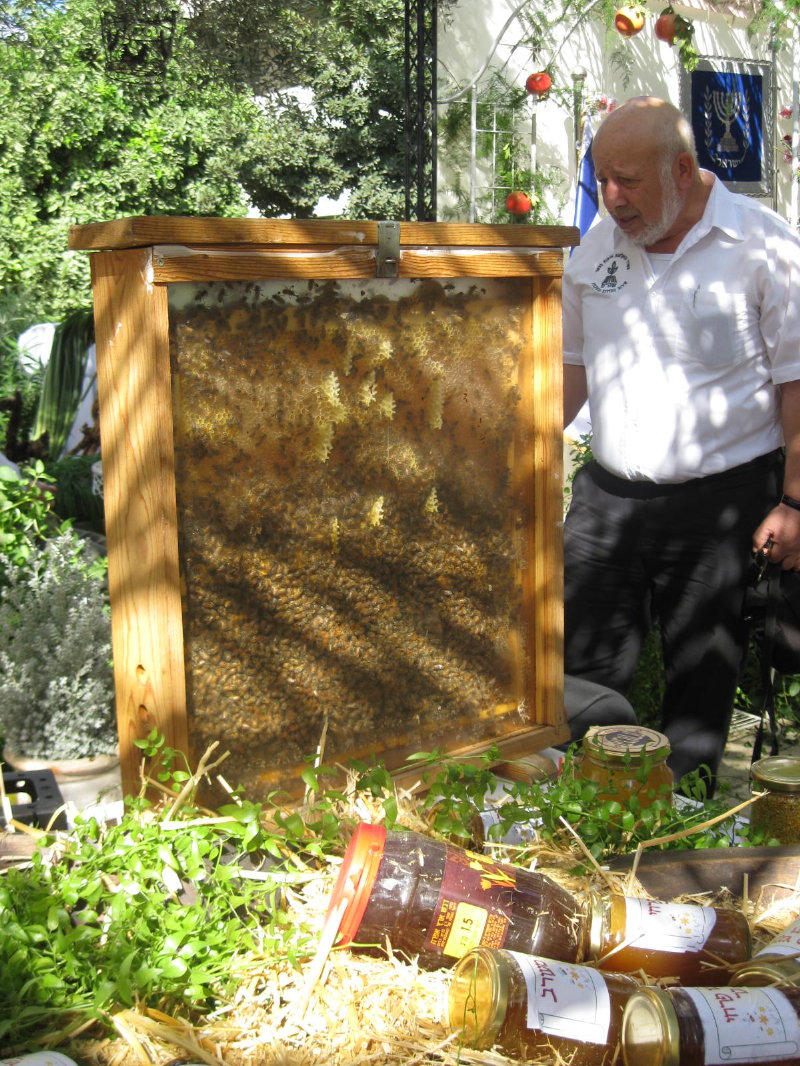
Busy bees were making honeycomb.

Honey in an important symbolic food at the start of the Jewish new year.
We dip apple slices in honey and say the blessing to ask for "a sweet new year."
.

Wednesday, October 12, 2011

Two very different sukkot

.
Happy Sukkot!
Tonight starts the week-long festival when we are supposed to eat and dwell in sukkot, temporary "booths" or "tabernacles."
.
This purple one is the most unusual sukkah I saw today in my little walk around the Jerusalem neighborhood Romema.
It's in the passageway that leads to the Central Bus Station.
The pattern on the fabric may have to do with the fact that the sukkah probably was put up by the owners of the shop there that sells India clothes from Goa.


The more typical sukkah for the more orthodox Jews has wooden sides with some palm branches on top.
The black cat was sleeping in the warm rays of the sun.
The cat's car looks muddy because we had rain last night, the second rain of the season.
.
Actually this is the only week of the rainy season that we don't want rain, as it would damage the pretty decorations in the sukkah.


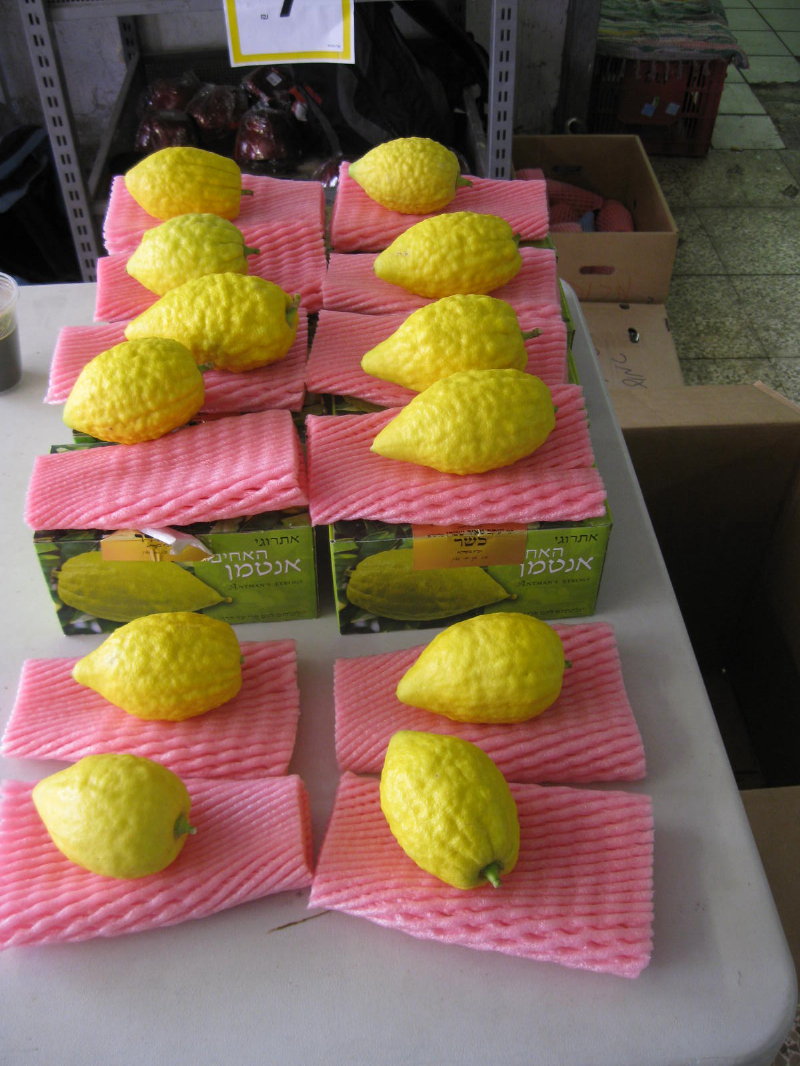
The etrog is part of the "four species" (palm frond, myrtle and willow branches, and etrog) needed for the Sukkot ritual blessing.

At Judaism 101 you can learn everything you every wanted to know about this strange fruit, the etrog. And about Sukkot too.

This year I didn't make it to the special four species market, but you can see my photos from previous years among the Sukkot posts.
.
Moadim lesimcha--happy holiday!

.

Tuesday, October 6, 2009

Lulav

.
All week we are celebrating the Jewish festival of Sukkot (instructions begin in Leviticus 23:39).
Let us combine it with L-Day at ABC Wednesday.

Lulav! This Hebrew word לולב is the name for a ripe, green, closed frond from a date palm tree.
The man is meticulously examining the lulavim, deciding which one meets his standards and his budget.

Limes? Lemons?
No! These are etrogim. The etrog is the fruit of the citron tree.
Together with myrtle branches and willow branches, the lulav and the etrog make up the "four species" that are required for Sukkot.
You will enjoy reading about their rich symbolism.
While holding the plants together with both hands, you say the blessing and shake them above you, downward, in front of you, in back, and two both sides--showing that God is everywhere.
The leaves of the lulav make a nice snapping sound.
.
But this should be done inside a sukkah, the temporary booth or hut we put up to "dwell in" during the week of Sukkot.
And, in the Diaspora at least, if you don't have or can't find a sukkah, Chabad will make sure you see their Sukkah Mobile at various obvious places.
The Chabadniks will make sure Jews perform the mitsva of eating in the sukkah and waving the lulav.

Look! Another Sukkah Mobile parked outside the Coliseum in Rome!
.
The last two photos are borrowed from Chabad, with thanks. Thanks for all they do.
.

Monday, October 20, 2008

Super-sukkah

Today was the last day for eating and dwelling in the sukkah.

These two what I dubbed "super-sukkahs" were at the Western Wall Plaza when I visited there this morning.
Very classy, no?
Top view of the skhakh roofing of the sukkah in the second photo.
 LOTS of palm branches!
.

Saturday, October 18, 2008

When a tree hut is not a sukkah

After the exodus from Egypt, during their forty years of wandering in the wilderness, the Jewish people were surrounded by protective "clouds of glory" [which is a term from rabbinic literature and not exactly from the Bible]. In Jewish tradition shade primarily represents God's protection, in relation to the symbolism of the clouds of glory. Shade and shadows are associated with the fleeting, the ephemeral (as our human life is, and especially Jewish life).
The essence of the sukkah, for the rabbis, lies in the special thatched roofing, the skhakh, and the shade it gives.
According to halakha (Jewish law), this skhakh must provide more shade than sun but must not block out the stars. It must come from plants that grew out of the ground but that are no longer attached to the ground.
A kosher roof can be bamboo or reed mats or wooden slats covered by palm fronds or other branches.
The photo shows some klutz-proof, easy to carry and put up, sukkah roof kits on sale just outside Jerusalem's Shuk Machaneh Yehuda. Oh, and some colored tinsel to decorate your sukkah, too.


And as luck and good timing would have it, New York's Madison Square Park has just had a dozen of its trees decorated with TREE HUTS, pinewood tree houses perched 30 feet up in the branches! The installation is being built under the direction of Japanese conceptual artist Tadashi Kawamata.
More information and real photos at the fine Daily Dose of Architecture blog. Or enjoy the Tree Huts blog.

Even if they got the skhakh right, I'm afraid these tree huts could not be counted as kosher sukkot. Why? Because nothing, not even a tree (or an overhanging balcony), may come between the sukkah and the sky. If a sukkah is built on the very TOP of a tree, then it is valid. Maybe not so safe, but kosher. . . .
Artist's sketch, from the Tree Hut blog 
.

Friday, October 17, 2008

Dwelling in a temporary hut

"You shall dwell in sukkot (huts) for seven days . . . so that you will know, for all generations, that I had the Children of Israel dwell in sukkot when I took them out of the Land of Egypt; I am God your God." (Leviticus 23:42-43)

"How [does one fulfill] the mitzvah of dwelling in the sukkah? One should eat, drink, and live in the sukkah, both day and night, as one lives in one’s house on the other days of the year: for seven days a person should make his home his temporary dwelling, and his sukkah his permanent dwelling." (Shulchan Aruch, Orach Chaim 639:1)

God says . . . “I have one easy mitzvah, and sukkah is its name.” (Talmud, Avodah Zarah 3a)

I have finally shot a few sukkah pictures to show you, now that we are already half-way through the week of the Sukkot holiday. The one above is typical for my village in the Jerusalem Hills where the moshavniks have plenty of space.

Many communities decorate the sukkah with posters on the walls or by hanging fresh fruits or other decorations from the sechach beams. Some, like Chabad Chassidim, have the custom not to put in decorations, as the sukkah itself is considered an object of beauty.
This plain big sukkah-hut is one of several in the garden of a restaurant at Beit Ticho, an art gallery in Jerusalem. You think they serve hut cuisine inside? :)
  
Yesterday I ventured into Geula, a strictly ultra-Orthodox (haredi) neighborhood, home to different segments of Chassidic and Lithuanian Judaism. My stealth photo shows a small plywood sukkah/booth/hut.
Look at this apartment building in a narrow Geula lane! Click to see it full-page. Sukkahs everywhere--on the roof, on the little balconies, even protruding from the corner.
Moadim lesimcha (the greeting said on the intermediate days of the holiday) and Shabbat shalom to you.
.