.
Today is UN Arabic Language Day.
December 18 was chosen as the date for the Arabic language as it is the day in 1973 when the General Assembly approved Arabic as an official UN language.
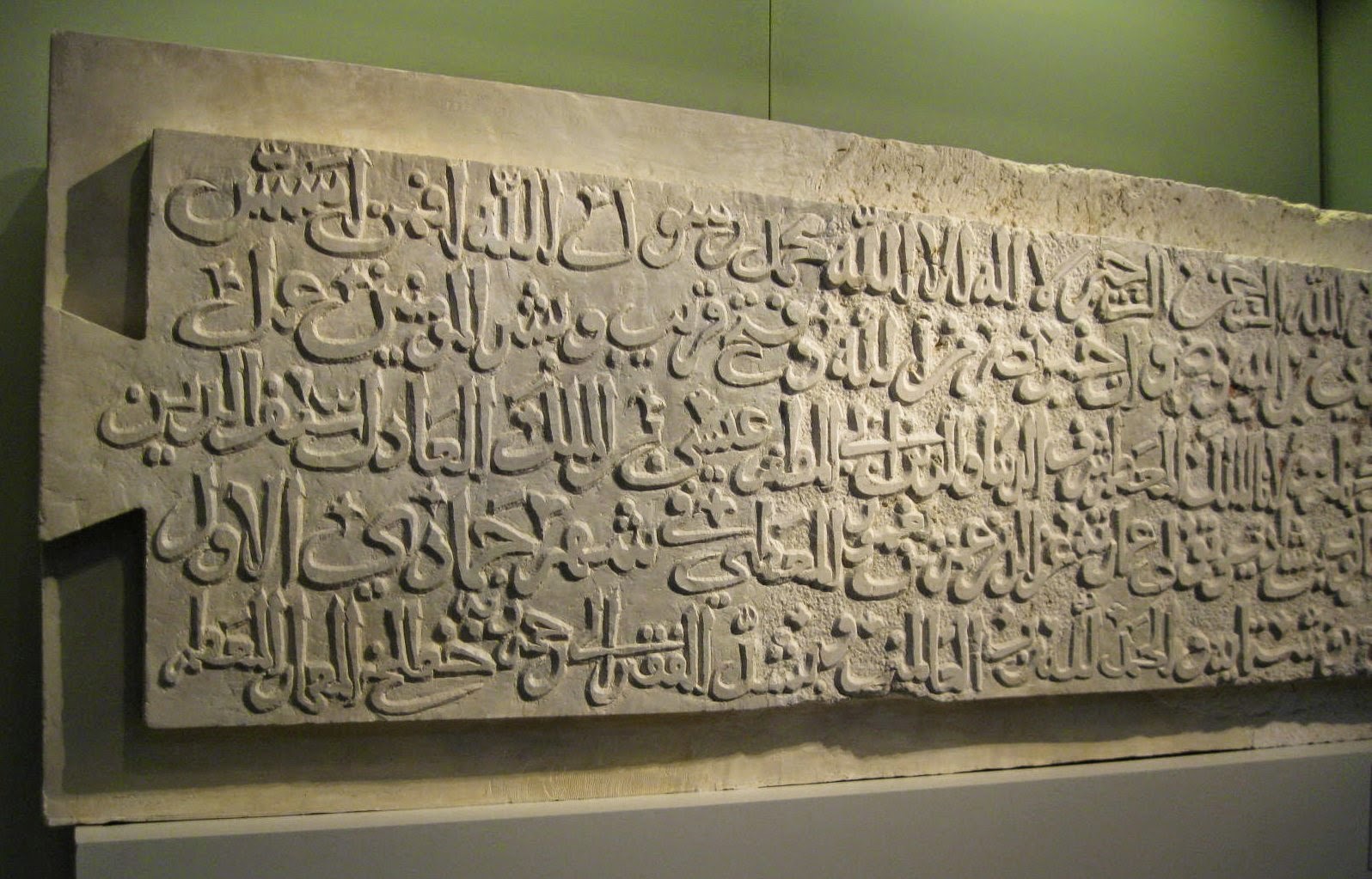
This long stone exhibited at the Israel Museum carries a dedication inscription from the year 1212 in the beautiful Naskhi script.
By the 11th century CE the Naskhi script appeared and gradually replaced the Kufic script as the most popular script for copying the Quran as well as secular and personal writings.
It is from the Naskhi script that modern Arabic script style developed.
The reused Herodian limestone block was found near the Zion Gate in Jerusalem.
Click on the sign to read the strange story of the building up and the tearing down of the city walls -- by the same man!
.
On a more personal note, you're welcome to see pictures of my 5-day immersion course in spoken Arabic in a Bedouin village in the Negev.
Hebrew and Arabic are the two official languages of Israel.
.
Showing posts with label Arabic. Show all posts
Thursday, December 18, 2014
Wednesday, January 23, 2013
The brave palm tree trimmer
.
Promise me you will enlarge this photo (by clicking once, and then once again).
Isn't this guy awesome?! He was so brave.
He was up in the crown of a palm tree trimming the fronds and after he climbed down, he agreed to show me those tree-climbing spikes strapped to his legs.
Awesome, right?
Go on, click on the picture. Look at that smile!
How often do you see a man doing a dangerous job but enjoying it and taking pride in good work?!
It must be hard enough to climb and keep your balance even without the heavy chainsaw hanging from your belt.
At least here, the man had a cinch holding him to the tree so he would have both hands free to saw.
But while he was coming down, he took off the cinch.
Oi veh! I was holding my breath. Please don't fall!
His two assistants on the ground asked me "Mafchid?" --Does it look scary to you?
Oh yeah.
Actually it was my first time to see a palm tree trimmer.
I had only seen pictures of this in Maryanne's blog, in Egypt, and there the man was cutting with an axe.
Click on her label "palm" to read all the many ways palm fiber and wood is used in Egypt.
If you enlarge this photo too, you can see all the drooping dead branches that needed to be trimmed.
The row of stately palm trees there at the entrance to Jerusalem's Hadassah Ein Kerem medical center looked a lot more stately after the trimmer's good treatment.
I thanked him profusely and said "Allah yisa'adek" which I hope is the proper Arabic for what I meant: May God help you in this challenging work and always keep you safe.
.
Promise me you will enlarge this photo (by clicking once, and then once again).
Isn't this guy awesome?! He was so brave.
He was up in the crown of a palm tree trimming the fronds and after he climbed down, he agreed to show me those tree-climbing spikes strapped to his legs.
Awesome, right?
Go on, click on the picture. Look at that smile!
How often do you see a man doing a dangerous job but enjoying it and taking pride in good work?!
It must be hard enough to climb and keep your balance even without the heavy chainsaw hanging from your belt.
At least here, the man had a cinch holding him to the tree so he would have both hands free to saw.
But while he was coming down, he took off the cinch.
Oi veh! I was holding my breath. Please don't fall!
His two assistants on the ground asked me "Mafchid?" --Does it look scary to you?
Oh yeah.
Actually it was my first time to see a palm tree trimmer.
I had only seen pictures of this in Maryanne's blog, in Egypt, and there the man was cutting with an axe.
Click on her label "palm" to read all the many ways palm fiber and wood is used in Egypt.
If you enlarge this photo too, you can see all the drooping dead branches that needed to be trimmed.
The row of stately palm trees there at the entrance to Jerusalem's Hadassah Ein Kerem medical center looked a lot more stately after the trimmer's good treatment.
I thanked him profusely and said "Allah yisa'adek" which I hope is the proper Arabic for what I meant: May God help you in this challenging work and always keep you safe.
.
Tuesday, January 24, 2012
Breaking bread together
.
Bread--before and after.
A bunch of B words for ABC Wednesday.

Bread being baked by a Bedouin.
Back in 2008 a dozen Jewish Israelis took part in a 5-day immersion course in spoken Arabic.
Part of each day we studied in class.
Each of us was hosted by a different family.
It was a blessed being together.
Click here to see more pictures of my time in the village of Darajat, down south in the Negev desert.
.
A bunch of B words for ABC Wednesday.
Bread being baked by a Bedouin.
Back in 2008 a dozen Jewish Israelis took part in a 5-day immersion course in spoken Arabic.
Part of each day we studied in class.
Each of us was hosted by a different family.
It was a blessed being together.
Click here to see more pictures of my time in the village of Darajat, down south in the Negev desert.
.
Wednesday, June 16, 2010
Lebanese Restaurant in Ein Kerem
.
When I do paid work in archaeology my fellow laborers speak Arabic all day.
So I learned that foochara is what we say when nice potsherds are uncovered and have to be collected.
But when the restaurant chef recommended a meal of meat and vegetables and foochara, I said "What?!"
.
When it came out of the oven and onto the table, I finally understood that foochara can also mean an unbroken clay pot.
Aha!
The waiter's T-shirt says (in Hebrew) "Abu Shukri's Lebanese Restaurant."
.
Ein Kerem has plenty of fancy restaurants but this rustic one has the best food, and that is where I took my two visiting American friends.
So I learned that foochara is what we say when nice potsherds are uncovered and have to be collected.
But when the restaurant chef recommended a meal of meat and vegetables and foochara, I said "What?!"
.
When it came out of the oven and onto the table, I finally understood that foochara can also mean an unbroken clay pot.
Aha!
.
Ein Kerem has plenty of fancy restaurants but this rustic one has the best food, and that is where I took my two visiting American friends.
This was my first time to have masachan, another great Lebanese dish made in the oven.
Two chicken legs and vegetables on a special brown pita and spiced, I think, with sumac.
.
Note the special issue Coke cans for the World Cup.
.
Monday, March 8, 2010
It takes a village to teach Dina Arabic
.
Earlier today I posted something for International Women's Day.
.
But in addition, for That's My World Tuesday, I invite you to see my post of exactly one year ago which is a tribute to the welcoming and hard-working Arab women of Dirijat.
Please click here to go down to their village in the Negev desert.
.
Earlier today I posted something for International Women's Day..
But in addition, for That's My World Tuesday, I invite you to see my post of exactly one year ago which is a tribute to the welcoming and hard-working Arab women of Dirijat.
Please click here to go down to their village in the Negev desert.
.
Sunday, March 8, 2009
This day was made for you
.
This post for International Women's Day is dedicated to the hard-working and welcoming women of the village of Dirijat (aka Darajat) and especially to the members of the hamula (clan) who housed and fed me for five days--Dahab, Amina, Zohara, Aisha, Nahed, and Wadina.
The village is in the Negev desert. Several times a year they offer a 5-day immersion course in spoken Arabic.
Our group last April had ten Jewish Israelis and one American lady pastor.
Each of us had a different host family. After class with our excellent teacher we went "home" to interact in our fledgling Arabic language.
One late afternoon some of the young people took us up the mountain on a hike to see the village from above. We saw the big quarry, a herd of camels, the area of the ancient Spice Route, and a desert sunset.
After breakfast of fresh pita, strong coffee, salads, and labaneh.
The matriarchs with the photo of the sheikh who started the village many years ago.
My dear hostess, in whose upstairs apartment I slept (on the floor).
Neighbor women watching the youngsters' Debka Troupe dancing for us.
Sheep milk is used to make labaneh. I asked to milk the sheep and clean the pen one morning and they let me! Kef!
All the women wanted to try out the mysterious camera of the American Pastor Suzanne (who is currently blogging about her time in Israel).
For several months a year the women are busy making big quantities of labaneh.
Scattered around the village are many ovens (taboon) that are kept warm all the time (burning dung). Two or three times a day the women come with their dough, flatten it like pizza, and put it directly on the hot rocks for a few minutes. Yum, hubez taboon flat bread!
This post for International Women's Day is dedicated to the hard-working and welcoming women of the village of Dirijat (aka Darajat) and especially to the members of the hamula (clan) who housed and fed me for five days--Dahab, Amina, Zohara, Aisha, Nahed, and Wadina.
Our group last April had ten Jewish Israelis and one American lady pastor.
Each of us had a different host family. After class with our excellent teacher we went "home" to interact in our fledgling Arabic language.
Thank you from the heart to the good women of Dirijat who taught me so much.
Shukran ya niswan!
.
.
Tuesday, August 19, 2008
The Teahouse of the August Moon
As I climbed the hill to work this morning, the round August moon was just setting behind the minaret of Beit Tsafafa. With the bright sun on it, the moon was so pale I didn't even try to photograph it.
Instead, I went for documentation of "the teahouse of the August moon."
At every dig it is some kind of ritual first thing in the morning and many times throughout the workday to light the Primus, boil water, and make strong Turkish coffee.
Or sometimes it is sweet sweet tea with leaves of mint or merimiyeh or babonag to give the wonderful aroma and taste.
Each little work group seems to have their own portable "kitchen" set up somewhere on a rock in a corner or a niche.
You are welcome to drink, but bring your own glass.

The Bedouin (like the man on the left) have a nice blessing when they serve you coffee (in what used to be the hospitality tent).
The Arabic means literally "Coffee always," meaning something like May we always drink coffee together [in peace].
Instead, I went for documentation of "the teahouse of the August moon."
At every dig it is some kind of ritual first thing in the morning and many times throughout the workday to light the Primus, boil water, and make strong Turkish coffee.
Or sometimes it is sweet sweet tea with leaves of mint or merimiyeh or babonag to give the wonderful aroma and taste.
Each little work group seems to have their own portable "kitchen" set up somewhere on a rock in a corner or a niche.
You are welcome to drink, but bring your own glass.
The Arabic means literally "Coffee always," meaning something like May we always drink coffee together [in peace].
Monday, April 28, 2008
Learning Arabic
Spoken Arabic is not a written language, so in our 5-day course in Darajat village we did not learn the letters.
Hebrew and Arabic are Semitic languages, often quite similar. We also had a textbook.
We studied together for six hours a day, learning over 300 of the most useful words.
Most of the week was a chamsin, a desert heat wave, 40 degrees C., over 100 F.
Luckily, this computer room was air conditioned.
.
Saturday, April 26, 2008
Darajat
I come back to Jerusalem filled with great affection and admiration for the kind and wonderul people of Darajat, the hard-working women and men and all the beautiful children.
In the coming posts I'll happily share these good and blessed times.
Subscribe to:
Posts (Atom)

