Thursday, June 21, 2012

Jerusalem by night

.
For SkyWatch Friday, the black dome of the heavens above Jerusalem!

The Old City was lit up last week with dozens of dazzling light displays for the 4th International Light Festival.

At the foot of the newly rebuilt Hurva Synagogue in the Jewish Quarter--a whirling "Meetings Composition" with its movements triggered by the location of the spectator.

At the Lutheran Church of the Redeemer--dynamic illumination to nice music.

Illuminated narrow street in the Armenian Quarter.

At Jaffa Gate--the Italian "Cupola."

But even with "just" her normal illumination, the Old City is beautiful, so beautiful.
Here, the Western Wall and above it, the Temple Mount with the Muslim Dome of the Rock and el Aksa mosque.

The Citadel or Tower of David.

Hundreds of thousands walked along the old city wall and entered by various gates.
Enlarge the photo to see the people.
In the sky above the Latin Patriarchate, a big Vatican flag.

The Old City and the new city.

Pray for the peace of Jerusalem.
.

Wednesday, June 20, 2012

Going out in style

.
This elegant carved and painted wood carriage was made in Szarvas, Hungary, in the 19th century.
Would you believe?--it was used for funerals!

The sign next to it at the Israel Museum says this about the Chevra Kadisha (Jewish burial society) carriage:
Accompanying the dead on their final journey towards burial is part of the tradition of honoring the deceased and is already mentioned in Rabbinic literature as one of the essential deeds "for which one is rewarded in one's lifetime and also earns a reward in the world to come."
Funeral processions were held with due ceremony, and the deceased was carried in a special vehicle, such as this majestic carriage from Hungary.


Please enlarge the photo to read about our Jewish way of death and mourning.
.
Julie's Taphophile Tragics is about cemeteries and the interesting stories in them, but I think this wagon might qualify for the meme.
.

Tuesday, June 19, 2012

Woman and watermelons in water

.
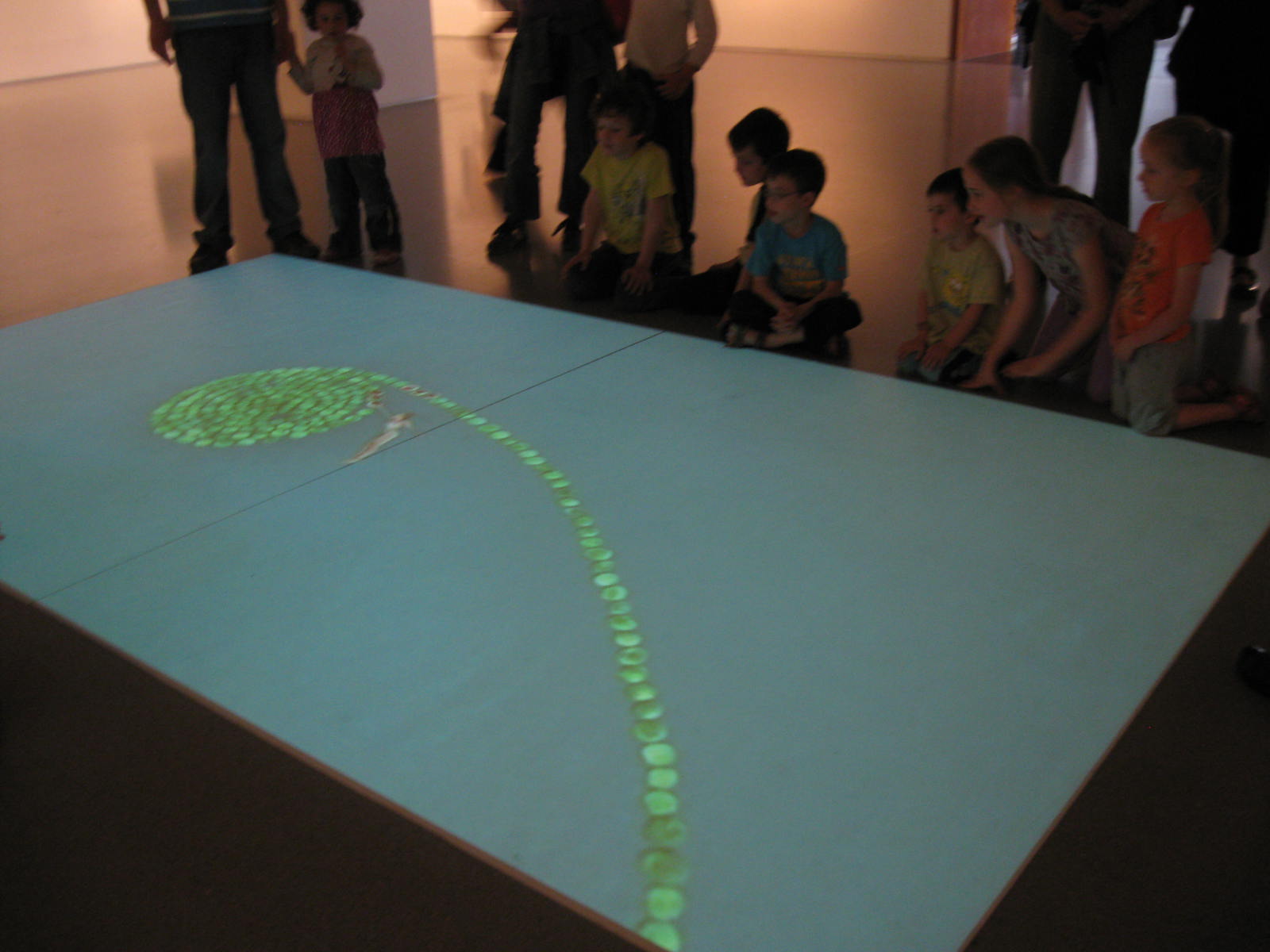
Look at the rapt attention of these kids to an 11-minute DVD projection at the Israeli section of the new fine-arts wing at Israel Museum!

You too can be mesmerized by a 7-minute video of DeadSee .

Artist Sigalit Landau (born 1969) explains her DeadSee creation:


A cord of two hundred and fifty meters penetrates five hundred watermelons forming a six meter spiral raft in the saturated salt waters of the Dead Sea. The spiral turns as a whirlpool reversed from it s normal direction.
I am floating locked inside the spiral layers between the center and the periphery of the sweet raft. I am reaching out against the direction of the turning raft towards a small area in the spiral where the fruit is wounded, red and exposed like myself to the sting of the salt. The salt solution of the dead sea enables everything to float on its illusive surface. The spiral gradually becomes a thin green line abandoning the viewer.
The film was shot in mid August 2004 in the area of Sdom south of Masada
.

(The woman with watermelons in water is for W-day at ABC Wednesday. And the spiral is a gift to blog-friend Cloudia of Comfort Spiral in Hawaii.)
.
UPDATE Jan. 26, 2014:  More about this artist at  http://israel21c.org/culture/inside-the-fertile-mind-of-sigalit-landau/
.

Monday, June 18, 2012

Beep beep! Honk!

.
OK, today is Ride to Work Day, but this is ridiculous!
A guy was riding a horse, without a saddle, in the middle of one of Jerusalem's noisiest and most congested intersections, during evening rush hour!

Actually the annual Ride to Work Day was started by some Americans and refers to motorcycles, not equines.

I have done four motorcycle posts in my four years of blogging.
I love both motorcycles and horses, but riding either on Israeli streets these days is too foolhardy for me.
.
Add Image(Hoping this quick look at the corner of Agron and King David Streets will qualify as a tour for Our World Tuesday.)
.

Sunday, June 17, 2012

A blessing etched in steel

.
Next Sunday's psalm will be the last until September.
Our fearless leader in Athens, Robert Geiss, has somehow gotten our little group (which you are welcome to join) to illustrate the first 67 psalms and now we will get summer vacation!
Visit his PsalmChallenge at daily athens photo blog.
__________________________________

PSALM 67
1. For the leader; with stringed instruments. A psalm. A song.


2. May God be gracious to us and bless us; may He cause his face to shine among us. Selah.

3. That Your way be understood throughout the earth, Your salvation among all nationalities.
4. May peoples praise You, O God; may all the peoples praise You.
5. Let nations exult and shout for joy, because You rule the peoples with equity, and nations You guide throughout the earth. Selah.

6. May peoples praise You, O God; may all the peoples praise You.
7. The earth yields its produce; may God, our God, bless us.
8. May God bless us, that all the ends of the earth fear Him.
__________________________________

Photo
"Birkat Cohanim" (The Priestly Blessing) by Etchi Werner-Nyiri, at Mamilla Mall, 2011, based on Numbers 6:22-26:

The Lord said to Moses, “Tell Aaron and his sons, ‘This is how you are to bless the Israelites. Say to them:

The Lord bless you and keep you;

the Lord make his face shine on you

and be gracious to you;
the Lord turn his face toward you
and give you peace.
.
The translation of today's psalm is by Rabbi Benjamin J. Segal.
His notes about Psalm 67 are worth reading, for example:
The terminology of verse 3 is drawn from the priestly blessing (Num. 6:24–26), cited several times in the Bible. Here the original application to “you” singular is transferred to first-person plural, “us.”
And also this:
Psalm 67 anticipates a new world, an ideal world. The psalm addresses the duality of God’s relationship to mankind as previously encountered in Psalms—He is God of both Israel and the world. Here, in this ideal, the two blend smoothly.
.

Saturday, June 16, 2012

The night life of Old City cats

.
This curious or maybe bewildered kitten didn't know what to make of this installation.
Neither did I.

It is one part of "Residents of the City" and was created by Bernardo Shkolnick.
Umm, I wonder what city he refers to.

It was part of last week's Old City of Jerusalem Light Festival. (See more in previous posts.)
Their website explains

The installation shows a representation of the different parts of our own personality in 5 stereotypes. The diverse mixture of these psychological stereotypic elements in each one of us creates the infinite kinds of human beings that we meet everywhere walking in the city . Skolnick uses ordinary illuminated display-window mannequins to represent these universal stereotypes as “humans” of diverse ages involved in different activities.

Near the "artwork" on Muristan Street I found the evening gathering place of the Old City's countless cats!
They must have felt secure behind the fence that protects this monument.

You can click on the photo and read the interesting history.

The complex in back of this stone is called the Muristan (bimaristan meaning "hospital" in Persian).
After the Hospitaler knights left their headquarters on the Temple Mount, they took up residence in the Muristan.
The order was founded during the First Crusade and is also known as the Order of St. John.
These knights, entrusted with caring for the health of Crusaders and pilgrims, built a hospital here.
.
We learn from the inscription, "the Grand Priory in the British Realm" followed their example in more recent times.
.
.
(This cat post is for Camera-Critters.)
.

Friday, June 15, 2012

Italy at the Jaffa Gate

.
An estimated quarter of a million Israelis, Jerusalemites, Old City residents, and tourists flocked to the week-long Festival of Light, and this cupola just outside Jaffa Gate greeted them and elicited many oohs and ahhs!

Against the black night sky (for SkyWatch Friday) and next to the illuminated city wall, the dome truly was spectacular.

Enlarge the photos to see the hundreds of tiny lights.

Especially when you looked upward from the inside.

The Festival website says

Artist: Luminarie De Cagna, Italy

At the Jaffa gate, a dome will rise which resembles a building from the Italian Renaissance, because of its size and shape.

Reaching 25 meters high and spreading over 20 meters wide, the dome in Jerusalem is a true spectacle and an impressive entrance for visitors to the city.

Luminarie De Cagna is an Italian family concern that was founded in 1930. Back then the firm illuminated buildings and squares on festive occasions with oil and carbide lamps. Soon they switched to electric lights and since 2006 they have been using LEDs only for new projects. The LEDs are chained into great curtains of light or mounted on a wooden structure. In this way, whole streets and even squares are fully lit.

Even something for Weekend Reflections!
The tourist bus caught a reflection of the cupola just before it drove under the bridge on which the dome stood.
.
There is more about the Light Festival in my previous post and more will be coming.
.

Thursday, June 14, 2012

The stuff of archaeologists' dreams

.
The "4th International Festival of Light in the Old City of Jerusalem" is in full swing.

This animated line of dig "volunteers" swinging buckets of excavated dirt from one to another was my favorite part!
It looked so life-like I wanted to join them!

Enlarge the photo and you can find the one guy down on the ladder, heaving the heavy buckets up over his head.

Meanwhile projectors went on and off, highlighting different areas of the big dig going on at the Givati Parking Lot.
It's just outside the Old City wall, next to the City of David.

Adding to the atmosphere was the background music--the clicking of many small pickaxes on ancient stones.
From time to time pictures of the discovered treasures lit up the back wall.
.
These scenes in the quiet Jerusalem night were heartwarming; I felt proud and lucky to be an archaeology worker in Jerusalem.

This best part of the Light Festival could very well be an illustration of what archaeologists dream about at night.
.

Tuesday, June 12, 2012

Votive offerings, ex-votos, and tamata

.
For OurWorld Tuesday and V-day at ABC Wednesday I show you some votive offerings that can be found all around Israel.

Here is a string of votive offerings, also called votive deposits, on the iconostasis of a Greek Orthodox church in Jerusalem.
(You know, click on the photo and then again on the opened photo, to see the details.)

It can be made of thin embossed metal or sometimes stone and the image on it reminds God of what the person is praying for.
It can also be in thanksgiving for a wish already granted, and then it is called an ex-voto.

A votive offering can also be something of value, like jewelry or these dollars that were left at the Greek Orthodox monastery church in Tiberias.
Stuck in the frame of the icon you can see little photos of people on whom the visiting pilgrim is asking a specific blessing or healing.

This one at the Gerasimus Monastery near Jericho emphasizes a breast, so hopefully someone was cured of breast cancer.

Strange, but sort of hidden or stuck behind the icon in the previous photo were these baby dolls.
They too are votive offerings, from couples asking for, or thanking for, the birth of a child.
.
Wikipedia has more information about ex-votos and votive offerings down through the ages.
I just learn now that the Greek Orthodox ones such as this post shows are called tamata (singular: tama).
.
This whole thing about votive offerings is fairly new to me (I'm Jewish, remember), so I'd appreciate anything you readers can add from your own experience and sightings.
.

Monday, June 11, 2012

Putting a face on death

.
Welcome to the archaeology wing of the newly re-done Israel Museum.
Behind the glass wall and reflected in the floor are six anthropoid clay coffins standing at the entrance to greet you.
(Enjoy the big version by clicking on the photo and then once again on the photo that opens. )

A 2005 Israel Museum publication explains these tall sarcophagi:

Late Canaanite period, 14th-13th century BCE

South of Gaza city, at Deir el-Balah, some fifty pottery sarcophagi were unearthed from a large, ancient cemetery.
Located near the sea, the site had been protected from plunder by massive sand dunes.
The sarcophagi were fashioned by hand, using the coil technique, the method employed for creating large vessels.
They were then fired with their lids in an open fire.
The lids were later refired in kilns located nearby, which accounts for their darker color.
Similar cemeteries have been discovered near the Nile Delta.

Several features of the Gaza sarcophagi shows clear signs of Egyptian influence.
At times the lids bear depictions of mummy-like figures, indicating the face, wig, arms, and hands of the deceased.
Many of the faces have small beards, perhaps symbolizing the beard of Osiris, the Egyptian god of death, into whose realm the deceased was about to enter.
The bodies of the dead, usually more than one, were laid unembalmed in the coffin, along with funerary gifts such as pottery food bowls.
If the deceased was wealthy, elaborate jewelry and vessels made of stone and bronze were also added.

You can see some of the jewelry masterpieces here.

Be sure to check this link to see the amazing faces of the sarcophagi.

The partial excavation at Deir el-Balah in the Gaza Strip was done in 1972 by Trude Dotan.
This review of her recent book, Deir el-Balah: Uncovering an Egyptian Outpost in Canaan from the Time of the Exodus, has some interesting gossip about the dig.

To discover Hershel Shanks' idea about Joseph being buried in such a coffin, see this blog.
.

.

Sunday, June 10, 2012

Through fire and water

.
This painting from 19th century Iran is quite amazing and deserves close scrutiny, so please click on the photo and then click once again.

Also amazing is what the Israel Museum writes on the wall next to this picture (it is part of the temporary exhibition "Divine Messengers: Angels in Art":

Pharaoh and His Army Drowning in the Red Sea
Isfahan, Iran, 19th century; Qajar style
Oil and lacquer on cardboard

In the center of the composition, the angel Gabriel holds out a "written decree" [shtar gzar hadin in Hebrew] to Pharaoh, who rides beside him.
Pharaoh knows that his end is near and therefore lifts up his hands in defeat and cries out to God:
"Yes, I have sinned. There is no God but Allah and Moses is his messenger . . . "
On the left, Moses and Aaron stand with the Israelites, who have safely crossed the Red Sea.
I wonder what the source of this interpretation is. It seems very strange to me.
_____________________________________________________

Be that as it may, the main reason I show you this painting is because it seems to illustrate many of the verses and ideas in Psalm 66, today's psalm for Robert's PsalmChallenge meme.

1. For the leader. A song. A psalm.

Shout with joy to God, all the earth;
2. sing out the glory of His name, make His praise glorious.
3. Say to God, ‘‘How awesome are Your deeds! Before Your great strength, Your enemies cower;
4. all the earth bows to You, they sing out to You; they sing out Your name.” Selah.

5. Come see the miracles of God, Awesome-of-feats, for humans.
6. He turned the sea into dry land; they passed through the waters on foot.
There we rejoiced in Him.
7. Ruler forever by His might; His eyes survey the nations; let the rebellious not exalt themselves. Selah.

8. O peoples, bless our God; cause the sound of His praise to be heard,
9. He Who has animated our life, and has not let our foot slip.

10. Indeed, You have tested us, O God, refined us as silver is refined.
11. You caused us to enter a net, set fetters round our loins.
12. You have let men ride over our heads; we entered fire and water.
But You have brought us out to abundance.

13. I will enter Your house with burnt offerings, I will pay You my vows,
14. that my lips spoke, that my mouth uttered when I was in distress.
15. I will offer up fat offerings to You, with the burnt sacrifice of rams; doing (sacrifice of) bulls and goats. Selah.

16. Come hear as I tell, all you who fear God, what He did for my life.
17. To Him I called out with my mouth, exaltation on my tongue.
18. Had I seen iniquity in my heart, my Lord would not hear.
19. But God did hear; He listened to the sound of my prayer.
20. Blessed be God who did not turn away my prayer or His loving-kindness from me.
.
.
Rabbi Benjamin J. Segal, whose translation I use today, titles his study of Psalm 66 "As a Nation's Salvation Becomes One's Own" and yet calls it inclusive, saying that it "radically avoids ethnocentricity."
.

Saturday, June 9, 2012

NASA pics of transit of Venus !

.
No, sorry, it's not the sun and Venus; it's just the full moon rising, as seen from my village in the Hills of Jerusalem.

BUT-- you can see stupendous photographs of the transit of Venus at NASA's Astronomy Picture of the Day:
http://apod.nasa.gov/apod/astropix.html for June 9
and also here.
More here.
.
(A post for SkyWatch Friday.)
.

Friday, June 8, 2012

Photography from a powered parachute!

.
This man has to have the most exciting photography job in the world!
Above the world, actually.
He makes photos of the earth below while flying in a powered parachute.

You can see his flying machine on the cover of his book, Knafayim shel tsipor (Bird's Wings).
Asaf Solomon stood still a minute for this picture with his book and with Or Solomon at the big AgriTech exhibition in Tel Aviv.

Go to the AgriTech website and click on the box "A Bird's Eye View of Agriculture in Israel" to see a short and amazing slideshow of some of his best shots.

Under Asaf's hand you can see his handout: each of the 18 boxes shows one aspect of what his photos are good for.
Artistic aerial photography and postcards of Israel, of course, and coverage of special events like hot air ballooning.
But also to find drainage problems in farm lands, to document the extent of forest fires, to better see roof solar panels and to map acres of greenhouses, to document building violations, to plan water reservoirs . . . and much more.
Asaf is also helping archaeologists see "the big picture" that they can't grasp while standing on the ground.

Channel 10 News made a video of Asaf in action!
You can watch it at the photographer's website, http://asafsolomon.com/en .
Just don't get too jealous.
.

Thursday, June 7, 2012

A city in a garden

.
I had planned to post an altogether different photo for ABC U-Day, but that was before I encountered the useful knife sharpener of yesterday.

Still, I beg to inform you that URBS IN HORTO, meaning "city in a garden," is the motto of the great City of Chicago.
Chicago, that beautiful and friendly city by the Lake, city of my birth, place of my first 22 years of life.

Imagine my surprise when, among the hundreds of exhibiting companies and institutions at the 18th International AgriTech in Tel Aviv, I came upon a booth of the State of Illinois.

I just stood gazing at the photo--had it included just a few more blocks, our apartment would have been visible.
Ah the memories--swimming and fishing in Lake Michigan, climbing the lake's snow mountains when it froze, riding my bike on the cycling path, riding horses on the bridle path . . .
Where else could a kid have such fun in nature in a city of millions?

And now that I know Chicago's motto, I heartily agree that Chicago is an urbs in horto.
.

Tuesday, June 5, 2012

Useful and utterly unassuming

.
U is for USEFUL and that's what this man's craft is.
You see him sharpening my little Fiskars scissors from Finland, the pair I've been using constantly for twenty years.
Every few years I walk to the back of Shuk Machane Yehuda market and am happy to find the man in his humble booth, still ready to work.

When at the end he lifted his nose from the grindstone, so to speak, his kind eyes had the hint of a smile.
Then he resumed his reading of the Hebrew prayerbook, which I had interrupted.

We had exchanged a total of five words:
"Efshar?" meaning CAN YOU [sharpen this]?
"Mutar?" meaning MAY I? as I showed him my camera.
"Kama?" How much?
"Shmoneh" Eight [shekels]
"Toda!" Thank you!

Only these few words; but sometimes two people of few words, both utterly unassuming, can have the best communication between them.
.
.
(This post joins the unending ABC Wednesday meme.)
.

Monday, June 4, 2012

In the Russian bell tower

.
Ascension Day was my first time to visit the Russian Monastery of the Ascension.
(I showed you some of the graves there last Tuesday.)

Everyone knows its tall landmark bell tower; you can't look toward the Mount of Olives and not see it rising on the crest of the mountain.

And guess what!
This was the only way up the tower.
Needless to say, I climbed to the first level and not to the very top.

Right next to the convent we saw this big Muslim cemetery and a mosque.

Beyond, one sees the modern tower of the Hebrew University Mt. Scopus campus.
(You can enlarge all the photos here.)

To its right is the tower of the Lutheran Augusta Victoria.
Off to the top right, in the haze of summer heat--the eastern desert.
.
While we were up there looking out in all four directions, our tower's bells rang!
.
The guidebook says
Sent from Russia to the Holy Land port of Jaffa [on the other side of the country] in 1885, the bell weighed eight tons and was too heavy to transport by horse.
In the end a special wheel-shaped wagon was built to house the bell, which was pulled, pushed, and rolled by Russian pilgrims--most of them women--all the way to the Mount of Olives.
The trip took three weeks and several pilgrims fell by the wayside.
But eventually, singing hymns, the group reached Jerusalem and the bell was lifted into the tower.
Aviva Bar-Am, Beyond the Walls: Churches of Jerusalem
.
I hope you enjoyed this tour for Our World Tuesday and just a glimpse of a Muslim cemetery for Taphophile Tragics. Shalom!
Linking also to inSPIREd Sunday.
.

Sunday, June 3, 2012

The song of silence

.
Happy Pentecost to all Orthodox Christians and especially in Athens, where our weekly PsalmChallenge is centered.

Psalm 65
1. For the leader. A psalm. Of David. A song.

2. To You, silence is praise, God, in Zion; a vow to You will be paid.
3. It is He Who hears prayer; unto You all flesh shall come.
4. Reports of sins overpowered me; our iniquities You will expiate.
5. Happy is he whom You choose to bring near and to dwell in Your courts; we will be sated with the bounty of Your house, the holiness of Your temple.

6. With awesome deeds of righteousness answer us, O God of our deliverance, O hope of the distant ends of the earth and sea,
7. Who by His strength has formed the mountains, Who is encompassed in power,
8. Who stills the roaring seas, their roaring waves, and the tumult of peoples.
9. Those who dwell at the ends of the world are awed by Your signs; You cause the portals of morning and evening to exult.


10. You watch over the earth and water it; You enrich it greatly, with a god(-like) stream full of water;
You form grain for men; truly, indeed, You do form it.
11. Engorge its troughs, its ridges level; with showers You will soften it, its growth You will bless.


12. You have crowned the year with Your bounty; abundance will drip in Your paths;
13. the wilderness grasslands will drip; with joy the hills will be girded.

14. The pastures will clothe themselves with flocks; the valleys will drape themselves in grain; they will raise a shout; they will even sing.
.
.
Translation by Rabbi Benjamin Segal. See also his notes and the Hebrew.
.
Photos:
1. The Jordan River at Kasr al Yahud
2. Neighbor goats in our valley in the hills
.

Saturday, June 2, 2012

Horsefeathers!

.
Two police horses were a bit spooked for a second here, near the Citadel.
The horses do well in disturbances on the ground, but I think here they were distracted by the unusual movement above them.
City workers on moving cranes and tall ladders were putting up big decorations for the upcoming Light Festival.

Hey, Camera-Critter folks, what's with the long hair on these horses' fetlocks and lower legs?
I thought only draft horses have such "feather." No?
Please click on the photo to get a closer view.

The horses peacefully passed the old gate of the Tower of David and just beyond, walked through the gate of the old Kishle police station.
Just about everything is old in the wonderful Old City.
.
UPDATE Jan. 4, 2014:  Willow solves the mystery and tells us these are Friesian horses!  See her comment below.  Thanks Willow.
.

Tune in to streaming video from Jerusalem church

.
This poster and reflection were on the glass door of the Christian Information Center in the Old City.

You can click on it (and click again on the photo that opens) and read about the " 8th Extraordinary Prayer of all Churches for Reconciliation, Unity and Peace, beginning in and proceeding from Jerusalem,"
being hosted by the Armenian Catholics.

You can watch it in live streaming video
--at 6:00 pm Israel time (4:00 pm GMT or 8:00 am California time).
Check on the handy time zone converter timeanddate.com.
.
Let's hope their prayer helps the situation.
.
UPDATE: It was a nice broadcast of the ecumenical service.
That same Franciscan Media Center that shared it online is a good source for documentary videos on religious life in the Holy Land.
.

Friday, June 1, 2012

Shabbat tranquility

.
One day a week we hyper Israeli Jews detach and enter into the tranquility of a sanctuary in time.

All because of what Genesis says: "And God blessed the seventh day and made it holy."
In the creation, in the beginning, time was the first thing that God made holy.

The Sabbath has its own architecture of holiness and Jews feel secure inside.

It is said that for the 25 hours of the Sabbath we receive a "neshama yetera," an added soul.

In a few hours the sun will set here in Jerusalem, just after we have lit the candles, and life will slow down.
Wishing you all Shabbat shalom, Sabbath peace.
.
City Daily Photo group's theme day today is tranquility.
Click here to view thumbnails for all participants.
.