Tuesday, September 21, 2010

Jackal jaws

.
Jackal jaws!
Perfect for J-Day at ABC Wednesday.
.
My American friends Mark and Kristine Schnarr were staying in a house near mine for a month this summer.
From the second floor terrace Kristine sighted this jackal early one morning and with her good zoom she got these two great photos.
.
Good job, Kristine!!

You can see other posts about jackals here (although my shots are not as close-up as Kristine's).
.
If you have never heard the resounding chorus of groups of jovial jackals, listen to the audio here and enjoy!
.

Speak softly

.
I took a tour myself yesterday and for That's My World I'll pass it on to you.
.
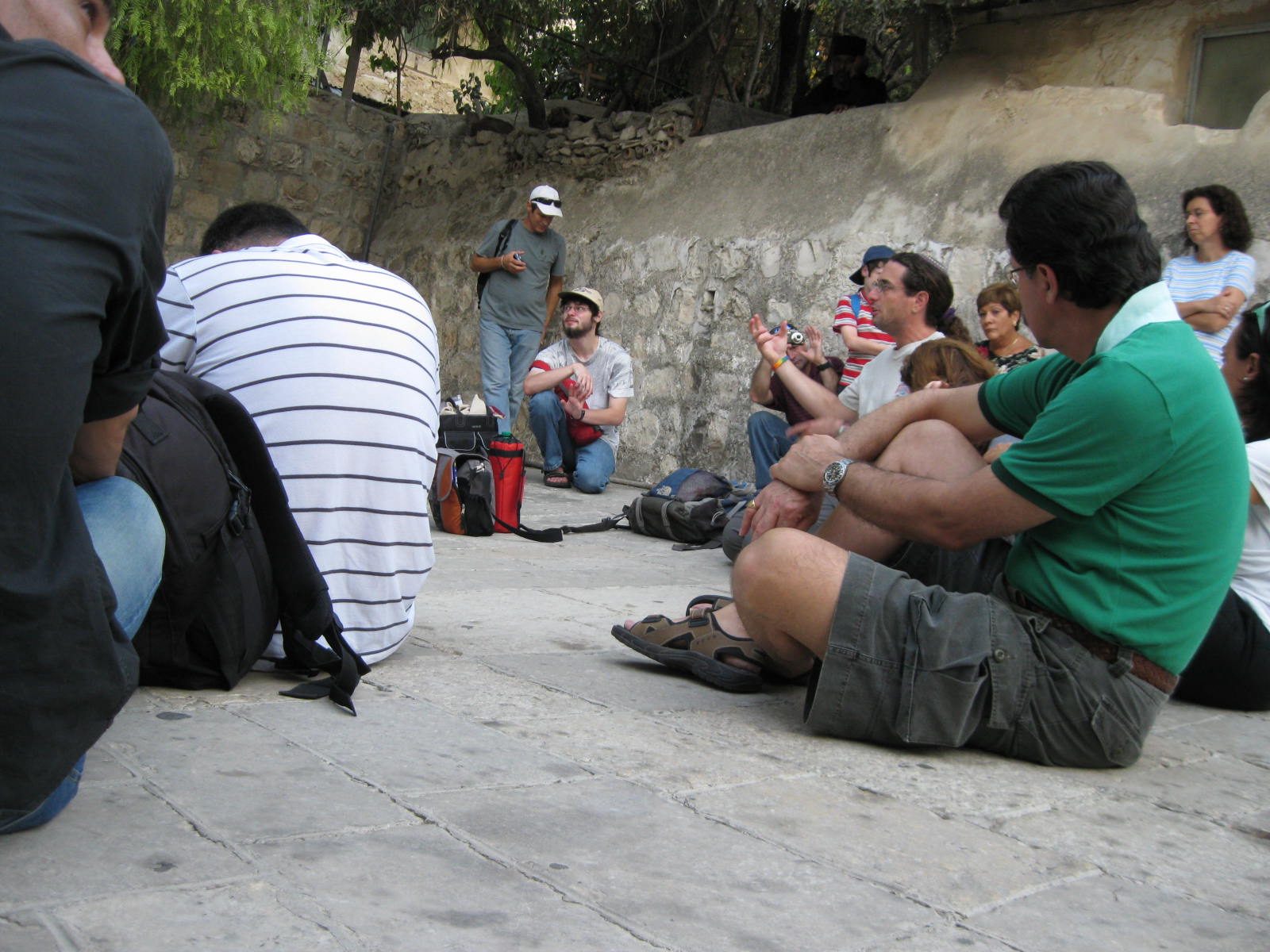
The subject of the 3-hour tour was "The People of Jerusalem's Old City."
It was sponsored by the Interfaith Encounter Association.
Our guide, shown in the photo above, was educator Jared Goldfarb.
.
A large group showed up for the English-speaking tour.
From Jaffa Gate we walked to the Armenian Quarter, then to the Jewish Quarter (pictured above).
The wooden hut you see is a sukkah for the coming holiday of Sukkot.

After hearing Jared's explanation of the situation of Muslims in the Muslim Quarter, we entered the Christian Quarter.
We ended up on the roof of the Holy Sepulchre for the final presentation, about the Christian minority.
Jared (here with hand in the air) lowered his teaching voice out of respect for the Ethiopian monks who live in tiny cells on the roof.
.
See the dark figure above looking down on us?
.
The monk seemed amused and curious.
I suspect he sees many many tour groups there every day but not many that sit on the ground and speak softly.
.
Happy International Day of Peace!
.

Sunday, September 19, 2010

Hand in hand

.

There's a new dog in the neighborhood.
He is just a puppy but look at the size of his paw!
.
I think he's supposed to be a guard dog but he often comes out and follows me into the woods and then follows me back to my home again, even when I tell him firmly "Lech habayita! Go home!"
He just wants to play and loves to shake hands.
.
This puppy is for today's Camera-Critters Sunday.
.

Up, up, and away

.
Somehow the length and incline of this bridge remind me of an ancient Roman aqueduct.
In reality, it transports not water but carloads of passengers going to and from the airport terminals.
.
It's the best I can do today for Louis la Vache's Sunday Bridges.
Bon dimanche.
.

Saturday, September 18, 2010

The sun has set on another Yom Kippur

.
Funny how the part of the shadow on the boulder makes my top half look like it's covered with fuzzy fur.

We just came out of a long day of Yom Kippur liturgy and 25 hours of no-food no-water fasting.
I expected to feel like a shadow of my former self or even, as Kurt Vonnegut Jr. once put it, a shadow of my former shadow.
But no!
This year the Day of Atonement brought no hunger and no headache.
It DID bring a good feeling of a new beginning.
.
This shadow is offered to Hey Harriet's Shadow Shot Sunday.
.

Friday, September 17, 2010

Shepherd and sheep on Yom Kippur

.
Two of the stained glass windows of Renanim synagogue in Hechal Shlomo, Jerusalem.
.
In a few hours Israel enters into both the Sabbath and Yom Kippur.
Everything shuts down and it gets very quiet all over the country.
This Day of Atonement is a time of intense prayer, total fasting for 25 hours, soul-searching, and repentence for many Jews.
(For many secular Jews, it is a time to stroll down the empty highways and for the children to bike ride or skate in the car-free streets.)
.
As the beautiful Yom Kippur window shows, the Gates of Repentence are open.
Above Jerusalem is the traditional image of God's Book of Life, open, with quill ready.
The long liturgy of the evening and of the following day centers on our plea that he will inscribe us in the Book of Life and seal it for another year.
.
The Rosh Hashana window (please do enlarge it) quotes from the moving and powerful piyyut (liturgical poem) Unetaneh Tokef which is sung in every synagogue both on Rosh Hashana and Yom Kippur.

כָל בָּאֵי עולָם יַעַבְרוּן לְפָנֶיךָ כִּבְנֵי מָרון. כְּבַקָּרַת רועֶה עֶדְרו. מַעֲבִיר צאנו תַּחַת שִׁבְטו .כֵּן תַּעֲבִיר וְתִסְפּר וְתִמְנֶה וְתִפְקד נֶפֶשׁ כָּל חָי. וְתַחְתּךְ קִצְבָה לְכָל בְּרִיּותֶיךָ. וְתִכְתּב אֶת גְּזַר דִּינָם:
בְּראשׁ הַשָּׁנָה יִכָּתֵבוּן וּבְיום צום כִּפּוּר יֵחָתֵמוּן כַּמָּה יַעַבְרוּן וְכַמָּה יִבָּרֵאוּן מִי יִחְיֶה וּמִי יָמוּת. מִי בְקִצּו וּמִי לא בְקִצּו מִי בַמַּיִם. וּמִי בָאֵשׁ מִי בַחֶרֶב. וּמִי בַחַיָּה מִי בָרָעָב. וּמִי בַצָּמָא מִי בָרַעַשׁ. וּמִי בַמַּגֵּפָה מִי בַחֲנִיקָה וּמִי בַסְּקִילָה מִי יָנוּחַ וּמִי יָנוּעַ מִי יִשָּׁקֵט וּמִי יִטָּרֵף מִי יִשָּׁלֵו. וּמִי יִתְיַסָּר מִי יֵעָנִי. וּמִי יֵעָשֵׁר מִי יִשָּׁפֵל. וּמִי יָרוּם וּתְשׁוּבָה וּתְפִלָּה וּצְדָקָה מַעֲבִירִין אֶת רעַ הַגְּזֵרָה
.
"All mankind will pass before You like members of the flock.
Like a shepherd pasturing his flock, making sheep pass under his staff, so shall You cause to pass, count, calculate, and consider the soul of all the living;
and You shall apportion the fixed needs of all Your creatures and inscribe their verdict. "

The piyyut is traditionally attributed to a medieval Rabbi Amnon of Mainz, who spoke the words while he was being martyred. More here.
.
You can read its translation in the ArtScroll Machzor.
Here is part of it:
.
"On Rosh Hashanah will be inscribed and on Yom Kippur will be sealed
how many will pass from the earth and how many will be created;
who will live and who will die;
who will die at his predestined time and who before his time;
who by water and who by fire,
who by sword, who by beast, who by famine, who by thirst,
who by storm, who by plague,
who by strangulation, and who by stoning.
Who will rest and who will wander,
who will live in harmony and who will be harried,
who will enjoy tranquility and who will suffer,
who will be impoverished and who will be enriched,
who will be degraded and who will be exalted.
.
But REPENTANCE, PRAYER and CHARITY

[tshuvah, tfilah, tzedaka]
Remove the evil of the Decree!

.
Don't you love that idea that by our re-turning, praying, and doing acts of kindness we can change everything?!
.
Before shutting down the computer for its yearly day of rest, I leave you with the traditional blessings--Shabbat shalom (Sabbath peace), tsom kal (easy over the fast), and Gmar chatima tova (May you be have a good inscription)!
.
P.S. My little grandson made his own ram's horn for these Days of Awe!
Here is a short and sweet video of Dean blowing the shofar.
.

Thursday, September 16, 2010

The new year dove

.
The dove of peace climbs upward into the sky.

The banner on this building at Ben-Gurion Airport proclaims that --
El Al announces "This is going to be a good year."
.
Shana tova, may it be so!

We are now near the conclusion of the Days of Awe, those awesome ten days between Rosh Hashana (New Year's day) and Yom Kippur (the Day of Atonement) when fateful decisions are made above and below.
.
.
The blue skies, both real and painted, are offered for SkyWatch Friday.
.

Wednesday, September 15, 2010

Elijah's chair

.
Please enlarge the photo to enjoy the rich detail of this special chair in the Great Synagogue in Jerusalem.
Written on the chair are the Hebrew words meaning
"THIS IS THE THRONE OF ELIJAH THE PROPHET, WHO IS REMEMBERED FOR GOOD."
.
These are the words the mohel proclaims to the guests as the 8-day-old boy is placed on the chair.
.
Usually the baby is then moved to the lap of the sandek (the man honored with the privilege of holding the baby during the act of circumcision); and Elijah's beautiful chair is left free for Elijah who, according to Jewish tradition, comes to witness every brit milah (circumcision).
.
Before beginning his quick work, the mohel recites several blessings, including this one:
"O Elijah, messenger of the covenant מַלְאַךְ הַבְּרִית , behold, yours is now before you; stand at my side and assist me."
.
I read that some communities use a regular chair over which is placed a nice cloth embroidered with "This is the throne [chair] of Elijah the prophet, who is remembered for good."
.
I noticed this one displayed in the window of a baby goods store on Jaffa Street.
It was on sale, reduced from 150 to 120 shekels.
Need one?
.
.
To see more of the Great Synagogue where the chair resides, see my post Bench on the Bima.
To understand who gets which honors in a traditional Orthodox Jewish brit, see AskMoses.com.
Non-Jewish readers might enjoy the explanation of the brit and naming ceremony at Hebrew4Christians.com.
.

Tuesday, September 14, 2010

If I forget you, O Jerusalem . . .

.
If I have to choose I-words for ABC Wednesday, they can only be these:
.
"If I forget thee, O Jerusalem, let my right hand forget her skill . . .
אִם-אֶשְׁכָּחֵךְ יְרוּשָׁלִָם-- תִּשְׁכַּח יְמִינִי.
.
Even today, after the ingathering of the exiles, after our immigration to Israel, after the rebuilding of Jerusalem, after partial redemption, we still remind ourselves of this verse and the next verse of the Psalm:
"Let my tongue cleave to the roof of my mouth, if I remember thee not; if I set not Jerusalem above my chiefest joy."
.
You find Psalm 137:5 quoted everywhere, even on T shirts!
See the one on the left, next to the red Coca Cola shirt? (Give a click to the photo.)
These are gifts for Christian tourists at Yardenit Baptism Site gift shop.
.

When you take an intercity bus and arrive at Jerusalem's Central Bus Station, this is the first thing you see when you get off the bus:
"IF I FORGET YOU, O JERUSALEM, LET MY RIGHT HAND FORGET HER CUNNING . . . "
.
That is a door on the right of the photo, so you can understand how big the words are.
.
One family has the reminder to remember hanging on their door, next to the garlic, in the old Jerusalem neighborhood of Mishkenot Shaananim.

In an earlier post we talked about this tile reminder of the destruction of the Temple and of the necessity to remember Jerusalem even, or especially, by the rivers of Babylon.
It's in the stairwell of an old house in Romema ( remember?).
.
For centuries the longing for Jerusalem was in the forefront of the Jewish consciousness.
Let's hope that Jerusalem will always be thought of with love by people everywhere for countless generations to come.
.
Monday, September 13, 2010

Surprises in the gardens

.
Let's stroll around the outdoor part of the Israel Museum in Jerusalem for our weekly tour meme, That's My World.

Half-hidden in the bushes is this 3rd century Samaritan sarcophagus.
Bulls' heads, a conch shell, garlands--beautiful what they carved in stone, eh?
It was discovered in Kfar Siris, near Jenin.
.
This marble lid of a Roman period sarcophagus was found in Caesaria.
According to the myth depicted, Zeus changed himself into a swan to ravish Leda, wife of the king of Sparta.
From their union, Helen of Troy was born, whose beauty was the cause of the Trojan War.
.
Too bad it is missing the upper part of the figures.
But, I guess you can't have everything . . . .
.
Ossuaries and sarcophagi are scattered all around the grounds.
I have a feeling they are the ones not perfect enough to be placed INSIDE the museum, but they make for delightful surprises when you find them.
.
It seems like even the form of these benches was inspired by the surrounding sarcophagi.
Enlarge the photo and take a close look. You think so?
.
Interment in these large stone coffins was widespread in the Mediterranean basin in the 2nd to 5th centuries CE.
This funerary custom was first practiced among pagans and was later also adopted by Jews, Christians, and Samaritans.
The Greek word sarcophagus means “flesh-eating.”
The sarcophagi were placed inside mausoleums or in rock-hewn burial caves.
.
And on that lively note we end the tour. ;-)
.

Sunday, September 12, 2010

Grand Priory of the Hospitaler Knights . . .

.
A cat enjoys the shadow of a flagpole in the Old City of Jerusalem, providing fodder for both Camera-Critters and Shadow Shot Sunday.

Please enlarge the photo to read the history!
.
The complex in back of this stone is called the Muristan (bimaristan meaning "hospital" in Persian).
After the Hospitaler knights left their headquarters on the Temple Mount, they took up residence in the Muristan.
The order was founded during the First Crusade and is also known as the Order of St. John.
These knights, entrusted with caring for the health of Crusaders and pilgrims, built a hospital here.
.
As you can learn from the inscription, "the Grand Priory in the British Realm" followed their example in more recent times.
.

A bridge over ancient history

.
For Sunday Bridges over at San Francisco Bay Daily Photo, here is a bridge, of sorts, in Jerusalem.
.
The 16th century Damascus Gate is the main entry into the Muslim Quarter.
From the street and sidewalk and plaza outside the portal you must walk over a bridge to enter the Old City.

The modern bridge rests on the remains of earlier structures, most of them from the Crusader period. The Crusaders built their own gate here after they captured Jerusalem in 1099.
.
Even farther down is what the tour sign calls the Roman Square.
The Roman Legion destroyed the Temple in 70 C.E. In the 2nd century emperor Hadrian changed Jerusalem's name to Aelia Capitolina and it became a pagan Roman city.
.
The arch you see in the photo is the only survivor of a magnificent Roman triumphal arch which was comprised of three vaulted gates.
.

Saturday, September 11, 2010

Jerusalem's September 11 memorial

.
I like this Mother and Child Center at Hadassah Medical Center mostly because of the flags.
.
We in Israel are especially united in memory with the people of the United States today.
.
I urge you to watch a 4-minute video of the dedication of the September 11 memorial sculpture and plaza in the Jerusalem Hills.
Its plaque reads

"A REMINDER OF SHARED LOSS AND A CALL FOR PEACE AMONG NATIONS."
.
The names of the 9/11 victims are written there, in the Jerusalem Forest, that we may remember.
.

Friday, September 10, 2010

Imagining the binding of Isaac

.
Today is the second day of Rosh Hashana, the Jewish new year.
.
The Torah portion that is read on this day is Genesis 22, God's testing of Abraham by asking him to sacrifice his son on Mount Moriah.
In Hebrew we call it the Akedah, the binding of Isaac.
.
Below is a wide variation of artistic portrayals of the story, on display at the Jewish museum in Jerusalem's Hechal Shlomo.
.
"Abraham's sacrifice," designed by W. Breathe, England, 1870, porcelain, manufactured by Wedgewood.
.
On the other extreme is this simple brass tub drilled with holes, made in Israel in the 20th century.
The inscription is "Lay not thy hand upon the lad," the welcome words of God's messenger-angel.
.
This is an illustration on a 1743 map of Eretz-Israel, painted in France.
.
A painting by Moshe Castel, 1925.
We can see the ram, tangled in the branches by its horns, which will be offered instead of Isaac.
.
"The way to the mountain," wool thread on cushion cover, embroidered in Ethiopia in the 1980s.
.
The servant boys stay behind with the donkey, Isaac carries the wood for the fire, Abraham carries the knife. Vultures circling above?
.
You have to admit, religion has a lot of drama at its core.
. .
More about Rosh Hashana in previous posts:
.

Home and away

.
Look who's standing on my desk (with a little help from her mom), and she's only four months old!
I have been spending many of the past nine days with these two.

We celebrated the eve of Rosh Hashana with relatives on the roof of their Tel Aviv apartment building.
I took a chance and took a picture of Naomi and Libby with only the light from the window and a little candlelight from the table.

Last night was our difficult parting, and today my beloved daughter and granddaughter are winging their way back to Australia (24 long hours of flying).
.
As a way of getting close to them again, today I experimented with photographing their photo on my computer screen, adding Grandma Dina's reflection looking at the kids with love and longing.
.
Sigh . . .
.
I hope it will be good for James' Weekend Reflections.
Happy new year 5771 to you all.
.

Monday, September 6, 2010

KinderKot

.
The KinderKot is so practical for travel.
Daughter Naomi bought it in Australia last week and here it is, in the Jerusalem Hills today!
And sleeping peacefully inside it, our little bundle of joy, Libby.
.
The KinderKot is like a pop-up tent for little ones, complete with self-inflating mattress.
It folds down and slips into a carrying case about the size of a steering wheel. Very light.
.
The windows can be either clear or curtained or with a bug screen.
The KinderKot website says this is one of Dutch designer Roy van Aalst's revolutionary designs.
.

Saturday, September 4, 2010

Reflections in a laptop

.

Three generations together at one computer!
.
Daughter Naomi, back in Israel for a short visit, had just signed off from a Skype video call with her husband and two sons back home in Australia. (Hence the big smile.)
For a second she and my granddaughter Libby were reflected on the blank screen.

I snapped a picture of them for James' Weekend Reflections.
.

Friday, September 3, 2010

First shy rain

.
Finally! Clouds on the horizon last night!
And at noon yesterday a whole minute of sprinkles, the first rain we've seen since last spring.

For the first time in a month, the day temperature dipped a few degrees below the 30s C.
.
For SkyWatch Friday, things are looking up.
.

Thursday, September 2, 2010

Sunrise breakfast with baby in the Jerusalem Hills

.
Meet Libby, my sweet 4-month-old grandbaby.
She and my daughter flew up from Australia yesterday for a short visit in the homeland.
.
As the photo proves, I am the typical doting grandmother; but hey, it was my very first time to hold the little girl!
In Hebrew libi means "my heart," and Libby has truly captured my heart.
.
After flying across seven time zones, Naomi and Libby felt the jet lag, so we were all up for a very early breakfast as the sun rose on the Jerusalem Hills.
We stay at the old house of friends who are conveniently away.
.

Wednesday, September 1, 2010

A baby goes to market

.
My favorite picture from Jerusalem's huge outdoor market, Shuk Mahane Yehuda.
.
City Daily Photo bloggers have our monthly Theme Day today and the subject is open air markets.

Click here to view thumbnails for all participants.
.