.
Frohe Weihnachten -- merry Christmas
from Vienna's famous Christkindlmarkt!
The Christmas market in the park is so big you might need this map for the "30 years of Vienna Magic of Advent."
The Rathaus City Hall makes a spectacular backdrop.
Even the trees are lit with decorative lights, each tree a different theme.
Hop on the train with the kids.
His machine was melting cheese onto bread for Raclette.
All kinds of crepes, aka Palatschinken.
All the happy holy Viennese, young and old, posed with angel wings.
My five days in Vienna were indeed heavenly.
.
Wednesday, December 23, 2015
Monday, December 21, 2015
Every pork product imaginable
.
By the time I had seen my 4th or 5th Christmas market in Vienna, I started taking pictures of only the REALLY unusual (to me) things.
Like this Speck Standl -- a booth for all things pork!
If you enlarge the photo you'll find Teufelswurst. Devil's sausage??
For me, a "nice Jewish girl" in Israel who does not eat unkosher food, ALL the meats hanging there seemed to be "from the devil." ; )
I felt guilty (and a bit sick) even just smelling them and gawking at them.
The chestnuts looked nice, though.
The yellow wheel of this steam engine (?) was turning, I guess helping to roast the Maroni, the chestnuts.
Everyone entering the Weihnachts Markt am Hof stopped to inspect the two fancy cars on display.
.
Check the previous post to see a different Viennese Christmas market.
.
(Linking to OurWorld Tuesday.)
.
By the time I had seen my 4th or 5th Christmas market in Vienna, I started taking pictures of only the REALLY unusual (to me) things.
Like this Speck Standl -- a booth for all things pork!
If you enlarge the photo you'll find Teufelswurst. Devil's sausage??
For me, a "nice Jewish girl" in Israel who does not eat unkosher food, ALL the meats hanging there seemed to be "from the devil." ; )
I felt guilty (and a bit sick) even just smelling them and gawking at them.
The chestnuts looked nice, though.
The yellow wheel of this steam engine (?) was turning, I guess helping to roast the Maroni, the chestnuts.
Everyone entering the Weihnachts Markt am Hof stopped to inspect the two fancy cars on display.
.
Check the previous post to see a different Viennese Christmas market.
.
(Linking to OurWorld Tuesday.)
.
Sunday, December 20, 2015
Like a fairyland . . .
.
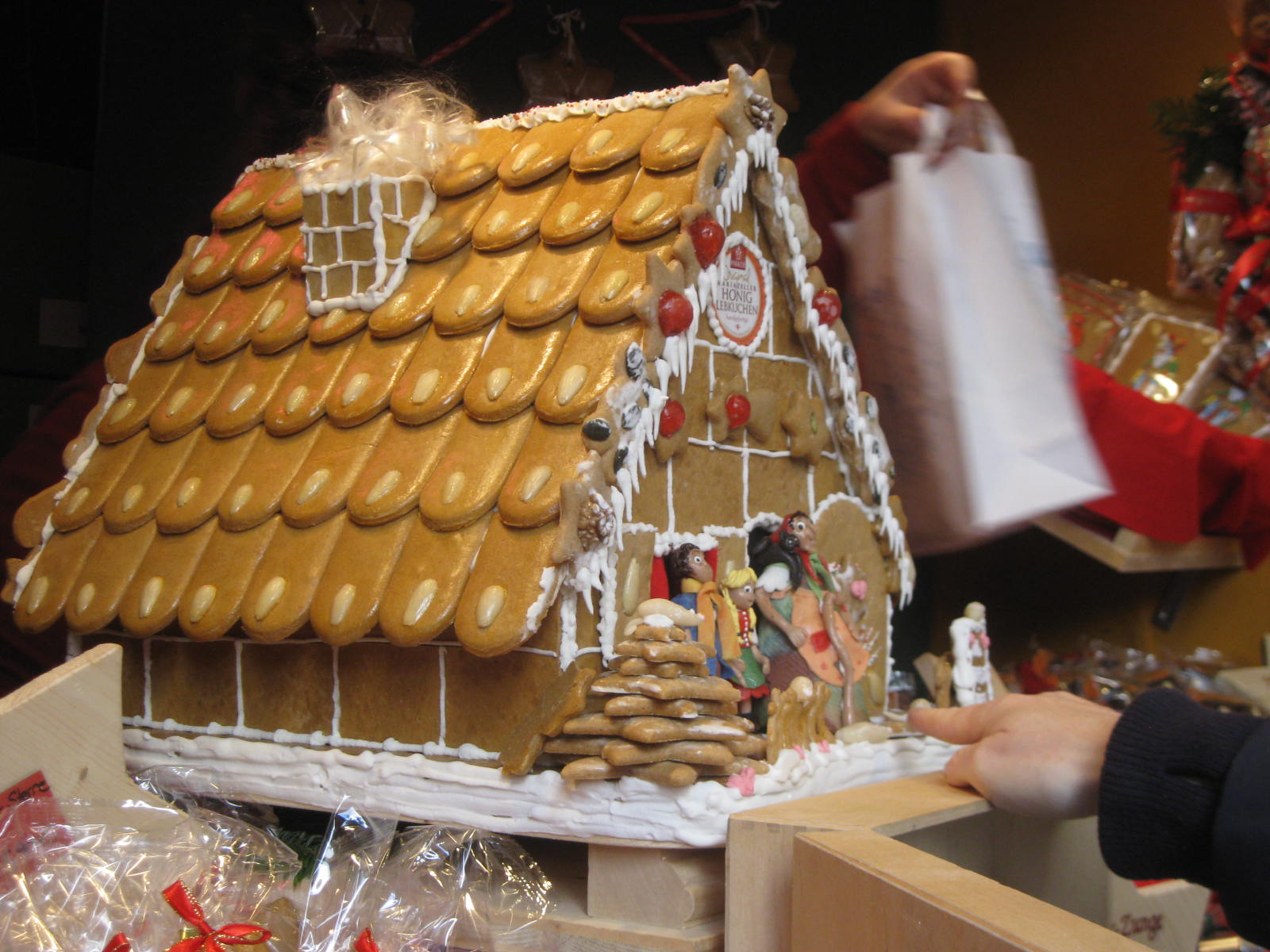
Vienna's Christmas markets were fun because I got to see all the things you never see in Israel.
Like gingerbread houses!
And snow globes!
The Schneekugel was apparently invented in Vienna.
I had to laugh, though, at these thumbs-up lollipops.
Nice German names for the Christmas cupcakes.
This particular market, one of many in Vienna, was the Weihnachtsmarkt am Stephansplatz, right at the base of St. Stephen's Cathedral with its multi-colored tile roof.
Ah, I'd love to still be in peaceful Austria, especially tonight when the fighter jets keep roaring over my place, after rockets were fired from Lebanon into the Western Galilee and Israel responded with artillery fire, etc. etc.
It's a whole different world . . . .
.
(Linking to inSPIREd Sunday.)
.
Vienna's Christmas markets were fun because I got to see all the things you never see in Israel.
Like gingerbread houses!
And snow globes!
The Schneekugel was apparently invented in Vienna.
I had to laugh, though, at these thumbs-up lollipops.
Nice German names for the Christmas cupcakes.
This particular market, one of many in Vienna, was the Weihnachtsmarkt am Stephansplatz, right at the base of St. Stephen's Cathedral with its multi-colored tile roof.
Ah, I'd love to still be in peaceful Austria, especially tonight when the fighter jets keep roaring over my place, after rockets were fired from Lebanon into the Western Galilee and Israel responded with artillery fire, etc. etc.
It's a whole different world . . . .
.
(Linking to inSPIREd Sunday.)
.
Friday, December 18, 2015
Mistletoe, fresh off the tree
.
Since National Geographic published a nice article about mistletoe today on their News site, I figure it's time to blog about my mistletoe experience.
No, mine had nothing to do with kissing under the plant ... in fact I had no idea about these Christmas-time customs or even what mistletoe looked like.
The very last day that I was at the farm community in Austria last month, several of the men went off to the forest to cut some mistletoe off the trees.
Bruder Fritz, who founded the lay Franciscan commune in 1984, was kind enough to show me a cluster and explain about it.
Especially that the white berries are poisonous!
Since National Geographic published a nice article about mistletoe today on their News site, I figure it's time to blog about my mistletoe experience.
No, mine had nothing to do with kissing under the plant ... in fact I had no idea about these Christmas-time customs or even what mistletoe looked like.
The very last day that I was at the farm community in Austria last month, several of the men went off to the forest to cut some mistletoe off the trees.
Bruder Fritz, who founded the lay Franciscan commune in 1984, was kind enough to show me a cluster and explain about it.
Especially that the white berries are poisonous!
It is a parasite and "it keeps that lively green color by stealing water and soil minerals from its host tree," as the National Geographic says.
The article has nice photos of clusters in a tree and of various species and of birds eating the berries.
And the surprising news is
There’s also evidence to suggest that some species of mistletoe can be used in treating cancer—something that people have actually used it for since the 1920s. Doctors today can prescribe mistletoe in Europe. And at Johns Hopkins’ School of Medicine, doctors are performing the first rigorous, I.V. study of mistletoe’s effects on cancer patients in the U.S.
Here is a funny tidbit from the Oxford Dictionaries blog:
The custom [of Christmas kisses] seems to be restricted to England and the USA. I’ve asked friends from Germany, Austria, France, Belgium, Bulgaria, Spain, and even from Scotland and Ireland. Bavarians bring mistletoe into their homes and put it in vases but none of my fellow Europeans came across kissing under the mistletoe as children. Their countries know of the custom now, but from Hollywood, and they think of it as an English or American eccentricity.
UPDATE: Make sure to read readers' input in the comments. All kinds of interesting things coming in from USA, Canada, and Europe!
UPDATE Dec. 24:
BBC earth just published about mistletoe, including this interesting info about a good plant-animal symbiosis:
.Pairs of mistle thrushes will often set up a territory around individual trees and defend their stock of berries. But mistle thrushes are not actually very efficient at distributing mistletoe seeds. They eat the berries whole, defecating a sticky mix of pulp and seed half an hour later, when the birds are likely to have moved on.Much more efficient are blackcaps. These little birds eat the skin and pulp of the berry, but discard the sticky seed first, wiping it off their beaks against the bark of the tree. This is perfect for the mistletoe, as the seed is placed firmly against the branch ready for germination.
Interestingly, in recent years we’ve seen many more blackcaps migrating to Britain over winter, and this could be beneficial for mistletoe.
There is evidence that mistletoe is increasing in some areas and some of this could be down to blackcap activity, although this is likely to be a combination of factors, including better protection of the ancient apple orchards that are the most important habitat for mistletoe.
Thursday, December 17, 2015
Cactus enjoys our cool winter
.
Crisp December skies,
a little rain now and then, and the cactus hill in Meitar gets interesting!
Blue skies for SkyWatch Friday.
The pictures are fun when enlarged.
.
Crisp December skies,
a little rain now and then, and the cactus hill in Meitar gets interesting!
Blue skies for SkyWatch Friday.
The pictures are fun when enlarged.
.
Wednesday, December 16, 2015
Effluents, drinking "frohibited"
.
We have a double W word today for ABC Wednesday: wastewater!
Since the public gardens in the Negev town of Omer are irrigated with effluents (wastewater), drinking from the town garden taps or hoses is . . . is what?! -- "frohibited"!
Haha, another Israeli sign blooper!
Purple is the conventional color to warn of effluents.
I have seen big purple valves in fields but this was my first time to see all the drip irrigation hoses thus marked.
The funny signs and the purple pipes are all along this long hedge, and behind the fence are several kindergartens.
Maybe that's why they are being so careful to warn about the water.
.
UPDATE Dec. 17, 2015: Funny, just a day after I blogged about greywater, Ben-Gurion Univ. posted this article on Facebook:
Greywater Reuse for Irrigation Is Safe and Does Not Cause Gastrointestinal Illness, According to Zuckerberg Institute for Water Research Study
.
(Linking also to signs, signs.)
.
We have a double W word today for ABC Wednesday: wastewater!
Since the public gardens in the Negev town of Omer are irrigated with effluents (wastewater), drinking from the town garden taps or hoses is . . . is what?! -- "frohibited"!
Haha, another Israeli sign blooper!
Purple is the conventional color to warn of effluents.
I have seen big purple valves in fields but this was my first time to see all the drip irrigation hoses thus marked.
The funny signs and the purple pipes are all along this long hedge, and behind the fence are several kindergartens.
Maybe that's why they are being so careful to warn about the water.
.
UPDATE Dec. 17, 2015: Funny, just a day after I blogged about greywater, Ben-Gurion Univ. posted this article on Facebook:
Greywater Reuse for Irrigation Is Safe and Does Not Cause Gastrointestinal Illness, According to Zuckerberg Institute for Water Research Study
.
(Linking also to signs, signs.)
.
Friday, December 11, 2015
Thursday, December 10, 2015
So many saddles!
.
The guided tour of Vienna's Spanish Riding School takes you into the impressive tack room.
Some 70 Lipizzaner horses live in the stable and each has his own Baroque dressage saddle.
The Spanish Riding School has 170-175 riders.
It takes years of training and they start anywhere between the ages of 16 to 25.
In recent years a small number of horsewomen have been admitted to what was always an all-male academy.
Stirrups are fastened up behind the saddle.
Riders need strong legs because some of the riding and the airs above the ground are done without stirrups.
Above each bridle is the stallion's name.
For more information and links about this wonderful place in wonderful Vienna please see my previous posts.
For those of you reading this on "PhotoManiac Daily pictures," a Blogspot "blog" that steals real bloggers' posts and publishes them without permission or attribution, you can find me at Jerusalem Hills Daily Photo.
.
The guided tour of Vienna's Spanish Riding School takes you into the impressive tack room.
Some 70 Lipizzaner horses live in the stable and each has his own Baroque dressage saddle.
The Spanish Riding School has 170-175 riders.
It takes years of training and they start anywhere between the ages of 16 to 25.
In recent years a small number of horsewomen have been admitted to what was always an all-male academy.
Stirrups are fastened up behind the saddle.
Riders need strong legs because some of the riding and the airs above the ground are done without stirrups.
Above each bridle is the stallion's name.
For more information and links about this wonderful place in wonderful Vienna please see my previous posts.
For those of you reading this on "PhotoManiac Daily pictures," a Blogspot "blog" that steals real bloggers' posts and publishes them without permission or attribution, you can find me at Jerusalem Hills Daily Photo.
.
Tuesday, December 8, 2015
Classical horsemanship in Vienna as a Cultural Heritage of Humanity!
.
Ach, just a few weeks ago I was here in Vienna; how I miss that city!
It was raining that Sunday when I first saw the Hofburg Palace.
At its gates, Christmas market booths were doing a brisk business with hot Gluhwein.
Inside the palace is the most beautiful riding hall in the world, a Baroque masterpiece outfitted between 1729 and 1735.
It was originally built to give aristocratic youths an opportunity to take riding instruction.
The two men in my photo were installing a new sound system in this Winter Riding School for the international audiences who come to see the Lipizzaner stallions perform.
Emperor Charles VI commissioned the building of the arena.
You can faintly see a tall painting of a white horse.
The guide on this tour explained that the monarch later had his own image added so that it became a portrait of himself on horseback.
Guide Sophia was good at explaining everything in just one hour.
She was strict, though, that we should not take pictures of the horses or the stables. :(
Till today the tradition is for the riders to doff their hats to that same portrait of the emperor when they enter his arena.
.
I'll soon have another post or two about Vienna's wonderful Spanish Riding School.
You can see my previous posts here and here, which have links to more information about the horses and the school.
The BIG NEWS is that the Spanische Hofreitschule has just now been inscribed in UNESCO's 2015 Representative List of the Intangible Cultural Heritage of Humanity!!
Be sure to see what they tell about classical horsemanship and see the photos at the bottom of the page, plus a wonderful video!
.
(For ABC Wednesday, V is for Vienna!)
(Linking also to Camera Critters. )
.
Ach, just a few weeks ago I was here in Vienna; how I miss that city!
It was raining that Sunday when I first saw the Hofburg Palace.
At its gates, Christmas market booths were doing a brisk business with hot Gluhwein.
Inside the palace is the most beautiful riding hall in the world, a Baroque masterpiece outfitted between 1729 and 1735.
It was originally built to give aristocratic youths an opportunity to take riding instruction.
The two men in my photo were installing a new sound system in this Winter Riding School for the international audiences who come to see the Lipizzaner stallions perform.
Emperor Charles VI commissioned the building of the arena.
You can faintly see a tall painting of a white horse.
The guide on this tour explained that the monarch later had his own image added so that it became a portrait of himself on horseback.
Guide Sophia was good at explaining everything in just one hour.
She was strict, though, that we should not take pictures of the horses or the stables. :(
Till today the tradition is for the riders to doff their hats to that same portrait of the emperor when they enter his arena.
.
I'll soon have another post or two about Vienna's wonderful Spanish Riding School.
You can see my previous posts here and here, which have links to more information about the horses and the school.
The BIG NEWS is that the Spanische Hofreitschule has just now been inscribed in UNESCO's 2015 Representative List of the Intangible Cultural Heritage of Humanity!!
Be sure to see what they tell about classical horsemanship and see the photos at the bottom of the page, plus a wonderful video!
.
(For ABC Wednesday, V is for Vienna!)
(Linking also to Camera Critters. )
.
Sunday, December 6, 2015
Our Scouts' Chanuka torch parade
.
The Scouts in Meitar had their traditional first-night-of-Chanuka torch parade tonight!
It was freezing cold but the kids walked many blocks through the town.
Sufganiot, jelly donuts, were waiting at the end.
Happy Chanuka!
Painted on the Scounts den, the motto, "BE PREPARED."
.
The Scouts in Meitar had their traditional first-night-of-Chanuka torch parade tonight!
It was freezing cold but the kids walked many blocks through the town.
Sufganiot, jelly donuts, were waiting at the end.
Happy Chanuka!
Painted on the Scounts den, the motto, "BE PREPARED."
.
Saturday, December 5, 2015
Beware of devilish Krampus tonight!
.
You surely recognize good St. Nicholas.
But do you recognize his opposite, the evil devil Krampus?
Every child in Austria knows about this demon, but I first learned of him only a few weeks ago when my hosts in Vienna gave me these chocolate figures and told me to eat Krampus -- the one with horns, chains, and claws -- only on December 6.
Dec. 6 is St. Nicholas Day but the night before is Krampusnacht, which looks to me to be a scary night to be out on the streets of Austria and some of the surrounding countries.
.
I can't begin to explain it well, having never experienced it, so I ask you to read some of these really interesting articles (with great photos!).
BTW, apparently this year there is a spurt of interest in all this in America too!
An explanation from the Archdiocese of Vienna, in German: Der Krampus hat mit dem Hl. Nikolaus eigentlich nichts zu tun
In German: Von altem Brauchtum bis Alpenerotik
From National Geographic:
Krampus the Christmas Devil Is Coming to More Towns. So Where's He From?
Another from National Geographic: How Krampus, the Christmas ‘Devil,’ Became Cool
Official trailer for the new American horror-comedy movie "Krampus"
("Legendary Pictures’ Krampus, a darkly festive tale of a yuletide ghoul, reveals an irreverently twisted side to the holiday.
When his dysfunctional family clashes over the holidays, young Max (Emjay Anthony) is disillusioned and turns his back on Christmas. Little does he know, this lack of festive spirit has unleashed the wrath of Krampus: a demonic force of ancient evil intent on punishing non-believers.
All hell breaks loose as beloved holiday icons take on a monstrous life of their own, laying siege to the fractured family’s home and forcing them to fight for each other if they hope to survive")
Merisi Vienna's blog post: Saint Nicholas and Krampus: Were you naughty or nice?
Bolzano Daily Photo, South Tyrol / Italy offers a short video (narrated in Ladin language!) of the actual festivities on Krampusnacht in the village of Urtijëi / St. Ulrich / Ortise.
.
Good luck. Be good. Watch out tonight!
And tomorrow, a happy St. Nicholas Day!
.
You surely recognize good St. Nicholas.
But do you recognize his opposite, the evil devil Krampus?
Every child in Austria knows about this demon, but I first learned of him only a few weeks ago when my hosts in Vienna gave me these chocolate figures and told me to eat Krampus -- the one with horns, chains, and claws -- only on December 6.
Dec. 6 is St. Nicholas Day but the night before is Krampusnacht, which looks to me to be a scary night to be out on the streets of Austria and some of the surrounding countries.
.
I can't begin to explain it well, having never experienced it, so I ask you to read some of these really interesting articles (with great photos!).
BTW, apparently this year there is a spurt of interest in all this in America too!
An explanation from the Archdiocese of Vienna, in German: Der Krampus hat mit dem Hl. Nikolaus eigentlich nichts zu tun
In German: Von altem Brauchtum bis Alpenerotik
From National Geographic:
Krampus the Christmas Devil Is Coming to More Towns. So Where's He From?
Another from National Geographic: How Krampus, the Christmas ‘Devil,’ Became Cool
Official trailer for the new American horror-comedy movie "Krampus"
("Legendary Pictures’ Krampus, a darkly festive tale of a yuletide ghoul, reveals an irreverently twisted side to the holiday.
When his dysfunctional family clashes over the holidays, young Max (Emjay Anthony) is disillusioned and turns his back on Christmas. Little does he know, this lack of festive spirit has unleashed the wrath of Krampus: a demonic force of ancient evil intent on punishing non-believers.
All hell breaks loose as beloved holiday icons take on a monstrous life of their own, laying siege to the fractured family’s home and forcing them to fight for each other if they hope to survive")
Merisi Vienna's blog post: Saint Nicholas and Krampus: Were you naughty or nice?
Bolzano Daily Photo, South Tyrol / Italy offers a short video (narrated in Ladin language!) of the actual festivities on Krampusnacht in the village of Urtijëi / St. Ulrich / Ortise.
.
Good luck. Be good. Watch out tonight!
And tomorrow, a happy St. Nicholas Day!
.
Thursday, December 3, 2015
Good luck pigs, Glücksschweinchen
.
Runner-up for City Daily Photo shop window theme day:
these strange Glücksschweinchen!
Good luck pig pillows in a Vienna store window.
For only 24 Euros you can take one home.
.
UPDATE: Thanks to Merisi of Vienna for explaining the pig mystery in the comments.
Here is some more on the subject of lucky things in German-speaking lands:
Pigs as Glücksbringer – Schwein as Austrian Good Luck Charm
Other luck bringers
Goethe Institute on Superstition
.
Runner-up for City Daily Photo shop window theme day:
these strange Glücksschweinchen!
Good luck pig pillows in a Vienna store window.
For only 24 Euros you can take one home.
.
UPDATE: Thanks to Merisi of Vienna for explaining the pig mystery in the comments.
Here is some more on the subject of lucky things in German-speaking lands:
Pigs as Glücksbringer – Schwein as Austrian Good Luck Charm
Other luck bringers
Goethe Institute on Superstition
.
Subscribe to:
Posts (Atom)