Sunday, May 13, 2012

How some see God

.
You are welcome to join our small group of bloggers who answer the PsalmChallenge and read and illustrate one Psalm every week, led by Robert Geiss at Daily Athens Photo.

PSALM 62
1. For the leader. On Jeduthun. A psalm of David.

2. Truly for God my soul waits quietly; from Him is my salvation.
3. Truly He is my rock and my salvation; my fortress—I shall never stumble.

4. How long will you attack a man—all of you to slay him—like a leaning wall, a tottering fence?
5. Truly, they lay plans to topple him from his eminence; they delight in falsehood; with their mouths they bless, but inwardly they curse. Selah.

6. Truly, wait quietly for God, O my soul, for from Him is my hope.
7. Truly He is my rock and my salvation, my fortress—I shall not stumble.
8. Upon God: my salvation and my glory; my rock of power, in God is my refuge.
9. Trust in Him at all times, O people; pour out your heart before Him; God is a refuge for us. Selah.

10. Truly, poor men are but a breath; rich men, false. Placed on a scale, they are together less than a breath.
11. Put no confidence in extortion, and have no illusions about plunder; riches accumulated—let your heart pay no attention.
12. (Not only) one thing God has spoken (but) twice have I heard: power belongs to God,
13. and faithfulness is Yours, my Lord. Thus You requite a man according to what he has done.
.
.
Photo:
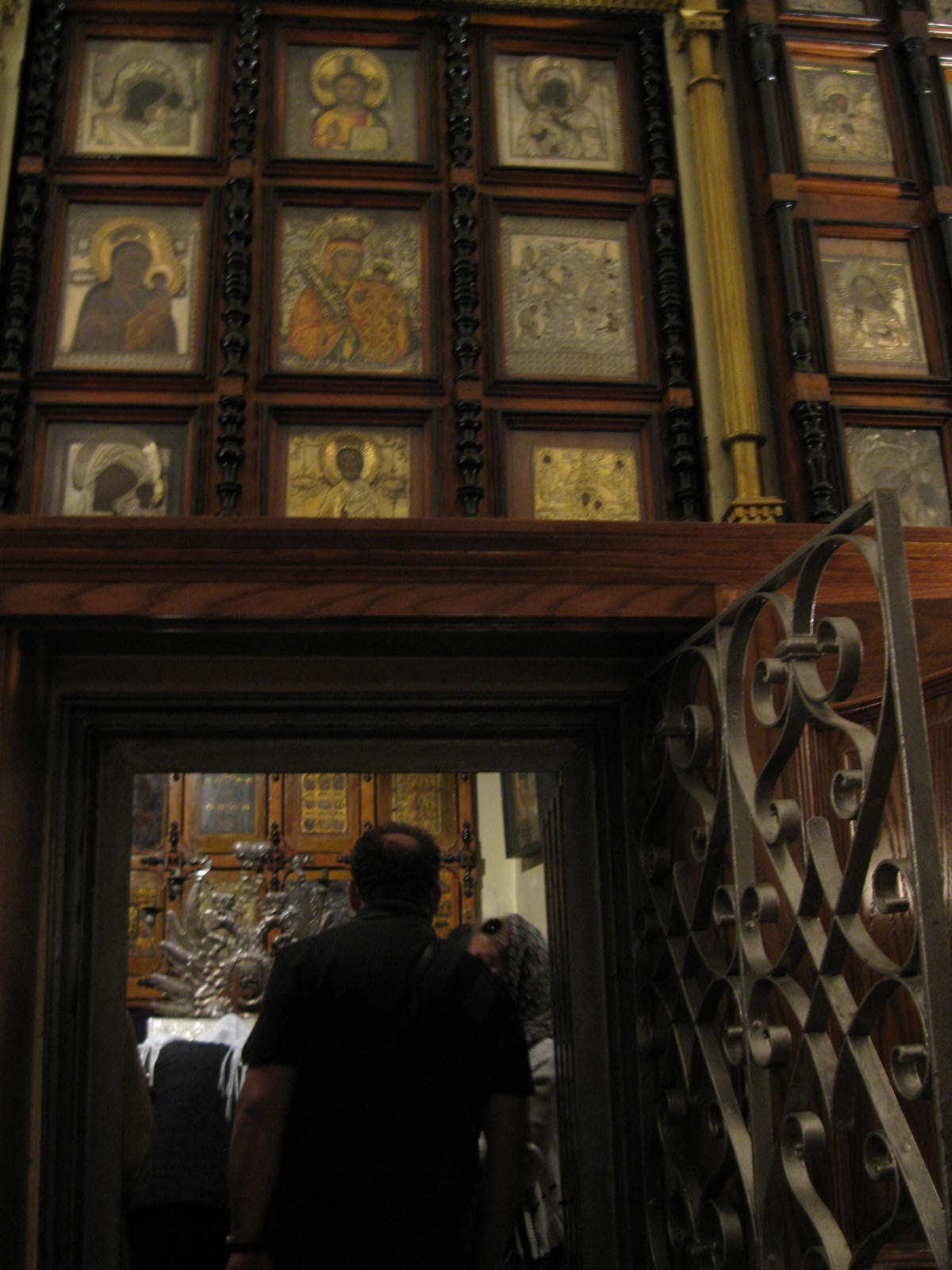
Church dome in St. Gerasimus Monastery near Jericho.
To see the Creator God, just click on the photo and then once on the photo that opens.
.
Today I used Rabbi Benjamin J. Segal's translation. See also his notes on Psalm 62 and the Hebrew original at his "A New Psalm, A New Look at Age-Old Wisdom."
.

Saturday, May 12, 2012

A monastery full of animals

.
This particular monastery does not have a problem with pigeons; in fact they raise pigeons.
And goats too.
They have some camels and donkeys, as well; oh, and aviaries and a talking parrot.

In short, a good place to find photos for Camera Critters meme.

Hogla is the Hebrew word for partridge, and St. Gerasimus Monastery has many cute ones like this in the photo.
The Arabic name for the monastery is Deir Hajleh [literally, the monastery of the partridge].
The Arabic comes from the Hebrew name of the town that was here back in biblical days, Beth-Hogla [literally, house of the partridge].

The Book of Joshua 18:19-21 says " Now the cities of the tribe of the children of Benjamin according to their families were Jericho, and Beth-hoglah, and . . . "

The very old monastery is in the desert near Jericho.

Greek Orthodox Archimandrite Chrysostomos has been abbot of the monastery for some 30 years.
His hard work and vision have turned the place into a beautiful oasis.
The kind monk is known as a holy man and pilgrims come from near and far to seek his blessing.

But why a full sized lion in the courtyard (and a lion on many of the icons)?

He is Yarden, or Jordanes, who became the faithful pet of St. Gerasimus after the monk saved him from injury.
But that story will come soon in a post of its own.
.
I think it is unusual for a monastery to have more animals than people.
At last count there were six monks and five novices, plus some volunteers mostly from Greece and Cyprus.

I wish I could live there as a volunteer for a time. It is a very special place.
.

Friday, May 11, 2012

Inn of the Good Samaritan

.
The modern addition to the Inn of the Good Samaritan, on the road from Jerusalem to Jericho, reflected the desert of the Judean Hills.

Here's the view from inside.
The tour group I was with yesterday was viewing the mosaics.
Opened in 2009, this is now one of the biggest mosaics museums in the world.

You arrive at the glass construction after passing through the 3 or 4 arches and galleries in the old Turkish building.

Oops, another reflection for Weekend Reflections.

You can enlarge the photo and read Jesus' parable of the Good Samaritan.
.
More about the old/new Inn of the Good Samaritan next week.
Meanwhile, you can read more about it here or see a short video here.
.
Shabbat shalom.
.

Thursday, May 10, 2012

A great day of learning

.
It was a great day--everything I saw was new!
Well, it was all ancient, but it was new to me.

First there was free admission (for International Museum Day) at the Bible Lands Museum.
Then at 4 p.m. I took a guided tour outside of Jerusalem, part of Yad Yitzhak Ben-Zvi's 3-day marathon of 120 tours.
Our bus took us to the Inn of the Good Samaritan and to Martyrius Monastery.
More on those in the coming days!

The ruins of the monastery are in the middle of a city of 39,000 Jewish Israelis.
The young city of Ma'ale Adumim is just 7 kilometers east of Jerusalem but all around it is desert, the Judean Desert.
Just before 7 p.m. the last rays of sun illuminated its white buildings high on the hill.

Less than 10 minutes later we passed this Palestinian village.
The green lights on the mosque's minaret, to the left, were already shining in the dusk.
For a good look, click on the photo, then click again on the image that opens up.
.
I thought the layers of colors in the desert sky would be nice for SkyWatch Friday meme.
.
(More about Ma'ale Adumim at the website of a resident and at Wikipedia.
.

Wednesday, May 9, 2012

Dancing on his grave

.
This little group of huts and tents marks the tomb of Shimon HaTsadik in the Sheikh Jarah neighborhood in Jerusalem.
Shimon (or Simeon the Just) was a Jewish High Priest somewhere around 300BCE.

On a quiet day the women's side of the prayer place looks like this.

Quoted on the velvet cover is Shimon's famous maxim from the Talmud:
"On three things the world stands [exists]--on Torah, worship, and acts of lovingkindness."

The gate was locked or I would have gone down to explore what probably is more tombs inside the cliff.
.
OK, so that is the scene on a normal day.
But tonight is the holiday of Lag BaOmer and hundreds of very religious Jews should be at the tomb right now, dancing and singing and praying and lighting bonfires.
Oh yes, and they will also do the upsherin, giving 3-year-old boys their first haircut.

Hundreds of thousands will be doing the same thing all night at another tomb of another Shimon, Rabbi Shimon bar Yochai on Mt. Meron.
But people who can't travel all the way to the north have the alternate site here in Jerusalem.
.
Meanwhile, I am in my house in the hills with windows and shutters closed, trying to keep out the smell of smoke from all the bonfires in my village.
.
Take a look at how Lag BaOmer was celebrated at the tomb of Shimon HaTsadik 90 years ago at the wonderful blog Israel's History--A Picture a Day.
.

Tuesday, May 8, 2012

Quill and Qulmus

.
For ABC Wednesday I found not one but two words beginnings with Q:
quill and the Hebrew word qulmus, which means quill.

This nice little video at the Israel Museum showed how a sofer stam , a scribe for holy writing, cuts a turkey or goose feather in a special way, turning it into a quill.
He then dips the qulmus in specially prepared black ink and "hangs" the Hebrew letters from the sirtut lines he has etched into the parchment. (Look closely and see his guide-lines in the photo.)

See more about this process at Wiki and Torah Tots.

Even more ancient than the feather quill is the reed quill.
Our Talmudic sages taught that to write a Torah scroll one must not use a quill from a cedar tree that stands tall and arrogant, rather a quill from a reed, which is soft, flexible, and humble.

The Hebrew word qulmus (also transliterated kulmus) come from the ancient Greek kalamos (and Latin calamus), meaning reed or reed pen.

The basis for this meaning is the story of the Greek mythological figure Kalamos, son of Maiandros (god of the Maeander river).
Two youths, Kalamos and Karpos, were competing in a swimming contest in this river when Karpos drowned.
In his grief, Kalamos allowed himself to drown also.
He was then transformed into a water reed whose rustling in the wind was interpreted as a sigh of lamentation.
.
On a happier note, have fun listening to Hora Ha-Kulmus, Dance of the Quill, for reed instruments!
.
UPDATE  See Bibi Netanyahu pen a word of Torah in the scroll-writing project in the synagogue atop Masada! 

Monday, May 7, 2012

The Treasure Room!

.
With two clicks the images will enlarge and reveal the details.

These birds stand guard over something very rare and special to many Christians:

-- a fragment of the True Cross! [although some say, "as legend has it . . . .]

The icon shows Emperor Constantine and his mother, St. Helena.
Queen Helena went to the Holy Land in about 326, searched for, and [some say] found, the three crosses that had stood on Calvary.
Mother and son then had the Church of the Holy Sepulchre built on the site.

To commemorate this, Jerusalem Catholics today (May 6-7) celebrated the day of The Finding of the Holy Cross.

My trusty calendar says that "On the day of the feast, Mass is celebrated, followed by a solemn procession through the Church of the Holy Sepulchre, led by the Custos holding a relic of the Holy Cross.

I assume the Franciscans have their own relic of the cross; however, what I show you in this post is the one belonging to the Greek Orthodox.

Getting back to our walk through the Treasure Room, which is only rarely open to pilgrims . . . in the photo above you see the glass-covered wooden cases along the walls of the tiny room.

They contains relics of early Christian saints, such as this hand.

And this forearm.

The lid of the reliquary is open to reveal a fragment of someone's skull.

During my brief visit to the Treasure Room I saw women crossing themselves and bending to kiss the glass over each of the relics.

LinkNext time you are in the Holy Sepulchre look for this door into the little Treasure Room.
It is a very strange and special experience [I say, speaking as a Jew].
.

In fact, let's see if Julie will take this post for Taphophile Tragics.
It is also a one-room tour for Our World Tuesday.

See also my post.St. Thérèse's relics on pilgrimage in Israel.
.
.

Sunday, May 6, 2012

Vows

.
A nice Psalm 61 for Robert's weekly PsalmChallenge at Daily Athens Photo, centered in Athens, where fateful elections are currently in full swing.

1. To the choirmaster: with stringed instruments. A Psalm of David.

2. Hear, O God, my supplication; heed my prayer.
3. From the end of the earth to You I call; when my heart is faint, lead me to a rock high above me.
4. For indeed You have been a refuge for me, a tower of strength in the face of an enemy.
5. I would dwell in Your tent forever, take refuge in the shelter of Your wings. Selah

6. For indeed You, O God, have heard my vows; You have given an inheritance (to) those who fear Your name.
7. Add days to the days of the king; may his years be from generation to generation;
8. may he ever dwell before the face of God; appoint steadfast love to guard him.

9. So I will sing Your name in hymns eternally, as I fulfill my vows day after day.
.
.
Photos:
A stringed King David statue exhibited at Mamilla Mall last year.
Franciscan friars and two nuns pray before the tomb of Jesus in the Church of the Holy Sepulchre.
By candlelight a nun sings the prayers.
.
Today's translation is by Rabbi Benjamin Segal.
.

Saturday, May 5, 2012

Donkey mowing service

.
Donkeys are my favorite, can you tell?

Photo taken by Wil

Donkeys love to have the inside of their ears scratched.

When Dutch blog-friend Reader Wil was here in March, a veteran kibbutz member of Degania Bet (where we overnighted) took our tour group way out to the fields near Umm Juni.
He tried to explain how Jewish pioneers came to farm there in 1910, in what would develop into Kibbutz Degania Alef, Israel's first kibbutz, at the southern tip of the Sea of Galilee.

I tried to stand and listen but was naughty instead and could not resist stepping away to play with the donkeys.
So then our guide had to explain how these days herds of donkeys are temporarily put in places that humans would find impossible to mow.
He said the donkeys learned to be more like mountain goats on the steep slopes.

And indeed, way down below by the water, you could see at least three more donkeys.

You can click on the photo and then click again on the photo that opens, to see it much bigger.
.
These sweet donkeys are for today's Camera Critters meme.
.

Friday, May 4, 2012

Through a glass elevator, brightly

.
Deep reflections in the floor of the elevator, for Weekend Reflections, had an almost dizzying effect as we went up.

But looking through the glass elevator, down onto Zion Square, was even more exciting.

You can see where the Ben-Yehuda Street pedestrian mall begins at Zion Square, corner of Jaffa Street.
The decorated parked car belongs to the joyful NaNach Jews, and the yellow bloodmobile waits for your blood donation.

Enlarge the photo and see the tram.
The light rail is now the only vehicle allowed in this part of Jaffa St., making it too a kind of pedestrian mall.

Here is a wider view (again, from the elevator) .

Hamashbir LeTsarchan was Israel's first department store, and its Jerusalem store recently moved into this new building with the two glass elevators.
You can see the modern building still under construction in an earlier post.
The tower (or rotunda) with the elevators looks like a lighthouse.

Architect Aaronson said he designed the elevators as a "kinetic sculpture" that will radiate light outward and add to the general experience of passersby.
.

Thursday, May 3, 2012

"Please do not climb" (into the sky)

.
A stainless steel tree against the blue Jerusalem sky for SkyWatch Friday.

Inversion (2008) came to stand in the Billy Rose Art Garden of the Israel Museum just last year.

Its creator is American artist Roxy Paine. He said this about Inversion:
It could be read as being emblematic of, and a monument to, how much we have altered the natural world. It could also be read as a meditation on humanity’s need to distill every entity into its component parts and then restructure them.

My first thought on seeing the upside down tree was that Israel is an appropriate resting place for it, considering how many Jews and Arabs know the feeling of being uprooted.

And I learn here that
Inversion was the first of Paine’s sculptures from his Dendroid series in which the dendritic form appears upside down, all of its weight resting on the smallest and finest limbs. This work was the first in the series to not require a foundation and thus proved to be a breakthrough in the artist’s development of subsequent works . . . .
These works rest directly on the ground, a discovery which opened up new avenues for the artist to explore the rules and codes defining the abundant possibilities of dendritic forms as they appear throughout nature, science and industry.

.
(Oh, and not to forget what the Israel Museum adds to the sign: "Please do not climb.")
.
P.S. I left the photo nice and big so you can enjoy the details.
Just click on the photo and then click again on the photo that opens up.
.

Wednesday, May 2, 2012

Minerva in Jerusalem

.
Isn't she beautiful, even with a busted nose?!

And so old--from the 2nd century CE [A.D.].

Athena (the Roman Minerva) in marble is one of the many treasures in the Israel Museum.

The museum writes this:
Athena (the Roman Minerva) was the daughter of Zeus, king of the gods.
She was the goddess of wisdom and the art of warfare, patroness of heroes, artists, and the arts.
She is usually depicted helmet-clad and armed with a spear and shield.

Of this statue, which originally rose to 2.5 meters, only the head has survived.
Traces of paint indicate that it was originally brightly painted.
The contrast between the smooth face and rough hair are typical of the style of the 2nd century CE.
She was discovered at Tel Naharon (northern Beit She'an).
.

Tuesday, May 1, 2012

Palmach, Parabellum, and pacem

.
For ABC Wednesday, P is for Palmach, Parabellum, and peace.
.
The Palmach Cave is a heritage site (and active tourist site) in Kibbutz Mishmar HaEmek in the Jezreel Valley.

This cave became the training place for the Palmach's special units, for example, the German Unit.

Established in 1941, the Palmach was the elite fighting force of the Haganah, the underground army of the Yishuv (Jewish community) during the period of the British Mandate of Palestine.
By the outbreak of the War for Independence in 1948 it consisted of over 2,000 men and women in three fighting brigades and auxiliary aerial, naval and intelligence units.

The display shows some of their various weapons.
Unfortunately there were not enough, and not every Palmachnik went into battle with a gun.

An old Pistol Parabellum is on the wall.

The pistol's name comes from the old Latin adage Si vis pacem, para bellum , meaning "If you wish for peace, be always ready for war."

As Wikipedia says, "this is usually interpreted as meaning peace through strength—a strong society being less likely to be attacked by enemies."
.

Monday, April 30, 2012

Baking in the monastery

.
Down through the centuries a lot of bread has been baked in this oven.

The bricks of the oven's interior make a nice big dome.

Imagine how many loaves had to be baked every day to feed the many monks who sat at this refectory table.

See here and here for more views of the Monastery of the Cross in Jerusalem's Valley of the Cross.
The fortress-like monastery was built in Byzantine times, probably in the 7th century.
.
The City Daily Photo group has "bakeries" for today's May 1 theme.
Click here to view thumbnails for all participants.
.
This room can also be a mini-tour for Our World Tuesday.
.

Sunday, April 29, 2012

Did Crusader knights pray this psalm too?

.
Up north, on the Jordan River, north of the Sea of Galilee, are the remains of a Crusader castle with an amazing, gruesome history.
The fortress at Vadum Iacov or Jacob's Ford, now known in Hebrew as Ateret, was attacked and razed and burned by Saladin and his army in August 1179.
Some 700 of the defeated Knights Templar were taken prisoner, but the other 800 Christian defenders were massacred.

Their bodies, together with their dead horses, were thrown into a deep well.
The Muslims then made the vaulted roof collapse over the corpses, and the well remained sealed for the next 800 years . . . until Israeli archaeologists re-discovered Vadum Jacob / Ateret fortress.

From 1999 to 2007 geoarchaeology was done at the scene.
Why also geologists?
It was a first-ever opportunity to excavate along the line of a major geological fault.
Sections of the castle's 50-meter-long walls were torn apart by a powerful earthquake in 1202 (and perhaps even more in the 1759 quake).
I was in awe seeing the crack (in the photo below)!

The Hebrew University's website about the research project has several short video clips that show the grizzly story of the battle, as well as what they found at the site.
If nothing else, please watch this one especially:
http://vadumiacob.huji.ac.il/movies/Destruction%20of%20the%20castle.wmv

Can we imagine the Crusaders, while under siege of the Muslims for four fateful days, praying Psalm 60?

That is our psalm for this Sunday's PsalmChallenge, led by Robert in Athens.

PSALM 60
For the choir director; according to Shushan Eduth. A Mikhtam of David, to teach; when he struggled with Aram-naharaim and with Aram-zobah, and Joab returned, and smote twelve thousand of Edom in the Valley of Salt.


1 O God, You have rejected us. You have broken us;
You have been angry; O, restore us.

2 You have made the land quake, You have split it open;
Heal its breaches, for it totters.
3 You have made Your people experience hardship;
You have given us wine to drink that makes us stagger.
4 You have given a banner to those who fear You,
That it may be displayed because of the truth.
Selah.

5 That Your beloved may be delivered,
Save with Your right hand, and answer us!

6 God has spoken in His holiness:
“I will exult, I will portion out Shechem and measure out the valley of Succoth.
7 “Gilead is Mine, and Manasseh is Mine;
Ephraim also is the helmet of My head;
Judah is My scepter.
8 “Moab is My washbowl;
Over Edom I shall throw My shoe;
Shout loud, O Philistia, because of Me!”


9 Who will bring me into the fortified city?
Who will lead me to Edom?
10 Have not You Yourself, O God, rejected us?
And will You not go forth with our armies, O God?
11 O give us help against the adversary,
For deliverance by man is in vain.
12 Through God we shall do valiantly,
And it is He who will tread down our adversaries.
.
.
P.S. Wikipedia calls the fortification Chastellet and gives its take on the Battle of Jacob's Ford.
.

Saturday, April 28, 2012

Why?

.
Right after the annual ANZAC Day ceremony last week in the Jerusalem War Cemetery, I walked alone between the graves, taphophile that I am.

If you like to wander around cemeteries and read headstones and wonder about the human history below them, you too are a taphophile. In fact you could contribute a post to our new meme, Taphophile Tragics, which Julie in Australia started and graciously hosts.

But wait--actually this post is for Shadow Shot Sunday 2, with a question for the shadow folks there.
You see the crows looking for food in the photo above?

I am curious, in the second photo why is the bird in flight blurred while its shadow on the grass is sharp?

You might have to enlarge the photo to even find the bird.
.

Sun-induced somnolence

.
Lara, my favorite feline, enjoying the springtime sun on the woodpile.

Eyes half-closed, she is half-asleep, simply resting and absorbing the warmth (the warmth of the sunbeams and of my friendship).

Hebrew has a nice expression for that state of not-quite-asleep: nim ve-lo nim.
.
.
Yet another Lara post for Camera Critters meme.
.

Friday, April 27, 2012

Reflections of life in a Torah scroll

.

Jerusalem and a Jewish family reflected in a rolled-open Torah scroll.
(And the Torah is reflected in the life of this family and of Jerusalem, too. )

The open scroll is in the Israel Museum's wing for Jewish Art and Life.

Yesterday, for Independence Day, the museum graciously opened its doors for free.
AND, not one of the guards in the galleries yelled at me for taking pictures! Yay!

Their next free admission day will be May 10, International Museum Day.
.
More reflections from around the world at Weekend Reflections meme.
.
Shabbat shalom!
.

Thursday, April 26, 2012

Sixty-four years of independence

.
HAPPY INDEPENDENCE DAY!

HAPPY 64th BIRTHDAY, ISRAEL!

By chance, I came out of the recently redone galleries of the Israel Museum exactly when the Air Force acrobatics began in the sky.
I don't know which was more breathtaking--the archaeology indoors or the aircraft outside!

The planes seemed almost low enough to fly into the 5-meter-tall polished steel hourglass "Turning the World Upside Down, Jerusalem" by sculptor Anish Kapoor (more about it here).

With a click to enlarge, you will find the four planes over the Knesset.

Appropriate for SkyWatch Friday, I do think.

May our pilots always fly in peaceful skies.
.