.
A friend who lives in Jerusalem started out early in the morning yesterday to capture all the beautiful snow-clad places, and now she graciously shares them with you and me.
.
Click and then click again to enlarge her photos.
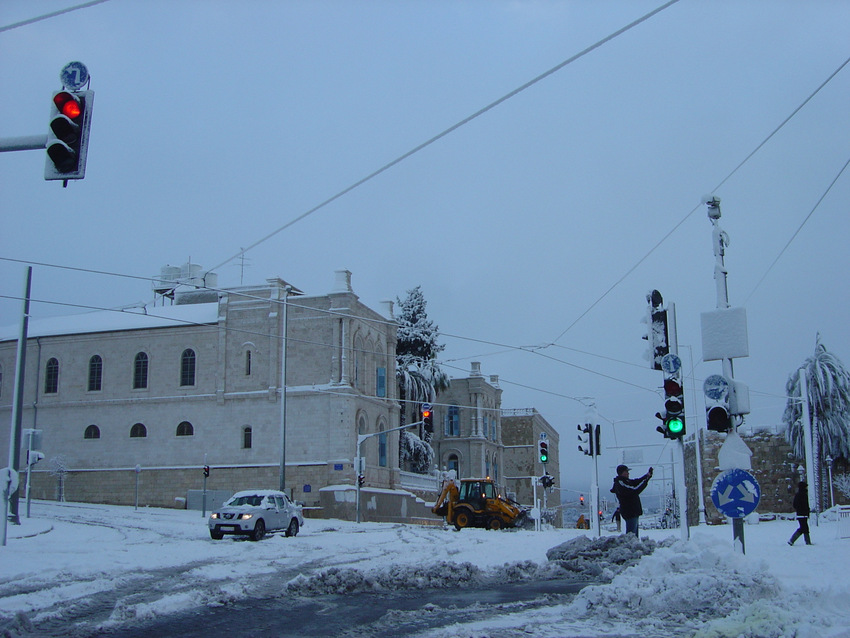
The tram had its first baptism of snow!
And to encourage people not to attempt to drive on the slippery roads, the tram was free of charge for a few days.
The yellow JCB doubled as a snowplow.
The Municipality was ready with tons of salt to spread, too.
They had fifty vehicles dedicated to the one rare snow day.
We got about 25 cm or 10 inches of snow.
The palm trees at Safra Square, City Hall, took it well.
Everybody was excited about our snow.
Families worked together to build snowmen, this one near Jaffa Gate.
People kept on praying.
The Western Wall is never alone.
From the rooftops of the Old City, the gorgeous view of a white Mount of Olives and the golden dome of the Dome of the Rock powdered with snow!
.
Thank you, Friend, for these rare photographs.
.
Pictures of my white village in the snowy Jerusalem Hills are in yesterday's post.
.
Friday, January 11, 2013
Thursday, January 10, 2013
SNOW at last!
.
(All photos can be enlarged with a click and then another click.)
"Shalom and welcome! I'm the banana-mouthed snowman of Dina's village in the Jerusalem Hills!"
YES, SNOW!!
For the first time in five years, our moshav woke up to a white winter wonderland.
Here's the other side of my street.
This is the first and only time I saw chains on a car wheel in Israel.
Wait a minute--are those paperclips??
In the foreground is my yard; on the far horizon to the right, Jerusalem sits in a cloud of its own snow.
By late morning the temperature was rising to above freezing and wet snow started sliding off trees onto my neck. brrr!
The sun came out for a few minutes and I saw some blue sky for the first time this week.
Oops. Who's got a chainsaw to open the path?
The red geranium didn't know what hit it.
Nor did the ktalav, the Eastern Strawberry tree.
The olive trees were straining under the weight of wet snow.
The green grass of winter looked so bright in the sunlight.
After 2.5 hours of picture-taking I came home and the precipitation was already becoming more like rain.
But Jerusalem was again visible across the valley.
.
It was impossible for me to get into the city because the buses stopped running.
But you can see Jerusalem snow pictures in the newspapers:
The Times of Israel
Jerusalem Post
And about the weather damage all over the country: Ynet
.
(All photos can be enlarged with a click and then another click.)
"Shalom and welcome! I'm the banana-mouthed snowman of Dina's village in the Jerusalem Hills!"
YES, SNOW!!
For the first time in five years, our moshav woke up to a white winter wonderland.
Here's the other side of my street.
This is the first and only time I saw chains on a car wheel in Israel.
Wait a minute--are those paperclips??
In the foreground is my yard; on the far horizon to the right, Jerusalem sits in a cloud of its own snow.
By late morning the temperature was rising to above freezing and wet snow started sliding off trees onto my neck. brrr!
The sun came out for a few minutes and I saw some blue sky for the first time this week.
Oops. Who's got a chainsaw to open the path?
The red geranium didn't know what hit it.
Nor did the ktalav, the Eastern Strawberry tree.
The olive trees were straining under the weight of wet snow.
The green grass of winter looked so bright in the sunlight.
After 2.5 hours of picture-taking I came home and the precipitation was already becoming more like rain.
But Jerusalem was again visible across the valley.
.
It was impossible for me to get into the city because the buses stopped running.
But you can see Jerusalem snow pictures in the newspapers:
The Times of Israel
Jerusalem Post
And about the weather damage all over the country: Ynet
.
Wednesday, January 9, 2013
It's snowing!! Yay!
.
With all this week's heavy rain in Israel everything is green and growing.
It is almost midnight now, but by morning all this will be WHITE!!
Yes, snow is starting to fall and to stick now, even in my village!
And up in Jerusalem for sure.
Photos for you tomorrow, God willing!
I can hardly wait for morning.
.
With all this week's heavy rain in Israel everything is green and growing.
It is almost midnight now, but by morning all this will be WHITE!!
Yes, snow is starting to fall and to stick now, even in my village!
And up in Jerusalem for sure.
Photos for you tomorrow, God willing!
I can hardly wait for morning.
.
Tuesday, January 8, 2013
Celestial cartography at Hebrew University
.
Shalom from Israel where this week's weather is wet, wild, and windy.
Tune in tomorrow to see if Jerusalem really gets the expected snow!
Meanwhile, for ABC Wednesday, Z is for zodiac.
But this, that I found on the wall of the National Library of Israel, is more than just a zodiac; it is a famous example of celestial cartography from 1515.
It is a reproduction of Albrecht Dürer's woodcut called Imagines coeli Septentrionales cum duodecim imaginibus zodiaci, a star chart of the Northern hemisphere sky with images of the 12 zodiacal constellations.
In the corners are four historical astronomers: Aratus of Cilician Soli, Ptolemy, Marcus Manilius, and Al-Sufi.
You can click once on the photo and then click again, to see it much enlarged.
Fascinating details about Albertus Durer's star charts are told in Electrum Magazine.
What other treasures lie in these big locked drawers of the National Library's Map Room?
Only the librarian knows for sure.
.
Shalom from Israel where this week's weather is wet, wild, and windy.
Tune in tomorrow to see if Jerusalem really gets the expected snow!
Meanwhile, for ABC Wednesday, Z is for zodiac.
But this, that I found on the wall of the National Library of Israel, is more than just a zodiac; it is a famous example of celestial cartography from 1515.
It is a reproduction of Albrecht Dürer's woodcut called Imagines coeli Septentrionales cum duodecim imaginibus zodiaci, a star chart of the Northern hemisphere sky with images of the 12 zodiacal constellations.
In the corners are four historical astronomers: Aratus of Cilician Soli, Ptolemy, Marcus Manilius, and Al-Sufi.
You can click once on the photo and then click again, to see it much enlarged.
Fascinating details about Albertus Durer's star charts are told in Electrum Magazine.
What other treasures lie in these big locked drawers of the National Library's Map Room?
Only the librarian knows for sure.
.
Labels:
ABC Wednesday,
Hebrew University,
maps,
National Library,
Zodiac
Monday, January 7, 2013
"Jew, speak Hebrew!" **
.
(** Slogan in the language battle of the Jews in pre-State Israel)
Google gave us a new doodle today in honor of 155 years since the birth of Eliezer Ben-Yehuda, the father of modern spoken Hebrew.
The doodle incorporates some of the words he coined:
glida meaning ice cream
buba for doll
millon meaning dictionary, from the root milla, word.
Even before Theodor Herzl envisioned a Jewish State, even before the whole Zionist Movement, Eliezer Ben-Yehuda was a visionary.
The word of God came to him in the 1870s at Kasr il Yahud, the crossing point of the Israelites through the Jordan River into the promised land.
"The Jewish People [Am Yisrael] in its own land and in its own language," became the young man's driving force and he moved from Europe to Jerusalem in 1881.
His grandson, Rabbi Ben-Yehuda, now living in the USA, summarizes thus:
For the biography book see http://fulfillment-of-prophecy.com/
and for articles on his webpage go here.
You can also watch the Rabbi giving a fascinating lecture on his grandfather to a group of Christian Zionists, in five segments, starting here.
And for some music try Chava Albertstein's singing of the modern song about Eliezer Ben-Yehuda that every Israeli child knows.
.
.
(A post for Our World Tuesday.)
(** Slogan in the language battle of the Jews in pre-State Israel)
Google gave us a new doodle today in honor of 155 years since the birth of Eliezer Ben-Yehuda, the father of modern spoken Hebrew.
The doodle incorporates some of the words he coined:
glida meaning ice cream
buba for doll
millon meaning dictionary, from the root milla, word.
Even before Theodor Herzl envisioned a Jewish State, even before the whole Zionist Movement, Eliezer Ben-Yehuda was a visionary.
The word of God came to him in the 1870s at Kasr il Yahud, the crossing point of the Israelites through the Jordan River into the promised land.
"A clear, incandescent
light flashed before my eyes
and a mighty inner
voice sounded in my ears:
‘the resurrection
of Israel on its ancestral soil.’"
"The Jewish People [Am Yisrael] in its own land and in its own language," became the young man's driving force and he moved from Europe to Jerusalem in 1881.
His grandson, Rabbi Ben-Yehuda, now living in the USA, summarizes thus:
Eliezer Ben-Yehuda, a pre-Zionist visionary and pioneer of Jewish national renaissance and resettlement in Eretz-Yisrael, was a writer, lexicographer, newspaper editor, teacher (first to teacher an entire curriculum in Hebrew) and statesman. He founded "Va'ad Halashon" - the parent of today's Academy of the Hebrew Language and the National Hebrew Library. He authored the "Ben-Yehuda Dictionary and Thesaurus of the Hebrew Language, Ancient and Modern" . . . , a seventeen volume tome that is the most complete Hebrew language research tool in existence. He is recognized as "the man who revived the Hebrew Language."I am just now discovering that Eliezer Ben-Yehuda the grandson has a wealth of little-known inside information available about his famous grandfather:
For the biography book see http://fulfillment-of-prophecy.com/
and for articles on his webpage go here.
You can also watch the Rabbi giving a fascinating lecture on his grandfather to a group of Christian Zionists, in five segments, starting here.
And for some music try Chava Albertstein's singing of the modern song about Eliezer Ben-Yehuda that every Israeli child knows.
.
.
(A post for Our World Tuesday.)
Sunday, January 6, 2013
Magi arrive today with frankincense and myrrh
.
IMPORTANT UPDATE: Read here how botanist Dr Elaine Solowey is currently nurturing a fragile frankincense tree sapling in Kibbutz Ketura, after the plant has been absent from Israel for 1,500 years!
". . . And there it was—the star they had seen in the east! It led them until it came and stopped above the place where the child was.
10 When they saw the star, they were overjoyed beyond measure.
11 Entering the house, they saw the child with Mary His mother, and falling to their knees, they worshiped Him.
Then they opened their treasures and presented Him with gifts: gold, frankincense, and myrrh."
IMPORTANT UPDATE: Read here how botanist Dr Elaine Solowey is currently nurturing a fragile frankincense tree sapling in Kibbutz Ketura, after the plant has been absent from Israel for 1,500 years!
". . . And there it was—the star they had seen in the east! It led them until it came and stopped above the place where the child was.
10 When they saw the star, they were overjoyed beyond measure.
11 Entering the house, they saw the child with Mary His mother, and falling to their knees, they worshiped Him.
Then they opened their treasures and presented Him with gifts: gold, frankincense, and myrrh."
--Matthew 2
January 6, the Feast of Epiphany, the day the Wise Men arrived in Bethlehem.
Happy Epiphany, Christian friends!
These days frankincense and myrrh are readily available in spice shops in Jerusalem's Old City.
.
You're welcome to see my older posts:
and
.
UPDATE: I realized I didn't know how they were made. Here is the answer from How Stuff Works:
"Derived from tree sap, or gum resin, both frankincense and myrrh are prized for their alluring fragrance.
Frankincense is a milky white resin extracted from species of the genus Boswellia, which thrive in arid, cool areas of the Arabian Peninsula, East Africa and India.
The finest and most aromatic of this species is Boswellia sacra, a small tree that grows in Somalia, Oman and Yemen. . . .
Myrrh is a reddish resin that comes from species of the genus Commiphora, which are native to northeast Africa and the adjacent areas of the Arabian Peninsula. Commiphora myrrha, a tree commonly used in the production of myrrh, can be found in the shallow, rocky soils of Ethiopia, Kenya, Oman, Saudi Arabia and Somalia. . . .
The processes for extracting the sap of Boswellia (for frankincense) and Commiphora (for myrrh) are essentially identical.
Harvesters make a longitudinal cut in the tree's trunk, which pierces gum resin reservoirs located within the bark.
The sap slowly oozes from the cut and drips down the tree, forming tear-shaped droplets that are left to harden on the side of the tree.
These beads are collected after two weeks."
.
The fascinating article continues here with more about the historical AND modern uses of frankincense and myrrh!
.
.
UPDATE: I realized I didn't know how they were made. Here is the answer from How Stuff Works:
"Derived from tree sap, or gum resin, both frankincense and myrrh are prized for their alluring fragrance.
Frankincense is a milky white resin extracted from species of the genus Boswellia, which thrive in arid, cool areas of the Arabian Peninsula, East Africa and India.
The finest and most aromatic of this species is Boswellia sacra, a small tree that grows in Somalia, Oman and Yemen. . . .
Myrrh is a reddish resin that comes from species of the genus Commiphora, which are native to northeast Africa and the adjacent areas of the Arabian Peninsula. Commiphora myrrha, a tree commonly used in the production of myrrh, can be found in the shallow, rocky soils of Ethiopia, Kenya, Oman, Saudi Arabia and Somalia. . . .
The processes for extracting the sap of Boswellia (for frankincense) and Commiphora (for myrrh) are essentially identical.
Harvesters make a longitudinal cut in the tree's trunk, which pierces gum resin reservoirs located within the bark.
The sap slowly oozes from the cut and drips down the tree, forming tear-shaped droplets that are left to harden on the side of the tree.
These beads are collected after two weeks."
.
The fascinating article continues here with more about the historical AND modern uses of frankincense and myrrh!
.
.
The city of God
.
Psalm 87
1. Of the Korachites. A psalm.
A song, its foundation on the holy mountains.
7. And they, singing as they dance: “All my roots are in you.”
Translation: Rabbi Benjamin J. Segal.
PHOTOS (all are enlargeable):
1. Zion Gate
2. Heinrich Bünting's map of 1581 with Jerusalem (Zion) as center of the world.
Please enlarge the photo to appreciate the ceramic map.
More about this work in a previous post.
3-4. Singers/drummers/shofar blowers lead the joyful procession through the Jewish Quarter of the Old City down to the Western Wall where the boy will become a bar mitsvah.
.
This post is for Robert Geiss' weekly PsalmChallenge at daily athens photo.
You are welcome to join in illustrating the Book of Psalms.
.
(Also linking to Whimsical Windows, Delirious Doors meme.)
Psalm 87
1. Of the Korachites. A psalm.
A song, its foundation on the holy mountains.
2. The LORD loves the gates of Zion, more than all the dwellings of Jacob.
3. Of you glorious things are spoken, O city of God. Selah.
4. I recall Rahab and Babylon to those who acknowledge Me; behold: Philistia and Tyre, with Nubia―“This one was born there.”
5. But of Zion, it is said, “Every single person was born in it.” He, the Most High, establishes it.
6. The LORD records in the census of peoples: “This one was born there.” Selah.
7. And they, singing as they dance: “All my roots are in you.”
Translation: Rabbi Benjamin J. Segal.
PHOTOS (all are enlargeable):
1. Zion Gate
2. Heinrich Bünting's map of 1581 with Jerusalem (Zion) as center of the world.
Please enlarge the photo to appreciate the ceramic map.
More about this work in a previous post.
3-4. Singers/drummers/shofar blowers lead the joyful procession through the Jewish Quarter of the Old City down to the Western Wall where the boy will become a bar mitsvah.
.
This post is for Robert Geiss' weekly PsalmChallenge at daily athens photo.
You are welcome to join in illustrating the Book of Psalms.
.
(Also linking to Whimsical Windows, Delirious Doors meme.)
Saturday, January 5, 2013
Six Persian fallow deer reintroduced in the Jerusalem Hills
.
These are Persian fallow deer at Jerusalem's Biblical Zoo in photos I took last February.
Enlarge the photos and enjoy.
Just last week six of these animals made big news in Israel.
Six yachmurot, female fallow deer, were released into nature--right here near us in the Jerusalem Hills, in a nature reserve in the Soreq Valley!
The breeding and return to nature program of this once almost extinct breed has been going on for quite some years.
But it was halted over the last three years because of the increasing danger to the deer from packs of hungry feral dogs.
Because the number of now-wild dogs grew, along with the danger of rabies, it was recently decided to once again allow official rangers to shoot such dogs in parks and reserves.
(See details in Haaretz.)
[If the article is behind a paywall you can do a simple registration for ten free articles per month at http://www.haaretz.com/misc/subscription .]
You can read more by enlarging this Zoo information sign.
Or see Zoo articles here and here.
.
What I heard yesterday in a radio interview with Zoo director Shai Doron:
.
To learn how the first four Persian fallow deer were flown out of Iran just in time, see in the Wall Street Journal
"How Bambi Met James Bond to Save Israel's 'Extinct' Deer --
It Took Cloak-and-Dagger Effort to Return Creatures From Iran to Biblical Home"
.
.
These are Persian fallow deer at Jerusalem's Biblical Zoo in photos I took last February.
Enlarge the photos and enjoy.
Just last week six of these animals made big news in Israel.
Six yachmurot, female fallow deer, were released into nature--right here near us in the Jerusalem Hills, in a nature reserve in the Soreq Valley!
The breeding and return to nature program of this once almost extinct breed has been going on for quite some years.
But it was halted over the last three years because of the increasing danger to the deer from packs of hungry feral dogs.
Because the number of now-wild dogs grew, along with the danger of rabies, it was recently decided to once again allow official rangers to shoot such dogs in parks and reserves.
(See details in Haaretz.)
[If the article is behind a paywall you can do a simple registration for ten free articles per month at http://www.haaretz.com/misc/subscription .]
You can read more by enlarging this Zoo information sign.
Or see Zoo articles here and here.
.
What I heard yesterday in a radio interview with Zoo director Shai Doron:
The six deer were tranquilized for the 20-minute drive from the zoo to their new home.I wish them luck. How I would love to be hiking in my beloved Jerusalem Hills and one day see a wild deer!
Each doe got a radio-telemetry transmitter collar so they can be tracked and monitored.
At Shmurat Hasoreq the cage was opened and they staggered out.
At the beginning they live in a big acclimation enclosure and when they have gotten used to the Mediterranean Woodland surroundings, they are set free.
Except--the first night one of the does managed to jump over the 2-meter high fence.
They found her dead the next morning, with no signs of having been attacked.
.
To learn how the first four Persian fallow deer were flown out of Iran just in time, see in the Wall Street Journal
"How Bambi Met James Bond to Save Israel's 'Extinct' Deer --
It Took Cloak-and-Dagger Effort to Return Creatures From Iran to Biblical Home"
.
.
(A post for Camera-Critters)
. Friday, January 4, 2013
Not for jumping on
.
Walk across Safra Square, the Jerusalem Municipality complex, and be surprised!
The pillow sign said "Touch me" so right away I touched it, only to discover, rather sheepishly, that it was hard as rock.
Only then did I see the rest of it:
Concrete cushion installation -- Smadar Carmeli
Around the corner there were more.
A whole plaza of deceptive cushions!
Here is a little video of the installation being set up and enjoyed.
Even Mayor Barkat tries out a cushion.
.
Walk across Safra Square, the Jerusalem Municipality complex, and be surprised!
The pillow sign said "Touch me" so right away I touched it, only to discover, rather sheepishly, that it was hard as rock.
Only then did I see the rest of it:
Concrete cushion installation -- Smadar Carmeli
Around the corner there were more.
A whole plaza of deceptive cushions!
Here is a little video of the installation being set up and enjoyed.
Even Mayor Barkat tries out a cushion.
.
Thursday, January 3, 2013
Jerusalem Municipality
.
The sky was a deep blue this morning over City Hall in Safra Square.
Not a cloud in the sky all day today.
But all that is about to change starting Saturday, as a new weather system heads our way.
Meteorologists predict extremely strong winds, cold days of maybe only 3 degrees C, and lots of rain and even hail for the next week.
Winter is finally coming!
.
(Linking to SkyWatch Friday and Whimsical Windows, Delirious Doors.)
.
The sky was a deep blue this morning over City Hall in Safra Square.
Not a cloud in the sky all day today.
But all that is about to change starting Saturday, as a new weather system heads our way.
Meteorologists predict extremely strong winds, cold days of maybe only 3 degrees C, and lots of rain and even hail for the next week.
Winter is finally coming!
.
(Linking to SkyWatch Friday and Whimsical Windows, Delirious Doors.)
.
Wednesday, January 2, 2013
A time to cast away stones, and a time to gather stones together ...
.
Around 2005 they had to temporarily move Jerusalem's 65-ton Calder sculpture a few blocks away so they could build an underground car park for the future light rail passengers.
The terminus of the tram would be right there, on top of Mt. Herzl.
On the night of March 12, 2008 two huge cranes slowly moved it back (in three pieces) to Holland Square, the original location, the one that the artist had chosen.
See a slideshow of how they did it at the Jerusalem Foundation website.
In the following months it got a fresh coat of Calder red, a stone plaza with stone benches was built, and lights were installed.
Enlarge the picture above to see it being worked on in 2008.
Eventually everything was in place, neat and tidy; but it never attracted people.
Everything was steel, stone, and concrete.
Guess what! This is how it looks NOW, for the last few months!
Everything is torn up again.
I have no idea what the plan is.
Apparently something greener, softer, shadier, and more inviting.
.
Meanwhile the small crew of Arab workmen built themselves a wood and plastic shelter, a booth where they can have a smoke, boil some Turkish coffee, and warm up.
And then go out and dismantle the plaza some more.
The winter wind can be fierce up there when it sweeps in from the valley.
The deep Soreq Valley cuts through the Jerusalem Hills.
Some say that the sculpture, called "Homage to Jerusalem--Stabile," is meant to mimic the contours of the hills.
Here are the American artist-engineer Alexander Calder's initials and the year he created this stabile.
(Oh, and there's the tram in the station, too.)
His sculpture was installed in Jerusalem the next year, 1977, but Calder did not live to see that fine moment.
I hope we will all live long enough to see the completion of all the digging and re-digging and construction and balagan (mess, chaos) along Herzl Boulevard.
.
(More posts about the Calder are here.)
.
Around 2005 they had to temporarily move Jerusalem's 65-ton Calder sculpture a few blocks away so they could build an underground car park for the future light rail passengers.
The terminus of the tram would be right there, on top of Mt. Herzl.
On the night of March 12, 2008 two huge cranes slowly moved it back (in three pieces) to Holland Square, the original location, the one that the artist had chosen.
See a slideshow of how they did it at the Jerusalem Foundation website.
In the following months it got a fresh coat of Calder red, a stone plaza with stone benches was built, and lights were installed.
Enlarge the picture above to see it being worked on in 2008.
Eventually everything was in place, neat and tidy; but it never attracted people.
Everything was steel, stone, and concrete.
Guess what! This is how it looks NOW, for the last few months!
Everything is torn up again.
I have no idea what the plan is.
Apparently something greener, softer, shadier, and more inviting.
.
Meanwhile the small crew of Arab workmen built themselves a wood and plastic shelter, a booth where they can have a smoke, boil some Turkish coffee, and warm up.
And then go out and dismantle the plaza some more.
The winter wind can be fierce up there when it sweeps in from the valley.
The deep Soreq Valley cuts through the Jerusalem Hills.
Some say that the sculpture, called "Homage to Jerusalem--Stabile," is meant to mimic the contours of the hills.
Here are the American artist-engineer Alexander Calder's initials and the year he created this stabile.
(Oh, and there's the tram in the station, too.)
His sculpture was installed in Jerusalem the next year, 1977, but Calder did not live to see that fine moment.
I hope we will all live long enough to see the completion of all the digging and re-digging and construction and balagan (mess, chaos) along Herzl Boulevard.
.
(More posts about the Calder are here.)
.
Tuesday, January 1, 2013
Making a square from a triangle
.
You see this little traffic island in between the trees?
According to the sign (click to read it), this little triangle will become Yad Vashem Square.
The red Calder sculpture to the left is across the street in Holland Square.
Interesting, the sign says "Remembering the past -- Shaping the future."
But the Hebrew means more like "Enabling the future," i.e. making sure we will have a future.
Yad Vashem, our Holocaust memorial, is way back on the edge of Mount Herzl.
(Those white buildings on the left of the photo.)
It is a bit of a hike from the main road, Herzl Street.
Foreign tourists often get off the tram at the last stop which is called Mt. Herzl and look around and wonder where Yad Vashem is.
The signs are not well-placed, so they have to ask directions.
I hope the new square being built will make it clear that yes, this is the right way toward Yad Vashem.
.
(A post for ABC Wednesday Y day, and also for Signs, signs.)
.
You see this little traffic island in between the trees?
According to the sign (click to read it), this little triangle will become Yad Vashem Square.
The red Calder sculpture to the left is across the street in Holland Square.
Interesting, the sign says "Remembering the past -- Shaping the future."
But the Hebrew means more like "Enabling the future," i.e. making sure we will have a future.
Yad Vashem, our Holocaust memorial, is way back on the edge of Mount Herzl.
(Those white buildings on the left of the photo.)
It is a bit of a hike from the main road, Herzl Street.
Foreign tourists often get off the tram at the last stop which is called Mt. Herzl and look around and wonder where Yad Vashem is.
The signs are not well-placed, so they have to ask directions.
I hope the new square being built will make it clear that yes, this is the right way toward Yad Vashem.
.
(A post for ABC Wednesday Y day, and also for Signs, signs.)
.
Monday, December 31, 2012
What's sproutin'?
.
As the year draws to a close, let's hope that all the nutty things that fell on us in 2012 will rest a while in the transforming earth and eventually emerge as OK oaks.
This is a-corny post but it comes to wish you a year full of new growth and peace.
.
(Linking to Our World Tuesday)
As the year draws to a close, let's hope that all the nutty things that fell on us in 2012 will rest a while in the transforming earth and eventually emerge as OK oaks.
This is a-corny post but it comes to wish you a year full of new growth and peace.
.
(Linking to Our World Tuesday)
Sunday, December 30, 2012
A monk, pilgrims, and a granddaughter
.
Psalm 86 for today's PsalmChallenge.
Our host, Robert Geiss in Athens, has a wonderful photo today for Verse 16--not to be missed!
.
PSALM 86. A prayer. Of David.
Psalm 86 for today's PsalmChallenge.
Our host, Robert Geiss in Athens, has a wonderful photo today for Verse 16--not to be missed!
.
PSALM 86. A prayer. Of David.
Incline Your ear, O LORD, answer me, for afflicted and needy am I.
2. Preserve my soul, for I am steadfast; deliver, O You, my God, Your servant who trusts in You.
3. Be merciful to me, O my Lord, for to You I call all day long.
4. Bring joy to Your servant's soul, for to You, my Lord, I lift up my soul.
5. For You, my Lord, are good and forgiving, abounding in loving kindness to all who call on You.
6. Give ear, O LORD, to my prayer; heed the voice of my pleas for mercy.
7. In the time of my trouble I call on You, so that You will answer me.
8. There is none like You among gods, O LORD, and there is nothing like You have created.
9. All the nations that You have created will come to bow down before You, O my Lord, and they will glorify Your name.
10. Indeed, great are You and creator of wonders; You are God, You alone.
11. Teach me Your way, O my LORD; I will go forward with your faithfulness; give me an undivided heart to fear Your name.
12. I will praise You, O my Lord my God, with all my heart, and I will glorify Your name forever.
13. Indeed, Your loving kindness toward me is great, and You will save my soul from the depths of Sheol.
14. O God, arrogant men have arisen against me; a band of ruthless men seek my soul―men without regard for You.
15.
But You, my Lord, are the Deity Who is compassionate and merciful, slow
to anger, abounding in loving kindness and faithfulness.
16. Turn to me and have mercy on me; grant Your strength to Your servant and deliver Your maidservant's child.
17. Create for me a miracle, for good, that those who hate me may see and be put to shame, for You, O LORD, have helped me and comforted me.
.
.
Translation: Rabbi Benjamin J. Segal. See also his explanations and the Hebrew original.
PHOTOS:
1. An Ethiopian monk prays at the door to their church at the Holy Sepulchre.
2. Pilgrims softly singing on the way, in the hill country of John the Baptist. Probably devout Russian Orthodox Christians. I met them as I hiked today. They and I were the only ones out in the wilderness.
3. Libby daughter of Naomi. My youngest grandchild. At Jerusalem's Biblical Zoo.
All the photos can be enlarged.
Labels:
doors,
family,
Holy Sepulchre,
Jerusalem Hills,
monk,
pilgrims,
Psalms,
zoo
Saturday, December 29, 2012
Friday, December 28, 2012
Joseph to Egypt, Herod to Israel Museum
.
December 27-28-29 are the days on which the various Western and Eastern churches mark the Feast of the Holy Innocents.
Wikipedia explains the Flight into Egypt:
But we know that Herod never hesitated to kill, even his own family.
Israel Museum is currently creating an outstanding exhibition called Herod the Great: The King's Final Journey, due to open February 12.
See the short video about its construction.
.
St. Joseph warned by the angel
by Dutch painter Govaert Flinck
1658. Oil on canvas
Israel Museum exhibit "Divine Messengers: Angels in Art"
December 27-28-29 are the days on which the various Western and Eastern churches mark the Feast of the Holy Innocents.
Wikipedia explains the Flight into Egypt:
When the Magi came in search of Jesus, they go to Herod the Great in Jerusalem and ask where to find the newborn "King of the Jews". Herod becomes paranoid that the child will threaten his throne, and seeks to kill him. Herod initiates the Massacre of the Innocents in hopes of killing the child.
But an angel appears to Joseph and warns Joseph to take Jesus and his mother into Egypt.The passage from Matthew 2:
Egypt was a logical place to find refuge, as it was outside the dominions of King Herod, but both Egypt and Palestine were part of the Roman Empire, making travel between them easy and relatively safe.
When [the Magi] had gone, an angel of the Lord appeared to Joseph in a dream. Get up, he said, take the child and his mother and escape to Egypt. Stay there until I tell you, for Herod is going to search for the child to kill him.So he got up, took the child and his mother during the night and left for Egypt, where he stayed until the death of Herod.And so was fulfilled what the Lord had said through the prophet: "Out of Egypt I called my son."
Historically, this massacre may or may not have happened.When Herod realised that he had been outwitted by the Magi, he was furious, and he gave orders to kill all the boys in Bethlehem and its vicinity who were two years old and under, in accordance with the time he had learned from the Magi.
But we know that Herod never hesitated to kill, even his own family.
Israel Museum is currently creating an outstanding exhibition called Herod the Great: The King's Final Journey, due to open February 12.
See the short video about its construction.
.
Thursday, December 27, 2012
A shiny black car draws a crowd
.
Two black cars in Ein Kerem on a Sabbath day.
Not the kind of car you normally see in Israel.
.
Which one would be yours if you had to choose?
.
If you enlarge the photo of the Pontiac Solstice you can find some curving reflections of the village buildings and the Israeli tourists who flock there on Shabbat--for Weekend Reflections.
.
Two black cars in Ein Kerem on a Sabbath day.
Not the kind of car you normally see in Israel.
.
Which one would be yours if you had to choose?
.
If you enlarge the photo of the Pontiac Solstice you can find some curving reflections of the village buildings and the Israeli tourists who flock there on Shabbat--for Weekend Reflections.
.
Subscribe to:
Posts (Atom)
.jpg)

.jpg)
.jpg)
.jpg)
.jpg)
.jpg)
.jpg)
.jpg)
.jpg)
.jpg)
.jpg)
.jpg)


.jpg)


.jpg)
.jpg)
.jpg)
.jpg)
.jpg)
.jpg)
.jpg)
.jpg)
.jpg)
.jpg)
.jpg)
.jpg)
.jpg)
.jpg)
.jpg)
.jpg)
.jpg)
.jpg)
.jpg)
.jpg)