Tuesday, October 5, 2010

Leaning on ladders

.
Do you like ladders?
Come have a laugh with these pictures in honor of ABC Wednesday L-Day.
.
Living in the Hills, we like our ladders long.
.
Part I: LADIES ON LADDERS
.
A brave friend on chapel-cleaning day.

A brave Russian Orthodox picking olives at Gorni Convent.
.
Our Tiberias excavation director about to photograph our square.
.
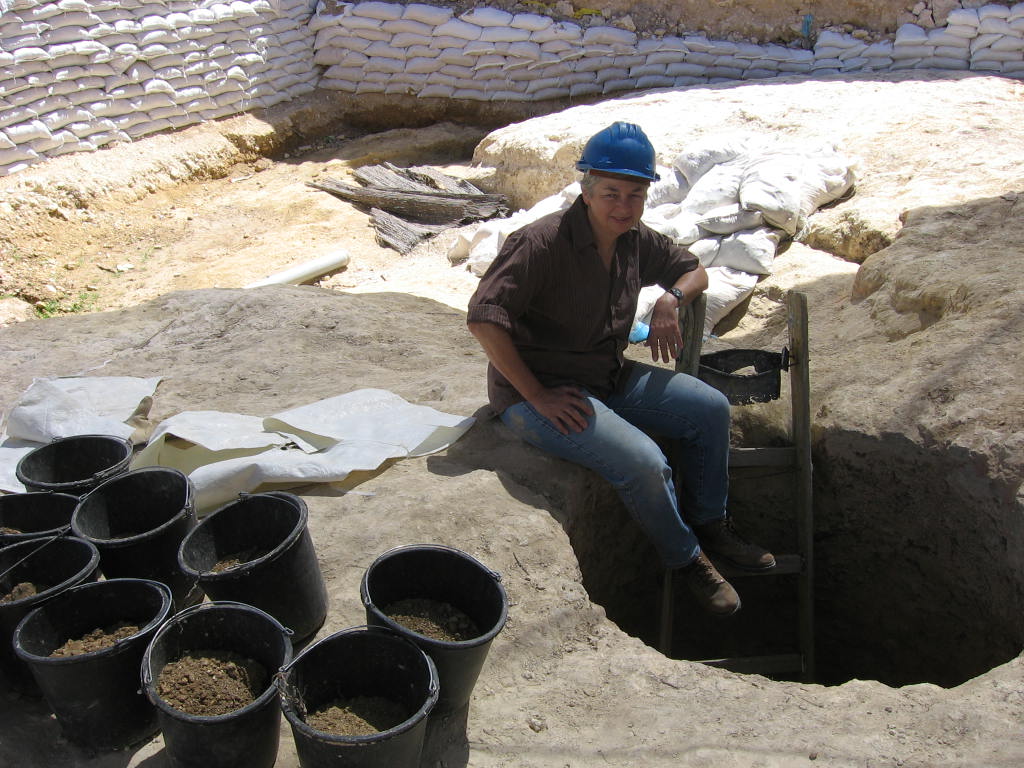
Hard-hatted me about to descend into a Canaanite shaft tomb in Jerusalem.
.
Part II: BOYS AND THEIR LADDERS
.
Before sun-up, the dig photographer at work at Tel Yarmouth.
.
The neighbor boy building a new roof.
.
"Plastering" over the straw bales in the neighbors' new straw bale house.
.
Part III: LEFT LADDERS
.
Under the window in the Church of the Holy Sepulchre, the famous ladder that none of the churchmen dares to move since the 19th century because of the Status Quo.
.
Night falls and the tired olive pickers leave their ladders.
.
Leaving little room between ladder and ceiling.
.
Silence and solitude, even for ladders!
View from the cemetery of the Sisters of Zion in Ein Kerem.
.
And to see the angels on the ladder of Jacob, please go back to an ABC post of two years ago.
.

Monday, October 4, 2010

Give him a hand

To all my Franciscan friends, to those of you who celebrate the Feast of St. Francis today and to those who do not, to all the animals that were blessed today--

Pax et bonum! . . . .
Pace e bene!
.

The ramparts walk

.
The Old City of Jerusalem is enclosed by a 16th century wall that has seven gates.
.
Map is from Wikitravel


For our That's My World tour let's walk on top of the ramparts.

Like this little group is doing.
.
You might have to enlarge the photo to see them.
I zoomed in on the people from the roof of St. Louis Hospital, which is across the street from the Old City.
.
Here, the Turkish sultan invites you to his wall!
.
The Hebrew poster bids you, "Walk through layers of time."
.
The old sign tells us that an Arabic inscription on the Jaffa Gate reads thus:
"In the name of Allah, the merciful and compassionate, our lord the great sultan, monarch of the Byzantines, Arabs and Persians, Suleyman son of Selim Khan, may Allah perpetuate his kingdom, commanded that this blessed wall be constructed. In the year 945"
[ 945 of the Muslim Hejira calender, i.e. 1538 C.E.].
.
Just climb the spiral staircase, push through the turnstyle (which is actually on the roof of the Kishle police station), and start walking along and above the Armenian Quarter.
Then at the Jewish Quarter, you have to come down.
.
The other Ramparts Walk segment starts below the Damascus Gate and goes along the Muslim Quarter up to St. Stephen's Gate.
Sixteen shekels will buy you a ticket for both sides.
.
The length of the entire city wall is about 4 km or 2.5 miles.
But it is not possible to walk around the entire Old City atop the wall.
.
Yalla, are you coming up? This is one walk I don't wish to do alone.
I'll wait for you.
.

Sunday, October 3, 2010

Just go over

.
Click on the picture and enjoy how the setting sun turns the city into Jerusalem of Gold.
.

I post this, however, to show the layout of the street, which has seen much development in recent years.

The new Kikar Zahal park is on the left, at the northwestern corner of the Old City wall.

From there, a delightful promenade at the foot of the wall takes you to Jaffa Gate.
.
The photo shows Jaffa Road emerging from a tunnel.
.


If you look back at yesterday's post, you can just about see that the road is slightly elevated.
Grave sites were discovered near Jaffa Gate when the road was being built.
Jewish tradition (law?) would never allow a road to be constructed ON the graves, but a little bit ABOVE them--OK.
.

Now I need a title . . .
"Just go over" comes to mind.
You might enjoy the Chassidic wisdom in an earlier post by that name, back here.
.

A bridge into Jaffa Gate

.
Unless you look down, it's easy to forget that when you walk from Mamilla to the Jaffa Gate and into the Old City, you are actually crossing a bridge.

Busy Jaffa Road is underneath.
And, like we saw at the Damascus Gate, the bridge to the Jaffa Gate also spans over some antiquities.
.
In the old days the road to the Mediterranean port of Jaffa started here, at the Jaffa Gate.
.
Proving you don't have to have water to have a bridge. :) For Louis la Vache's Sunday Bridges.
.
UPDATE: Please continue to the next post for a further explanation of why the road itself is elevated.
.

Saturday, October 2, 2010

Flowers above, flowers below

.
This unusual "flowerpot" and its shadow greet you just outside the entrance to Jerusalem's military cemetery on Mount Herzl.
(More about this beautiful and moving place under my label "Mt. Herzl.")
.
For Hey Harriet's Shadow Shot Sunday.
.

Monastic reflections

.
Colored glass window reflected in the black marble floor tiles.

Just outside the entrance to the church of our local Franciscan monastery.

Enlarge and see reflections in the seat of the bench too (at least in the parts where pants and skirts have removed the dust).
.
To see more of the surprising world of reflections, visit James' meme, Weekend Reflections.
.

Friday, October 1, 2010

That drooping feeling

.
It's not fair!
Here it is October already and we are still sweating through temps of 36 C (almost 97 F) with 15% humidity today and tomorrow.
And that's in high-altitude Jerusalem where it is cooler than other Israeli cities.
.
Even one of the Sabbath candles at a nearby friend's house was drooping.
I know how that candle feels.
.
Shabbat shalom. Take it easy.
.

Na nach

.
The most widespread graffito in Israel has to be the one about Rabbi Nachman of Breslov.
The mantra (written in Hebrew in the photo) is "Na, nach, nachma, Nachman me-Uman."

For the explanation of this phenomenon please see my earlier post, The Ubiquitous Nachman.

You can see more examples of graffiti in Jerusalem, including inside the Church of the Holy Sepulchre (!), under my label "graffiti."
.
City Daily Photo community members are sharing their graffiti today for our monthly Theme Day.
Click here to view thumbnails for all participants .
.

Thursday, September 30, 2010

A Torah's wanderings

.
For the Simchat Torah holiday today, when we dance and sing with the Torah scrolls and rewind them back to Genesis 1, here is a very old scroll with a dramatic history.
.
The deerskin on which it is written is unusually dark. Normally a Torah is a light tan color.

The Jewish museum at Hechal Shlomo in Jerusalem, where it is now housed, tells this story:

This Torah scroll was written in Spanish script, probably before 1492, by an excellent scribe on deerskin.
It wandered to Germany. There the Jewish congregation of Krautheim repaired it and added a piece of parchment with the missing chapter, written in Ashkenazic script.
The scroll survived a flood, the Gestapo, and bombings of the house in whose attic is was hidden during World War II.
.
The middle photo on the right shows the old Jewish hospital in Karlsruhe where it was hidden.

If you enlarge this photo you can see where the two pieces were stitched together.
.
.
This post is especially for my good friend Angelika, a teacher in Karlsruhe.
.

Wednesday, September 29, 2010

One more day

.

Today is the Hoshanah Raba holiday.
These men are praying at the Western Wall with lulav and etrog.
.
The one in the foreground is wearing a fur streimel, the traditional hat worn by certain branches of haredim (ultra-Orthodox Jews) on festive occasions.
.
In a few hours the joyous holiday of Simchat Torah begins; and tomorrow night the week of Sukkot will come to an end.
I have not gone into Jerusalem and the Old City all week, wanting to avoid the press of the multitudes and the intense heat of this never-ending summer. I have not even been inside a sukkah.
.
But I can offer you holiday posts from last year and the year before, in case you missed some.

Beating the willow on Hoshanah Rabah at the Kotel
About Simchat Torah and the Chagall windows synagogue
My first time inside the men's world of the four species market
The yearly shuk of the four species
Myrtle, willow, and palm branches at the shuk arba'at haminim

Selecting the perfect lulav
Dwelling in a temporary hut
Super-sukkah at the Western Wall Plaza
Chabad sukkah-mobiles in Rome and New York, and selecting the right lulav
About Simchat Torah, grandson Dean with a baby Torah scroll, and Seth Brown's new Torah translation in verse
.
Shalom and chag sa-me-ach, happy holiday!
.

Tuesday, September 28, 2010

Knee-mail

.
The Church of Our Lady of the Spasm marks the 4th station of the cross on the Via Dolorosa.

Along the left-hand wall you see something beginning with K, needed for today's ABC Wednesday.

Kneelers!

Well, actually only the lower part, where you kneel, is called the kneeler.
The whole prayer desk is more properly called a prie-dieu.
The French names means literally "pray [to] God."
.
These prie-dieux look hard, but I think the Armenian Catholics (to whom the church belongs) are modest and tough enough to use them well.
.
More about this nice church and the Armenians in a previous post.
Just for contrast, I show you a more cushy prie-dieu.
It is in St. Mary's Cathedral in Sydney, Australia.
.
Either way, remember the saying that they taught me in Arkansas:
"God answers knee-mail."
.

Monday, September 27, 2010

More on Mount Herzl

.
Come in.
Let's walk around and sit and absorb the peace and silence and sense of reverence that enfold the cemetery on a normal day.

(A strange choice for That's My World, you think?)
.
The metal gates of Mt. Herzl military cemetery are like the gates at the Knesset and Yad Vashem.
The stones of the entrance were brought from all parts of Israel to express the idea that all remember and appreciate the soldiers buried here in Jerusalem.
.
These are just some of the moving places on Mt. Herzl.
.
Let's sit low on the stone bench and unite with those whose memory lives on here.
.
The soldiers' graves are in small groupings to express the idea that in one way their sacrifice was individual.
.
The cemetery has an east-west orientation to follow the practice of burying Jewish dead with their feet pointing in the direction of Jerusalem's ancient Temple.
.
Jerusalem's military cemetery together with Yad Vashem and Mt. Herzl the national burial place for Israel's leaders make up Har HaZikaron, the Mount of Remembrance.
.
The site encapsulates the last century of Jewish national history.
.
The large number of casualties in the War of Independence, 6,000 (1% of the Jewish population at the time), made the need for a new cemetery obvious.
The first remains were transferred here in 1949 from temporary burial grounds.
.
Just beyond, you can see the hills where battles were fought in the various wars.
So close . . .
.
These clusters of shaded benches are near the exit.
.
I imagine people who have just attended a funeral or a memorial service might like to linger and talk together before going out to the bustling world.
.
Right next to the exit gate is this corner for the seudat avelim, the meal for the bereaved, that follows a funeral.
.
If you'd like to see more, please click on the label "Mt. Herzl."

Sunday, September 26, 2010

Bridging the Suez Canal

.
The annual memorial ceremony for the soldiers we lost during the Yom Kippur War was held at Mt. Herzl military cemetery in Jerusalem one week ago, the day after Yom Kippur (the Day of Atonement).

I did not have the heart to come and sit among the families of the fallen.
I came after they had gone home, as the flags, the podium, and the posters of old war photographs were being taken down.

Egypt attacked Israeli positions in the Sinai in full force on October 6, 1973 and took us by surprise.
The Egyptian Army put down several Soviet-made floating bridges and crossed the Suez Canal.
.
It took several days for Israel to call up the reserves and get organized and to bring up material to enable a crossing.
Many army engineers were killed by enemy fire while constructing the pontoon bridges and roller bridges that would span the canal.
After more than 140 of our tanks had driven across into Egypt, Egyptian shells hit one of the floating bridges as more tanks were crossing on it, and dozens of our tanks and their crews fell into the water of the Suez.
It was a horrible war with too many mistakes and way too many casualties.
In the 19 days before the ceasefire, 2,521 Israeli soldiers were killed, 293 were captured, and over 7,000 were wounded.
The losses among Egyptian and Syrian troops were several times these numbers.
.
The photo above shows not only the seats where the bereaved families had sat for the memorial service but also a group of IDF recruits who were not even born yet during the Yom Kippur War.
The 18-year-olds were being taken on a guided tour of the national military cemetery, being taught the history by their commander.
I always wonder how it makes them feel to see the still empty spaces.
.
Mt. Herzl, the cemetery, is like an open book of Israel's history, very moving.
.
.
The photo of a photo of the bridge is for Sunday Bridges over in peaceful San Francisco.
.

Saturday, September 25, 2010

Fresh chameleon for lunch

.
If you're not squeamish please enlarge some of these photos of the hunt.

The chameleon would have remained well-hidden if he had stayed still. His fatal error was to run when Lara and I started down the old stone stairs. Lara saw him move. .

 
You could almost hear his silent scream as Lara's claws pierced him.

 
Belly up.

 
The tail hung from the cat's mouth as she did what born-in-the-wild hunter carnivores do.
.
As I heard the crunching sounds, a little wave of doubt or even shame passed over me.
Maybe I should have helped the chameleon escape before Lara's first pounce . . . .
instead of my first reaction being "Run for the camera, Dina! For the blog, for Camera-Critters!"
.

Duvet days

.

Finally! After sleeping with just a thin single sheet for a long, long, hot summer, the nights are becoming cool enough to graduate to a duvet cover instead.

A re-launder of it and a hanging out to dry in the noonday sun gave it a fresh smell, as well as yielding a picture for Shadow Shot Sunday.

Who knows when it will ever get cold enough to have to stuff the feather blanket itself inside the duvet cover. We still have almost every day in the low 30s C/ low 90s F.
.
Looking from this low angle gave me a flash-back to growing up in the big city of Chicago. As kids we would drape a sheet over a table and play under it, pretending it was a tent or wigwam or teepee.

Good adventures, even if they were really only on the living room floor and not the forest floor.
.
P.S.
I just learned this from Wikipedia:

The term "Duvet day" is used in some countries to describe an allowance of one or more days a year when employees can simply phone in and say that they are not coming in to work, even though they have no leave booked and are not ill.
The provision of this benefit became fashionable in the late 1990s with many larger companies in the UK.
.

Friday, September 24, 2010

Double joy

.
In Jewish liturgy and literature the week-long holiday of Sukkot, which we are now in, is called Zman Simchateinu, meaning "the season of our joy" or "our time of celebration."

So let's have some joy (especially since yesterday's post was unhappy news).
Even just looking at pictures of my newest grandchild gives me great joy!
.
Libby loves to amuse herself by looking in the mirror.
This reflection is for James' Weekend Reflections.
.
The photo was taken by Naomi, my daughter, another great source of joy.
Hard to believe it was only two weeks ago that the two of them were here, visiting from far-off Australia. It seems more like two years ago.
.

Moadim lesimcha, happy Sukkot!
.

Thursday, September 23, 2010

Trouble in Jerusalem

.
Violence erupted yesterday on the eastern side of Jerusalem.

Riots took place in the Palestinian village of Silwan and on and around the Temple Mount.
.
The picture above (taken on a quieter day) is from inside Silwan, looking toward the Temple Mount which is just behind the Old City wall.
.
Some 40,000 Palestinians live in Silwan, on both sides of the valley.
This photo is taken from the City of David excavations.

Since the 1990s several hundred Jewish settlers have moved in, renovating or building new houses like the ones seen in the pictures above and below.

Over the last four years I have tried to educate myself by taking three tours in Silwan, guided by guides from opposing ends of the political spectrum, from Elad/Ir David to Emek Shaveh to Ir Amim.

The only tour where you actually talk to and listen to the Arab residents of Silwan, in this protest tent, is the one led by the Alternative-Archaeology archaelogists of Emek Shaveh.
.
Unfortunately for this blog, but luckily for me, I was not in the fires and the blood of the riots yesterday.
I can only direct you to media reports with slideshows that you can click through:

Wednesday, September 22, 2010

Red magen David

.
I knew the pomegranate has special symbolic value for the Jewish new year Rosh Hashana.
I knew the fruit tastes good and is good for you.

But I never realized until looking at this photo that the pomegranate wears a star of David!
.
Sukkot starts tonight. Chag sameach, happy holiday!
.